Financing Your Thai Condo: Payment Plans and Options
Thailand condo financing for foreigners: cash via FET, developer instalments 5-8%, Bangkok Bank Singapore USD loan, UOB, MBK, or home-country re-mortgage compared.
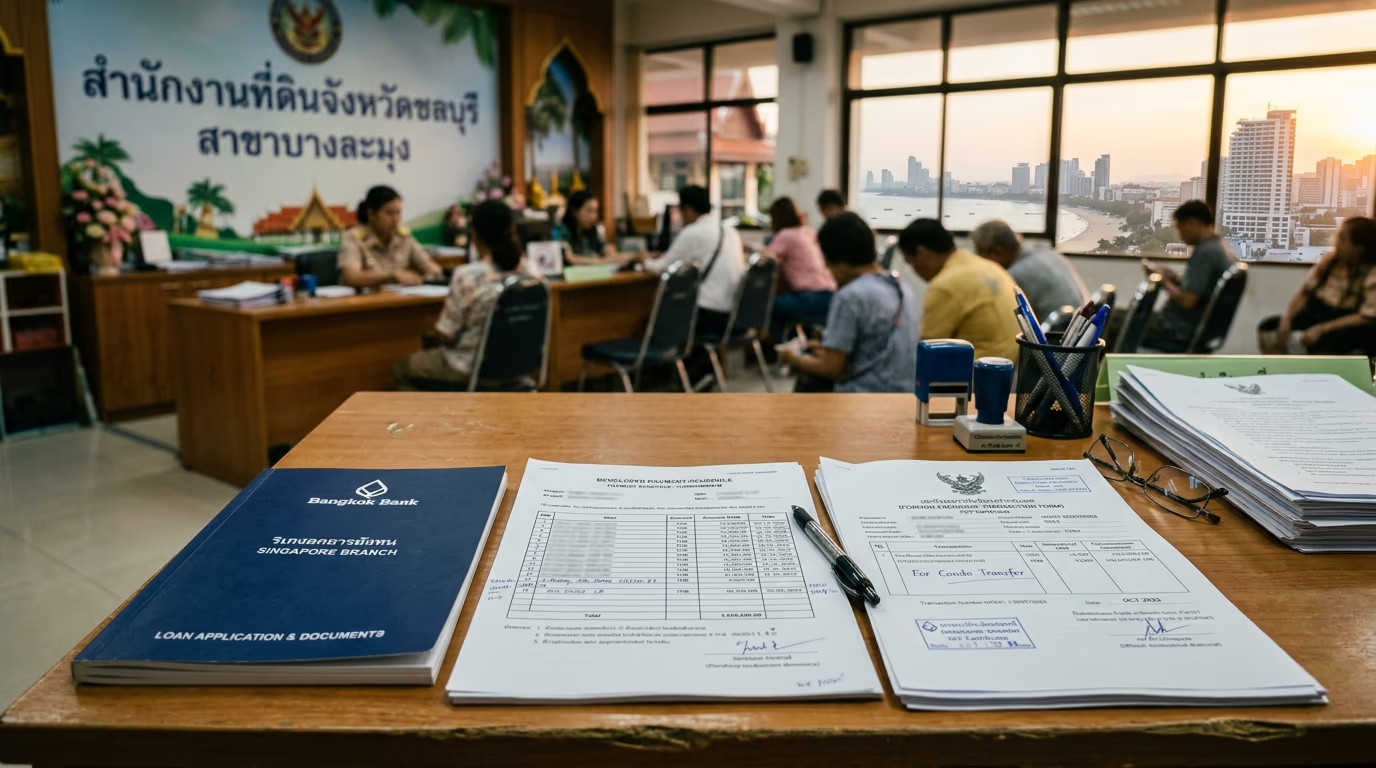
Most foreigners buying a Thai condominium in 2026 pay cash. Developer in-house financing runs a close second, typically 30 to 40% down and 3 to 10 years at 5 to 8% with title retained by the developer until final payment. Thai bank mortgages for foreign individuals are restricted: Bangkok Bank’s Singapore branch offers USD or SGD loans at 50 to 70% LTV for 3 to 20 years at SOFR or SIBOR plus 4.5 to 6.0% (around 9 to 11% all-in), UOB Thailand runs a selective THB programme for long-term residents and private bank clients, and MBK Guarantee plus similar non-bank lenders bridge the gap at 8 to 12%. A home-country re-mortgage against existing equity is often the cheapest route for asset-rich buyers. The decision framework is not “can I borrow” but “which route is cheapest after tax and currency risk”.
1. Direct answer: the working routes
Six routes available to foreign buyers in 2026.
| Route | LTV | Tenor | Rate (2026) | Best for |
|---|---|---|---|---|
| Cash via FET | 100% equity | - | - | Cheapest overall |
| Developer in-house | 60-70% | 3-10 yrs | 5-8% | Primary-market, 30%+ deposit |
| Bangkok Bank Singapore | 50-70% | 3-20 yrs | 9-11% USD | Offshore-income foreigner |
| UOB Thailand | 50-70% | 5-20 yrs | 7-9% THB | Thai residents, UOB Private Bank |
| MBK and non-bank | 50-70% | 1-10 yrs | 8-12% | Bridging, buyers declined by banks |
| Home-country re-mortgage | up to 100% of Thai price | home-country | home-country rate | Asset-rich buyers with home equity |
Selection order: home-country re-mortgage first (often cheapest if collateral is available), cash if feasible, developer financing on primary-market, Bangkok Bank Singapore, UOB Thailand, non-bank lenders as last resort.
The right answer is total cost of capital after fees and currency risk, compared to opportunity cost of home-country capital. A USD-based buyer with a 5% home rate should not take a 10% Bangkok Bank USD loan. A THB-earning buyer should avoid USD loans entirely.
2. Cash purchase via FET
Paying cash is the most common route. The Condominium Act requires the full purchase price to be remitted in foreign currency and converted to THB by a Thai bank, which issues the Foreign Exchange Transaction form (FET, also called Tor Tor Sam). The FET is a condition of foreign-quota registration under Section 19.
FET mechanics:
- Open a Thai bank account (simplifies the process). Bangkok Bank, Kasikornbank, SCB, Krung Thai accept foreign individuals with a visa.
- Wire the price in foreign currency (USD, EUR, GBP, SGD) to the Thai bank. The bank converts at spot and credits the buyer’s Thai account or the lawyer’s client account.
- The FET is issued showing the foreign currency amount, THB equivalent, sender’s name, purpose (must state “purchase of condominium”), and date.
- Deliver the FET at the Land Department on transfer day. The FET amount must match or exceed the declared purchase price.
Points that trip buyers up:
- FET must state “purchase of condominium”. Generic purposes (“investment”, “personal transfer”) are rejected.
- Each FET must exceed USD 50,000 equivalent for BOT rules. Consolidate smaller wires into a single final transfer.
- FET is issued in the buyer’s own name. Family remittance on behalf does not generate a valid FET.
- FX margin runs 1-2% on large consumer transactions. On 5M THB, 50,000-100,000 THB. Specialist FX (Wise, Revolut Business, OFX) often beats bank rates by 0.5-1.0%.
See the buy condo Thailand foreigner guide and transfer fees and taxes.
Advantages: cheapest total cost, fastest close (30-45 days), cleanest title. Limitation: requires the full price in liquid offshore funds.
3. Developer in-house financing
Most primary-market developers offer instalment plans to foreign buyers: 30-40% down and the balance over 3-10 years at 5-8%. The developer retains title until final payment. No credit bureau, limited income verification, no Thai bank involvement. The all-in price is usually 5-10% above cash and the buyer accepts developer credit risk.
Three common structures:
- Staged deposit plus handover balance: 10-20% reservation, 20-30% milestones, 50-70% at handover with transfer. Developer finance activates only if the buyer cannot pay the balance.
- Low deposit with long developer mortgage: 10-30% during reservation and progress, then a promissory note for 70-90% over 5-10 years. Title at final payment.
- Back-loaded completion: 30-40% during construction, 60-70% financed on completion over 5-10 years. Most common on Pattaya and Phuket foreign-targeted projects.
Watch:
- All-in vs cash price: the spread (5-10%) is the effective interest cost.
- Title retention: developer keeps title until final payment. Insolvency during the instalment period creates complications — your rights are subordinate to secured lenders.
- FET timing: foreign currency inflow required at or before transfer registration. Coordinate with your lawyer by transferring the full price to Thailand at completion.
- Prepayment penalties: 1-3% on outstanding balance is common.
- Default: 2-3 missed instalments typically terminates the contract with forfeiture of payments made.
Most listed developers (Sansiri, Land and Houses, Ananda, SC Asset, Origin, Riviera, Raimon Land, AP Thailand) publish terms on request. Boutique developers are less consistent. Insist on a written finance agreement separate from the SPA.
Fits buyers who plan to hold the full term, are comfortable with developer credit, cannot qualify for Bangkok Bank Singapore, or are negotiating a package deal. Does not fit short-term holders or buyers with cheaper alternatives.
See the off-plan condos guide.
4. Bangkok Bank Singapore
Thailand’s largest structured programme for foreign-individual mortgages. Non-resident applicants, USD or SGD loans, first-ranking mortgage on the Thai title, LTVs 50-70%, tenors up to 20 years. All-in 2026 rates 9-11% USD.
- Eligibility: non-resident foreigners 21-65 at maturity, non-sanctioned jurisdictions.
- Currency: USD or SGD; no THB retail.
- LTV: up to 70% completed, 50-60% off-plan.
- Tenor: 3-20 years; most 10-15.
- Rate: USD at SOFR plus 4.5-6.0%, SGD at SIBOR/SORA plus similar. April 2026 SOFR ~4.5% gives 9-11% USD.
- Fees: arrangement 1%, Thai mortgage registration 1% capped, legal 100,000-200,000 THB.
- Documentation: 2 years tax returns or employer letter, 3 months bank statements.
- Collateral: first-ranking mortgage at the Thai Land Department.
Approval 6-12 weeks. The bank runs its own valuation; build a finance contingency into the SPA.
Cross-border mechanic: the loan disburses in USD or SGD to the borrower’s Thai account at Bangkok Bank domestic. Thailand converts to THB at transfer and pays the developer. The conversion produces the FET — the disbursement itself qualifies as the foreign currency inflow. This is why Bangkok Bank Singapore works where other offshore lenders do not.
Currency risk: borrowing in USD to own a THB asset creates exposure. If THB weakens against USD, debt service in USD costs more THB and asset USD value falls. Buyers earning in USD can treat currency alignment as a feature; THB-earners face a material mismatch.
See the foreigner mortgage Thailand guide.
5. UOB Thailand selective lending
Selective THB-denominated programme for foreigners referred through UOB Private Bank (Singapore) or holding long-term Thai residency. Removes currency risk for buyers earning or renting in THB.
- Access: UOB Private Bank referral (USD 1M+ AUM) or long-term Thai residency (LTR, Thai Elite) with tax ID and income history. Walk-in applications are not entertained.
- LTV: up to 70%, usually 50-60% on first approach.
- Tenor: 5-20 years.
- Rate: THB MLR minus 0.25% to MLR plus 2%. April 2026 MLR 7.30% gives 7.00-9.30%.
- Fees: arrangement 0.5-1.0%, mortgage registration 1% capped.
- Documentation: Thai tax ID, long-term visa or work permit, 3 years income history.
UOB is the only Thai domestic bank with a structured foreign-individual product. HSBC, Standard Chartered, and Citibank Thailand have materially reduced foreign retail mortgage appetite since 2020.
Advantages over Bangkok Bank Singapore for a qualifier: no currency mismatch if income is THB, lower nominal rate. Trade-off: tighter eligibility and longer approval.
6. MBK Guarantee and non-bank lenders
MBK Guarantee and similar non-bank lenders offer shorter-tenor, flexible financing to buyers declined by banks or needing fast approval. Rates 8-12% fixed, turnaround 2-4 weeks.
MBK Guarantee terms:
- LTV up to 70% on completed Bangkok and Pattaya units, 50-60% other cities.
- Tenor 1-10 years (most 2-5).
- Rate 8-12%.
- Origination 1-2%.
- Lighter documentation; emphasis on collateral.
Fits: bridging between SPA and Bangkok Bank Singapore approval; buyers declined (age 65+, insufficient income, higher-risk nationality) with sufficient collateral; short-dated facilities bridging to a home-country liquidity event.
Private money lenders operate informally around Pattaya and Phuket at 10-15% and LTVs up to 50%. Legal if documented as a registered mortgage through a Thai law firm, but counterparty risk puts them in a different category. Use only if no other route is available.
7. Home-country re-mortgage
Re-mortgage or draw equity against a property in the buyer’s home country and pay cash for the Thai unit. Often the cheapest route for asset-rich buyers.
Mechanics: arrange a home-country mortgage, HELOC, or offset. Funds wired to Thailand generate the FET. The Thai condo is purchased free and clear.
Typical 2026 home-country rates: UK 4.5-6.0%, US 6.5-7.5% (HELOC 7.5-9.5%), Australia 5.5-6.5%, Singapore 3.0-4.5% SORA-linked, Hong Kong 4.0-5.5%, Eurozone 3.5-5.0%. Most are materially below Bangkok Bank Singapore’s 9-11%.
Advantages: lowest cost of capital, no Thai mortgage registration fee, cleaner Thai title, possible home-country interest deductibility. Limitations: home-country equity required, currency risk if THB weakens, some jurisdictions restrict using domestic mortgage funds for foreign property.
8. Off-plan vs resale payment
Off-plan uses progress payments during construction followed by a completion balance. Resale is a single transfer-day settlement.
Off-plan schedule over 24 months: booking 50,000-200,000 THB; reservation 5-10% on SPA signing; 2-6 progress milestones each 5-15% of price; completion balance 50-70% at handover with title transfer.
Cash buyers wire each milestone, generating an FET each time, aggregated at the Land Department. Developer-financed buyers pay progress in cash; the developer finances only the completion balance. Bangkok Bank Singapore or UOB disburse at completion — buyers fund 50-70% in cash during construction, the bank reimburses on completion day.
Resale is a single transfer-day event, 30-60 days SPA to transfer. Developer financing is not available on resale.
9. Worked example: cash vs leverage on 5M THB
Assumptions: 5,000,000 THB Jomtien 1BR, 5-year hold, 6% gross yield, 3% annual appreciation, 2% CAM and tax drag, sold at year 5.
Cash
- Price: 5,000,000 THB; transaction costs 150,000 THB. Total invested: 5,150,000.
- Net rent 5 years (6% gross, 2% drag): 1,000,000.
- Sale at year 5 (15.9% cumulative at 3%): 5,796,000; sale costs 232,000; net 5,564,000.
- Total proceeds: 6,564,000. Net return: 1,414,000. Annualised IRR: ~5.2%.
60% LTV Bangkok Bank Singapore at 8% USD (15-yr amortising)
- Equity at start: 2,340,000 (includes transaction, mortgage registration, arrangement, legal).
- Annual debt service: ~344,000. 5-year debt service: ~1,722,000.
- 5-year net rent: 1,000,000. Net cash outflow: -722,000.
- Loan outstanding at year 5: ~2,400,000.
- Sale net of loan: 5,796,000 − 232,000 − 2,400,000 = 3,164,000.
- Total: 2,442,000. Net return on 2,340,000 equity: 102,000. Annualised IRR: ~0.9%.
60% LTV at 5.5% home-country rate (UK or Australia illustrative, 25-yr amortising)
- Equity at start: 2,180,000.
- Annual debt service: ~221,000. 5-year: ~1,105,000.
- 5-year net rent 1,000,000 (roughly covers debt service).
- Loan outstanding year 5: ~2,646,000.
- Sale net of loan: 5,796,000 − 232,000 − 2,646,000 = 2,918,000.
- Total: 2,813,000. Net return: 633,000 on 2,180,000 equity. Annualised IRR: ~5.4%.
Takeaways: cash delivers ~5.2% with no currency risk. Bangkok Bank Singapore at 8% USD delivers ~0.9% — levering into a 6% gross asset at 8% debt cost consumes most of the upside. Home-country re-mortgage at 5.5% delivers ~5.4% — the positive-leverage zone. At 6% appreciation leveraged returns jump; at 0% appreciation both leverage options go negative. Leverage magnifies underlying returns in both directions. For Thai condos where yield plus appreciation typically runs 7-10%, only leverage below ~6% is clearly value-accretive.
Stress against your own case using the cost calculator and yield calculator.
10. Tax implications of financing
Thai rental income is taxed under Section 40(5) with a 30% standard deduction. Mortgage interest paid to a Thai lender is not deductible against Thai rental income for foreign individuals; interest paid to a non-Thai lender is generally not deductible in Thailand either.
- Thai rental income tax: 30% standard deduction or actual expenses if higher (not Thai-side mortgage interest for individuals).
- Withholding: 5% if tenant is a juristic person; 15% if PM withholds on remittance to a non-resident.
- Double tax treaties: Thai tax paid is credited against home-country liability (US, UK, Australia, Canada, most EU).
- Home-country interest deductibility: may apply subject to local rules. US generally disallows foreign-purpose loan interest against main deduction; UK BTL loans may deduct interest against UK rental income if structured properly.
- Capital gains: no separate Thai CGT; gains are taxed as personal income with 30% deduction. See the capital gains guide.
A UK tax resident with deductible UK interest on a Thai rental typically comes out ahead of the same buyer with a non-deductible Thai-side mortgage. Another factor favouring home-country re-mortgage.
11. Frequently asked questions
Can a foreigner get a mortgage from a Thai bank?
Generally no for non-residents. Exceptions for long-term residents with income, work permit, tax history. See the foreigner mortgage guide.
What is the cheapest way to finance a Thai condo?
Cash. Among leveraged routes, home-country re-mortgage is typically cheapest (3.5-6.5% Western vs 8-11% Bangkok Bank Singapore).
Do I need an FET with a bank mortgage?
Yes. Foreign-quota registration requires foreign currency inflow evidenced by the FET regardless of borrowing.
Can I pay cash for part and finance the rest?
Yes. Most Bangkok Bank Singapore or developer-financed buyers put 30-40% cash and borrow the rest. Cash generates its own FET; bank disbursement generates a second FET.
What if I cannot pay developer progress payments on time?
Missed payments trigger a 14-30 day grace with interest, followed by default remedies that may forfeit prior payments. Negotiate early.
Can I take a mortgage on a condo I already own?
Only through Bangkok Bank Singapore (refinance with existing relationship), UOB Thailand, or MBK. Thai domestic banks do not generally refinance foreigner-owned condos.
How long does mortgage approval take?
6-12 weeks Bangkok Bank Singapore, 4-8 weeks UOB Thailand, 2-4 weeks MBK. Negotiate a finance contingency in the SPA.
Is developer financing a mortgage?
In substance yes, but structured as instalment sale with title retention rather than a registered mortgage.
Highest LTV for a foreigner?
Up to 75% in rare Bangkok Bank Singapore cases. 70% is the typical ceiling. Most buyers end at 50-60%.
Should I use an offshore holding company?
Thai foreign-quota ownership is permitted only by an individual foreigner or a Thai company. Foreign offshore companies are not eligible for direct ownership.
What happens to my Thai mortgage if I die?
Mortgages continue as estate liabilities. The condo passes to heirs via Thai probate under the Civil and Commercial Code. See the condo inheritance guide.
References
Sources
- 01Bank of Thailand Foreign Exchange Regulations, Notice on Foreign Currency Inward Remittance for Property Purchase · https://www.bot.or.th/en/financial-markets/foreign-exchange-regulations.htmlBank of Thailand foreign exchange regulations and FET certificate requirement for foreign condominium purchases. Accessed 2026-04-16.
- 02Condominium Act B.E. 2522 (1979), amended 2008, Sections 19 and 19 bis; Ministerial Regulation on Registration of Foreign-Owned Units · https://www.krisdika.go.th/Condominium Act requirements on foreign currency remittance as precondition to foreign-quota registration. Accessed 2026-04-16.
- 03Bangkok Bank Singapore Branch Home Loan for International Customer, 2025-2026 programme terms · https://www.bangkokbank.com/en/Personal/Other-Services/Home-Loan-for-International-CustomerBangkok Bank (Singapore Branch) international home loan programme for foreign buyers of Thai condominiums. Accessed 2026-04-16.
- 04UOB Thailand Home Loan and Private Bank Thailand Lending Guidelines 2025-2026 · https://www.uob.co.th/personal/loans/home-loans.pageUOB Thailand foreign buyer selective mortgage programme and MLR rate trajectory. Accessed 2026-04-16.
- 05CBRE Thailand Real Estate Market Outlook 2026; Cushman and Wakefield Thailand Market Beat Q1 2026 · https://www.cbre.co.th/insights/reports/thailand-real-estate-market-outlook-2026Developer in-house financing typical terms, down payments, and rates in the Thai primary condo market. Accessed 2026-04-16.
- 06MBK Guarantee Public Company Limited foreign-buyer lending product disclosures 2025 · https://www.mbkguarantee.com/MBK Guarantee non-bank lending for foreign condominium buyers and bridging loan structures. Accessed 2026-04-16.
- 07Siam Legal International Foreign Mortgage Guide 2025-2026; Tilleke and Gibbins Thailand Banking and Finance Briefing 2025 · https://www.tilleke.com/insights/Siam Legal and Tilleke Gibbins practice briefings on Thai condo financing and mortgage registration. Accessed 2026-04-16.
- 08Thailand Land Department fee schedule 2025-2026; Revenue Code Sections 103-121 on land-transaction taxes · https://www.dol.go.th/Thailand land-transfer taxes, stamp duty, and mortgage registration fees applicable to condominium sales. Accessed 2026-04-16.
Published · How we research and date our content