Thailand Condo Costs 2026: Complete Breakdown for Foreign Buyers
Every cost of buying, owning, and selling a Thai condo as a foreigner in 2026: transfer fees, taxes, legal, CAM, sinking fund, insurance, and worked examples.
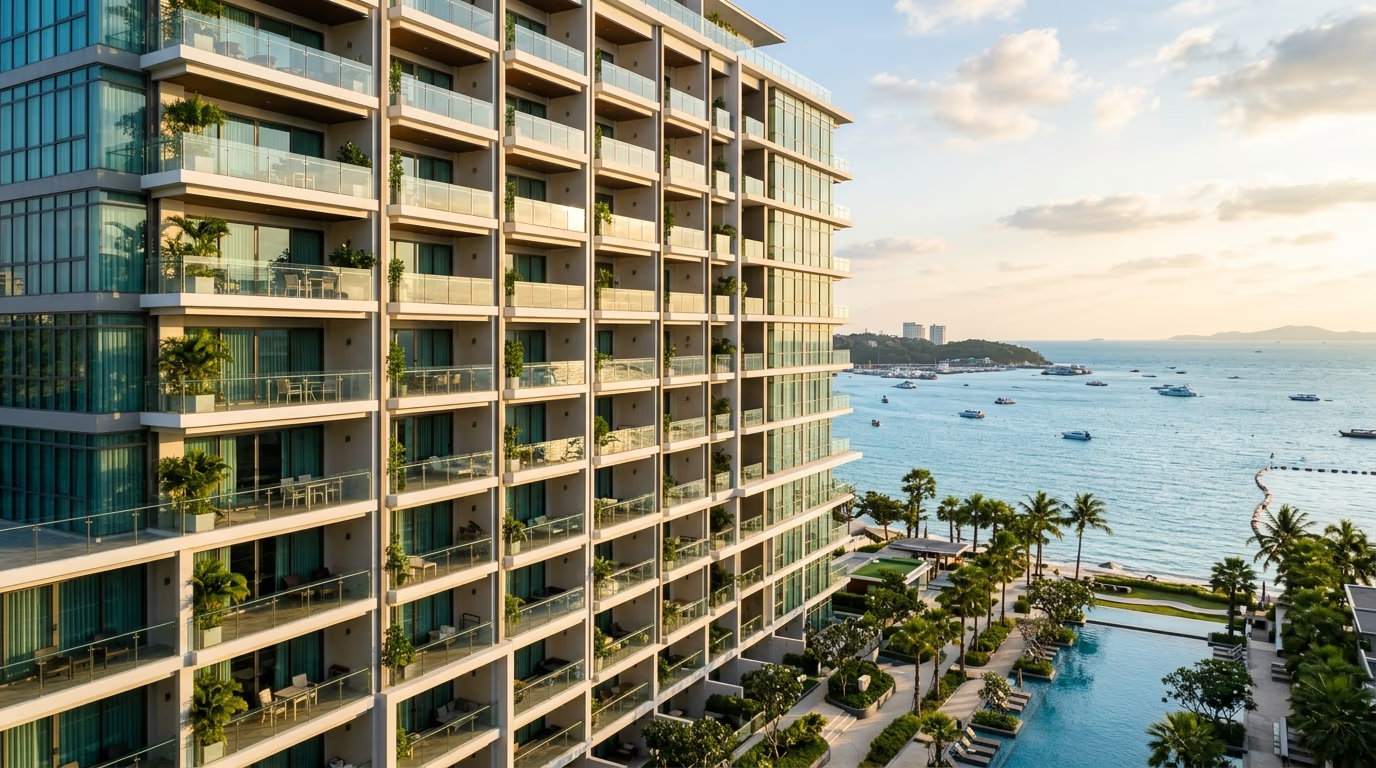
A foreign buyer purchasing a Thai condominium should budget roughly 6 to 8% of the purchase price in one-off transaction costs at handover, then 0.5 to 2.0% of value per year in recurring costs during ownership. For a 5,000,000 THB Jomtien one-bedroom, that is about 300,000 to 400,000 THB at purchase and 25,000 to 100,000 THB per year to hold. The exact split depends on who pays the transfer fee, whether the unit is in the foreign quota, the common area maintenance rate, and whether the owner rents the unit out. The figures below walk through every line item using 2026 Thai Revenue Code rates, Land and Building Tax Act B.E. 2562 (2019) schedules, and real price data from the CBRE Thailand Market Outlook 2026 and the GlobalPropertyGuide Q1 2026 rental yield survey.
The goal of this guide is to replace the two common online summaries (a partial transfer-fee post and a partial CAM-fee post) with a single costed model covering purchase, hold, and sale. It is written for the foreign buyer who wants to know the full five and ten-year number before signing a reservation form.
1. Purchase price: what condos actually cost in 2026
New-build foreign-quota condominium prices in Thailand in 2026 run from roughly 70,000 THB per square metre in secondary Chiang Mai to more than 350,000 THB per square metre on Bangkok riverside and Phuket branded beachfront. The four markets most foreigners compare are Bangkok, Pattaya, Phuket, and Chiang Mai, with Hua Hin and Koh Samui as secondary options.
The table below uses CBRE Thailand Market Outlook 2026 primary-market data and Cushman and Wakefield Thailand Market Beat Q1 2026 for Bangkok and Pattaya. Prices are in Thai Baht per square metre for new-build foreign-quota units. A typical foreign-oriented one-bedroom is 30 to 45 sqm; a typical two-bedroom is 55 to 85 sqm.
| City / zone | Entry (THB/sqm) | Mid-market (THB/sqm) | Premium (THB/sqm) |
|---|---|---|---|
| Bangkok CBD (Sukhumvit, Silom, Sathorn) | 180,000 | 250,000 | 400,000+ |
| Bangkok riverside / Chao Phraya | 200,000 | 300,000 | 500,000+ |
| Pattaya Central and Pratumnak | 90,000 | 130,000 | 200,000 |
| Jomtien beachfront | 95,000 | 140,000 | 220,000 |
| Wongamat / North Pattaya | 110,000 | 170,000 | 280,000 |
| Phuket beachfront | 150,000 | 220,000 | 450,000 |
| Phuket inland / branded residence | 120,000 | 180,000 | 300,000 |
| Hua Hin beachfront | 90,000 | 130,000 | 200,000 |
| Koh Samui villa-condo hybrid | 120,000 | 180,000 | 300,000 |
| Chiang Mai city and Nimman | 70,000 | 100,000 | 150,000 |
Worked reference unit for the rest of this guide: a 38 sqm one-bedroom in a new-build Jomtien beachfront project at 130,000 THB per sqm, purchase price 4,940,000 THB rounded to 5,000,000 THB. This is the price point the majority of foreign buyers actually transact at in Pattaya according to the REIC 2025 foreign transfer data.
Resale (secondary-market) prices typically sit 15 to 30% below equivalent new builds for buildings over 5 years old, with the gap closing for boutique low-density projects. That resale gap is a genuine cost consideration: buyers who overpay at primary launch often find the value does not show up at resale. See rental yield by area for how this interacts with net returns.
2. Transfer fees and taxes at purchase
At the Land Department, the one registration event triggers four possible charges: transfer fee (2%), specific business tax (3.3%) or stamp duty (0.5%), and withholding tax. Who pays what is set by the sale and purchase contract, not by law. Custom in Thailand is a 50/50 split of the transfer fee, with taxes paid by the seller — but everything is negotiable. The full legal basis is set out in the transfer fees and taxes guide; the summary below covers what actually hits the buyer’s wallet.
Transfer fee: 2% of appraised value
The transfer fee is fixed at 2% of the Land Department’s appraised value (ราคาประเมิน), not the contract price. The appraised value is the government assessor’s figure, usually 20 to 40% below open-market price for new builds. For the 5,000,000 THB Jomtien reference unit, the appraised value might be 3,200,000 THB, producing a transfer fee of 64,000 THB. Split 50/50, each side pays 32,000 THB. If the contract says “buyer pays full transfer fee”, that becomes 64,000 THB.
Ministerial discount cycles occasionally drop the transfer fee to 0.01% for specific price bands (for example the 2023-2024 Thai-buyer stimulus for units under 7M THB). Most of these discounts do not apply to foreign buyers, and they are short-lived.
Specific Business Tax or stamp duty — not both
If the seller has owned the unit for fewer than 5 years, Specific Business Tax (SBT) applies at 3.3% (3% + 10% municipal surcharge) of the higher of the sale price or appraised value. If the seller has owned for 5 years or more, SBT is replaced by stamp duty at 0.5% of the higher of sale or appraised value.
For a 5,000,000 THB sale with 3,200,000 THB appraised value where the seller has held under 5 years: SBT equals 3.3% of 5,000,000 THB = 165,000 THB. In almost every contract the seller pays SBT because it is technically a tax on their business revenue, not the buyer’s acquisition cost.
On a new developer sale of a foreign-quota unit, the developer has held for under 5 years and SBT is always in play. On a private resale, always ask before signing: “Has the seller held this unit five full years?” It changes the sale arithmetic meaningfully.
Withholding tax on sale (paid by seller)
Revenue Code Section 50(5) requires the Land Department to withhold income tax at the moment of transfer. The computation is progressive: years-held reduction under Ministerial Regulation No. 126 reduces the taxable deemed profit; the remaining amount is taxed at progressive personal rates and divided by years held. Effective withholding tax on a condo resale typically lands between 1% and 3% of the appraised value. For the buyer this is a seller cost, but it matters because sellers often try to push it into the price.
Example: full Land Department bill on a 5,000,000 THB Jomtien one-bedroom
Assumptions: appraised value 3,200,000 THB, seller held under 5 years, typical contract split.
| Line | Amount (THB) | Paid by |
|---|---|---|
| Transfer fee 2% of 3,200,000 | 64,000 | 50/50 split: 32,000 each |
| Specific Business Tax 3.3% of 5,000,000 | 165,000 | Seller |
| Stamp duty (not applicable, SBT in play) | 0 | — |
| Withholding tax (progressive, approx. 1.5% of appraised) | ~48,000 | Seller |
| Buyer total at Land Department | ~32,000 | Buyer |
| Seller total at Land Department | ~245,000 | Seller |
On a developer primary sale, developers increasingly quote “net to developer” pricing, meaning the buyer covers the full 2% transfer fee. That pushes the buyer’s line to 64,000 THB and is worth confirming in writing.
- Transfer fee 2% of appraised (split) 64k THB (23.1%)
- Specific Business Tax 3.3% (seller) 165k THB (59.6%)
- Withholding tax (seller, progressive) 48k THB (17.3%)
3. Legal and due diligence fees
Expect to pay 30,000 to 80,000 THB for a competent property lawyer to handle contract review, due diligence, and Land Department transfer. Fixed-fee packages are the norm. Pay for a lawyer even on a primary developer sale: the reservation agreement and foreign currency remittance mechanics deserve a second pair of eyes.
Typical scope and pricing in 2026:
- Contract review only (SPA and reservation): 15,000 to 30,000 THB. Lawyer reviews the sale and purchase agreement, flags clauses, does not attend transfer.
- Full due diligence and transfer: 40,000 to 80,000 THB. Land title search, juristic person confirmation letter, foreign quota confirmation, tax clearance, Land Department attendance. This is what most foreign buyers need.
- Full service including fund remittance coordination: 60,000 to 100,000 THB. Lawyer coordinates with the buyer’s Thai bank on FET form issuance and timing.
Large firms (Tilleke and Gibbins, Siam Legal, Baker McKenzie Thailand) sit at the upper end. Mid-tier boutique firms focused on foreign condo buyers handle the bulk of 5 to 15M THB transactions at 40,000 to 60,000 THB. Avoid agents who “include legal” in their package without naming a specific licensed lawyer.
See the due diligence checklist for the step-by-step scope of work your lawyer should deliver.
4. One-time fees at handover
Beyond the Land Department and lawyer, expect another 200,000 to 800,000 THB in handover charges depending on unit size and whether a furniture package is included. These are not negotiable line items in most developer contracts, though the amounts can sometimes be reduced.
Sinking fund (กองทุนสะสม)
The Condominium Act requires every building to maintain a sinking fund for major repairs — elevator replacement, roof works, facade repainting, pool resurfacing. At handover each unit owner pays a one-time sinking fund contribution, which is added to the reserve.
Market convention in Pattaya, Bangkok, and Phuket is 500 to 1,000 THB per sqm, calculated on saleable area. For the 38 sqm Jomtien reference unit: 38 × 700 THB = 26,600 THB. Luxury developments often charge 1,000 to 1,500 THB per sqm; budget buildings as low as 300 THB per sqm. The sinking fund is separate from the monthly common area maintenance fee and is not refundable on resale.
Utility meter installation
Water and electricity meters must be installed in the buyer’s name at handover. Thai building code treats this as a one-time setup fee:
- Electricity (MEA / PEA): 6,000 to 15,000 THB per unit depending on meter size (single-phase 15(45)A is standard for a one-bedroom).
- Water (MWA / PWA or building-supplied): 2,000 to 6,000 THB.
Some developers absorb meter installation into their quoted price; read the SPA carefully. The deposit portion of the electricity fee (roughly 2,000 to 4,000 THB) is refundable when the buyer eventually sells and transfers the account.
Furniture and appliance packages
Developer-sold furniture packages on foreign-quota condos run from 150,000 THB for a studio in a budget project to 600,000 THB or more for a two-bedroom in a premium development. Packages typically include: bed and mattress, sofa, dining set, wardrobe, curtains or blinds, built-in kitchen, refrigerator, washing machine, air conditioning units, and a television.
Buying furniture independently after transfer (IKEA Bangrak, Index Living Mall, online Lazada bundle) runs 80,000 to 300,000 THB for the same scope but takes 2 to 6 weeks and requires physical presence. Most foreign buyers take the developer package for the same reason they hire a lawyer: time.
Other handover charges
- Common fee prepayment: developers typically require 12 months CAM and sinking-fund contribution prepayment at handover (covered in Section 5 below).
- Title deed and juristic person registration fees: 500 to 2,000 THB administrative cost.
- Juristic person membership payment: usually included in the CAM prepayment but occasionally itemised at 5,000 to 10,000 THB.
Typical total handover bill for the 5M THB Jomtien reference unit: roughly 280,000 THB (sinking fund 26,600 + meters 12,000 + furniture package 200,000 + 12 months CAM prepayment 22,000 + admin 2,000 + legal 50,000).
5. Ongoing costs: common area maintenance and sinking fund top-ups
Common Area Maintenance (CAM) fees in Thai condos run from 25 THB per sqm per month for mid-market Pattaya buildings to 150 THB per sqm per month for branded Bangkok luxury towers. CAM covers security, cleaning, landscaping, pool maintenance, lift servicing, shared utilities, and juristic person administration.
Typical 2026 CAM ranges, based on the CBRE Thailand Market Outlook 2026 and direct juristic-person disclosures:
| Building tier | CAM (THB per sqm / month) | Annual cost for 38 sqm 1BR |
|---|---|---|
| Budget Pattaya / Chiang Mai / Hua Hin | 25 to 40 | 11,400 to 18,200 THB |
| Mid-market Pattaya / Phuket / Bangkok non-central | 40 to 70 | 18,200 to 31,900 THB |
| Premium Bangkok / Wongamat / Phuket beachfront | 70 to 120 | 31,900 to 54,700 THB |
| Branded residence / ultra-luxury | 120 to 180 | 54,700 to 82,100 THB |
CAM is billed monthly, quarterly, or annually in advance, depending on the juristic person’s preference. A 50 THB per sqm CAM on the 38 sqm reference unit equals 1,900 THB per month or 22,800 THB per year.
Two CAM reality checks:
- Published CAM is the floor, not the ceiling. Juristic persons can raise CAM by simple general-meeting vote. Older buildings with deferred maintenance often see CAM double over 10 years as pool equipment, lifts, and facades hit replacement cycles.
- Low CAM is a red flag as often as a green one. A 20 THB per sqm CAM on a 15-year-old building means the juristic person has been under-collecting. Expect a sinking fund special call when something breaks. Always ask to see the last two years of juristic person financial reports before buying resale.
Sinking fund top-ups above the one-time handover contribution occur by general-meeting special resolution. Expect 10,000 to 50,000 THB per unit per special call in older buildings, typically every 5 to 10 years.
6. Insurance
Building structural insurance is mandatory and is paid by the juristic person from CAM, so the owner does not pay it separately. Contents insurance for the unit is optional and costs 3,000 to 15,000 THB per year.
What CAM already covers
The juristic person’s master policy covers:
- Structural damage from fire, flood, earthquake, and common perils.
- Common-area liability.
- Lift and major plant insurance.
What contents insurance covers (optional)
A dedicated condo contents policy (available from Bangkok Insurance, AXA, Dhipaya, FWD) covers:
- Furniture, appliances, valuables inside the unit.
- Interior finishes beyond the structural shell.
- Third-party liability inside the unit (for example tenant injury).
- Loss of rent if the unit becomes uninhabitable.
Typical rates for a 5M THB unit: 4,000 to 8,000 THB per year for standard coverage; 10,000 to 15,000 THB for high-value contents (gold, watches, art). Foreign owners renting the unit out short or long term should carry landlord contents insurance: premiums run 20 to 30% higher than owner-occupier policies.
7. Annual property tax under the Land and Building Tax Act 2019
The Land and Building Tax Act B.E. 2562 (2019) replaced the old House and Land Tax in January 2020. For a condominium that is the owner’s primary residence, rates run from 0 to 0.10% of appraised value progressively. For a condominium that is not the primary residence (including a second home or rental property), rates run from 0.02% to 0.30% progressively.
The Ministerial Regulation on rates currently sets the following bands for residential condominiums:
| Appraised value | Primary residence rate | Non-primary / investment rate |
|---|---|---|
| 0 – 50,000,000 THB | 0.00% (primary home of Thai national with house registration); 0.03% cap in most ministerial cycles for non-registered | 0.02% |
| 50,000,001 – 75,000,000 THB | 0.03% | 0.03% |
| 75,000,001 – 100,000,000 THB | 0.05% | 0.05% |
| Above 100,000,000 THB | 0.10% | 0.10% |
For a foreign owner of the 5,000,000 THB Jomtien reference unit, used personally for under 180 days per year (so treated as non-primary in most municipalities): appraised value roughly 3,200,000 THB × 0.02% = 640 THB per year. This is the line item that surprises people in both directions — it is very small for ordinary units, and only becomes meaningful above 25M THB appraised.
Tax is collected by the local municipality (Pattaya City, Bangkok Metropolitan Administration, Phuket Provincial Administrative Organisation) typically between January and April each year. The municipality mails a bill to the address on the title deed, so maintaining a current mailing address is essential.
Penalties for non-payment: 40% of tax due if paid after deadline, plus 1% per month interest. A 5-year arrears bill can therefore exceed the original principal.
8. Rental income tax for foreigners
Non-resident foreigners renting out a Thai condo face two tax treatments under the Revenue Code. The default is 15% withholding at source on gross rental receipts (Section 50(3) for payments to non-residents, Section 70 for cross-border payments). The alternative is filing a Thai personal income tax return (PND.91) and paying progressive personal rates on net rental income with deductions allowed.
Option A: 15% withholding (default for non-residents)
Tenants who are Thai companies or registered withholding agents are required to deduct 15% from rental payments to a non-resident landlord and remit it to the Revenue Department. On a 25,000 THB per month rental: 3,750 THB withheld, 21,250 THB to the owner.
For non-corporate tenants (individuals renting personally), withholding does not happen at source. The foreign landlord is still technically liable for the tax and should file.
Option B: File PND.91 under progressive rates
A foreign owner who spends 180 or more days in Thailand in a tax year becomes a Thai tax resident and files PND.91. Rental income is reported under Revenue Code Section 40(5). Two deductions apply:
- Standard lump-sum deduction of 30% for rental of buildings (no receipts required).
- Or actual expenses with full documentation (mortgage interest, CAM, repairs, agent fees, depreciation).
After deductions, progressive personal income tax applies:
- 0 to 150,000 THB: 0%
- 150,001 to 300,000 THB: 5%
- 300,001 to 500,000 THB: 10%
- 500,001 to 750,000 THB: 15%
- 750,001 to 1,000,000 THB: 20%
- 1,000,001 to 2,000,000 THB: 25%
- 2,000,001 to 5,000,000 THB: 30%
- Above 5,000,000 THB: 35%
For the reference unit rented at 25,000 THB per month (300,000 THB annual), 30% standard deduction = 90,000 THB deduction, taxable 210,000 THB. Personal allowance 60,000 THB brings it to 150,000 THB. Tax: 0 THB in the 0 to 150,000 band. In this scenario the Thai-resident foreign owner pays no Thai income tax on modest rental income.
House and Land Tax equivalent already paid
The Land and Building Tax (Section 7 above) is a separate obligation and is not a credit against income tax. Foreigners sometimes confuse the two.
Withholding on management agent payments
If a Thai property management company collects rent on the owner’s behalf, Revenue Department guidance generally treats the payment to the foreign owner as subject to 15% withholding regardless of residency status. This is the cleanest compliant setup for most non-resident foreign landlords.
See Thailand rental yields for how tax netting affects real returns.
9. Capital gains / sale-time tax
Thailand does not have a separate capital gains tax for individuals. The “CGT” on a condo sale is simply the withholding tax under Revenue Code Section 50(5) calculated on deemed profit after the years-held reduction, plus the SBT or stamp duty covered in Section 2.
The years-held reduction table
Ministerial Regulation No. 126 prescribes the allowable deduction as a percentage of appraised value based on years of ownership:
| Years held | Allowable deduction |
|---|---|
| 1 | 92% |
| 2 | 84% |
| 3 | 77% |
| 4 | 71% |
| 5 | 65% |
| 6 | 60% |
| 7 | 55% |
| 8+ | 50% |
Worked example — sale of the reference unit after 7 years
Assumptions: purchase 5,000,000 THB in 2026, sale 6,500,000 THB in 2033, appraised value at sale 4,500,000 THB.
- Allowable deduction: 55% of 4,500,000 THB = 2,475,000 THB.
- Deemed taxable amount: 4,500,000 – 2,475,000 = 2,025,000 THB.
- Divide by 7 (years held): 289,286 THB per year.
- Apply progressive rates to 289,286 THB: tax = 5% × (289,286 – 150,000) = 6,964 THB per year.
- Multiply back by 7: 48,750 THB total withholding.
- SBT does not apply (held 7 years, over the 5-year threshold). Stamp duty instead: 0.5% × 6,500,000 = 32,500 THB.
- Transfer fee 2% × 4,500,000 = 90,000 THB, typically split.
Total Land Department bill on sale: ~126,000 THB. Of that, the seller typically pays SBT or stamp duty plus withholding (81,250 THB) plus half the transfer fee (45,000 THB) = roughly 126,000 THB. The buyer pays the other 45,000 THB.
- Transfer fee 2% (seller half) 45k THB (35.6%)
- Stamp duty 0.5% of sale price 33k THB (25.7%)
- Withholding tax (7-yr hold) 49k THB (38.6%)

Net proceeds repatriation
The Bank of Thailand permits the remittance abroad of Thai Baht sale proceeds in foreign currency up to the original inward remittance amount certified by the Foreign Exchange Transaction form (FET form) on the original purchase. Amounts above the original FET require Bank of Thailand approval. This is covered in detail in the condo resale guide.
10. Total cost of ownership: 5-year and 10-year models
Using the 5,000,000 THB Jomtien one-bedroom reference unit, a five-year buy-hold-sell scenario costs roughly 800,000 to 1,200,000 THB in fees, taxes, CAM, and transaction costs on top of the capital tied up in the unit. Over 10 years the total fee drag lands between 1,400,000 and 2,000,000 THB. The model below reconciles all earlier sections into a single cashflow.
5-year owner-occupier scenario
Purchase 2026 at 5,000,000 THB; sell 2031 at 5,400,000 THB (8% total appreciation conservative); occupied personally.
| Line | Amount (THB) |
|---|---|
| Purchase price | 5,000,000 |
| Transfer fee paid by buyer (50/50 split) | 32,000 |
| Legal and DD | 50,000 |
| Sinking fund handover | 26,600 |
| Meter installation | 12,000 |
| Furniture package | 200,000 |
| CAM × 5 years (22,800/yr) | 114,000 |
| Contents insurance × 5 years (5,000/yr) | 25,000 |
| Land and Building Tax × 5 years (640/yr) | 3,200 |
| Sale transfer fee (half of 2% × 4,300,000 appraised) | 43,000 |
| Sale SBT 3.3% × 5,400,000 | 178,200 |
| Sale withholding (approx., 5 yrs held) | ~60,000 |
| Agent commission 3.5% × 5,400,000 | 189,000 |
| Total outflows excluding purchase price | ~933,000 |
| Sale proceeds received by seller | 5,400,000 – 470,200 (seller taxes) – 189,000 commission = 4,740,800 |
| Net position vs initial 5M outlay + holding costs | Roughly –540,000 THB over 5 years |
Translation: holding for exactly 5 years with modest 8% appreciation does not cover fees in a buy-hold-sell scenario. The break-even is roughly 12 to 15% gross appreciation over 5 years before factoring in use value (the benefit of occupying the unit in lieu of rent).
10-year buy-to-let scenario
Purchase 2026 at 5,000,000 THB; let at 25,000 THB/month (6% gross yield); sell 2036 at 6,200,000 THB (24% cumulative appreciation, roughly 2.2% per year).
| Line | Amount (THB) |
|---|---|
| Gross rent × 10 years (300,000/yr, 90% occupancy) | 2,700,000 |
| Management 10% × 2,700,000 | (270,000) |
| CAM × 10 (22,800/yr) | (228,000) |
| Insurance × 10 (5,000/yr) | (50,000) |
| Land and Building Tax × 10 (640/yr) | (6,400) |
| Repairs and refurb reserve (~1% value/yr) | (500,000) |
| Income tax (PND.91 filed, minimal) | (20,000) |
| Net cash during hold | +1,625,600 |
| Purchase transaction costs (Section 1-4) | (320,000) |
| Sale at 6,200,000: transfer 2% × 4,800,000 appraised, 50/50 split | (48,000) |
| Sale stamp duty 0.5% × 6,200,000 (held 10 yrs, no SBT) | (31,000) |
| Sale withholding (years-held factor 50%, progressive) | ~(70,000) |
| Agent commission 3.5% × 6,200,000 | (217,000) |
| Net sale proceeds | 5,834,000 |
| Total return vs 5M capital | 5,834,000 + 1,625,600 – 5,000,000 = +2,459,600 THB over 10 years |
That is roughly 4.2% per year simple IRR on capital, before considering Thai Baht / home-currency FX. The 10-year model reliably beats cash in a deposit and loses to Bangkok-listed equity, which matches the consensus view in the Cushman and Wakefield Thailand Market Beat Q1 2026. The investment case for a Thai condo does not rest on capital appreciation — it rests on yield, lifestyle, and currency diversification.
Use the cost calculator tool to run this model on your own target unit and holding period.
FAQ
What is the single biggest hidden cost in a Thai condo purchase?
The one-time sinking fund and 12-month CAM prepayment at handover. On a 38 sqm Jomtien unit this adds up to roughly 50,000 THB that most online price breakdowns omit. It is not a tax and it is not negotiable — but buyers should plan for it in the pre-transfer budget.
Do foreigners pay more transfer fees than Thai buyers?
No. The transfer fee is 2% of appraised value regardless of buyer nationality. The specific business tax, stamp duty, and withholding tax are also nationality-neutral. The only foreign-specific cost is the inward remittance banking fee (typically 500 to 1,500 THB per wire) required for the Foreign Exchange Transaction form.
Can I reduce the transfer tax by reporting a lower price on the SPA?
This is illegal under Revenue Code Section 37 (tax evasion) and Land Department guidance. In practice the Land Department uses the higher of the declared sale price or its own appraised value, so under-reporting mostly affects SBT and stamp duty, not the transfer fee. The risk-reward is poor and legitimate lawyers will refuse.
Is there an annual property tax on a 5M THB Thai condo for a foreign owner?
Yes, the Land and Building Tax under the 2019 Act. For a 5M THB Jomtien unit owned by a non-resident foreigner the annual tax is typically 640 to 960 THB (0.02% to 0.03% of the 3.2M THB appraised value). The bill comes from the local municipality between January and April.
How much should I budget for closing costs on a 10M THB Phuket condo?
Using the same framework: transfer fee 50/50 of 2% × 7M appraised = 70,000 THB buyer portion; legal 60,000 THB; sinking fund 40,000 THB; meters 12,000 THB; furniture 400,000 THB; 12-month CAM prepayment 50,000 THB. Total buyer outlay on top of the 10M purchase: roughly 630,000 THB or 6.3%.
Does the CAM cover building insurance or do I need my own?
CAM covers the building master policy (structural fire, flood, common-area liability). It does not cover contents inside your unit. Foreign owners should carry a contents policy at 3,000 to 15,000 THB per year; landlords renting the unit out should carry the landlord variant.
If I hold for 5 years exactly, do I pay SBT or stamp duty?
Specific Business Tax applies only to sales within 5 years of acquisition. The five-year count is calculated to the day. Sellers approaching the five-year mark should check the exact acquisition date on the title deed and, if possible, time the transfer to fall on or after the anniversary. The difference is 3.3% vs 0.5% of sale value — on a 5M THB sale, 140,000 THB.
How does rental income tax work if my condo is managed by an agent?
A Thai property management company collecting rent on behalf of a non-resident foreign owner is required to withhold 15% of gross rent (Revenue Code Section 50(3) / 70). The owner receives 85% of rent and receives a withholding tax certificate. If the owner later becomes Thai tax resident (180+ days per year), the 15% already withheld is credited against the annual PND.91 liability, and the standard 30% deduction often produces a refund.
What is the FET form and why does it matter for costs?
The Foreign Exchange Transaction form is the Bank of Thailand document issued by the receiving Thai bank when foreign currency is remitted into Thailand for a condo purchase. It certifies the inward currency, amount, and purpose. Two cost implications: (1) the Land Department requires the FET at transfer as proof of foreign-currency funding; (2) on eventual sale, the FET is the legal basis for remitting sale proceeds abroad in foreign currency. Losing the FET costs nothing upfront but can cost 5 to 10% on eventual repatriation. See transferring money into Thailand for the banking mechanics.
How much do Thai property lawyers charge in 2026?
Boutique foreign-buyer-focused firms: 40,000 to 60,000 THB for full due diligence and transfer on a 5 to 15M THB unit. Mid-tier Bangkok firms (Siam Legal, Chaninat and Leeds, Mahanakorn Partners): 50,000 to 80,000 THB. Top-tier international firms (Tilleke and Gibbins, Baker McKenzie): 80,000 to 150,000 THB. Most 5M THB transactions are well served in the 40,000 to 60,000 THB band.
References
Sources
- 01Thailand Land Department Fee Schedule (Ministerial Regulation under the Land Code) · https://www.dol.go.th/Transfer fee of 2% of Land Department appraised value on condo transfers. Accessed 2026-04-16.
- 02Specific Business Tax under the Thailand Revenue Code, Sections 91/2 and 91/6; Royal Decree No. 342 · https://www.rd.go.th/english/37749.htmlSpecific Business Tax of 3.3% (3% plus 10% municipal surcharge) on sale within 5 years of acquisition. Accessed 2026-04-16.
- 03Thailand Revenue Code, Stamp Duty Schedule, Item 28 · https://www.rd.go.th/english/37749.htmlStamp duty of 0.5% on the higher of sale or appraised value, applied only when SBT is not applicable. Accessed 2026-04-16.
- 04Thailand Revenue Code Section 50(5) and Ministerial Regulation No. 126 years-held reduction schedule · https://www.rd.go.th/english/37749.htmlPersonal withholding tax on sale calculated on deemed profit after years-held deduction table. Accessed 2026-04-16.
- 05Land and Building Tax Act B.E. 2562 (2019), Sections 37 and 40; Ministerial Regulations on rates · https://www.mof.go.th/Land and Building Tax rates for residential condominiums: primary residence 0 to 0.10%, non-primary 0.02 to 0.30% progressive. Accessed 2026-04-16.
- 06Thailand Revenue Code Sections 40(5), 50(3), and 70 · https://www.rd.go.th/english/37749.htmlRental income for non-resident individuals subject to 15% withholding at source on gross rental. Accessed 2026-04-16.
- 07CBRE Thailand Real Estate Market Outlook 2026 · https://www.cbre.co.th/insights/reports/thailand-real-estate-market-outlook-2026Condo price per square metre ranges and 2026 primary-market positioning. Accessed 2026-04-16.
- 08GlobalPropertyGuide Thailand Rental Yields Q1 2026 · https://www.globalpropertyguide.com/asia/thailand/rental-yieldsGross rental yield benchmarks for Thai condominiums. Accessed 2026-04-16.
- 09Cushman and Wakefield Thailand Market Beat Q1 2026 · https://www.cushmanwakefield.com/en/thailand/insights/thailand-marketbeatBangkok and Pattaya condo price and demand indicators for Q1 2026. Accessed 2026-04-16.
- 10Condominium Act B.E. 2522 (1979), amended by Act No. 4 B.E. 2551 (2008)Condominium Act framework for ownership and juristic person governance. Accessed 2026-04-16.
- 11Bank of Thailand Foreign Exchange Regulations and FET form guidance · https://www.bot.or.th/en/financial-markets/foreign-exchange-regulations.htmlBank of Thailand guidance on foreign currency inward remittance and FET certification. Accessed 2026-04-16.
- 12Tilleke and Gibbins property briefings 2025-2026 and Siam Legal fee schedule · https://www.tilleke.com/insights/Legal and due diligence fee ranges quoted by established Thai property lawyers. Accessed 2026-04-16.
Published · How we research and date our content