Can Foreigners Get a Mortgage in Thailand? 2026 Lender Guide
Thailand foreigner mortgage reality 2026: Bangkok Bank Singapore, UOB, MBK Guarantee, developer finance, LTV and rates, plus a 5M THB cash-vs-leverage worked example.
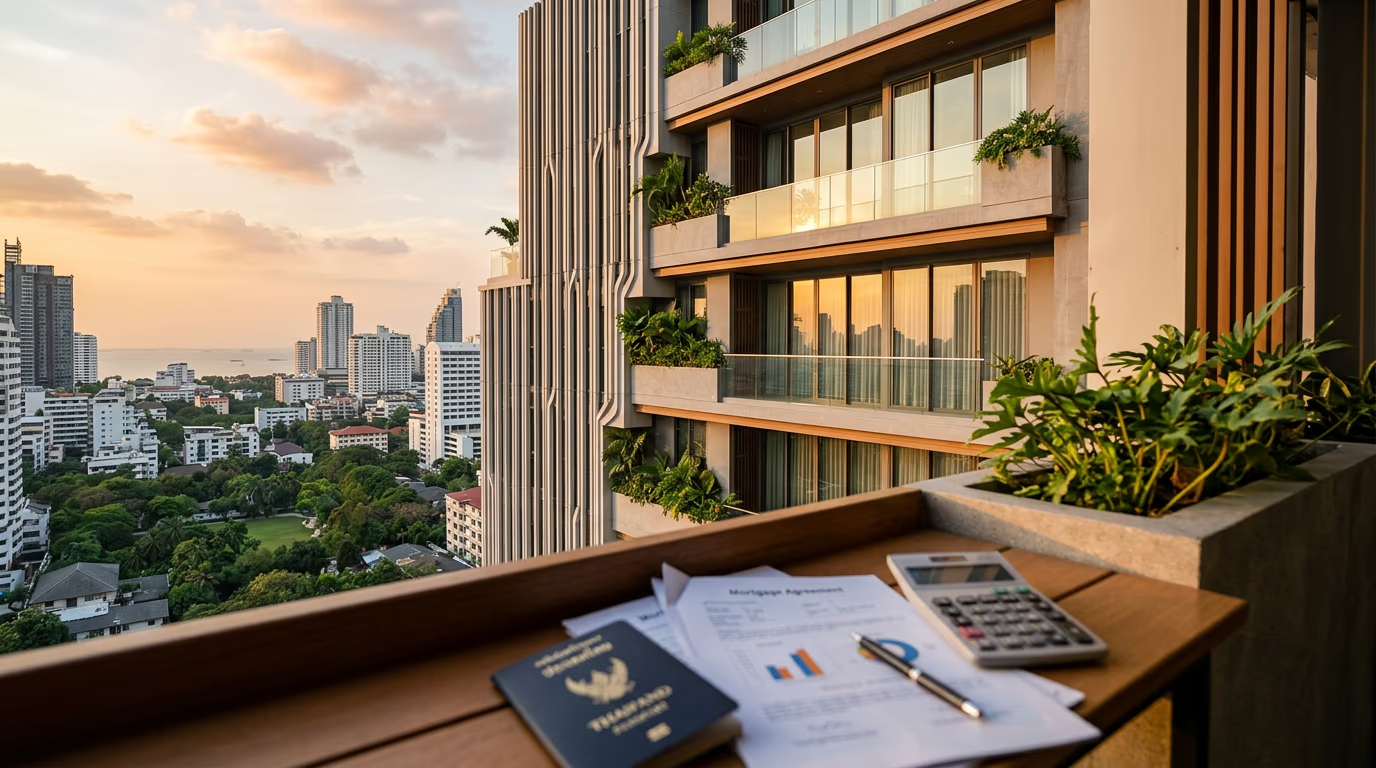
Most Thai commercial banks will not lend to foreign individuals to buy a Thai condominium in 2026. The three working routes are Bangkok Bank’s Singapore branch (USD or SGD-denominated loans, typically 50 to 70% LTV, 3 to 20 years, rates 6 to 8% above SOFR or base), UOB Thailand (selective THB lending to long-term residents and private-bank clients), and MBK Guarantee or comparable non-bank lenders (shorter-tenor THB loans at 8 to 12% interest). Developer financing — typically 3 to 10 years at 5 to 8% — is the most common route in practice and is offered directly by the project on primary-market units. For most foreign buyers the numerical question is not “can I get a mortgage” but “should I”. At a 60% loan-to-value on a 5,000,000 THB Jomtien condo, interest cost of 8% on a USD loan adds roughly 960,000 THB of interest over a five-year hold — which eats most of the levered return unless the asset appreciates faster than the interest rate. This guide walks through every available route, the current 2026 terms, the regulatory and foreign-exchange constraints that shape them, and a full cash-versus-leverage working example on a 5,000,000 THB condo.
The short version: Thai condo finance for foreigners is a real product, just not from the channel most foreign buyers assume. The retail Thai bank branches in Bangkok and Phuket that advertise home loans to Thai residents will decline a foreign application for straightforward reasons set out in Section 2. The products that do work sit in offshore branches, private banks, and developer in-house finance desks — and each has its own eligibility, LTV ceiling, and cost structure.
1. Direct answer: the three routes that work
For a foreigner buying a Thai condominium in 2026, there are three realistic finance routes: (a) Bangkok Bank’s Singapore branch international mortgage, (b) UOB Thailand selective lending on referral from UOB Private Bank, and (c) developer in-house financing on primary-market units. A fourth route, MBK Guarantee and similar non-bank lenders, works for specific profiles but comes at materially higher cost.
| Route | Typical LTV | Tenor | Rate (2026) | Currency | Who it suits |
|---|---|---|---|---|---|
| Bangkok Bank (Singapore Branch) | 50 to 70% | 3 to 20 years | SOFR + 4.5 to 6.0% (~USD 9 to 11%) | USD or SGD | Offshore-income foreigner with bankable paper trail |
| UOB Thailand (private-bank referral) | 50 to 70% | 5 to 20 years | THB MLR + 1 to 3% (~THB 7 to 9%) | THB | Long-term Thai residents, UOB Private Bank clients |
| MBK Guarantee and similar non-bank | 50 to 70% | 1 to 10 years | 8 to 12% | THB | Buyers declined by banks, off-plan completion bridge |
| Developer financing | 30 to 70% | 3 to 10 years | 5 to 8% | THB | Primary-market buyers with 30%+ deposit |
| Offshore re-mortgage on home-country property | up to 100% of Thai price | home-country terms | home-country rate | home currency | Asset-rich buyers with home equity |
Rate notes: Bangkok Bank Singapore uses SOFR (US dollar) or SIBOR/SORA (Singapore) as the floating benchmark, both at roughly 4.5% in Q1 2026. UOB Thailand’s MLR (Minimum Loan Rate) in April 2026 sits at 7.30%. MBK and non-bank rates are fixed or semi-fixed. Developer rates are set by the project and negotiable.
The rest of this guide walks through each route in turn, explaining who qualifies, what documents are required, and the quirks that trip up foreign applicants.
2. Why Thai banks generally do not lend to foreigners
Three structural reasons explain why Krung Thai, Siam Commercial Bank, Kasikornbank, Bangkok Bank (domestic branches), and Bank of Ayudhya decline almost all foreign applications for condominium mortgages. Understanding these reasons is the key to understanding why the working routes are structured the way they are.
First, collateral enforcement. Under Thai law a bank can register a mortgage over a condominium unit owned by a foreigner, but enforcing that mortgage in a default — court-ordered auction, resale under the Civil Procedure Code — requires the foreclosed unit to remain within the 49% foreign quota or be sold to a Thai buyer. The secondary-market pool of buyers for a distressed foreign-quota unit is thinner than for a Thai-quota unit, and recovery values are lower. Thai banks price this extra risk out of their retail product rather than build it in.
Second, credit bureau visibility. The National Credit Bureau of Thailand (NCB) reports credit data on Thai residents. A non-resident foreigner, by definition, has no NCB record. Thai retail lending models depend heavily on NCB scoring for approval decisions. Without it, the bank’s underwriter cannot run the standard model and has to substitute manual review, which is expensive for a mortgage book and uneconomic at retail scale.
Third, income verification and FX exposure. A foreigner earning in USD, EUR, or GBP carries income currency risk against a THB-denominated loan — if the home currency weakens, debt service in home currency terms rises. Thai banks are not set up to price this risk at retail, and there are no cross-currency mortgage products for foreign individuals in the Thai domestic market.
The narrow exceptions: Thai banks will lend to foreigners who hold a long-term Thai visa (Long-Term Resident Visa, Thai Elite), a Thai work permit, a Thai tax ID, and at least two years of declared Thai income. In practice this covers the small population of foreign residents employed in Thailand. Everyone else — offshore employees, remote workers, retirees on tourist or retirement visas — is declined by the retail Thai banks and has to route through one of the channels below.
The buy condo Thailand foreigner guide covers the full legal framework for foreign ownership under the Condominium Act.
3. Bangkok Bank Singapore branch: the workhorse route
Bangkok Bank’s Singapore branch runs the largest foreign-individual mortgage programme for Thai condominium purchases. It accepts applications from non-resident foreigners, lends in USD or SGD, takes security via mortgage registered on the Thai title deed, and runs tenors of up to 20 years with LTVs between 50 and 70%. It is the default answer when a foreigner asks an agent “where do I get a mortgage for a Thai condo”.
Programme mechanics as of early 2026:
- Eligible borrowers: non-resident foreign individuals aged 21 to 65 (65 at loan maturity), with documented income from any country except a limited OFAC and sanctions list.
- Loan currency: USD or SGD. No THB-denominated retail product at the Singapore branch.
- Loan-to-value: up to 70% for completed units; 50 to 60% for off-plan units pending completion. The bank underwrites against a Singapore branch valuation, not the Land Department appraised value.
- Tenor: 3 to 20 years. Most foreign applicants take 10 to 15 years.
- Interest rate: USD floating at SOFR plus a margin of 4.5 to 6.0% depending on profile; SGD floating at SIBOR/SORA plus comparable margin. In April 2026 this translates to roughly 9 to 11% in USD.
- Fees: 1% arrangement fee (sometimes reducible), mortgage registration fee at the Thai Land Department (1% of loan amount, capped), legal fees in both Singapore and Thailand (100,000 to 200,000 THB combined).
- Income documentation: two years of tax returns or employer letter, three months of bank statements, documented proof of cross-border payment capacity.
- Collateral: first-ranking mortgage registered at the Thai Land Department against the title deed of the purchased unit.
The cross-border mechanic that trips foreign applicants: Bangkok Bank Singapore disburses the loan in USD or SGD to the borrower’s Thai account at Bangkok Bank (domestic). The Thai branch converts to THB on the transfer date and pays the developer. The conversion generates the Foreign Exchange Transaction certificate that the Land Department requires for foreign-quota registration — the loan disbursement itself qualifies as the foreign currency inflow. This is the reason Bangkok Bank Singapore works where other offshore lenders do not: the whole transaction is choreographed inside the Bangkok Bank group and the FET certificate issues cleanly.
Approval timeline: 6 to 12 weeks from complete application, including property valuation in Thailand. Build this into your SPA timeline and negotiate a finance contingency clause.
4. UOB Thailand: selective THB lending
UOB Thailand runs a selective mortgage programme for foreign individuals referred through UOB Private Bank (Singapore) or who already hold a long-term Thai residency status. Unlike Bangkok Bank Singapore, the loan is THB-denominated, which removes currency risk for a buyer earning or receiving income in THB.
Programme characteristics as of early 2026:
- Eligibility: private bank relationship (typically USD 1 million or more of assets under management) or long-term Thai resident status. Walk-in applications are not entertained.
- Loan-to-value: up to 70% for qualifying borrowers, usually 50 to 60% on first approach.
- Tenor: 5 to 20 years.
- Currency: THB only. No cross-currency lending at the Thai branch.
- Interest rate: THB MLR minus 0.25% to MLR plus 2% depending on profile. MLR at UOB Thailand in April 2026 is 7.30%, so effective rates run approximately 7.00 to 9.30%.
- Documentation: Thai tax ID, long-term visa or work permit, three years of income history, UOB Private Bank portfolio statements if relevant.
UOB is the only Thai domestic bank running a structured foreign-individual mortgage programme beyond case-by-case exception lending. HSBC Thailand, Standard Chartered Thailand, and Citibank Thailand have all materially reduced their foreign retail mortgage appetite since 2020 and most no longer run a published product.
For a foreign buyer who qualifies, UOB’s THB product has two practical advantages over Bangkok Bank Singapore: no currency mismatch if rental income is in THB, and a lower nominal rate. The trade-off is tighter eligibility and a slower approval pathway for borrowers not already in the UOB Private Bank pipeline.
5. MBK Guarantee and non-bank lenders
MBK Guarantee Public Company Limited (listed on the Thai stock exchange under MBK-W1) and a handful of similar non-bank lenders offer bridging and term finance to foreign condo buyers who have been declined by banks or who need faster approval. Interest rates are materially higher than bank products — typically 8 to 12% fixed — but the underwriting is flexible and the turnaround is 2 to 4 weeks.
Use cases where MBK Guarantee or similar routes make sense:
- A buyer has signed an SPA on an off-plan unit, completion is imminent, and a Bangkok Bank Singapore application is still in underwriting. MBK provides a 6 to 12 month bridging loan to complete the purchase, refinanced into the bank facility once approved.
- A buyer does not qualify for Bangkok Bank Singapore (age over 65, insufficient documented income, high-risk nationality) but has substantial collateral. MBK lends against the Thai unit plus additional Thai-based collateral at 50 to 60% LTV.
- A buyer wants a short-dated facility (1 to 3 years) to bridge to a liquidity event in their home country — a business sale, a property sale abroad — without paying 20-year mortgage set-up costs.
Terms at MBK Guarantee as of early 2026: LTV up to 70% on completed Bangkok and Pattaya units, 50 to 60% on other cities; tenor 1 to 10 years; interest rate 8 to 12% depending on LTV and borrower profile; origination fee 1 to 2% of loan; first-ranking mortgage on the Thai title deed.
A parallel universe of private money lenders operates informally around the Pattaya and Phuket property markets at rates of 10 to 15% and LTVs up to 50%. These are typically high-net-worth individuals lending off personal balance sheets through a Thai law firm. They are legal if documented as a registered mortgage and conducted through a law firm, but the cost and the counterparty risk put them in a different category from the regulated non-bank lenders.
6. Developer financing
Developer financing is the most common way foreigners actually buy Thai condos on leverage in 2026. Most mid-market and premium Thai developers offer in-house instalment plans on primary-market units — typically 30% deposit, 60 to 70% financed by the developer over 3 to 10 years at 5 to 8% interest, with the title deed transferred at full payment. No credit bureau check, no income verification, and the developer secures the deal by withholding title transfer until paid.
Typical developer finance structures on Thai primary-market foreign-quota units:
- Progress payment + balance finance: 30% on reservation and progress payments, 70% financed at handover. The 70% is paid over 3 to 10 years in monthly instalments; title transfer happens at final payment.
- Part-instalment on handover: 50% at handover (part cash, part bank loan if available), 50% over 3 to 5 years at the developer’s rate.
- Discount for cash, surcharge for instalment: the all-in price is often 5 to 10% higher on the instalment plan than the cash price. The spread is the effective developer finance cost.
Who offers it: most large Thai developers (Sansiri, Land and Houses, Ananda, SC Asset, Origin, Riviera Group, Copacabana Group, Nam Talay Developments) run in-house finance desks and will quote terms on request. Smaller boutique developers are less consistent. Developer financing is almost never offered on secondary-market resales — it is a primary-market, developer-balance-sheet product.
Limitations:
- Title transfer deferred: until final payment, the title deed stays with the developer. The buyer has contractual rights but not registered ownership. A developer insolvency during the instalment period creates complications.
- No FET certificate until final payment: the Bank of Thailand foreign exchange rules require the foreign currency inflow to happen at or before transfer registration. Buyers on developer instalment plans need to time the FET paperwork carefully with their lawyer — usually by transferring the full price into Thailand and holding it in a Thai bank account, or by staggered FET certificates across payment milestones.
- Limited enforcement rights: the buyer is a contractual creditor, not a secured mortgagee. If the developer defaults, the buyer’s recovery depends on the sale and purchase agreement and Thai consumer protection law.
Developer financing works best for buyers who plan to hold the unit for the full finance term, do not need registered title deed ownership until end of plan, and can live with the 5 to 10% price premium. For a buyer with cash or a bank mortgage available, cash or bank finance is nearly always cheaper on a total-cost basis.
7. Offshore re-mortgage on home-country property
A fourth route that bypasses Thai lenders entirely is to re-mortgage or draw equity against a property in the buyer’s home country and pay cash for the Thai unit. This is the most common route for established expat buyers and long-term investors.
Mechanics: the buyer arranges a home-country mortgage, HELOC (home equity line of credit), or offset mortgage against a property in the US, UK, EU, Australia, Singapore, or Hong Kong. The drawn funds are wired to Thailand through an authorised bank, generating the FET certificate that the Land Department requires for foreign-quota registration. The Thai condo is purchased free and clear — no Thai mortgage, no Thai lender.
Advantages:
- Lowest cost of capital: home-country mortgage rates are typically materially below Bangkok Bank Singapore offshore rates. In April 2026, UK mortgage rates sit at 4.5 to 6.0%, US at 6.5 to 7.5%, Australian at 5.5 to 6.5%, Singaporean at 3.0 to 4.5%.
- No Thai mortgage registration fee: saves the 1% Thai Land Department mortgage registration fee.
- Cleaner title: unencumbered Thai title makes resale simpler and faster.
Limitations:
- Home-country equity required: the buyer must have sufficient property collateral at home. Renters and asset-poor buyers do not have this option.
- Currency risk: loan in GBP, debt service in GBP, rental income in THB. A THB weakness against GBP means the rental does not cover the mortgage in GBP terms.
- Home-country regulation: some jurisdictions restrict using domestic mortgage funds for foreign property purchase, or require specific disclosure.
For asset-rich buyers this route is almost always the winner on cost. The decision is whether you want Thai-property equity encumbered or home-country equity encumbered, and which interest rate is lower after tax.
8. Worked example: cash versus leverage on a 5,000,000 THB Jomtien condo
Assumptions: 5,000,000 THB Jomtien one-bedroom, 5-year hold, 6% gross rental yield, 3% annual price appreciation, 2% CAM and tax drag, sold at year 5. Compare paying cash versus Bangkok Bank Singapore mortgage at 60% LTV, 8% USD rate, 15-year amortisation schedule but held for 5 years then sold and paid off.
Cash purchase
- Purchase price: 5,000,000 THB.
- Purchase-side transaction costs: 150,000 THB (3%).
- Total invested at start: 5,150,000 THB.
- Gross rental over 5 years: 5,000,000 × 6% × 5 = 1,500,000 THB.
- Net rental after CAM and tax drag (2% of value per year): 1,500,000 − 500,000 = 1,000,000 THB.
- Sale price year 5: 5,000,000 × 1.03^5 = 5,796,000 THB.
- Sale-side costs (SBT if under 5 years; held exactly 5 years here, so stamp duty regime): 0.5% stamp duty + 2% transfer fee half-share + withholding ~100,000 + agent 3% + legal = roughly 310,000 THB.
- Net sale proceeds: 5,796,000 − 310,000 = 5,486,000 THB.
- Total return on cash: 5,486,000 + 1,000,000 − 5,150,000 = 1,336,000 THB.
- Return on invested capital (5 years): 1,336,000 / 5,150,000 = 25.9% total, or ~4.7% per year compound.
Leveraged purchase (60% LTV Bangkok Bank Singapore)
- Down payment: 40% × 5,000,000 = 2,000,000 THB.
- Loan: 60% × 5,000,000 = 3,000,000 THB.
- Purchase-side transaction costs + mortgage registration: 180,000 THB.
- Total cash at start: 2,180,000 THB.
- Annual interest (simple approximation, first five years of 15-year amortisation averages ~8%): 8% × 2,700,000 average balance = 216,000 THB per year, or 1,080,000 THB over 5 years.
- Principal amortised over 5 years: approximately 700,000 THB.
- Gross rental over 5 years: 1,500,000 THB.
- Net rental after CAM, tax drag, and interest: 1,500,000 − 500,000 − 1,080,000 = negative 80,000 THB (cash flow is negative; the owner subsidises the carry).
- Sale price year 5: 5,796,000 THB.
- Loan balance to repay at year 5: 3,000,000 − 700,000 = 2,300,000 THB.
- Sale-side costs: roughly 310,000 THB.
- Net sale proceeds after loan payoff: 5,796,000 − 310,000 − 2,300,000 = 3,186,000 THB.
- Total return on leveraged cash: 3,186,000 + (−80,000) − 2,180,000 = 926,000 THB.
- Return on invested capital (5 years): 926,000 / 2,180,000 = 42.5% total, or ~7.3% per year compound.
Reading the numbers
Leverage produces a higher percentage return on invested capital (~7.3% versus ~4.7%) but a lower absolute Thai baht return (926,000 versus 1,336,000). The leveraged owner pays roughly 1,080,000 THB of interest over five years — meaningful money that goes to the Singapore branch, not to the investor.
Leverage makes sense when:
- The buyer is genuinely capital-constrained and needs to preserve cash for other deployments.
- Rental yield exceeds interest cost by enough margin to carry positively (unusual in 2026 at 6% yield vs 8% USD rates).
- The buyer has a strong view that appreciation will materially exceed the interest rate.
Leverage does not make sense when:
- The buyer has the cash and the Thai rental yield is below the offshore mortgage rate. The carry is negative and the levered return only beats the cash return if appreciation is strong.
- The buyer’s home-country rate is lower than the Bangkok Bank Singapore rate (almost always true for UK, EU, Singaporean, Japanese borrowers). Re-mortgage at home instead.
Run your own numbers using the cost calculator and the yield calculator to test different hold periods, yields, and LTVs. The rental yield guide covers the yield assumptions by city and area.
9. When financing makes sense vs cash
Cash works for the majority of foreign buyers in Thailand. Financing is right for buyers who genuinely need leverage, have a cheaper home-country borrowing route, or are buying a bigger unit than cash alone can cover.
Cash makes sense when:
- The buyer has the funds available without distorting broader asset allocation.
- Home-country borrowing costs would be above 7% (currently rare in most developed markets).
- The unit is a retirement or lifestyle purchase, not a leveraged investment.
- The foreign quota and FET paperwork are the dominant practical constraints. Cash simplifies both.
Financing makes sense when:
- The buyer can access home-country equity at a materially lower rate than Thai offshore lending.
- The buyer is capital-constrained and wants to own Thai property on a smaller cash outlay.
- The buyer is acquiring a portfolio of Thai condos and wants to spread capital across more units.
- Developer financing is offered at a meaningful discount (4 to 5% interest) on a primary-market unit the buyer is committed to buying anyway.
Three practical rules that hold across most scenarios:
- Always model cash versus leverage over your planned hold period, not over the full mortgage tenor. Early-year amortisation favours the lender.
- Compare your Thai offshore rate to your home-country rate. If home is materially cheaper, re-mortgage at home.
- Keep a cash reserve for unplanned items — special assessments, vacancy, currency moves, visa renewals. A unit financed to the LTV ceiling with no reserve is fragile.
For the legal and procedural mechanics of the underlying purchase, see the buy condo Thailand foreigner guide. For the full cost stack including carry, see the condo costs guide and the transfer fees and taxes guide.
10. Frequently asked questions
Can I get a Thai bank mortgage as a non-resident foreigner?
Not from the domestic retail branches of Thai banks. The three working routes are Bangkok Bank’s Singapore branch (offshore USD or SGD loan), UOB Thailand (selective THB lending on private-bank referral), and non-bank lenders such as MBK Guarantee. Developer financing is the fourth and most common practical route.
What is the maximum LTV for a foreigner in 2026?
70% on completed units is the practical ceiling at Bangkok Bank Singapore and UOB Thailand for strong applicants. 50 to 60% is more typical on first approach, especially for off-plan purchases or borrowers with less established documentation.
Do I need a Thai tax ID for a mortgage?
Not for Bangkok Bank Singapore (offshore loan, uses your home-country tax filings). Yes for UOB Thailand and most developer in-house finance programmes. A Thai tax ID is issued by the Revenue Department on request once you have a Thai visa or work permit.
Can I use my mortgage funds as the FET inflow?
Yes, for Bangkok Bank Singapore. The loan disbursement is structured to land in Thailand as foreign currency, converted by the Thai branch, and the Bank of Thailand FET certificate issues against that conversion. For UOB Thailand THB loans, you still need a separate foreign currency inflow to cover your own down payment.
What happens if I default on a Thai mortgage?
The lender registers the mortgage at the Land Department. On default, the lender initiates court-ordered sale under the Civil Procedure Code. Recovery values on Thai condo foreclosures typically run 20 to 40% below open-market value. The remaining debt after auction is still owed by the borrower and may be enforced in the home country if treaties allow.
Is developer financing a good deal?
Depends on the effective rate after the cash-versus-instalment price spread. If the developer offers a 5% rate but prices the instalment plan 10% above cash, the true rate is substantially higher than the headline. Always ask for the cash price separately and compute the effective financing cost. Many developers will negotiate if you have competing bank finance approved.
Can I get a Thai mortgage for an off-plan condo?
Bangkok Bank Singapore lends against off-plan at reduced LTV (50 to 60%), typically disbursing at completion rather than during construction. Non-bank lenders will bridge off-plan progress payments. Thai domestic retail banks generally decline off-plan foreign applications.
How long does Bangkok Bank Singapore approval take?
6 to 12 weeks from a complete application. Put a finance contingency clause in your SPA. Singapore branch underwriting runs valuation on the Thai property, income and asset checks, and compliance screening in parallel.
Are rates likely to fall in 2026?
Base rates (SOFR, THB MLR, SIBOR) are on a gradual declining path in 2026 as regional central banks ease from 2024 peaks. Spreads over base for foreign retail mortgages have been stable. Expect modest rate improvements through 2026 rather than a step change.
What happens to my mortgage if I sell the condo?
The loan is repaid at sale proceeds, with any surplus going to the seller. The mortgage is released at the Land Department when the lender confirms full repayment, and the new owner takes unencumbered title. Plan the cash-flow timing with your lawyer, because the Land Department transfer, mortgage release, and settlement happen together on the same day.
References
Sources
- 01Bangkok Bank (Singapore Branch) Home Loan for International Customer; 2025-2026 programme terms · https://www.bangkokbank.com/en/Personal/Other-Services/Home-Loan-for-International-CustomerBangkok Bank Singapore branch international mortgage programme for foreign buyers of Thai condominiums. Accessed 2026-04-16.
- 02UOB Thailand Home Loan and Private Bank Thailand Lending Guidelines 2025-2026 · https://www.uob.co.th/personal/loans/home-loans.pageUOB Thailand foreign buyer selective mortgage and private banking-referred lending practice. Accessed 2026-04-16.
- 03MBK Guarantee Public Company Limited foreign-buyer lending product 2025 · https://www.mbkguarantee.com/MBK Guarantee and boutique non-bank lenders for foreign condo buyers in Thailand. Accessed 2026-04-16.
- 04Bank of Thailand Foreign Exchange Regulations, Notice on Foreign Currency Inward Remittance for Property Purchase · https://www.bot.or.th/en/financial-markets/foreign-exchange-regulations.htmlBank of Thailand foreign exchange regulations, FET certificate requirement, and inward remittance rules for foreign condominium purchases. Accessed 2026-04-16.
- 05Condominium Act B.E. 2522 (1979), amended 2008, Sections 19 and 19 bis; Ministerial Regulation on Registration of Foreign-Owned Units · https://www.krisdika.go.th/Condominium Act requirements on foreign currency remittance as a precondition to foreign-quota registration. Accessed 2026-04-16.
- 06National Credit Bureau Thailand, Credit Information Business Act B.E. 2545 (2002) scope of reporting · https://www.ncb.co.th/enNational Credit Bureau scope and limitation for non-resident foreign borrowers. Accessed 2026-04-16.
- 07CBRE Thailand Real Estate Market Outlook 2026; Cushman and Wakefield Thailand Market Beat Q1 2026 · https://www.cbre.co.th/insights/reports/thailand-real-estate-market-outlook-2026Developer financing structures, typical terms, and market incidence for Thai primary-market condo sales. Accessed 2026-04-16.
- 08Tilleke and Gibbins, Thailand Banking and Finance Briefing 2025; Siam Legal International, Foreign Mortgage Guide 2025-2026 · https://www.tilleke.com/insights/Cross-border mortgage structures and Thai condominium security enforcement practice. Accessed 2026-04-16.
Published · How we research and date our content