Transfer Fees and Taxes Buying a Condo Thailand 2026
Thailand condo transfer fees and taxes in 2026: 2% transfer fee, 3.3% SBT, 0.5% stamp duty, withholding tax schedule, worked 5M THB examples, and 2026 stimulus updates.
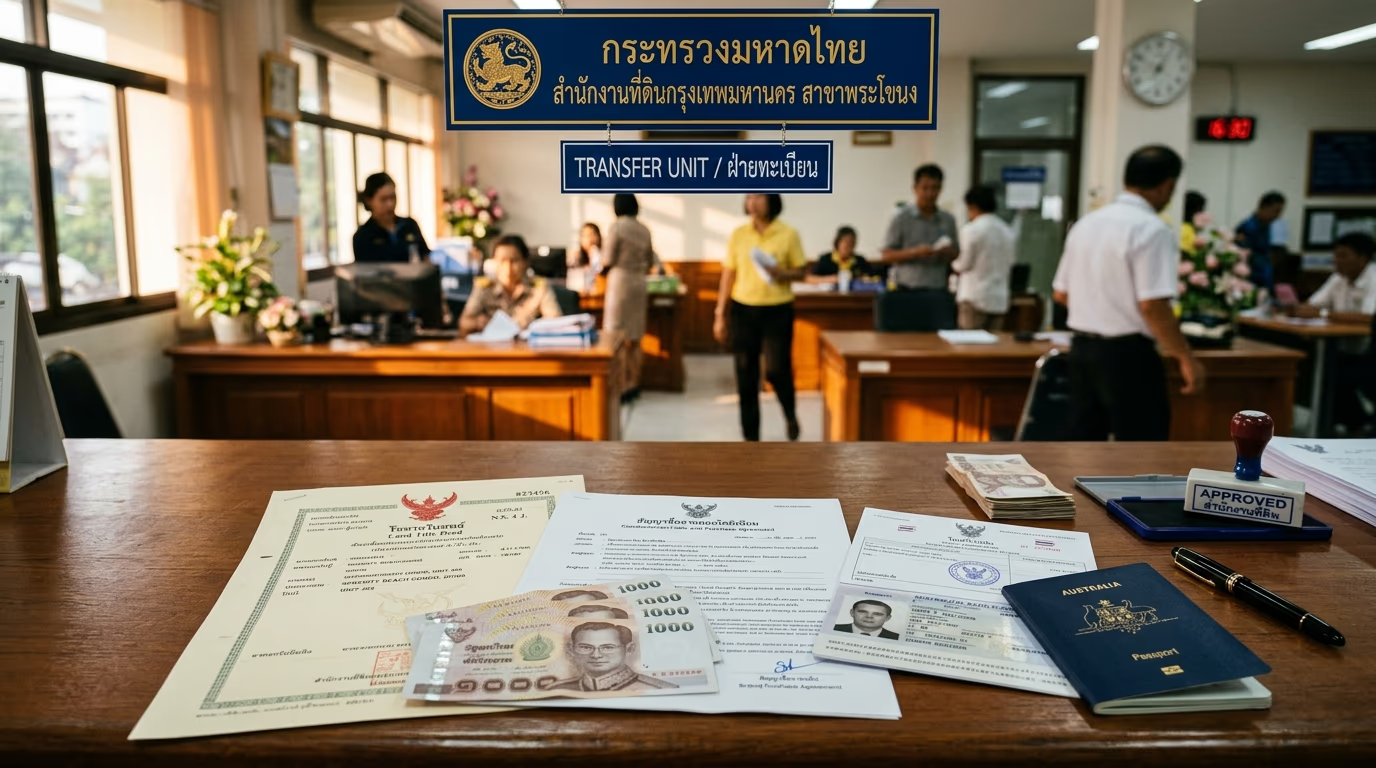
At the Thai Land Department, the transfer of a condominium unit triggers four possible taxes: a 2% transfer fee on the appraised value, a 3.3% Specific Business Tax on the sale or appraised value (higher figure) if held under five years, a 0.5% stamp duty (if SBT does not apply), and a progressive personal withholding tax on the seller’s deemed profit. Total fees and taxes on a primary-market purchase of a 5,000,000 THB Jomtien condo typically run 164,000 to 295,000 THB, depending on how the contract splits the costs. Selling the same unit after three years adds roughly 215,000 to 260,000 THB in taxes payable at the Land Department on the sale. All of this is set by the Thai Revenue Code and the Land and Building Tax Act B.E. 2562 (2019), with rates fixed by ministerial regulation. This guide walks through every line item at 2026 rates, shows who actually pays under Thai market custom, and works two numerical examples end to end on a 5,000,000 THB condominium held for three years.
The most important point a foreign buyer can internalise before signing a reservation agreement is that Thai property taxes are calculated on two different numbers — the contract price, and the Land Department’s appraised value (ราคาประเมิน). The appraised value is a Ministry of Interior figure, reassessed every four years, that generally runs 20 to 40% below open-market price for new-build condominiums. Some taxes apply to the appraised figure, some to the higher of the two, and some to a deemed profit built off the appraised figure. Confusing them is the single most common error in self-calculated transfer budgets.
1. Transfer fee: 2% of Land Department appraised value
The transfer fee is a flat 2% of the Land Department’s appraised value of the unit. The Land Department collects it at the moment the transfer is registered. Thai market custom is a 50/50 split between buyer and seller, but the split is contractual and fully negotiable. The legal basis is the Ministerial Regulation on Fees under the Land Code, applied to condominium transfers through the Condominium Act.
The appraised value (ราคาประเมิน) is determined by the provincial Land Department using a reassessment cycle set by the Ministry of Interior — the current valuation is effective from 1 January 2023 and runs to 31 December 2026. The appraised value covers the unit’s share of land plus the saleable floor area of the unit, calculated under a tariff published per province and per district. For foreign buyers the appraised value is visible on request at the local Land Department branch or can be estimated through the developer’s legal team.
Worked calculation: a 5,000,000 THB Jomtien one-bedroom (38 sqm) typically has an appraised value in the region of 3,200,000 THB at 2026 Chonburi tariffs.
- Transfer fee: 2% of 3,200,000 THB = 64,000 THB.
- Split 50/50 (Thai custom): buyer 32,000 THB, seller 32,000 THB.
- Contract language saying “buyer pays full transfer fee” (common in developer primary sales): buyer 64,000 THB, seller 0 THB.
The transfer fee is the only item where the calculation basis is unambiguously the appraised value, not the sale price. Every other tax either uses the sale price, the higher of sale or appraised, or a deemed profit.
Stimulus reductions: 2024 to 2026 context
The Thai government has periodically reduced the transfer fee to 0.01% for residential property under a price ceiling as a stimulus measure. The last full run of this programme covered 2023 and 2024 for residential units under 7,000,000 THB, implemented by ministerial announcement. The programme lapsed and was partially re-extended in 2025 at a 1% reduced rate for units under 3,000,000 THB; the 2026 status is under annual Cabinet review.
Two caveats for foreign buyers. First, the reductions are designed to support Thai first-home buyers and have sometimes excluded foreign purchasers by requiring the buyer to hold a Thai tax ID with primary-residence status. Second, even when the reduction technically covers foreign buyers, developers often re-price the reduction back into their asking price, so the saving disappears in the contract. Always confirm the current programme status with your lawyer at the contract-signing stage — the current Cabinet Resolution text governs, not marketing material.
2. Specific Business Tax: 3.3% if seller held under 5 years
If the seller has owned the unit for fewer than five calendar years, Specific Business Tax (SBT) applies at 3.3% — 3% under Revenue Code Section 91/6 plus a 10% municipal surcharge — on the higher of the sale price or the appraised value. SBT is a seller tax by law, although sellers routinely try to build it into the asking price. SBT and stamp duty are mutually exclusive: one or the other applies, never both.
SBT counts the five years from the date of the seller’s acquisition (the date recorded on the title deed registration) to the date of the new transfer. Developers selling primary-market units by definition fall within the five-year window — SBT is always in play on a new developer sale. Secondary-market sellers who have held the unit for more than five years switch to the stamp duty regime in Section 3 below.
Worked calculation: 5,000,000 THB Jomtien one-bedroom, appraised value 3,200,000 THB, seller held 3 years.
- SBT base: higher of 5,000,000 (sale) and 3,200,000 (appraised) = 5,000,000 THB.
- SBT: 3.3% of 5,000,000 = 165,000 THB.
- Payable by the seller at the moment of transfer registration.
Five narrow exceptions remove SBT even inside the five-year window: transfers by inheritance, transfers between direct-line relatives, transfers to the government or a charitable organisation under a ministerial ruling, and a one-time residential exemption for a unit registered as the seller’s primary residence for at least one year (Royal Decree No. 342). The primary-residence exemption is the most common and the most commonly misapplied — foreigners do not qualify unless the unit is genuinely registered as their Thai residential address.
3. Stamp duty: 0.5% when SBT does not apply
Stamp duty at 0.5% of the higher of sale or appraised value applies only when SBT does not — that is, when the seller has held the unit for five or more years, or when an exemption removes SBT. Stamp duty is collected at the Land Department at the moment of transfer. By Thai market custom the seller pays.
Worked calculation: 5,000,000 THB Jomtien one-bedroom resale after 6 years of ownership.
- SBT: not applicable (held over 5 years).
- Stamp duty base: higher of 5,000,000 (sale) and 3,200,000 (appraised) = 5,000,000 THB.
- Stamp duty: 0.5% of 5,000,000 = 25,000 THB.
- Payable by the seller at transfer.
The difference between the two regimes is substantial. On the same 5,000,000 THB resale, the seller pays 165,000 THB in SBT at year 3 versus 25,000 THB in stamp duty at year 6 — a 140,000 THB tax saving simply by waiting past the five-year anniversary. This is the single biggest tax-planning lever in Thai condo ownership. If you are a foreign investor considering exit in year 4 or 5, the numbers almost always favour holding to the five-year anniversary.
4. Personal withholding tax on sale
At the moment of transfer, the Land Department withholds personal income tax on the seller’s deemed profit under Revenue Code Section 50(5). The calculation uses a years-held reduction schedule in Ministerial Regulation No. 126 (Item 18), progressive personal income tax brackets, and a per-year division. Effective withholding rate on condo resales typically runs 1 to 4% of the appraised value.
The Section 50(5) calculation runs as follows.
- Start with the appraised value (not the sale price).
- Apply the years-held reduction to compute deemed taxable gain. The reduction percentages in Ministerial Regulation No. 126 are:
| Years held | Deemed gain (% of appraised) |
|---|---|
| 1 year | 92% |
| 2 years | 84% |
| 3 years | 77% |
| 4 years | 71% |
| 5 years | 65% |
| 6 years | 60% |
| 7 years | 55% |
| 8 or more years | 50% |
- Divide the deemed gain by the years held to get deemed annual taxable income.
- Apply Thailand’s progressive personal income tax rates (0 to 35%) to the deemed annual income to get deemed annual tax.
- Multiply deemed annual tax by the years held to get total withholding.
Worked calculation: 5,000,000 THB Jomtien one-bedroom sold after 3 years, appraised value 3,200,000 THB, individual seller.
- Deemed gain: 77% of 3,200,000 = 2,464,000 THB.
- Deemed annual income: 2,464,000 / 3 years = 821,333 THB.
- Thai personal income tax on 821,333 THB (2026 brackets): roughly 74,333 THB.
| Bracket | Rate | Tax on bracket |
|---|---|---|
| First 150,000 THB | 0% | 0 |
| 150,001 to 300,000 THB | 5% | 7,500 |
| 300,001 to 500,000 THB | 10% | 20,000 |
| 500,001 to 750,000 THB | 15% | 37,500 |
| 750,001 to 821,333 THB | 20% | 14,267 |
| Total annual tax | 79,267 THB |
- Total withholding: 79,267 × 3 years = 237,801 THB.
- Effective rate: 237,801 / 3,200,000 = 7.4% of appraised value, or 4.8% of sale price.
Corporate sellers use a different formula — a flat 1% of the higher of sale or appraised value is withheld, with the net gain taxed under Corporate Income Tax (currently 20%). That is relevant for condos held inside a Thai company structure or a BOI entity. Almost all foreign individual sellers fall under Section 50(5).
5. Local development tax and sinking fund at handover
A small set of handover-related charges are technically separate from transfer taxes but are paid in the same registration window. The most important are the sinking fund contribution (a one-time charge to the building’s reserve under Section 40 of the Condominium Act) and the juristic person administrative fee for preparing the no-arrears certificate.
Sinking fund: typically 500 to 1,000 THB per square metre of saleable area in mid-market foreign-quota projects, 1,000 to 2,000 THB per sqm in premium and branded-residence projects. For the Jomtien reference unit (38 sqm at 700 THB per sqm): 26,600 THB, payable once at handover. The sinking fund is not refundable on resale and transfers with the unit. See the condo maintenance fees guide for the full sinking fund mechanics.
Juristic person administrative fee: 500 to 2,000 THB at handover for no-arrears certificate issuance, utility account setup, and registration of the new owner in the building’s books.
Land and Building Tax (ภาษีที่ดินและสิ่งปลูกสร้าง): annual, not one-off, but budgeted for in the first year. Under the Land and Building Tax Act B.E. 2562 (2019), residential condominiums pay progressive rates. A self-occupied primary residence worth 0 to 50 million THB pays 0.02% to 0.10% progressively (0.02% on the first 50M, rising). A non-self-occupied residential property pays 0.02 to 0.30% progressively on value bands. For a 5,000,000 THB Jomtien unit used as a second home or rental, the annual Land and Building Tax is roughly 1,500 to 5,000 THB. The tax is assessed by the local administrative organisation and payable in April each year.
6. Worked example: buying a 5,000,000 THB Jomtien condo (primary market)
Full cost breakdown for a foreign buyer purchasing a new-build 38 sqm one-bedroom at 5,000,000 THB from the developer. Appraised value 3,200,000 THB, developer held (under 5 years by definition, so SBT applies). Contract terms: buyer pays half of transfer fee; seller (developer) pays SBT and withholding.
| Line | Amount (THB) | Paid by |
|---|---|---|
| Purchase price | 5,000,000 | Buyer |
| Transfer fee 2% of 3,200,000 (buyer share 50%) | 32,000 | Buyer |
| Transfer fee 2% of 3,200,000 (seller share 50%) | 32,000 | Seller |
| Specific Business Tax 3.3% of 5,000,000 | 165,000 | Seller |
| Withholding tax (not applicable for corporate developer on SBT-sale primary issue) | 0 | — |
| Corporate income tax on developer profit (seller’s own affair) | n/a | Seller |
| Sinking fund 38 sqm at 700 THB/sqm | 26,600 | Buyer |
| Utility meter installation (electricity + water) | 12,000 | Buyer |
| Juristic person admin fee | 2,000 | Buyer |
| 12 months CAM prepayment at 50 THB/sqm/month | 22,800 | Buyer |
| Legal fees (full due diligence and transfer) | 50,000 | Buyer |
| Buyer total out of pocket | 5,145,400 | |
| Net to developer (after seller-side tax) | 4,803,000 |
Buyer-side transaction costs above the purchase price: 145,400 THB, or 2.9% of the price. That is the clean benchmark for a primary-market foreign-quota purchase at 5M THB. Apply the cost calculator to vary the parameters and test price points up to 20M THB.
- Transfer fee 2% (buyer 50% share) 32k THB (22.0%)
- Sinking fund (700 THB/sqm × 38 sqm) 27k THB (18.3%)
- Utility meter installation 12k THB (8.3%)
- Juristic person admin 2k THB (1.4%)
- 12-month CAM prepayment 23k THB (15.7%)
- Legal fees (DD + transfer) 50k THB (34.4%)
If the contract shifts the full transfer fee onto the buyer (some developers quote “net to developer” pricing), the buyer total rises by 32,000 THB to 5,177,400 THB. If the buyer also absorbs the furniture package (200,000 THB at the mid-market tier), the all-in number reaches roughly 5,345,400 THB — 6.9% over the headline price. The condo costs guide breaks down the full five-year and ten-year total cost of ownership.
7. Worked example: selling a 5,000,000 THB Jomtien condo after 3 years
Same unit, held by an individual foreign seller for 3 years, resold to a Thai buyer for 5,000,000 THB. Appraised value now 3,400,000 THB (modest appraisal uplift since purchase). Contract: 50/50 transfer fee split, seller pays SBT and withholding.
| Line | Amount (THB) | Paid by |
|---|---|---|
| Sale price | 5,000,000 | Buyer pays |
| Transfer fee 2% of 3,400,000 (seller share 50%) | 34,000 | Seller |
| Transfer fee 2% of 3,400,000 (buyer share 50%) | 34,000 | Buyer |
| Specific Business Tax 3.3% of 5,000,000 | 165,000 | Seller |
| Stamp duty (not applicable, SBT in play) | 0 | — |
| Withholding tax (Section 50(5), 3 years held, appraised 3,400,000) | ~87,000 | Seller |
| Agent commission (market standard 3% of sale) | 150,000 | Seller |
| Juristic person no-arrears certificate | 1,000 | Seller |
| Legal fees for sale coordination | 40,000 | Seller |
| Seller total deductions at transfer | 477,000 | |
| Net proceeds to seller | 4,523,000 |
Calculated withholding: deemed gain 77% × 3,400,000 = 2,618,000; annual deemed income 872,667; Thai tax brackets yield roughly 28,800 + 58,500 = 87,300 total over three years, rounded here to 87,000.
Net exit return: the seller recovers roughly 90.5% of the sale price after all charges, commissions, and taxes. If the same seller had held to the five-year mark, SBT would switch to 0.5% stamp duty (saving 140,000 THB in SBT but adding 17,000 THB in stamp duty, net saving 123,000 THB) and the years-held reduction would drop the deemed gain percentage from 77% to 65% — reducing withholding tax meaningfully. The condo resale guide covers the full exit procedure including fund repatriation under the Foreign Exchange Transaction form.
8. 2025 to 2026 regulatory updates
Thailand has run periodic transfer fee and mortgage registration reductions since 2019 as a property sector stimulus. The 2024 programme expired at the end of that year; a partial re-extension ran through 2025 at reduced scope. The 2026 position as of April is that the headline 2% transfer fee, 3.3% SBT, 0.5% stamp duty and the Section 50(5) withholding schedule are the rates in force, with any reductions subject to Cabinet Resolution and Royal Gazette publication.
Three specific 2025 to 2026 developments worth tracking for any transaction in planning:
- Land and Building Tax rate reaffirmation (2026): the Ministry of Finance confirmed the progressive residential rate schedule for the 2023 to 2026 valuation cycle; the 2027 reassessment will reset appraised values for the next four-year cycle.
- Cabinet stimulus scope (2025): the reduced-fee window of 2024 was re-extended in 2025 only for residential units under 3,000,000 THB and with restrictions on foreign buyer eligibility. Expect further Cabinet review in 2026.
- Foreign buyer remittance rules (2025): the Bank of Thailand reaffirmed the Foreign Exchange Transaction certificate requirement for foreign condo purchases. Funds must enter Thailand as foreign currency and be converted by an authorised bank to support the foreign-quota registration; incoming wire messages must reference the purpose as “purchase of condominium.”
Always confirm current rate status with a licensed Thai property lawyer before a transaction. Rate changes typically take effect from Royal Gazette publication date and apply to registrations completed after that date.
9. Frequently asked questions
Is the 2% transfer fee calculated on the purchase price or the appraised value?
Appraised value. The transfer fee in Thailand is explicitly calculated on the Land Department’s appraised value (ราคาประเมิน), which is typically 20 to 40% below open-market price for new-build condominiums. This is the most common error in self-calculated transfer budgets.
Who pays the transfer fee, buyer or seller?
Contractually negotiable. Thai market custom is a 50/50 split, but the contract wording controls. Developer primary sales increasingly quote “net to developer” pricing, which pushes the full 2% onto the buyer. Always read the SPA carefully on this point.
Are SBT and stamp duty ever both payable?
No. The two taxes are mutually exclusive under the Revenue Code. SBT applies when the seller has held under five years; stamp duty applies when SBT does not. Only one reaches the Land Department cashier at registration.
What counts as “five years” for SBT purposes?
Five calendar years from the date the seller acquired the unit (the Land Department registration date on the title deed) to the date of the new transfer. Possession date under the SPA does not count — only the formal transfer registration date. Plan exit timing against the registration date, not the reservation or handover date.
Do I pay withholding tax on a condo I bought years ago at a loss?
Yes. The withholding is calculated on deemed profit under the Section 50(5) schedule, not actual profit. The deemed gain percentages apply regardless of whether the sale produces a real profit or loss. A seller who sold at a loss can apply for a refund of overpaid tax through the Revenue Department’s personal income tax return, but the Land Department still collects at transfer.
Can a foreigner claim the primary residence SBT exemption?
Only if the unit is genuinely registered as the foreign seller’s primary Thai residence for at least one continuous year before sale, supported by a Thai tax ID, work permit or long-stay visa, and utility bills. In practice very few foreign sellers qualify, because foreign-quota units are typically held as investment or second homes.
How do stimulus reductions affect my transfer fee?
Only if a reduction is in force at the date of registration, your unit is below the price ceiling, and you (the buyer) qualify under the current scheme’s eligibility rules. Foreign buyers have frequently been excluded from the tightest eligibility tiers. Check the current Royal Gazette and Cabinet Resolution at the time of your transfer — your lawyer will know.
Does buying a condo give me a Thai tax ID?
No. Thai tax ID issuance is separate from property ownership and is based on residence status, income sourcing, or specific Revenue Department requests. You do not need a Thai tax ID to register a condo transfer. Foreign sellers selling a rental property may, however, benefit from obtaining a tax ID to reclaim over-withheld tax on rental income.
How do I repatriate sale proceeds after selling my condo?
Under Bank of Thailand foreign exchange rules, sale proceeds up to the amount originally remitted under the Foreign Exchange Transaction certificate may be repatriated without further restriction, through the Thai bank that holds the unit’s registration records. Amounts beyond the original remittance require additional documentation and are subject to the prevailing foreign currency purchase rules. Plan this with your lawyer in the three months before sale.
References
Sources
- 01Thailand Land Department, Ministerial Regulation on Fees under the Land Code and the Condominium Act; Department of Lands practice note · https://www.dol.go.th/Transfer fee of 2% of Land Department appraised value on condominium unit transfers. Accessed 2026-04-16.
- 02Thailand Revenue Code, Sections 91/2 and 91/6; Royal Decree No. 342 B.E. 2541 (1998) · https://www.rd.go.th/english/37749.htmlSpecific Business Tax of 3.3% (3% plus 10% municipal surcharge) applies to sales within 5 years of acquisition. Accessed 2026-04-16.
- 03Thailand Revenue Code, Stamp Duty Schedule, Item 28 · https://www.rd.go.th/english/37749.htmlStamp duty at 0.5% applies when SBT is not applicable, on the higher of sale or appraised value. Accessed 2026-04-16.
- 04Thailand Revenue Code, Sections 40(8) and 50(5); Ministerial Regulation No. 126 (Item 18) years-held reduction schedule · https://www.rd.go.th/english/37749.htmlPersonal withholding tax on condo sale calculated on deemed profit using the years-held reduction schedule. Accessed 2026-04-16.
- 05Land and Building Tax Act B.E. 2562 (2019), Sections 37, 40, 41 and 42; Ministerial Regulations on rates · https://www.mof.go.th/Land and Building Tax rates for residential condominiums and self-occupied primary residence treatment. Accessed 2026-04-16.
- 06Thailand Ministry of Interior announcement and Royal Gazette publications 2024; Cabinet Resolution extending measures · http://www.ratchakitcha.soc.go.th/2024 to 2025 transfer fee and mortgage registration fee reductions under government stimulus measures. Accessed 2026-04-16.
- 07Condominium Act B.E. 2522 (1979), amended by Act No. 4 B.E. 2551 (2008), Sections 19 and 19 bis · https://www.krisdika.go.th/Condominium Act framework for registration of unit transfers and unit-specific fee calculation. Accessed 2026-04-16.
- 08Tilleke and Gibbins, Thailand Real Estate Briefing 2025; Siam Legal International, Condo Purchase Tax Guide 2025-2026 · https://www.tilleke.com/insights/Practical Thai condo transaction cost breakdown and custom-of-market splits for foreign buyers. Accessed 2026-04-16.
- 09Bank of Thailand, Foreign Exchange Regulations and Foreign Exchange Transaction Form guidance · https://www.bot.or.th/en/financial-markets/foreign-exchange-regulations.htmlBank of Thailand foreign currency inward remittance requirements and FET certification for foreign buyers. Accessed 2026-04-16.
Published · How we research and date our content