Foreign Quota in Thailand: The 49% Rule Explained (2026)
The Thailand 49% foreign quota rule explained. How the cap is calculated, how to verify availability, quota vs Thai-quota units, and what happens when the cap is hit.
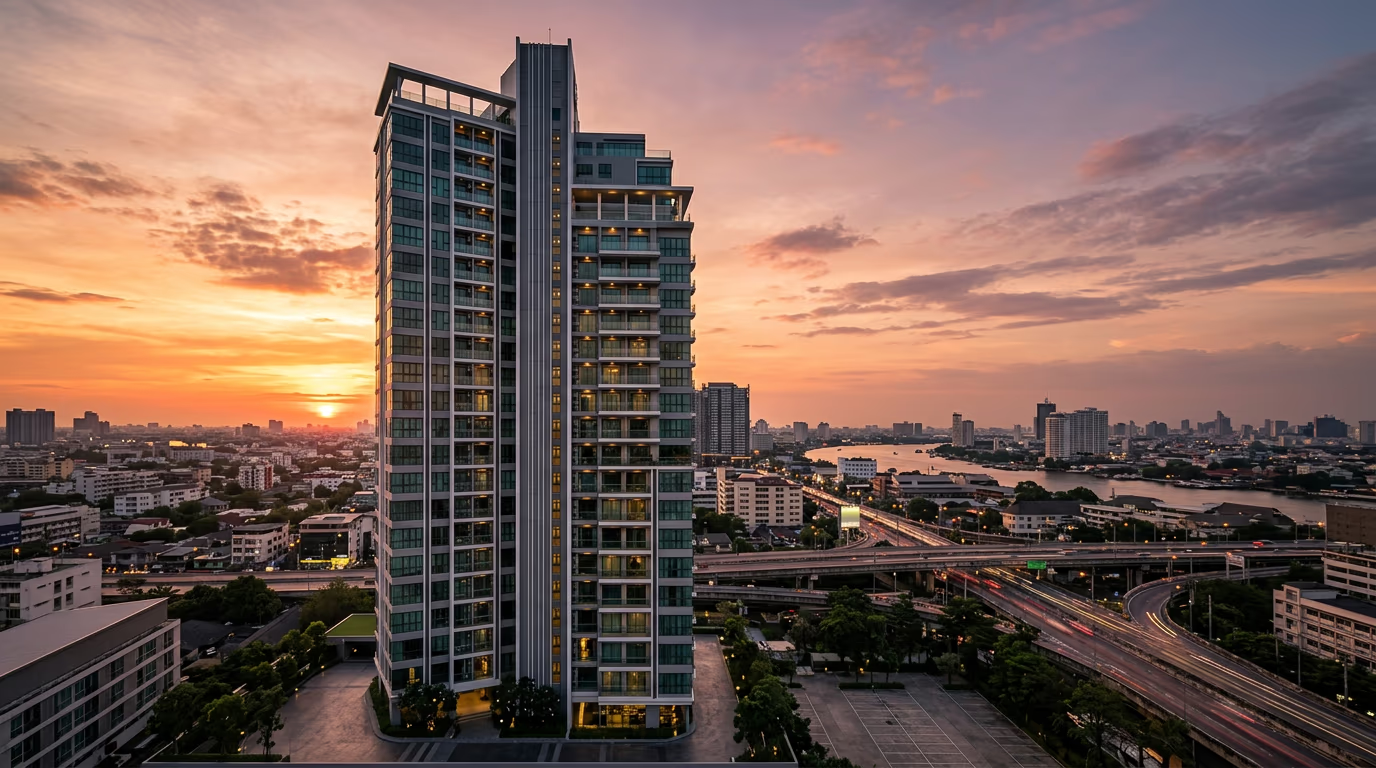
The 49% rule caps aggregate foreign ownership in any Thai condominium at 49% of the building’s total saleable floor area, measured in square metres. This is Section 19 bis of the Condominium Act B.E. 2522 (1979), as amended by Act (No. 4) B.E. 2551 (2008). It is a hard legal ceiling, enforced at the Land Department — a foreigner cannot register freehold ownership of a unit that would push the building above the 49% cap. The rule is measured by area, not by unit count, which produces non-intuitive results in mixed-size buildings. A tower of 100 identical units reaches the cap at 49 foreign owners. A tower where foreigners buy the larger premium units and Thais buy smaller studios reaches the cap well before 49 foreign names are on the register.
This guide covers how the quota is calculated, how to verify whether a specific unit is on foreign or Thai quota, how to read the juristic person’s quota ledger, what happens when the cap is hit, and what the Land Department actually does when a foreign buyer tries to register a Thai-quota unit.
What is the 49% rule?
The 49% rule is the statutory ceiling on aggregate foreign freehold ownership in a single Thai condominium, set by the Condominium Act Section 19 bis. No individual condominium can have more than 49% of its total saleable floor area registered to foreign natural persons or foreign juristic persons. The Thai government introduced the cap to preserve domestic ownership of a majority of the country’s condominium stock while allowing genuine foreign investment in the sector.
The cap applies per building, not per project. A development with three towers is three separate 49% calculations, because each tower has its own condominium-level registration with the Land Department. A single-tower development is one calculation.
The cap is measured at two points: on every registration at the Land Department (the officer refuses to register a transfer that would breach the cap), and on ongoing reporting by the juristic person (Section 29 of the Condominium Act requires the juristic person to maintain the ownership register).
How the quota is calculated
Foreign quota is calculated by saleable floor area, not by unit count. The juristic person sums the registered area of each foreign-owned unit, divides by the building’s total saleable area, and the result must be at or below 49% at all times.
A worked example — a hypothetical 50-unit beachfront tower in Jomtien with a total saleable area of 5,000 sqm:
- Total saleable area: 5,000 sqm
- Maximum permitted foreign-owned area: 5,000 × 49% = 2,450 sqm
- Current foreign-owned area: 2,380 sqm
- Foreign quota remaining: 70 sqm
A buyer looking at a 65 sqm one-bedroom in this tower can register. A buyer looking at a 90 sqm two-bedroom cannot — the registration would push the foreign-owned area to 2,470 sqm, above the cap.
- Foreign quota (max) 49.0%
- Thai quota (min) 51.0%
This is why you cannot simply ask “how many foreign-quota units are left?” and get a useful answer. The question that matters is “is there foreign quota available for the specific unit, at its specific registered area, at today’s date?”
Key inputs:
- Saleable area is the registered area shown on the building’s Ownership Certificate for each unit, not the marketing area or the plan area. The Land Department uses registered area.
- Common area (corridors, lifts, lobbies, car park) is excluded from the 49% calculation. Only unit saleable area counts.
- Rooftop, pool, and amenity space owned collectively through the juristic person is also excluded — it is common area.
- Leasehold units do not count towards foreign quota. Only freehold foreign ownership is counted.
Who tracks the quota:
- The juristic person is the first line. Section 35 of the Condominium Act requires the juristic person to maintain the condominium’s ownership register and make it available to co-owners. The register shows each unit’s owner, nationality, registered area, and quota designation.
- The developer tracks quota on primary-market units being sold for the first time.
- The Provincial Land Department is the authoritative record. Every transfer flows through the Land Office, and the officer checks the quota position against the Land Department’s computerised register before stamping the transfer.
Freehold foreign quota vs Thai quota
Foreign-quota units are registered in the foreign buyer’s personal name as freehold forever. Thai-quota units cannot be registered to a foreigner as freehold; the available foreign structures for Thai-quota units are a 30-year registered lease or ownership through a Thai-majority company (subject to the nominee rules below). The practical and price consequences are material.
Price. Foreign-quota freehold typically trades at a 10-20% premium over an identical Thai-quota unit in the same building. The premium reflects the narrower eligible buyer pool (global foreigner demand) versus a Thai-quota unit (Thai buyers only, with a small leasehold sub-market). CBRE Thailand and Cushman & Wakefield both report this premium in their 2026 outlook reports. In supply-constrained beachfront buildings in Wongamat or Pratumnak the premium can reach 25-30%.
Resale. Foreign-quota units resell faster and at stronger prices because the global foreigner pool is larger than the Thai domestic pool in prime resort markets. Foreign-quota Jomtien one-bedrooms typically transact within 60-120 days of listing at market price; Thai-quota equivalents often take 6-12 months.
Freedom of exit. A foreigner selling a foreign-quota unit to another foreigner maintains the quota position — one foreign owner out, one in. A foreigner selling to a Thai frees up foreign quota in the building, which is sometimes commercially desirable (the developer or a new foreign buyer will pay to unlock a quota slot). A Thai owner selling a Thai-quota unit to a foreigner is only possible if the building has free foreign quota at the time of transfer.
Financing. Thai banks do not routinely lend to foreigners for condo purchase. The financing distinction therefore applies mostly to the Thai domestic market, where banks accept either quota class.
Inheritance. Foreign heirs can inherit a foreign-quota unit but must register the inheritance within 1 year. If the building is already at 49% at the date of death, heirs have 1 year to dispose of the unit under Condominium Act Section 19 septendecim. Detailed inheritance mechanics live in the condo inheritance guide.
The freehold vs leasehold guide covers the comparison with the main leasehold alternative in more depth.
How to verify foreign quota availability
Three sources of evidence should all agree before you pay any meaningful reservation deposit: a juristic person letter dated within the last 30 days, a developer commitment letter naming the unit, and a Land Department search confirming the building’s current foreign quota position. If any two disagree, stop and investigate.
Step 1 — Juristic person letter
Every condominium in Thailand has a juristic person office on site. Walk in with the unit number you’re interested in and request:
- A letter on juristic person letterhead, signed by the committee chair or manager, stating (a) the total saleable area of the building, (b) the total area currently registered to foreign owners, (c) the resulting foreign quota headroom in sqm, and (d) the quota designation of the specific unit (foreign quota, Thai quota, or not yet allocated).
- A copy of the current ownership register page showing the target unit (redacted for other owners’ personal data is fine).
The letter should be dated within the last 30 days. Juristic persons routinely issue these letters — they are a standard service to buyers and agents. A fee of 500-2,000 THB is normal. A juristic person that refuses or stalls is a hard red flag; you should not buy in a building whose management cannot produce its own quota ledger.
Step 2 — Developer commitment letter (primary market)
If buying a primary-market unit from the developer, you need a commitment letter on developer letterhead stating:
- The specific unit number and registered saleable area.
- That the unit is being sold on foreign quota.
- That the developer will not sell the foreign-quota slot to another buyer while your reservation is live.
- That the developer will cooperate with your transfer at the Land Department within the SPA’s closing window.
A reservation agreement without a corresponding quota commitment is unfinished paperwork. Do not pay more than a nominal deposit on only a reservation agreement.
Step 3 — Land Department search
Your lawyer can request a current Land Department record search for the building. The search returns:
- The building’s registration details.
- The official foreign-ownership position as of the most recent transfer.
- Any pending transfers in the queue that would change the position.
The Land Department search usually takes 1-3 business days and costs 500-1,500 THB. It is the authoritative source. If the juristic person says “2,380 sqm foreign-owned” and the Land Department search says “2,410 sqm foreign-owned,” trust the Land Department — it means a transfer has been filed but not yet reflected in the juristic person’s copy of the register.
Step 4 — Align the three sources
Once you have all three, cross-check the numbers. They should agree within a small margin (typical lag 0-30 days between Land Department and juristic person). Any discrepancy over 50 sqm warrants a written explanation before you proceed. Full due diligence procedure lives in the due diligence checklist guide.
What happens if you buy a Thai-quota unit as a foreigner
The Land Department will refuse to register a Thai-quota unit in a foreigner’s personal name under Section 19 of the Condominium Act. The transfer does not complete, and the buyer does not become the registered owner, regardless of what they have paid the seller. The only legal routes for a foreigner to “hold” a Thai-quota unit are a 30-year registered lease under the Civil and Commercial Code Sections 537-571, or ownership through a Thai-majority company with genuine Thai shareholders — not nominees.
The nominee-company structure is the single biggest legal risk area for foreign buyers and is treated seriously by Thai authorities.
The nominee rule. A Thai company holding real property must have at least 51% genuine Thai ownership. The Ministry of Interior’s Regulation dated 15 May 2006 (and subsequent Land Department circulars) authorises the Land Department to investigate the Thai shareholders of any company acquiring real property. Signals the Land Department looks for:
- Thai shareholders with no visible ability to have funded their shareholding (unemployed, student, or low-income individuals holding six- or seven-figure paid-up capital).
- Thai shareholders who have never attended a company meeting.
- Thai shareholders who cannot answer basic questions about the company when interviewed.
- Overlapping shareholder registers across multiple companies controlled by the same foreign beneficial owner.
- Loan agreements from the foreign shareholder to the Thai shareholders “funding” their shares.
Penalties. Land Code Sections 96 and 113 provide for (a) civil forfeiture of the property to the state (the company is compelled to dispose of the land/unit within 180 days, with the state entitled to proceeds if the company fails to act), and (b) criminal fines and imprisonment for the nominees and the beneficial owner. Tilleke & Gibbins and Siam Legal both document active enforcement of these provisions, particularly in Phuket and Koh Samui where company-structure foreign ownership has been most common.
Practical guidance. If a developer, agent, or lawyer proposes a Thai-majority company structure for a Thai-quota unit, treat it as a major transaction risk. A genuine Thai-majority company (family members, business partners with real substance) is legal and is routinely used by family-owned Thai property holdings; a pure-nominee company built for a single foreign buyer to evade the 49% cap is unlawful and enforceable against.
The 30-year lease alternative. The legitimate alternative route to Thai-quota unit use is a registered 30-year lease under the Civil and Commercial Code. Statutory ceiling is 30 years, which is registered on the chanote; additional “renewal” terms written into private lease contracts are enforceable between the parties but have no statutory guarantee — the Thai Supreme Court has consistently held that pre-committed post-30-year extensions are unenforceable as against third parties and future heirs. Leasehold mechanics and risk profile are covered in the freehold vs leasehold guide.
What happens when the quota is exceeded
A transfer that would push the building’s foreign ownership above 49% is refused by the Land Department registrar at the counter. The buyer does not become the registered owner, the seller remains the owner of record, and the parties are left to negotiate a refund or an alternative structure. The cap is a hard stop, not a soft constraint.
More complex scenarios:
Scenario 1 — Inheritance pushes building over 49%. A Thai owner dies and wills the unit to a foreign heir. The building is already at 49.00%. The heir inherits but cannot hold long-term: Condominium Act Section 19 septendecim (inserted by Act No. 4 B.E. 2551) gives the foreign heir 1 year from the date of inheritance registration to dispose of the unit. After 1 year, the Director-General of the Land Department can compel sale.
Scenario 2 — Registration anomaly corrected. A transfer is registered in error (juristic person misreports area; Land Department corrects six months later). Once the error is corrected, any over-quota foreign-owned units registered after the correction point are compelled to be sold within 1 year to restore compliance. This is rare in practice but is on the statutory books.
Scenario 3 — New building handover before primary-market allocation finalised. At first handover, developers typically pre-allocate a target foreign-quota mix (often marketed as “49% foreign quota fully available at launch”). If initial sales exceed the foreign allocation, the developer will convert additional units from Thai quota to foreign quota on a first-come-first-served basis, up to the 49% cap. Developers are required to register the initial quota split at the Land Department when the condominium is first registered under Section 6.
Scenario 4 — Sale from foreigner to Thai freeing quota. A foreign owner sells to a Thai buyer. Foreign quota in the building frees up by the area of the sold unit. This quota can then be taken by another foreign buyer for a subsequent transaction. Building-level foreign quota is dynamic over time.
Impact on resale value
Foreign-quota units consistently trade at a 10-20% price premium over Thai-quota units of identical floorplate in the same building, and resell materially faster. This is documented in CBRE Thailand’s 2026 Outlook and Cushman & Wakefield’s Q1 2026 Market Beat. Two drivers:
- Eligible buyer pool. Foreign quota can be sold to a foreign buyer (global pool) or a Thai buyer. Thai quota can be sold only to a Thai buyer (domestic pool, much smaller in resort markets).
- Foreign buyer demand concentration. In Pattaya, Phuket, and Koh Samui, foreign buyers make up the majority of active demand in prime beachfront stock. A Thai-quota unit in Jomtien beachfront competes in a much thinner market.
Typical resale timing observation — a foreign-quota Jomtien one-bedroom at realistic asking price transacts in 60-120 days; the equivalent Thai-quota unit in the same building typically takes 6-12 months and closes 10-20% below comparable foreign-quota listings. The condo resale guide covers the resale mechanics end to end.
For areas where foreign demand is concentrated and foreign quota is the standard investment product, see:
- Jomtien — large beachfront inventory, active foreign resale market.
- Wongamat — premium beachfront, strongest foreign quota premium.
- Pratumnak — hillside views, tighter supply, larger premium.
- Central Pattaya — city-centre stock, mixed quota availability.
- Naklua — quieter premium foreign-buyer area.
- Na Jomtien — newer southern beachfront stock.
- Bang Saray — fishing-village premium, limited foreign inventory.
- South Pattaya — older stock, variable quota position.
Pattaya and Bangkok buildings — foreign quota snapshot
Foreign quota availability is a point-in-time snapshot. The list below reflects building-level positions at the time of publication and will move with every transaction. Always re-verify with a current juristic person letter before paying a reservation deposit.
General patterns observed in Q1 2026:

- Pattaya beachfront new-build (2024-2026 completion). Most developers launch with foreign quota fully available at primary sale and typically transact 80-95% of foreign-quota allocation within the first 12-18 months of launch. Foreign quota tightens in the second year.
- Pattaya established buildings (10+ years old). Foreign quota position varies widely. Well-managed buildings often retain 5-15% foreign quota headroom through secondary-market churn. Poorly managed buildings may sit at the cap indefinitely as foreign owners hold for yield.
- Bangkok central business district. Foreign quota tighter than Pattaya due to concentrated Asian institutional demand. Premium Sukhumvit and Sathorn buildings often at the cap within 6 months of launch.
- Phuket beachfront. Similar pattern to Pattaya premium beachfront, with faster absorption in the ultra-luxury segment.
For national market context, see the Thailand market report.
Ministry of Interior and Land Department guidance updates 2023-2026
The substantive 49% rule has not changed since the 2008 amendment. What has changed is enforcement intensity on company-structure ownership and procedural clarity at the Land Department counter. Key updates:
- 2023 Ministry of Interior circular. Strengthened guidance to Provincial Land Offices on screening Thai shareholders in companies acquiring real property. Land Offices now typically request source-of-funds documentation for the Thai shareholders, not just the company’s paid-up capital certificate.
- 2024 Department of Lands digital register upgrade. Real-time national register of condominium ownership allows cross-Provincial quota checks. Previously, a Phuket Provincial Land Office could not instantly see a transfer registered in Chonburi against the same building if the building had dual-province registration quirks. The digital register eliminates this.
- 2025 proposed 75% cap reform. A draft amendment raising the foreign ownership cap from 49% to 75% circulated in 2024-2025 but did not progress to Royal Gazette publication. The reform was withdrawn after public consultation. As of April 2026, the cap remains 49% and no active parliamentary draft proposes changing it. Foreign buyers should model to the 49% rule, not to speculated higher future caps.
- Periodic enforcement sweeps. 2024 and 2025 enforcement actions in Phuket and Koh Samui prosecuted several nominee-company structures, with civil forfeiture orders issued against the property and criminal prosecutions against the beneficial owners and Thai nominees.
Read the Condominium Act overview guide for the full statutory history and a plain-English walkthrough of the Act’s core sections.
Frequently asked questions
Is the 49% rule measured by units or by area?
By area. Section 19 bis uses “aggregate area” language. A building where foreigners buy larger units will reach the cap with fewer foreign owners on the register than a building where foreigners buy smaller units.
Can the 49% cap be waived?
No. There is no statutory waiver procedure. The only way additional foreign ownership occurs in a capped building is through resale from foreigner to foreigner (net-zero) or from Thai to foreigner after another foreigner has sold out (freeing quota first).
What is the difference between foreign quota and foreign freehold?
They are the same thing. “Foreign quota” is the real-estate-industry term; “foreign freehold” is the legal concept. Both refer to a condominium unit registered to a foreign natural or juristic person in accordance with Section 19 of the Condominium Act.
Can I buy a Thai-quota unit and later convert it to foreign quota?
Conversion is not a formal statutory procedure. What can happen: a Thai owner sells to a foreigner, freeing the building to absorb another foreign registration up to the cap. The “conversion” is simply a Thai-to-foreigner transfer that changes the building’s foreign quota headroom.
Do time-share or fractional-ownership arrangements count towards the 49%?
Only if registered as freehold ownership in the foreign holder’s name. Most time-share and fractional-ownership structures in Thailand are contractual rights rather than registered freehold title and therefore do not count — but they also do not give the foreign holder registrable condominium ownership. Check the title documents carefully before buying any fractional product.
What if a building’s foreign quota is listed differently by the developer and the juristic person?
Request both in writing, then run a Land Department search. The Land Department is authoritative. Developer inventory sheets sometimes lag actual registered transfers by weeks. Juristic person registers are updated whenever the JP receives transfer paperwork from owners, also with lag.
Can Thai-Thai married couples hold a Thai-quota unit if one spouse is foreign?
A Thai citizen married to a foreigner can own a Thai-quota unit in her/his sole name, but must sign a declaration at the Land Department stating the funds used to buy the unit are the Thai spouse’s separate property, not community property with the foreigner. Otherwise the unit is treated as jointly owned and the foreign quota rule applies.
Does the 49% rule apply to commercial or mixed-use condos?
Yes. The Condominium Act Section 19 bis applies to all buildings registered under the Act, residential or mixed-use. Pure commercial buildings not registered under the Condominium Act are subject to different foreign-ownership rules (generally prohibited for land; permitted through the BOI for certain investment projects).
How do I know a building is registered under the Condominium Act at all?
The building has a Condominium Registration Certificate issued under Section 6. Ask to see the certificate. If the building is not registered as a condominium, it is a different product — typically an apartment, serviced residence, or a branded residence scheme — and the Condominium Act protections and foreign-ownership rights do not apply.
All statutory citations in this guide are current at April 2026 and reflect the Condominium Act B.E. 2522 (1979) as amended by Act (No. 4) B.E. 2551 (2008) and active Ministry of Interior enforcement guidance. For transactions where quota verification is the primary risk, retain an independent Thai property lawyer who will run the Land Department search directly.
References
Sources
- 01Condominium Act B.E. 2522 (1979), Section 19 bis, as amended by Condominium Act (No. 4) B.E. 2551 (2008) · https://www.krisdika.go.th/librarian/get?sysid=443975&ext=pdfAggregate foreign ownership in a condominium cannot exceed 49% of the total saleable floor area. Accessed 2026-04-16.
- 02Condominium Act B.E. 2522 (1979), Section 19, categories (1) through (5) · https://www.krisdika.go.th/librarian/get?sysid=443975&ext=pdfForeigner eligibility to own a condominium unit requires qualifying categories including funds remitted from abroad. Accessed 2026-04-16.
- 03Condominium Act B.E. 2522 (1979), Section 35 and Section 29 · https://www.krisdika.go.th/librarian/get?sysid=443975&ext=pdfJuristic person of a condominium must maintain the ownership register and report foreign quota position. Accessed 2026-04-16.
- 04Land Code Act B.E. 2497 (1954), Section 96, Section 98, and Section 113 · https://www.krisdika.go.th/Land Code restrictions on foreign shareholding in property-owning Thai companies. Accessed 2026-04-16.
- 05Ministry of Interior Regulation dated 15 May 2006 and subsequent Land Department circulars · https://www.dol.go.th/Ministry of Interior guidance on verification of Thai shareholders in companies acquiring real property. Accessed 2026-04-16.
- 06Bank of Thailand, Foreign Exchange Regulations under the Exchange Control Act B.E. 2485 (1942) · https://www.bot.or.th/en/our-roles/financial-markets/foreign-exchange-regulations.htmlForeign Exchange Transaction form required when a single inward remittance is USD 50,000 equivalent or higher. Accessed 2026-04-16.
- 07Thailand Real Estate Information Center (REIC), 2025 Foreign Condominium Transfer Report · https://www.reic.or.th/Thai Land Department recorded 14,899 foreign condominium transfers in 2025, with Chonburi and Bangkok provinces dominating volume. Accessed 2026-04-16.
- 08CBRE Thailand Real Estate Market Outlook 2026; Cushman & Wakefield Thailand Market Beat Q1 2026 · https://www.cbre.co.th/insights/reports/thailand-real-estate-market-outlook-2026Foreign-quota units typically trade at a 10-20% price premium over Thai-quota units in the same building. Accessed 2026-04-16.
- 09Tilleke & Gibbins, Foreign Ownership of Condominiums in Thailand · https://www.tilleke.com/insights/foreign-ownership-of-condominiums-in-thailand/Tilleke & Gibbins analysis of foreign condominium ownership rules and company-structure enforcement risk. Accessed 2026-04-16.
- 10Siam Legal International, Thailand Condominium Act and Foreign Ownership · https://www.siam-legal.com/realestate/thailand-condominium-act.phpSiam Legal analysis of the Condominium Act's 49% foreign ownership rule and Thai-majority company-structure risk. Accessed 2026-04-16.
Published · How we research and date our content