Due Diligence Checklist Before You Buy a Condo in Thailand
The 12-point Thailand condo due diligence checklist: title deed, foreign quota, EIA, permits, developer records, liens, bylaws, sinking fund, and contract review.
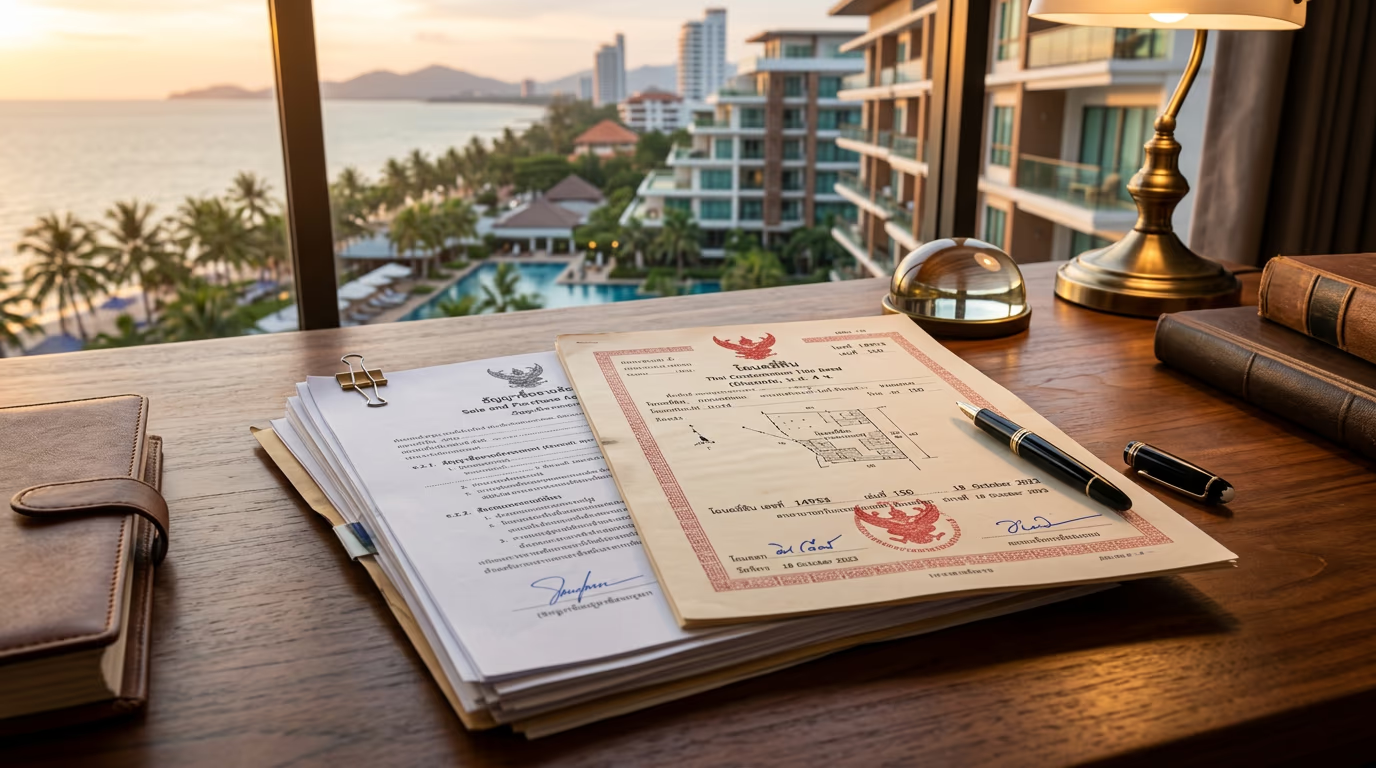
Thailand condo due diligence: the 12 checks that protect foreign buyers
Full due diligence on a Thai condominium purchase takes 5 to 15 business days, costs 25,000 to 60,000 THB in lawyer fees, and covers 12 specific items — title deed, foreign quota, EIA, building permit and condominium license, developer corporate records, encumbrances on the unit, juristic person bylaws, common area maintenance arrears, sinking fund balance, planned major maintenance, construction quality for completed units, and contract legal review. Skipping any single item creates a specific failure mode. Skipping the whole process is how foreign buyers in Thailand lose the majority of their deposit in deals that looked safe on the marketing brochure.
This guide sets out each of the 12 checks: what it verifies, the authority that holds the source document, the typical issues that surface, and the cost. The framework sits on the Condominium Act B.E. 2522 (1979, amended 2008), the Land Code B.E. 2497 (1954), the Building Control Act B.E. 2522, the Enhancement and Conservation of National Environmental Quality Act B.E. 2535 (1992), and Revenue Code provisions on condo transfer taxes. Procedure is drawn from the Thailand Land Department (Department of Lands), the Department of Business Development, and practitioner guidance from Tilleke & Gibbins, Siam Legal, and Forbes & Partners.
Due diligence is the cheapest insurance in a Thai condo purchase. A 40,000 THB lawyer fee on a 7 million THB unit is 0.6% of the deal. The issues it catches — undisclosed liens, foreign-quota miscounting, unregistered encumbrances, juristic person arrears, permit defects — routinely cost 200,000 THB and upwards to unwind. For off-plan purchases, pair this checklist with the off-plan condos guide. For the foreign ownership framework, see the foreign quota rule.
- 1
Day 1-2 — Document request
Lawyer requests title deed copy, foreign-quota certificate, juristic person bylaws, CAM arrears statement, and developer DBD extract.
Typical duration: 1-2 days
- 2
Day 2-5 — Land Department verification
Title authenticity, encumbrance search, foreign-quota confirmation at the provincial Land Department.
Typical duration: 1-3 days
- 3
Day 3-7 — Permits & EIA
Building permit, Or. Chor. 2 condominium license, EIA approval status via ONEP for 80+ unit projects.
Typical duration: 2-4 days
- 4
Day 5-10 — Juristic person diligence
Bylaws review, CAM arrears, sinking fund balance, planned major maintenance, AGM minutes.
Typical duration: 2-5 days
- 5
Day 8-15 — Construction & contract
Physical inspection for completed units, contract legal review before signing.
Typical duration: 2-5 days
Item 1 — Title deed verification at the Land Department
Verify the title deed (chanote, land title deed form NS4) at the Land Department office with jurisdiction over the land plot. A condominium unit’s ownership derives from the land’s master title deed plus the Or. Chor. 2 condominium license issued against that deed. Both must exist and both must be clean.
The buyer’s Thai lawyer applies for a certified copy of the current land title deed and the condominium’s master title, cross-checks the document presented by the developer or seller against the Land Department’s certified copy, and flags any discrepancy. The chanote (NS4 Jor.) is the highest grade of Thai title deed and the only grade appropriate for condominium development. Lower grades (NS3, NS3K, SK1, Sor Por Kor) cannot carry a registrable condominium.
Recorded encumbrances on the master land title appear on the reverse of the chanote and include mortgages, leases, servitudes, and usufructs. Each needs a clean explanation. A mortgage against the developer company is normal during construction and typically released at handover; a mortgage that persists past handover blocks foreign transfer. Verification cost: 1,000-3,000 THB in Land Department fees plus lawyer time.
Item 2 — Foreign quota verification
Request a written confirmation of current foreign quota usage from the juristic person and, for new or off-plan projects, from the developer, and verify at the Land Department on the transfer date. The Condominium Act Section 19 bis limits foreign freehold ownership to 49% of the building’s total saleable floor area. The Land Department calculates compliance at every transfer and refuses registration that breaches the cap.
A proper foreign-quota check covers three sources. First, the juristic person’s registry of unit ownerships, which should show current foreign vs Thai allocation by unit and by sqm. Second, the developer’s sales records for off-plan or newly-launched projects where units have been sold but not yet transferred. Third, the Land Department’s running calculation at the transfer desk on the day of transfer.
A unit sold to a foreign buyer outside the quota is not registrable. The buyer’s options shrink to a 30-year registered leasehold (legally different from freehold, with its own risks), waiting for Thai-quota space to open (which may never happen), or walking away and recovering the deposit through dispute. See foreign quota 49% rule for the full mechanics.
Item 3 — EIA approval status
Request the EIA approval letter from the developer and verify with the Office of Natural Resources and Environmental Policy and Planning (ONEP). Condominium projects of 80 or more units, 4,000 sqm or more of usable floor area, or 30 metres or more in height require EIA approval before construction under the Enhancement and Conservation of National Environmental Quality Act B.E. 2535 (1992).
For a completed building, the EIA should be on file and the approved design should match what was built. Material deviations between the approved EIA and the delivered building are a red flag that can trigger regulatory action against the developer and, in extreme cases, restrictions on the building’s operating status.
For an off-plan or under-construction project, EIA approval should be in place before construction begins. A project marketing pre-sales without EIA approval is carrying risk that the final design will change during ONEP review, potentially altering the unit mix, building height, or amenity provision. The practical effect: the unit a buyer thinks they reserved may not be the unit delivered.
Item 4 — Building permit and Or. Chor. 2 condominium license
Verify the building permit (issued by the local Tessaban or Or. Bor. Tor. under the Building Control Act B.E. 2522) and the Or. Chor. 2 condominium license (issued by the Land Department under Sections 6-7 of the Condominium Act). The first authorises construction; the second authorises registration of individual units as condominium freehold property transferable to foreign and Thai buyers.
A completed building without Or. Chor. 2 is not a condominium. No unit in it can be registered in a foreign name at the Land Department. Buyers occasionally encounter projects where the building is physically complete but Or. Chor. 2 has been delayed — most commonly because the final construction deviates from the permit or the EIA, or because required common-area improvements have not been completed. Until the license issues, the building operates as rental or hotel space, not as a condominium.
For off-plan purchases, Or. Chor. 2 is issued late in the project. The risk is that it is not issued at all. A developer with a history of consistent Or. Chor. 2 issuance across prior projects is a meaningfully different risk from a first-time developer.
Item 5 — Developer company DBD records
Pull the developer’s corporate record from the Department of Business Development (DBD) public registry at datawarehouse.dbd.go.th. The record shows the company’s registered capital, paid-in capital, registered address, director list, and audited annual financial statements where filed.
The checks that matter to a foreign buyer: Is the named developer in the sale and purchase agreement the same entity on the DBD record? Is the registered capital proportionate to the project’s total value (a 2 billion THB project run through a special purpose vehicle with 1 million THB paid-in capital is a thin capital structure)? Have annual financial statements been filed for the last three years? Are there any insolvency or receivership filings? Are the directors the same as those named in the marketing materials, or is there a disconnect between the marketing brand and the actual corporate vehicle?
A common pattern in Thai condo development is for each project to sit in its own single-purpose company. This is legal and ordinary. The risk is that single-purpose companies with no other assets cannot compensate defaulting buyers if the project fails. That risk is priced in the discount, but only if the buyer knows it exists.
Item 6 — Encumbrances and liens on the unit
For resale purchases, the buyer’s lawyer applies to the Land Department for a certified copy of the condominium unit title deed (the unit chanote) and reviews the encumbrance record. Recorded encumbrances include mortgages, registered leases, usufructs, and any other interest that runs with the title.
A mortgage on the unit must be released before or concurrent with transfer to the buyer. The standard procedure is for the seller’s bank to release the mortgage on receipt of cleared funds at the Land Department on the transfer date. Registered leases granted by the current owner to third parties survive the sale unless cancelled before transfer. Usufructs similarly survive and grant the usufructuary possession rights.
For off-plan units, the master land title deed may carry a mortgage securing the developer’s construction loan. This is normal. The buyer’s lawyer confirms that the developer will procure release of the mortgage on the specific unit at handover. Without that release, the unit cannot be transferred free of the bank’s interest.
Item 7 — Juristic person bylaws
Request the current juristic person bylaws (condominium regulations) and the most recent AGM minutes. The bylaws are the internal law of the building: how common areas are used, who can live in the building, which pets are allowed, what commercial activities are permitted, what modifications an owner can make to their unit, and critically for many foreign buyers, whether short-term (daily or weekly) rental is permitted.
Short-term rental restrictions matter because Thailand’s Hotel Act B.E. 2547 (2004) regulates rentals below 30 days and, separately, many juristic persons ban short-lets in their bylaws. A buyer relying on daily Airbnb-style rental as the investment case must verify the building’s bylaws explicitly. The Airbnb Thailand legal guide covers the national framework; the juristic person’s bylaws can be more restrictive than the national law.
AGM minutes from the last 2-3 years show how the building operates: what financial decisions have been made, what the current manager and committee composition is, what disputes have been raised, and what capital projects have been budgeted. A building with a history of contested AGMs, manager turnover, or capex disputes is materially riskier than a well-run building.
Item 8 — CAM fee arrears on the unit
Request a statement of common area maintenance (CAM) fee payment status from the juristic person for the specific unit. Under Section 18 bis of the Condominium Act, CAM fees are an obligation of unit ownership. Arrears attach to the unit and in most buildings must be paid before the Land Department will process a transfer.
A seller behind on CAM is a signal. The seller may be in financial distress, may dispute a juristic person charge, or may simply be disengaged. In each case, the arrears must be settled at or before transfer. The standard procedure is to deduct outstanding CAM from the seller’s proceeds at the Land Department on the transfer date and pay directly to the juristic person.
For off-plan units, CAM has not yet been charged and this item is not applicable. The buyer should, however, verify the current or projected CAM rate (typically 30 to 150 THB per sqm per month) so the total annual holding cost is modelled realistically. See condo costs Thailand and sinking fund Thailand for the full cost structure.
Item 9 — Sinking fund balance at building level
Request the juristic person’s financial statements showing current sinking fund balance and recent year capital expenditure. The sinking fund is the building’s long-term reserve for major capital works under Section 40 bis of the Condominium Act. It is funded by a one-time contribution from each new unit owner at first handover, typically 500 to 1,000 THB per sqm, and is intended to cover large, irregular expenses — roof replacement, elevator overhaul, facade works, pool and plumbing major maintenance — that fall outside the monthly CAM operating budget.
A building with a depleted sinking fund is a building where large capex decisions have been deferred, paid for through special assessments on current owners, or both. A sinking fund balance that has been repeatedly drawn down to fund routine operations (where CAM is insufficient) indicates management failure and usually precedes a CAM increase or a special assessment. The financial statements should show the sinking fund as a distinct line item with its own ledger, separate from the operating account. See sinking fund vs maintenance fee for the legal distinction.
Item 10 — Planned major maintenance
Ask the juristic person manager and the committee chair what major capital projects are budgeted or planned in the next 3-5 years. Thai condominiums typically need elevator overhauls every 15-20 years, facade and waterproofing works every 10-15 years, pool resurfacing every 7-10 years, and roof works every 15-25 years. Older buildings near the end of a major-maintenance cycle carry a near-term special assessment risk.
The question is simple and the answer is informative. A well-run building has a forward capex plan with dated projects and funding allocations. A badly-run building has no plan and will fund emergencies through special assessments as they arise. A new building has no capex history but should have a budget projection from the developer and from the initial juristic person manager.
For older buildings, cross-check the committee’s answer against visible building condition: lobby, lift cabs, corridors, pool deck, gym equipment, landscaping, and parking structure. Visible wear without corresponding capex plan is a leading indicator of a surprise assessment.
Item 11 — Construction quality inspection (completed units)
For resale and completed off-plan units, commission an independent building inspection before transfer. A qualified Thai building inspector or a firm like CBRE’s technical services team will check the unit for structural issues, water ingress, electrical compliance, plumbing pressure and drainage, HVAC function, tile and flooring defects, and common-area defects adjacent to the unit.
Typical inspection cost: 10,000-25,000 THB for a standard unit. For a larger unit or a unit in a problem-prone building, the cost can reach 40,000-60,000 THB for a more thorough engineering review. The output is a written report identifying defects and remediation recommendations. Material defects can be remediated before transfer, credited against the purchase price, or treated as a walk trigger.
For off-plan purchases, this inspection happens on handover. The buyer’s SPA should include a punch list right — the buyer physically inspects the unit, lists defects, and requires the developer to remediate them before final payment. Developers typically allow 30-90 days for punch-list completion. Missed punch-list items become the buyer’s problem after title transfers.
Item 12 — Contract legal review before signing
Engage an independent Thai-qualified real estate lawyer to review the sale and purchase agreement before signing. For off-plan contracts, the review confirms compliance with the 2015 OCPB standard form, identifies any developer-added clauses that undercut the consumer-protective baseline, and negotiates specific protective terms — foreign-quota confirmation, delivery-slippage rescission right, material-change cap, refund-plus-interest remedy on default.
For resale, the review confirms the seller’s clean title, identifies any encumbrances that must be discharged pre-transfer, checks the transfer tax allocation between buyer and seller (conventionally 50/50 on transfer fee; specific business tax and stamp duty on the seller; withholding on the seller), and validates the flow of funds at the Land Department.
Fee ranges by firm, complexity, and deal size. Siam Legal’s typical off-plan review runs 30,000-50,000 THB. Tilleke & Gibbins and other larger firms run higher for complex or higher-value deals. Forbes & Partners and other boutique firms cover the mid-market. Choose a firm not introduced by the developer or the selling agent — a firm introduced by the counterparty has a conflict of interest, even if the individual lawyer is capable.
Cost and timeline for full due diligence
Full due diligence on a typical Thai condo purchase takes 5 to 15 business days and costs 25,000 to 60,000 THB in professional fees, excluding any building inspection or translation work. The timeline extends for complex deals: off-plan with incomplete permit documentation, resale where the seller is overseas or cannot produce title documents quickly, or buildings with litigated juristic person disputes that require deeper review.
Cost breakdown (indicative):
- Lawyer due diligence and contract review: 25,000-50,000 THB
- Land Department document retrieval fees: 1,000-3,000 THB
- DBD corporate search: 500-1,500 THB
- Independent building inspection (if commissioned): 10,000-25,000 THB
- Certified translation of key documents: 2,000-8,000 THB depending on volume
For a 5 million THB unit purchase, the fully-loaded due diligence budget sits at roughly 40,000-80,000 THB, or 0.8-1.6% of the deal. That spend routinely catches 200,000-2,000,000 THB of risk: undisclosed liens, foreign-quota misallocations, CAM arrears, defective permits, and SPA clauses that would let the developer retain funds without remedy. Relative to the exposure, the due diligence cost is the cheapest component of the purchase budget.
Combine with the cost calculator to model the full acquisition cost including transfer fees, specific business tax or stamp duty, withholding, and sinking fund contribution at handover. See transfer fees and taxes for the statutory rates.
Due diligence FAQ
How long does a full condo due diligence take in Thailand?
Five to 15 business days for a standard transaction. Longer (20-40 business days) for off-plan with incomplete permit documentation, for higher-value deals, or where the seller is overseas and document retrieval takes longer. The lawyer’s workstream runs in parallel with the developer’s or seller’s document production.
What does due diligence cost?
Typical range: 25,000 to 60,000 THB in lawyer fees for a standard purchase. Larger or more complex deals run higher — 80,000-150,000 THB for off-plan branded-residence transactions or for deals with multi-jurisdictional structuring. Budget roughly 0.5-1.5% of the purchase price for due diligence across all workstreams (legal, inspection, translation).
Can I do the due diligence myself without a lawyer?
Parts of it — pulling the DBD record, reviewing marketing materials, running portal cross-checks. But the three highest-value items (Land Department title verification, SPA legal review, foreign quota confirmation) require Thai legal qualification and Thai-language document handling. Self-serve due diligence on a 5 million THB transaction is not a prudent trade-off.
Which Thai law firms do foreign buyers use?
Named firms visible on international-buyer transactions include Tilleke & Gibbins, Siam Legal International, Forbes & Partners, DFDL (Thailand), Baker McKenzie (Thailand), Mahanakorn Partners, and numerous smaller practices specialised in Pattaya or Phuket. The correct choice depends on deal size, location, and language needs. Avoid firms introduced by the selling counterparty.
What happens if the due diligence finds a problem?
Standard options: fix the problem before transfer (seller discharges the lien, juristic person confirms quota, developer cures a permit defect), adjust the purchase price to reflect the remediation cost, include a protective clause in the SPA that transfers the risk back to the seller or developer, or walk away and recover the deposit. Walking away is often the correct choice and should not be treated as a failure — the due diligence worked.
Is escrow part of due diligence?
Escrow is a risk-mitigation tool separate from due diligence. Thai law does not mandate escrow for condo pre-sales (Escrow Business Act B.E. 2551 (2008) provides a voluntary framework). Due diligence identifies whether escrow is appropriate for a specific deal and negotiates its inclusion in the SPA where it is.
Can I walk away after paying the booking fee?
In most Thai off-plan standard practice, yes — the booking fee is usually non-refundable if the buyer withdraws, but no further liability attaches before signing the reservation agreement or SPA. The reservation agreement is the first binding instrument. After that, the buyer’s ability to walk depends on the specific default and rescission clauses.
Does due diligence cover rental income projections?
Legal due diligence does not. Commercial due diligence — realistic rental comparables, occupancy assumptions, operating cost estimates — sits separately. Use the rental yield Thailand guide and the yield calculator for this workstream. A seller or developer projection should never be accepted without independent comparables.
What if the seller refuses to provide documents?
A seller refusing to produce title documents, encumbrance history, juristic person letters, or CAM statements is providing the answer. Walk. A clean seller has nothing to withhold.
References
Sources
- 01Thailand Land Department (Department of Lands), title deed and condominium transfer procedures · https://www.dol.go.th/Thailand Land Department procedures for title deed verification and condominium unit transfer. Accessed 2026-04-16.
- 02Condominium Act B.E. 2522 (1979), Section 19 bis, amended by Condominium Act (No. 4) B.E. 2551 (2008)Condominium Act foreign freehold quota of 49% of saleable floor area per building. Accessed 2026-04-16.
- 03Department of Business Development (DBD), Ministry of Commerce, data warehouse · https://datawarehouse.dbd.go.th/Department of Business Development public registry of Thai juristic persons with company capital, directors, and filings. Accessed 2026-04-16.
- 04Office of Natural Resources and Environmental Policy and Planning (ONEP), EIA Notification under the Enhancement and Conservation of National Environmental Quality Act B.E. 2535 (1992) · https://www.onep.go.th/Environmental Impact Assessment required for condominiums of 80 units or more or 4,000 sqm usable area. Accessed 2026-04-16.
- 05Building Control Act B.E. 2522 (1979), as amendedBuilding Control Act governs building permits issued by local municipal authorities. Accessed 2026-04-16.
- 06Condominium Act B.E. 2522 (1979), Sections 17, 36-38, 40 bis, 48, and 48 bisCondominium juristic person structure, committee, and AGM procedure. Accessed 2026-04-16.
- 07Tilleke & Gibbins, Thailand Real Estate Legal Briefings 2024-2026 · https://www.tilleke.com/insights/Tilleke & Gibbins briefings on Thailand property due diligence, contract review, and encumbrance checks. Accessed 2026-04-16.
- 08Siam Legal International, Thailand Real Estate Resources · https://www.siam-legal.com/realestate/Siam Legal International practical guides on Thai condo due diligence and lawyer fee ranges. Accessed 2026-04-16.
- 09Bank of Thailand, foreign exchange regulations · https://www.bot.or.th/FET (Foreign Exchange Transaction) form requirement for foreign-currency remittance into a Thai condo purchase. Accessed 2026-04-16.
- 10Revenue Code of Thailand, Sections 91/2 (SBT) and Stamp Duty Schedule · https://www.rd.go.th/english/Thai Revenue Code applicable to transfer tax, specific business tax, stamp duty, and withholding on condo transfers. Accessed 2026-04-16.
- 11CBRE Thailand Real Estate Market Outlook 2026 · https://www.cbre.co.th/insights/reports/thailand-real-estate-market-outlook-2026CBRE Thailand practitioner guidance on condominium building inspection and construction quality review. Accessed 2026-04-16.
Published · How we research and date our content