Condo Hua Hin 2026: Foreign Buyer's Market Guide
Buy a condo in Hua Hin 2026: Central Hua Hin, Khao Takiab, and Cha-Am prices, 4.5 to 6.5 percent yields, retiree market reality, and honest buying trade-offs.
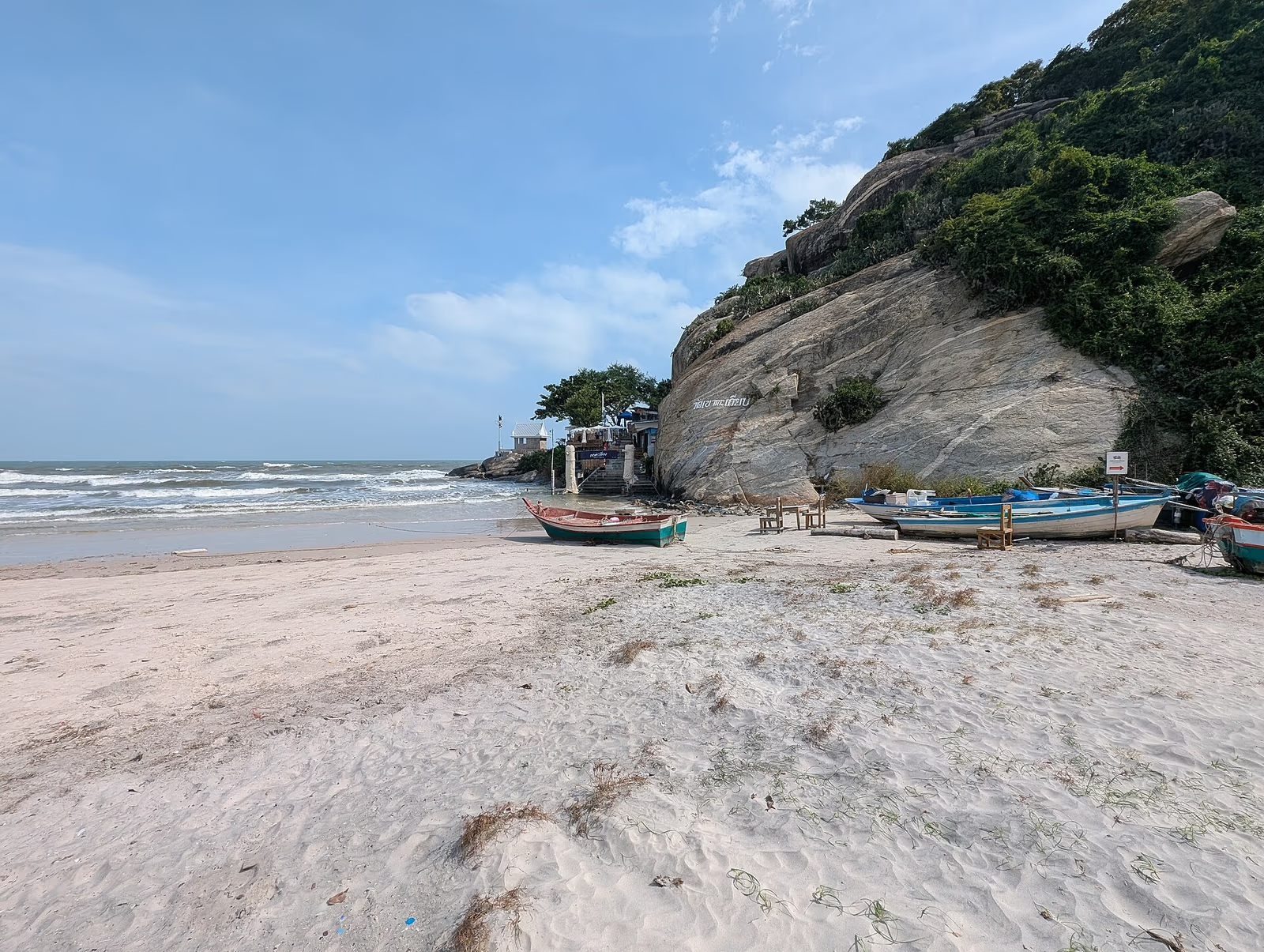
Hua Hin is Thailand’s mature royal-coast resort market, 200 km south of Bangkok, defined by European and UK retiree demand, golf-course density among the highest in Southeast Asia, and a calmer risk profile than Pattaya (Colliers Thailand 2026; CBRE Thailand 2026). Foreign ownership is permitted under freehold title up to the 49% building cap set by the Condominium Act B.E. 2522 (Condominium Act 1979, amended 2008). Per-sqm pricing in 2026 runs 70,000 to 160,000 baht across the three main foreign-buyer corridors (Central Hua Hin, Khao Takiab, Cha-Am), with gross rental yields 4.5 to 6.5% on long-term leases.
Hua Hin foreign condo market in 2026
Hua Hin is Thailand’s longest-established resort condo market for European buyers. Cushman & Wakefield and Knight Frank Thailand describe 2026 as a constrained-supply year marked by branded-residence launches and resilient retiree demand (Cushman & Wakefield Thailand 2026; Knight Frank Thailand 2026). New condominium supply has settled below 1,500 units per year across Hua Hin and Cha-Am combined, well under the 2016-2018 peak, which is price-supportive in the premium beachfront segment.
Thailand recorded 14,899 foreign condo transfers nationally in 2025 with a combined value of 60.92 billion baht (Thailand REIC, March 2026). Prachuap Khiri Khan province (which contains Hua Hin) plus Phetchaburi (Cha-Am) account for roughly 4 to 6% of national foreign transfer volume. The city attracts a disproportionate share of Scandinavian, German, UK, and Swiss long-hold buyers relative to its transfer-count ranking.
The dominant buyer is the 55+ European or UK retiree on a Non-Immigrant O-A visa or LTR-Wealthy Pensioner route. Secondary cohorts are Bangkok-based Thai weekenders (the two-hour drive supports a mixed weekend-resident demographic) and Chinese long-stay holders who prefer Hua Hin’s quieter profile over Pattaya. Russian volume is materially lower than in Pattaya or Phuket.
Infrastructure supports the retiree ecosystem: royal-initiative developments around Klai Kangwon Palace, Hua Hin Airport (regional connections to Bangkok, Singapore, and select Chinese cities), and more than 10 championship golf courses across greater Hua Hin and Cha-Am (Tourism Authority of Thailand, 2025). For purchase mechanics, see the foreigner buying guide.
The 3 Hua Hin areas at a glance
Hua Hin’s foreign-buyer condo market concentrates in three areas: Central Hua Hin around the main beach and town grid, Khao Takiab to the south with its signature headland and quieter beachfront, and Cha-Am to the north as the value-entry alternative. The table below uses Q1 2026 median per-sqm pricing compiled from Hipflat, FazWaz, Thailand-Property, and direct developer price sheets.
| Area | Per-sqm range (THB) | Gross yield | Beach distance | Best for |
|---|---|---|---|---|
| Central Hua Hin | 90,000 – 160,000 | 4.5 – 6.0% | 0 – 800 m | Walkable retiree living, resale liquidity, golf access |
| Khao Takiab | 80,000 – 140,000 | 5.0 – 6.5% | 0 – 600 m | Quieter beachfront, sea view, lower-density projects |
| Cha-Am | 70,000 – 120,000 | 5.5 – 6.5% | 0 – 1.0 km | Value entry, long-stay rental yield, short Bangkok commute |
Central Hua Hin’s ceiling (160,000 baht per sqm) runs 2.3x Cha-Am’s floor (70,000 baht per sqm), a narrower spread than Pattaya’s Wongamat-to-Naklua gap but wider than Chiang Mai’s intra-city range. Cha-Am in particular delivers the strongest yield-on-price ratio in the greater Hua Hin market.
Central Hua Hin: the walkable town core
Central Hua Hin runs from the railway station south along Phetkasem Road to the fishing pier and north toward Cicada Market, combining walkable retail density, proximity to the royal compound, and a cluster of older established beachfront buildings. Active developers include Sansiri (Baan San Ploen line, The Base Hua Hin), LPN, Raimon Land, and Boathouse.
Q1 2026 per-sqm pricing runs 90,000 to 160,000 baht. Entry one-bedrooms in newer inland stock start near 3.5 to 4.5 million baht; beachfront new-build sits 6 to 12 million baht. Gross long-term yields 4.5 to 6.0%. Seasonal short-stay (November through February) drives yield upside; structured 60-day-plus programs report gross yields 7 to 8% in well-located stock. Foreign quota availability is mixed: older beachfront stock (completed 2010-2016) is often at or near 49%; new inland mid-rise typically retains open quota.
Khao Takiab: the south headland
Khao Takiab (“Chopstick Hill”) sits 4 km south of Central Hua Hin. The area is defined by the headland itself, a longer uninterrupted beach stretch, and lower building density. Boathouse Hua Hin and several branded residences sit in this corridor, alongside Hyatt-branded residential activity flagged by Cushman & Wakefield 2026.
Q1 2026 per-sqm pricing 80,000 to 140,000 baht. Entry two-bedroom inventory from 4.5 million baht inland; beachfront 7 to 15 million baht. Gross yields 5.0 to 6.5%, higher than Central Hua Hin because short-stay demand is stronger in the beach-view sub-segment. Foreign quota is typically open in new-build.
Cha-Am: the value entry
Cha-Am sits 25 km north of Hua Hin in Phetchaburi province, functionally the northern extension of the market. The foreign-buyer share has grown through the 2020s as price gaps widened versus Central Hua Hin. The area offers the lowest entry to the greater Hua Hin market with a 20-minute drive to Central Hua Hin amenities.
Q1 2026 per-sqm pricing 70,000 to 120,000 baht. Entry studios and compact one-bedrooms from 1.8 to 2.5 million baht; two-bedroom inventory 3.5 to 5.5 million baht. Gross long-term yields 5.5 to 6.5%, the strongest profile in the greater Hua Hin market, driven by steady long-stay retiree tenancies. Foreign quota is widely open.
How foreign ownership quota works in Hua Hin buildings
Foreigners may own up to 49% of the total saleable floor area of any Hua Hin or Cha-Am condominium building under Section 19 bis of the Condominium Act B.E. 2522 (amended 2008). The quota caps square metres of saleable area, not unit count. Once foreign owners collectively hold 49%, additional units can only register in Thai-national names under freehold.
Three practical realities for Hua Hin specifically:
- Central Hua Hin beachfront stock from 2010-2016 is the main quota trap. Several established beachfront buildings along the main bay sold heavily to Scandinavian and German buyers during the 2013-2017 demand wave. These projects sit at or near 49% today; remaining units sold to foreigners are usually re-sales or leasehold conversions.
- New inland mid-rise and Cha-Am stock retain wide foreign quota. Buyers targeting new-build freehold with open quota find the cleanest availability in inland Central Hua Hin launches, Khao Takiab branded-residence product, and Cha-Am broadly.
- The foreign quota letter is standard and free. Request it from the juristic person before depositing funds. Sansiri, LPN, Raimon Land, and Boathouse produce the letter reliably; smaller developers should also comply within 48 hours. Any stall beyond that is a red flag.
Broader quota mechanics are covered in the 49% foreign quota rule guide.
Hua Hin vs Pattaya vs Bangkok for foreign buyers
Hua Hin is Thailand’s calmest mainstream foreign market by volatility: lower yields than Pattaya, softer capital growth than Bangkok CBD, but the most stable pricing and the most predictable retiree-driven rental pool of any coastal market.
| Metric | Hua Hin | Pattaya | Bangkok CBD |
|---|---|---|---|
| Median foreign-unit price (2026) | 3.5 – 5.5M THB | 3.5 – 5.0M THB | 6.0 – 8.5M THB |
| Median per-sqm (2026) | 70,000 – 160,000 THB | 70,000 – 130,000 THB | 160,000 – 280,000 THB |
| Gross rental yield | 4.5 – 6.5% | 6.0 – 8.0% | 4.5 – 6.1% |
| Dominant buyer | UK / Scandinavian / German retiree, Bangkok weekender | Retiree, yield investor, Russian relocation | Expat professional, Chinese investor |
| Rental pattern | Long-stay retiree + seasonal | Mixed short/long | Year-round expat lease |
| Volatility | Low | Medium-high | Medium |
Sources: Thailand REIC 2025; Global Property Guide Q3 2025; CBRE Thailand 2026; Colliers Thailand Resort Residential 2026; Knight Frank Thailand 2026.
For retiree-profile buyers on a 10-year-plus horizon, Hua Hin’s lower volatility is typically worth the yield discount. For yield-maximising investors on a 5 to 7 year horizon, Pattaya generally prices better. For the full cost stack, see the Thailand condo costs guide.
Hua Hin regulatory and market shifts to know in 2026
Three developments are shaping the 2026 Hua Hin environment: a branded-residence supply wave flagged by Cushman & Wakefield, the dual-track rail upgrade reducing the Bangkok commute, and continued narrow overall new-supply pressure.
Cushman & Wakefield Thailand’s Q1 2026 outlook identifies Hua Hin among resort markets absorbing branded-residence launches, including Hyatt-affiliated product in the Khao Takiab corridor. Branded stock sits 30 to 50% above comparable non-branded projects on a per-sqm basis; buyers should underwrite the premium against realistic resale timelines of 18 to 30 months.
The Southern Line dual-track upgrade continues through 2026 with incremental speed improvements. Full completion is forecast for 2027-2028, cutting the Bangkok-Hua Hin journey to roughly 2.5 hours. The more meaningful impact falls on Cha-Am weekend-resident demand.
Knight Frank Thailand notes Hua Hin and Cha-Am absorb fewer than 1,500 new condominium units per year combined, well under 2016-2018 peak. The constraint supports list pricing in the beachfront segment and prevents the oversupply dynamic pressuring parts of Jomtien Pattaya and southern Phuket resale.
Hua Hin’s notable developers and projects
The active developer base includes national brands (Sansiri, LPN, Raimon Land) alongside resort specialists (Boathouse) and branded-residence operators (Hyatt-affiliated). The following are notable for scale, foreign-buyer relevance, and track record.
- Sansiri, with the Baan San Ploen beachfront line and The Base Hua Hin inland mid-rise. Reliable foreign-quota compliance.
- LPN (Lumpini Property Development), Lumpini Park Beach Hua Hin and Lumpini Cha-Am product for the mid-market entry point. Large block structures, open foreign quota on most new launches.
- Raimon Land, premium beachfront activity including Zire and adjacent branded product. Targets capital-preservation buyers rather than yield.
- Boathouse Hua Hin, boutique beachfront operator with smaller-scale premium projects in Khao Takiab and south-central Hua Hin.
- Hyatt-branded residences, part of the branded-residence expansion flagged by Cushman & Wakefield 2026.
- Charn Issara (Issara Residences Hua Hin), established developer with resort-adjacent product in Central Hua Hin.
Sources: Thailand-Property Hua Hin listings (accessed April 2026); Hipflat developer pages; FazWaz Hua Hin inventory; direct developer price sheets Q1 2026; Colliers Thailand 2026 reporting.
Who Hua Hin suits as a foreign buyer
Hua Hin’s foreign-buyer base splits into three profiles that actually close purchases: European and UK retirees on long-hold horizons, Bangkok-based weekenders buying a secondary residence, and holiday-home buyers prioritising low-key resort living.
- Retirees on Non-Immigrant O-A or LTR-Wealthy Pensioner visas. Typical spend 3.5 to 8.0 million baht for a one- or two-bedroom in Central Hua Hin, Khao Takiab, or Cha-Am. Priority: proximity to Bangkok International Hospital Hua Hin or San Paulo Hospital, walkable retail, quiet at night, reliable long-term rental market if hold strategy shifts. Hold horizon 10 years plus.
- Bangkok weekenders. Typical spend 4.0 to 10.0 million baht for a two-bedroom beachfront or sea-view unit. Priority: drive time under 2.5 hours, secure compound, golf or beach-club access. Hold horizon variable; often long-term with occasional seasonal rental through networks rather than open listing.
- Holiday-home foreign buyers. Typical spend 5.0 to 15.0 million baht for branded-residence or premium beachfront. Concentrated in Khao Takiab and central beachfront. Priority: personal use 6 to 12 weeks a year, seasonal rental cover during absence. Not optimising for yield.
Hua Hin does not suit buyers seeking Pattaya-level yields, Bangkok-style urban amenity density, or Phuket-style short-stay tourism exposure. The retiree-weighted market structure trades those three variables for stability.
References
Sources
- 01Thailand Real Estate Information Center (REIC) / Thailand Land Department, reported by Nation Thailand, March 2026 · https://www.nationthailand.com/business/property/4006505314,899 foreign condo transfers registered in Thailand in 2025, up 2.2% year on year, total value 60.92 billion baht. Accessed 2026-04-16.
- 02Condominium Act B.E. 2522 (1979), Section 19 bis, amended by the Condominium Act (No. 4) B.E. 2551 (2008)Condominium Act B.E. 2522 (1979) limits foreign ownership of any condominium to 49% of total saleable floor area, amended 2008. Accessed 2026-04-16.
- 03Colliers Thailand Resort Residential Market Report 2026 · https://www.colliers.com/en-th/researchHua Hin and Cha-Am resort residential market characterised by European and UK retiree demand, with Colliers Thailand noting stable price performance against Bangkok and eastern seaboard volatility. Accessed 2026-04-16.
- 04CBRE Thailand Market Outlook 2026 · https://www.cbre.co.th/insights/reports/thailand-market-outlook-2026CBRE Thailand 2026 outlook classifies Hua Hin among resort markets with steady domestic and secondary-foreign demand, distinct from the higher-volatility Pattaya and Phuket cycles. Accessed 2026-04-16.
- 05Knight Frank Thailand Residential Market Review 2026 · https://www.knightfrank.co.th/researchKnight Frank Thailand 2026 review places Hua Hin's condominium new-supply pipeline below 1,500 units per year, well below peak 2016-2018 levels. Accessed 2026-04-16.
- 06Cushman & Wakefield Thailand Market Outlook Q1 2026 · https://www.cushmanwakefield.com/en/thailandCushman & Wakefield Thailand Q1 2026 outlook anticipates limited new launches nationwide with branded-residence activity concentrated in resort markets including Hua Hin. Accessed 2026-04-16.
- 07Global Property Guide, Thailand Rental Yields Q3 2025 · https://www.globalpropertyguide.com/asia/thailand/rental-yieldsGlobal Property Guide Q3 2025 records Thailand gross residential yields averaging 6.05% in Bangkok and higher in secondary resort markets including Hua Hin. Accessed 2026-04-16.
- 08Hotel Act B.E. 2547 (2004), Ministry of Interior ThailandHotel Act B.E. 2547 (2004) bars nightly condominium rental below 30 days without a hotel operating licence. Accessed 2026-04-16.
- 09Tourism Authority of Thailand, Hua Hin and Cha-Am visitor infrastructure profile 2025 · https://www.tourismthailand.org/Hua Hin hosts over 10 championship-level golf courses within the greater Hua Hin and Cha-Am area, among the highest per-capita golf course densities in Southeast Asia. Accessed 2026-04-16.
Published · How we research and date our content