How to Buy a Condo in Thailand as a Foreigner (2026 Guide)
The complete 2026 guide to buying a condo in Thailand as a foreigner. Legal rules, 12-step process, FET form, due diligence, full cost breakdown, timelines.
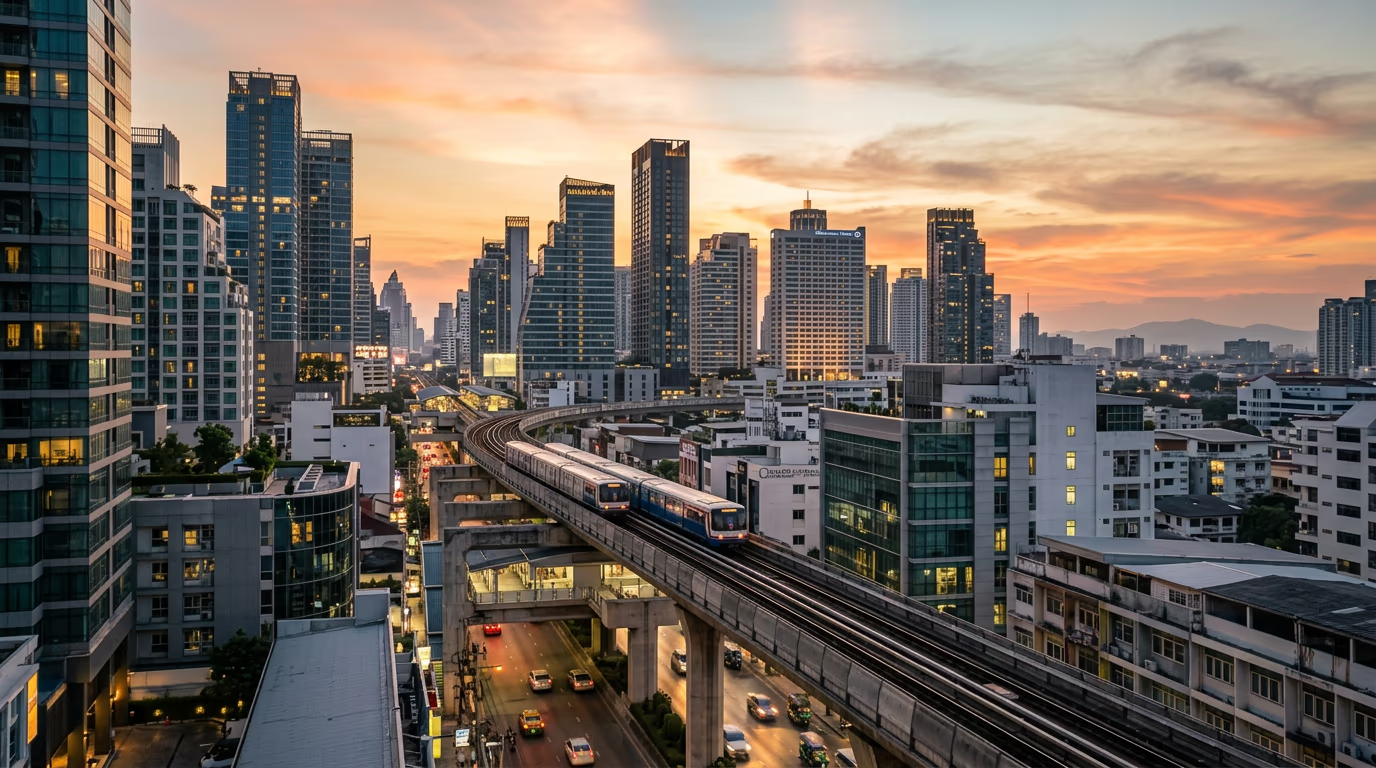
Yes, foreigners can legally buy condominium units in Thailand as freehold property, provided the building’s foreign ownership stays at or below 49% of its total saleable area and the purchase funds are remitted from abroad in foreign currency. This is the only form of direct real estate ownership available to non-Thais — land ownership remains closed under the Land Code Act B.E. 2497 (1954). The legal framework is the Condominium Act B.E. 2522 (1979), amended by Act (No. 4) B.E. 2551 (2008). In 2025, the Thailand Land Department registered 14,899 foreign condominium transfers nationwide, with Chonburi province (Pattaya) accounting for roughly a third of the volume, according to the Thailand Real Estate Information Center.
This guide walks through the full process end to end: the legal framework, the 12-step buying procedure with typical timings, the documents you need, the due diligence required, total costs on a worked example, the Foreign Exchange Transaction form mechanics, and the mistakes that cost foreign buyers money.
Can foreigners buy a condo in Thailand?
Yes. Non-Thai citizens can own condominium units outright as freehold property under Section 19 of the Condominium Act, subject to the 49% foreign quota rule and the foreign-currency funds requirement. No visa, work permit, or residency is required to own. You can buy on a tourist entry or fly in specifically for the transfer.
What foreigners cannot do:
- Own land directly (Land Code Act, Section 86).
- Own more than 49% of the aggregate saleable floor area in any single condominium building (Condominium Act, Section 19 bis).
- Register ownership using funds earned inside Thailand. Funds must originate from abroad and be remitted in foreign currency, then converted by the receiving Thai bank. This is the rule that produces the Foreign Exchange Transaction form described later.
- Hold a Thai-quota unit through a Thai company where the foreign buyer is the real controller. The Land Department screens company structures, and nominee arrangements have been actively prosecuted under Land Code Sections 96 and 113.
The practical consequence: a foreigner buying the right unit, in the right building, with funds transferred the right way, owns a Thai condominium with the same freehold title as a Thai citizen. The chanote-equivalent document for a condo unit is the Nor Sor 4 Jor (for the building’s land) combined with an Ownership Certificate (Or Chor 2) for the specific unit.
Foreign ownership rules explained
The 49% rule is the hard legal ceiling on foreign condominium ownership, measured by saleable floor area of the building, not by unit count. This is stated explicitly in Section 19 bis of the amended Condominium Act. A building with 10,000 sqm of total saleable area can sell up to 4,900 sqm to foreign buyers on freehold foreign quota. Everything beyond that must be held by Thai nationals or Thai-majority companies on Thai quota.
A deeper breakdown of quota mechanics, verification procedures, and what happens when the cap is exceeded lives in the foreign quota 49% rule guide. The short version for this page:
Foreign quota (freehold). The unit is registered in your personal name. You hold it forever, can sell to another foreign or Thai buyer, and can pass it to heirs. This is the default structure foreigners should seek.
Thai quota (freehold). The unit is reserved for Thai owners. Foreigners cannot register it in their own name. If a foreigner wants it, the only legal routes are a 30-year registered lease (renewable, but the first term is the only one guaranteed by statute) or a Thai-majority company with genuine Thai shareholders and economic substance. Nominee shareholders are illegal.
Source-of-funds rule. Under Section 19 of the Condominium Act, foreigners can register freehold ownership only if the purchase price is remitted into Thailand from abroad in foreign currency and converted to Thai baht by the receiving bank. Each inward remittance of USD 50,000 or more must be accompanied by a Foreign Exchange Transaction form issued by that bank. The Land Department will refuse registration without this evidence. The Bank of Thailand publishes the governing foreign exchange regulations under the Exchange Control Act.
The 12-step buying process (with typical timings)
From first viewing to key handover, a clean completed-unit purchase takes 30-90 days. An off-plan purchase runs from a 1-5% reservation fee to completion 18-36 months later, with staged payments. The sequence below assumes a completed unit in an existing building, which is the faster and lower-risk path for a first-time foreign buyer.
- 1
Define the buy box
City, neighborhood, unit size, budget, yield target, freehold vs leasehold.
Typical duration: Week 1
- 2
Shortlist and verify quota
5-10 buildings; confirm foreign quota availability in writing from juristic person.
Typical duration: Week 1-2
- 3
Reservation agreement
Pay 50,000-300,000 THB; unit held 14-30 days.
Typical duration: Week 2-3
- 4
Engage independent lawyer
Not the seller's or developer's. 35,000-70,000 THB typical fee.
Typical duration: Week 2-3
- 5
Legal due diligence
Title, quota, EIA, juristic person health, encumbrances.
Typical duration: Week 3-4
- 6
Sign SPA
10-25% deposit; closing date and conditions precedent locked.
Typical duration: Week 4
- 7
Remit funds & obtain FET
Foreign-currency wire; FET issued for remittances ≥USD 50,000.
Typical duration: Week 4-6
- 8
Prepare cashier's cheques
Thai-bank cheques for seller, agent, and government fees.
Typical duration: Week 6
- 9
Land Department transfer
Both parties attend; chanote reissued; keys handed over.
Typical duration: Week 6-8
- 10
Juristic person registration
Sinking fund, CAM prepayment, utilities, access cards.
Typical duration: Week 8
- 11
Utilities and insurance
MEA/PEA and water transfers; contents insurance arranged.
Typical duration: Week 8-9
- 12
Tax registration
Rental registration if letting; Land and Building Tax annual bill.
Typical duration: Week 8-12
Step 1 — Define the buy box (week 1)
Set the city, neighborhood, unit size, budget in both THB and home currency at the current rate, and target net yield if investing. Pattaya, Bangkok, and Phuket dominate foreign transactions, with regional character differences documented in the Pattaya hub, Bangkok hub, and Phuket hub. Decide now whether you need foreign quota freehold or whether a leasehold alternative is acceptable — this narrows the building list significantly.
Step 2 — Shortlist buildings and verify foreign quota (week 1-2)
Shortlist 5-10 buildings. For each, confirm three quota data points:
- Does the building currently have foreign quota available?
- Is the specific unit you want a foreign-quota unit, a Thai-quota unit, or not yet designated?
- What price premium (if any) applies to the foreign-quota unit vs the same floorplate on Thai quota?
The juristic person (the building’s management office, required under Section 35 of the Condominium Act) keeps the current quota ledger. The developer keeps the quota on primary-market units. The Land Department holds the authoritative record. For any shortlisted unit, ask for the juristic person’s written statement of remaining foreign quota and for the developer’s commitment letter stating the unit is reserved on foreign quota. Do not accept a verbal assurance.
Step 3 — Reservation and reservation agreement (week 2-3)
Once you select a unit, you sign a reservation agreement and pay a reservation fee. Typical fees:
- Resale unit: 50,000-200,000 THB, held by the agent or the seller’s lawyer.
- Off-plan primary unit: 50,000-300,000 THB paid to the developer, crediting against the first instalment.
The reservation pulls the unit off the market for 14-30 days while you complete due diligence and prepare the sale-and-purchase agreement. The reservation fee is almost always non-refundable if you walk away for non-legal reasons, and refundable only if specific contractual triggers fire (failed title search, foreign quota turns out unavailable, financing condition unmet).
Step 4 — Engage an independent lawyer (week 2-3)
Use a Thai lawyer who is not recommended by the seller or the developer. Fees for a straightforward condo transaction run 35,000-70,000 THB for due diligence, contract review, and attendance at the Land Department. For off-plan or higher-value purchases, expect 60,000-150,000 THB. This cost is covered in detail in the full cost breakdown guide.
Step 5 — Legal due diligence (week 3-4)
The lawyer runs the standard due diligence package. The full checklist lives in the due diligence guide; the essential items are:
- Title deed (Nor Sor 4 Jor for the land; Ownership Certificate for the unit) verified at the Chonburi, Bangkok, or Phuket Provincial Land Office.
- Foreign quota confirmation letter from the juristic person.
- Building permit and Environmental Impact Assessment (EIA) for projects over 79 units or 4,000 sqm of floor area, per Ministry of Natural Resources and Environment rules.
- Juristic person financial statements for the last 2 years (sinking fund balance, outstanding debts, litigation).
- Any unpaid common area fees or taxes on the target unit.
- Encumbrances on the title (mortgage, lease, usufruct).
- Developer’s licence to sell, if primary market.
Expect to receive a written due diligence report within 7-14 days. Green-flag report means proceed to contract. Red-flag items (missing EIA, unpaid fees, unresolved litigation against the juristic person) are deal-level issues — renegotiate the price, require the seller to cure at closing, or walk.
Step 6 — Sale and purchase agreement (week 4)
The SPA is signed after due diligence clears. Typical deposit is 10-25% of the purchase price on signing, with the balance due at Land Department registration. The SPA must specify:
- Exact unit number, floor, and registered saleable area.
- Purchase price in THB, and the currency in which it will be paid.
- Foreign-quota designation.
- Allocation of transfer fees, SBT, withholding tax, and stamp duty between buyer and seller.
- Closing date and penalty clauses for delay.
- Condition precedent that FET evidence will be issued for the buyer’s transfer.
Step 7 — Remit funds from abroad and obtain FET (week 4-6)
Send the purchase price (plus a buffer for fees, typically 5%) from your home-country bank to your Thai receiving bank via SWIFT. The wire instruction must state the purpose as “purchase of condominium unit” and name the seller (or the developer on primary market) so the remittance documentation matches the transfer at the Land Department.
For each inward remittance of USD 50,000 or more, the receiving Thai bank will issue a Foreign Exchange Transaction form. This is the single most important document in the entire transaction — without it, the Land Department will not register a foreigner as owner. Collect the FET directly from the bank branch once the wire clears. Keep the original for the transfer, and keep certified copies for your permanent file (you will need them again when you eventually sell and repatriate proceeds). Detailed bank-selection and wire-sequence guidance lives in the money transfer guide.
Step 8 — Obtain cashier’s cheques for Land Department (week 6)
On the day of transfer, the Land Department accepts cashier’s cheques drawn on a Thai bank or bank-draft cash. Personal cheques are not accepted; foreign-currency instruments are not accepted. Split the cashier’s cheques as agreed in the SPA: one for the seller, separate cheques for any agent commission, and bank drafts for the government fees if the buyer is paying them directly.
Step 9 — Transfer registration at the Provincial Land Office (week 6-8)
Both parties (or their powers of attorney) attend the Provincial Land Office serving the district where the condo is located. Typical attendance time is 2-4 hours including queue. The registrar:
- Checks the foreign-quota position of the building.
- Verifies the FET form matches the purchase price.
- Collects transfer fee, SBT (or stamp duty), and withholding tax.
- Cancels the seller’s chanote-equivalent and issues a new Ownership Certificate naming the buyer.
- Endorses the building’s foreign-quota register.
You leave the office the same day with the original Ownership Certificate and the building’s common-area regulations (a bound book in Thai, which your lawyer will translate on request).
Step 10 — Notify the juristic person and pay handover fees (week 8)
Within 7 days, register your ownership with the building’s juristic person. At this meeting:
- Pay the one-off sinking fund contribution (typically 500-1,000 THB per sqm), if this is a primary-market handover and not already included in the SPA.
- Settle the prorated common area management fee through the end of the current billing period.
- Pay one-off utility meter installation fees if you’re first owner.
- Register your name for access cards, parking tag, mail, and emergency contact.
Step 11 — Utilities and insurance (week 8-9)
The Provincial Electricity Authority and Metropolitan Waterworks Authority accounts transfer in your name. Condo fire insurance is usually held at the building level by the juristic person, but the unit contents policy is yours to arrange. Typical contents insurance runs 3,000-8,000 THB per year for a 35-45 sqm unit.
Step 12 — Tax registration (week 8-12)
Foreign owners who rent the unit must register for rental income tax with the Thai Revenue Department. Non-renting owners pay only the annual Land and Building Tax under the Land and Building Tax Act B.E. 2562 (2019): 0.02-0.10% for residential used by owner; 0.02-0.30% for second home or non-self-occupied. The tax bill is issued by the municipal (Tambon/Tesaban) office in February, payable by April.
Required documents
For a foreign buyer at transfer, the Land Department requires passport, Foreign Exchange Transaction evidence, signed SPA, and the seller’s cooperation on title and tax documents. No Thai visa is required, but the passport must be valid and the entry stamp page must show a lawful current stay.
The buyer brings:
- Original passport plus 3 copies of the photo page and the current entry stamp (signed in blue ink on each copy).
- Original Foreign Exchange Transaction form(s) totalling at least the purchase price, issued by the receiving Thai bank, with “purchase of condominium unit” stated as purpose.
- Original signed sale and purchase agreement.
- Cashier’s cheques for seller and bank drafts for government fees.
- If unmarried, a statutory declaration of single status (not always required, but Chonburi and Phuket offices sometimes ask).
- If married to a Thai citizen, a marital-property declaration that the funds are the foreigner’s separate property, otherwise the Thai spouse becomes co-owner automatically under the Civil and Commercial Code.
The seller brings:
- Original Ownership Certificate (Or Chor 2) or foreign-owner equivalent.
- House registration book (Tabien Baan) if issued.
- Tax invoice and proof of no outstanding common-area fees from the juristic person.
- Corporate documents if seller is a company (certified within 30 days).
The Land Department officer also requires a Thai-language translation of the SPA if the original is in English — your lawyer arranges a certified translation in advance.
Legal due diligence checklist
Full due diligence costs 15,000-40,000 THB through a lawyer, takes 7-14 days, and is the single highest-ROI expense in the entire transaction. Skipping it to “save money” is the most common pattern in foreign-buyer disputes.
The core items:
Title deed verification. The lawyer physically retrieves the title record from the Land Office (same-day service in Chonburi and Bangkok; 1-3 days in outer provinces). The chanote shows registered ownership, encumbrances, servitudes, and lease registrations. Older deed types (Nor Sor 3, Nor Sor 3 Gor, Sor Kor 1) should raise immediate questions on a condo project — chanote is the expected standard.
Foreign quota confirmation. Written statement from the juristic person dated within the last 30 days confirming (a) the building’s aggregate foreign quota remaining and (b) the specific unit’s quota designation.
Building permit and EIA. The building permit confirms the structure was legally built and the floorplate matches the marketed saleable area. The EIA is required for projects over 79 residential units or 4,000 sqm under the Enhancement and Conservation of National Environmental Quality Act — no EIA means no valid occupancy permit, regardless of what the developer says.
Juristic person health check. Two years of audited financials: sinking fund balance (should be building reserves, not eroding), common-area fee collection rate (below 85% is a warning sign), outstanding litigation, structural repairs outstanding. A building with underfunded reserves becomes an owner liability as the building ages.
Unit-specific encumbrances. Mortgages, leases, usufructs, and unpaid common area fees all attach to the unit and transfer to you if not cleared at closing.
Developer licence (primary market only). The developer must hold a valid licence to sell condominiums in that project, registered with the Land Department under Section 6 of the Condominium Act. Without it, deposits and stage payments are unprotected.
The full 27-point verification checklist, with links to the exact government forms, is the due diligence checklist guide.
Total costs breakdown — worked example
For a 5,000,000 THB, 45 sqm one-bedroom freehold foreign-quota unit in Jomtien, total one-off closing costs typically run 250,000-340,000 THB (5-7% of purchase price), split between buyer and seller per the SPA. Ongoing costs then run 30,000-70,000 THB per year.
This example assumes the buyer pays the statutory 1% withholding tax prorated share and half the transfer fee, which is the most common split negotiated in Chonburi.
One-off costs:
| Item | Calculation | Amount (THB) | Who pays (typical) |
|---|---|---|---|
| Purchase price | fixed | 5,000,000 | Buyer |
| Transfer fee | 2% of appraised value | 80,000-100,000 | Split 50/50 |
| Specific Business Tax (if seller owned <5 years) | 3.3% of higher of sale or appraised | 165,000-175,000 | Seller |
| Stamp duty (if SBT not applicable) | 0.5% of sale price | 25,000 | Seller |
| Withholding tax (personal, progressive) | on assessed profit, years held | 25,000-120,000 | Seller |
| Lawyer fees (independent) | flat | 35,000-70,000 | Buyer |
| Sinking fund (primary market) | 500-1,000 THB/sqm × 45 sqm | 22,500-45,000 | Buyer |
| Utility meter installation | fixed | 8,000-15,000 | Buyer |
| Translation & notarisation | flat | 3,000-8,000 | Buyer |
Worked total for this buyer (assuming secondary market, seller held >5 years): 40,000 THB transfer fee share + 55,000 THB lawyer + 35,000 THB handover fees = 130,000 THB of buyer-side one-offs on a 5,000,000 THB unit (2.6% of price).
- Transfer fee (50/50 split) 40k THB (27.2%)
- Independent lawyer 55k THB (37.4%)
- Sinking fund (45 sqm) 35k THB (23.8%)
- Utility meters 12k THB (8.2%)
- Translation & notarisation 5k THB (3.4%)
Ongoing annual costs at the same unit:
- Common area management fee at 50 THB/sqm/month × 45 sqm × 12 = 27,000 THB.
- Land and Building Tax at 0.02% (owner-occupied under 10M appraised) = 1,000 THB.
- Contents insurance = 5,000 THB.
- Periodic repairs reserve (self-funded) = 10,000-20,000 THB.
- Total: 43,000-53,000 THB per year (~0.9-1.1% of purchase price).
The cost calculator tool lets you run your own purchase price, province, and holding period. A deeper fees-and-taxes breakdown with calculation methodology lives in the transfer fees and taxes guide.
Payment methods and the FET form
The only legal payment method that produces registrable foreign ownership is an inward wire in foreign currency from abroad, converted to THB by a Thai commercial bank, documented on a Foreign Exchange Transaction form for any single remittance of USD 50,000 or more. This is codified in Section 19 of the Condominium Act and in the Bank of Thailand’s Exchange Control regulations.
Practical sequence:
1. Choose the receiving Thai bank. Bangkok Bank, Kasikornbank, Siam Commercial Bank, and Krungsri Ayudhya all issue FETs routinely and have branches experienced in condo transfers at every major foreign-buyer destination. If you plan to keep a Thai account for rental income and property tax, open it first; otherwise the receiving bank can deposit the funds into a new THB account at the counter.
2. Draft the wire instruction. The SWIFT message must state:
- Remitter’s full name and home address, matching the buyer name on the SPA.
- Beneficiary’s Thai bank account and name (buyer’s own Thai account, or the seller’s — seller-direct is accepted but buyer-direct is cleaner for FET paperwork).
- Purpose: “Purchase of condominium unit, unit [XXX], [building], [district], [province], Thailand.”
- Foreign currency amount (USD, EUR, GBP, etc.), not pre-converted to THB.
3. Execute the wire. Settlement typically runs 1-3 business days for USD and EUR; longer for smaller currencies that route through correspondent banks.
4. Collect the FET at the branch. Visit the receiving branch in person within 7 days of settlement. Bring passport and the SPA. The bank issues the FET on a per-remittance basis. If you split the purchase across multiple transfers (common for 10M+ THB purchases to stay within daily home-bank limits), you will collect multiple FETs and present them as a bundle at the Land Department.
5. Present at transfer. The Land Department officer inspects each FET, cross-references totals, and retains certified copies in the transfer file.
The detailed bank-selection and wire-sequence walkthrough, with screenshots of an actual FET form, is the money transfer guide.
Common mistakes and how to avoid them
The ten mistakes below cause the majority of foreign-buyer disputes in Thailand. All are avoidable with the process described in this guide.
-
Accepting a verbal foreign-quota assurance. The agent or developer says “yes, it’s foreign quota.” The Land Department refuses registration two months later because the unit was actually on Thai quota. Always demand a dated written confirmation from the juristic person.
-
Wiring funds to a Thai baht account held in the buyer’s name abroad. This is not a qualifying remittance. The funds must enter Thailand in foreign currency and be converted by a Thai bank — not by the buyer’s home-country bank.
-
Using a pre-existing Thai account with unclear funding history. Banks cannot issue an FET on funds already converted or mixed with local-source money. New inward remittance, dedicated receiving account.
-
Skipping the independent lawyer in favour of the developer’s “free” legal service. The developer’s lawyer represents the developer. The one-off 50,000 THB spent on an independent lawyer is the cheapest insurance in the transaction.
-
Paying a large reservation deposit before due diligence. Any reservation over 300,000 THB without a written refund trigger for failed due diligence is a red flag. Walk.
-
Buying on a Thai-majority company structure to evade the 49% quota. Nominee structures have been actively prosecuted under Land Code Sections 96 and 113. The Land Department has screening procedures for company-held purchases, and the penalties run from civil forfeiture of the property to criminal charges against the foreign beneficial owner.
-
Signing a Thai-language contract without a certified English translation. Discrepancies between Thai and English SPAs are resolved in favour of the Thai version. Get a certified translation and initial every page of both.
-
Underfunding the wire and having to top up locally. If the THB equivalent of your wire falls short of the purchase price (currency movement, bank charges), the Land Department will register foreign ownership only up to the FET-evidenced amount. Send the full purchase price plus a 3-5% currency buffer.
-
Ignoring the 1-year rule on inheritance. If you die holding a foreign-quota unit, your heirs must register the inheritance within 1 year. If the building is already at 49% quota at the time of your death, heirs have 1 year to dispose of the unit. Estate planning specifics live in the condo inheritance guide.
-
Buying off-plan from an unlicensed developer. Every condominium developer selling primary units needs a Licence to Sell Condominium Units from the Land Department under Section 6. Check the licence number before paying a deposit. The full scam taxonomy is in the Thailand condo scams guide.
Timeline — how long does it take?
Completed unit resale: 30-90 days from offer to keys. Off-plan primary unit: 18-36 months from reservation to completion, with staged payments. Two realistic timelines below.
Timeline A — Completed resale unit, cash buyer (typical 45 days)
- Week 1: viewings, shortlist, unit selected.
- Week 2: reservation agreement signed, reservation fee paid.
- Week 3-4: lawyer engaged, due diligence, SPA negotiated.
- Week 5: SPA signed, 10-20% deposit paid.
- Week 5-6: foreign-currency wire sent, FET collected.
- Week 6-7: cashier’s cheques prepared, transfer appointment booked at Land Office.
- Week 7: transfer at Land Office, ownership registered, keys transferred.
- Week 8: juristic person registration, utilities in buyer’s name.
Timeline B — Off-plan primary unit (typical 24-30 months)
- Month 0: reservation fee, 1-5% of price. Reservation agreement identifies foreign-quota slot.
- Month 1: SPA signed, 10-15% booking instalment.
- Month 3-18: construction milestone payments (typically 8-15% per structural milestone, ending at 25-30% pre-handover balance).
- Month 18-24: topping out, internal fit-out, snagging inspection.
- Month 24-30: TVC/Licence to Occupy issued, final balance wired from abroad with fresh FET, transfer at Land Office, handover. The FET sequence is identical to Timeline A — just spread across multiple transfers.
Off-plan buyers should note: if the developer delays completion beyond the SPA date, the typical remedy is a daily liquidated-damages sum (0.01-0.03% of price per day, capped at 10-15% of purchase price). The off-plan condos guide covers the staged-payment risk profile in depth.
Foreign buyers and mortgages
Thai commercial banks do not routinely lend to foreign buyers of Thai condominium property. The two realistic financing routes are (a) the international subsidiary desks of UOB, Bangkok Bank Singapore, and ICBC Thai, or (b) developer-arranged financing on primary-market off-plan units. Loan-to-value is typically 50-70%, terms 15-25 years, interest rates 5.5-7.5% per annum as of Q1 2026 — materially more expensive than home-country mortgages for most Western buyers.
The majority of foreign condo purchases in Thailand are cash, precisely because the financing terms are unattractive and the foreign-currency inward remittance rule makes a Thai baht mortgage structurally awkward. The foreigner mortgage guide covers eligibility, rates, and alternative financing in detail.
Visa and property — clearing up the biggest misconception
Buying a condominium in Thailand does not grant any immigration right. Ownership and visa are separate legal regimes. You can own a condo on a tourist visa-exempt entry. You can lose your visa and still own the condo. You can own ten condos and still need to apply for a retirement, LTR, DTV, or Elite visa separately.
The common visa pairings for condo owners:
- Retirement Non-Immigrant O-A/O-X. For applicants aged 50+. Requires 800,000 THB in a Thai bank account or 65,000 THB monthly income. Not linked to property.
- Long-Term Resident (LTR) Visa. Ten-year visa for high-income or wealthy pensioners and professionals. Property ownership is not a requirement but can support net-worth documentation.
- Destination Thailand Visa (DTV). Five-year multiple entry for digital nomads with foreign income. Independent of property.
- Thailand Elite Visa. Membership-based long-stay visa with tiers from 5 to 20 years. Property ownership is independent.
The full comparison lives in the Thailand visa and property guide.
Regional price context 2026
Pattaya remains the highest-volume foreign-buyer market; Bangkok commands the highest prices per sqm; Phuket leads on beachfront premium. Reference ranges from CBRE Thailand Real Estate Market Outlook 2026 and Cushman & Wakefield Thailand Market Beat Q1 2026:
- Chinese 46.0%
- Russian 12.0%
- American 8.0%
- British 6.0%
- French 5.0%
- Other 23.0%

- Pattaya city average 100,000-160,000 THB/sqm for new-build; Jomtien 90,000-130,000; Wongamat and Pratumnak 150,000-350,000 for premium beachfront.
- Bangkok central business district (Sukhumvit, Sathorn, Silom) 250,000-400,000 THB/sqm; outer city 120,000-200,000.
- Phuket beachfront 180,000-450,000 THB/sqm; inland 90,000-150,000.
For area-by-area breakdowns, see the individual area hubs: Jomtien, Wongamat, Pratumnak, Naklua, Central Pattaya, Na Jomtien, and Bang Saray. National-level 2026 data sits at the Thailand market hub.
Frequently asked questions
Can I buy a condo in Thailand on a tourist visa?
Yes. No visa, work permit, or residency is required to own. You can fly in on a 30-day visa exemption, attend the Land Office, register ownership, and leave. The transaction is purely civil-commercial.
Can a foreign company own a condo on foreign quota?
A foreign-registered company can own on foreign quota, with the shares remitted value documented via an FET. Thai companies with majority foreign shareholding cannot own land but can own a condo unit on foreign quota, counted towards the 49% cap. Thai-majority companies can own Thai-quota units, subject to the nominee rules.
What’s the difference between freehold and leasehold?
Freehold is full ownership registered in your name. Leasehold is a registered 30-year lease under Civil and Commercial Code Sections 537-571, renewable contractually but only the first 30-year term is statute-guaranteed. Leasehold is typically 15-30% cheaper than freehold equivalent but is harder to resell and cannot be freely inherited. See the freehold vs leasehold guide.
Do I need a Thai bank account to buy?
Not strictly. The receiving Thai bank can deposit your inward remittance and issue the FET without you having a pre-existing account — they will open an account at transaction-support counters experienced with condo purchases. But having a Thai account is useful for paying ongoing management fees, property tax, and receiving rental income.
Can I pay the seller in cash (USD, EUR) at the Land Office?
No. The Land Department requires cashier’s cheques or bank drafts drawn on a Thai bank in Thai baht. Foreign-currency cash payments are not accepted and would not produce the FET evidence required for foreign ownership registration.
What if the wire arrives short due to currency movement?
Top up with another inward remittance in foreign currency, collect a supplementary FET, and present the combined FETs at transfer. Never make up the shortfall with local-source THB — the Land Department counts only FET-documented foreign inflows towards foreign-quota eligibility.
Can I transfer the unit to my Thai spouse later?
Yes, but with care. Gifting from foreign owner to Thai spouse is a registered transfer at the Land Office and triggers transfer fee (2%) and potentially gift tax under the Revenue Code. Once in the spouse’s name, the unit moves from foreign quota to Thai quota in the building’s register, freeing up foreign quota for another foreign buyer.
How do I protect against developer insolvency on off-plan?
Four practical protections: (1) buy from developers with a licence to sell registered under Condominium Act Section 6, (2) insist on escrow under the Escrow Act B.E. 2551 (2008), (3) tie payments to verifiable construction milestones, not calendar dates, (4) buy from developers with public-company disclosure (SET-listed) for financial transparency. Details in the off-plan condos guide.
What about condominium insurance?
Fire and building insurance is held by the juristic person at building level and funded through common-area fees. Unit contents insurance is yours. Some lenders on mortgaged units require the owner to name the bank as loss-payee on the building policy.
What happens if I die owning the condo?
Foreign heirs can inherit the unit and must register the inheritance at the Land Department within 1 year. If the building is already at 49% foreign quota at the time of inheritance, heirs must dispose of the unit within 1 year under Condominium Act Section 19 septendecim. A Thai will covering Thai-situs assets is essential for expat owners. Full treatment is in the condo inheritance guide.
All legal citations in this guide are current at April 2026 and reflect the Condominium Act B.E. 2522 (1979) as amended by Act (No. 4) B.E. 2551 (2008), the Land and Building Tax Act B.E. 2562 (2019), and active Bank of Thailand exchange control regulations. Thai law evolves — for transactions above 10,000,000 THB, verify current rules with a licensed Thai property lawyer before signing.
References
Sources
- 01Condominium Act B.E. 2522 (1979), Section 19 bis, as amended by Condominium Act (No. 4) B.E. 2551 (2008) · https://www.krisdika.go.th/librarian/get?sysid=443975&ext=pdfForeign ownership cap of 49% of saleable area in each condominium building. Accessed 2026-04-16.
- 02Bank of Thailand, Foreign Exchange Regulations under the Exchange Control Act · https://www.bot.or.th/en/our-roles/financial-markets/foreign-exchange-regulations.htmlForeign Exchange Transaction Form required when overseas funds of USD 50,000 equivalent or more are remitted into Thailand for property purchase. Accessed 2026-04-16.
- 03Thailand Land Department Fee Schedule, Ministerial Regulation issued under the Land Code · https://www.dol.go.th/Transfer fee is 2% of the Land Department appraised value at the time of registration. Accessed 2026-04-16.
- 04Thai Revenue Code, Section 91/2 and Section 91/6 · https://www.rd.go.th/english/37749.htmlSpecific Business Tax of 3.3% (including 10% municipal surcharge) applies on sales within 5 years of ownership, calculated on the higher of sale price or appraised value. Accessed 2026-04-16.
- 05Thai Revenue Code, Stamp Duty Schedule · https://www.rd.go.th/english/37749.htmlStamp duty of 0.5% applies only when Specific Business Tax is not imposed. Accessed 2026-04-16.
- 06Land and Building Tax Act B.E. 2562 (2019) · https://www.krisdika.go.th/librarian/get?sysid=849090&ext=pdfLand and Building Tax rates for residential condominiums used as principal residence. Accessed 2026-04-16.
- 07Thailand Real Estate Information Center (REIC), Thailand Land Department Annual Report 2025 · https://www.reic.or.th/Thailand Land Department reported 14,899 foreign condominium transfer units in 2025, with Chonburi province accounting for roughly one-third of national volume. Accessed 2026-04-16.
- 08CBRE Thailand Real Estate Market Outlook 2026 · https://www.cbre.co.th/insights/reports/thailand-real-estate-market-outlook-2026Thailand's 2026 condominium market outlook, including foreign buyer share and new supply forecast. Accessed 2026-04-16.
- 09Cushman & Wakefield Thailand Market Beat Q1 2026 · https://www.cushmanwakefield.com/en/thailand/insightsForeign condominium buyer nationality mix and transaction price bands in key provinces Q1 2026. Accessed 2026-04-16.
- 10Tilleke & Gibbins, Foreign Ownership of Condominiums in Thailand · https://www.tilleke.com/insights/foreign-ownership-of-condominiums-in-thailand/Foreign condominium ownership rules, allowed source-of-funds for registration, and company-structure risks. Accessed 2026-04-16.
- 11Land Code Act B.E. 2497 (1954), Section 98 and Section 113 · https://www.krisdika.go.th/Restrictions on land ownership by companies with foreign shareholding above 49%. Accessed 2026-04-16.
- 12Siam Legal International, Condominium Purchase Costs in Thailand · https://www.siam-legal.com/realestate/thailand-condominium-act.phpSinking fund contribution is set by the juristic person and typically ranges from 500 to 1,000 THB per sqm on handover. Accessed 2026-04-16.
Published · How we research and date our content