Thailand Visa + Property: Every Visa Option for Condo Buyers 2026
Buying a Thai condo gives no visa. The DTV, LTR, Privilege Card, O-A, O-X, and BOI visas explained for foreign condo owners, with 2026 rules, costs, and comparisons.
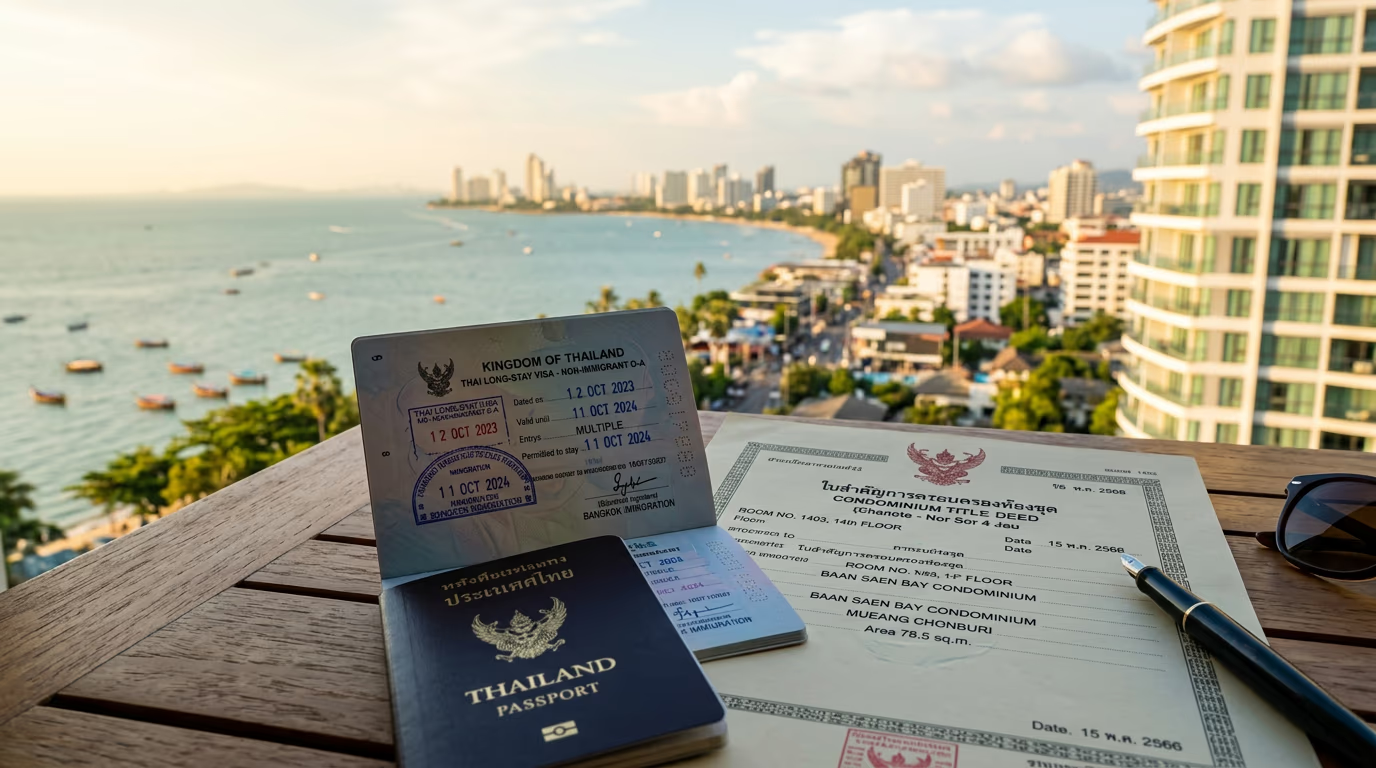
Buying a condominium in Thailand does not give you a visa, residency, permanent residency, or any right to stay beyond your passport’s visa-exempt allowance. Condo ownership and immigration status are separate legal tracks. Foreigners who want to live in Thailand alongside owning a condo choose between six main long-stay visas in 2026: the Destination Thailand Visa (DTV, 5 years), the Long-Term Resident Visa (LTR, 10 years, four categories), the Thailand Privilege Card (5 to 20 years), the Retirement Visa O-A (1 year renewable) and O-X (10 years), and, for larger investors, the Non-Immigrant IB investment visa linked to a Board of Investment project. The cheapest long-stay route is the O-A retirement visa at roughly 800,000 THB in a seasoned bank account; the most flexible for remote workers is the DTV; the strongest for genuine residency is the LTR.
This guide walks through each visa with its 2026 requirements, costs, work rights, tax treatment, and buyer fit, with a master comparison table at the end.
Does buying a condo give you a visa?
No. The Condominium Act B.E. 2522 allows a qualified foreigner to hold freehold title to a condominium unit within the 49% building quota, but it grants no immigration status. Condo ownership is a property right, not a residency right. Thailand has no property-for-residency or “golden visa” programme. The closest thing to an investment-backed long-stay visa is the LTR Wealthy Global Citizen category, which requires at least USD 500,000 of Thai investment (including real estate) on top of separate wealth and income tests — and it is the investment plus wealth plus income combination that grants the visa, not the property alone.
Three practical consequences for a foreign condo buyer: you cannot use a condo purchase to qualify for a visa (property is supporting evidence at most); you can legally buy a condo on a tourist visa, an exempt entry, or any valid non-immigrant visa (the Land Department registers on passport plus Foreign Exchange Transaction (FET) form, not visa class); and you still need a visa to live in the unit beyond the entry allowance. Most buyers secure a long-stay visa in parallel with completion, not as a precondition.
The Land Department’s checks apply to the source of funds (they must be remitted from abroad under Section 19 of the Condominium Act) and the building’s foreign quota, not to the buyer’s visa. See the 49% foreign quota rule and buying as a foreigner.
Destination Thailand Visa (DTV)
The DTV is a 5-year multiple-entry long-stay visa launched 15 July 2024 by the Ministry of Foreign Affairs, priced at 10,000 THB with a 500,000 THB proof-of-funds requirement. Each entry allows 180 days, extendable once by 180 days for 10,000 THB, giving up to 360 days continuous stay per cycle. Eligibility covers three tracks: Workcation (remote workers and freelancers with a foreign employer or clients), Thai Soft Power (applicants coming for Thai cooking, Muay Thai training, traditional Thai medicine, sports training, seminars, or medical treatment), and dependants of either. The DTV is the most accessible long-stay route in 2026 for remote workers and for condo owners who want a non-tourist footing without the LTR and Privilege Card price tags.
Headline terms: 5 years multiple entry; 180 days per entry, extendable once in-country by 180 days (10,000 THB); 10,000 THB government fee; 500,000 THB equivalent liquid in the applicant’s own bank account at application. No Thai employment rights; work for a foreign entity or freelance for non-Thai clients is permitted under the Workcation track. Ministry of Labour guidance clarifies that non-Thai-sourced income activity is not “work” requiring a Thai work permit under a DTV. Spouses and children under 20 are eligible.
Who it fits: remote workers and freelancers, split-year condo owners, and students of Thai cultural disciplines.
Where it falls short: no Thai employment, no airport fast-track, no tax concession. DTV holders who stay 180 days or more in a tax year become Thai tax residents under the standard rule.
Long-Term Resident Visa (LTR)
The LTR Visa is Thailand’s 10-year long-stay programme, administered by the Board of Investment (BOI). It covers four eligibility categories — Wealthy Global Citizen, Wealthy Pensioner, Work-from-Thailand Professional, and Highly-Skilled Professional — each with its own financial and professional tests. LTR holders receive a digital work permit (where applicable), 90-day reporting reduced to annual reporting, multiple re-entry as standard, and — for Highly-Skilled Professionals only — a flat 17% personal income tax rate on Thai-source employment income in targeted industries. The LTR is the strongest long-term residency option for high-income professionals and wealthy retirees, and the only visa with a genuine Thai investment link (USD 500,000 in the Wealthy Global Citizen and lower-income Wealthy Pensioner tracks).
Four categories in 2026:
Wealthy Global Citizen
- Assets: at least USD 1,000,000 total.
- Personal income: at least USD 80,000 per year in the last two years.
- Thai investment: at least USD 500,000 in Thai government bonds, foreign direct investment, or Thai property (including condominium units).
- Ideal for: internationally mobile HNW individuals who want a long-horizon Thai base and are willing to allocate capital onshore.
Wealthy Pensioner
- Age: 50 or older.
- Personal income: at least USD 80,000 per year in passive income (pensions, dividends, rental, investment income), or
- USD 40,000 to USD 80,000 if combined with at least USD 250,000 invested in Thai government bonds, foreign direct investment, or Thai property.
- Ideal for: retirees with moderate to high passive income who want a 10-year visa instead of annual O-A renewals.
Work-from-Thailand Professional
- Employment: employed by a well-established foreign company (minimum 3 years of operation and USD 150 million of revenue in the last 3 years, or equivalent listed-company status).
- Personal income: at least USD 80,000 per year, or USD 40,000-80,000 with a Master’s degree or intellectual property or Series A funding.
- Work experience: at least 5 years in the relevant field.
- Ideal for: remote workers employed by substantial foreign companies.
Highly-Skilled Professional
- Employment: in targeted industries (S-curve industries — BOI-designated) with a Thai corporation, government agency, higher-education institution, or research centre.
- Personal income: at least USD 80,000 per year, or USD 40,000-80,000 with a Master’s degree, specialised experience, or work in a government agency.
- Work experience: at least 5 years in the relevant field (waived for government-agency work).
- Tax concession: 17% flat personal income tax on Thai-source employment income in targeted industries, under Royal Decree No. 743 B.E. 2565.
- Ideal for: experienced professionals taking roles in Thai targeted-sector employers.
Common LTR terms: 10 years (initial 5 + 5 renewal); 50,000 THB government fee over the 10 years; health insurance of USD 50,000 coverage or a USD 100,000 Thai bank deposit for 12 months; LTR-embedded digital work permit for employment categories; annual (not quarterly) 90-day reporting. Qualifying categories receive tax concessions on certain foreign-source income remitted into Thailand; see the tax section below.
Where it falls short: wealth and income thresholds screen out most buyers. The Wealthy Pensioner track requires genuine USD 80,000-a-year passive income, higher than most retirees can show. Those who do not qualify fall back to DTV, Privilege Card, or O-A.
Thailand Privilege Card (formerly Thailand Elite)
Thailand Privilege Card is a paid long-stay membership issued by Thailand Privilege Card Co., Ltd. (rebranded from Thailand Elite in 2023). The 2026 tier structure is Gold (900,000 THB, 5 years), Platinum (1.5 million THB, 10 years), Diamond (2.5 million THB, 15 years), and Reserve (5 million THB, 20 years, invitation-only). Members receive multiple-entry long-stay privilege, airport Fast Track and limousine services at Suvarnabhumi and selected airports, 90-day reporting assistance, and tier-graded personal services. The Privilege Card is not a work visa and grants no employment rights. It is the cleanest option for buyers who want long-stay certainty without income or age tests.
2026 tiers (government fee included; post-VAT):
| Tier | Duration | Price (THB) | Key features |
|---|---|---|---|
| Gold | 5 years | 900,000 | Fast Track at Suvarnabhumi, 20 airport transfers, member privilege services |
| Platinum | 10 years | 1,500,000 | Gold benefits plus additional transfers, Privilege Points, upgraded concierge |
| Diamond | 15 years | 2,500,000 | Platinum plus full concierge, wider government liaison, upgraded health benefits |
| Reserve | 20 years | 5,000,000 | Invitation-only; full Diamond plus extended family inclusion and bespoke services |
Practical terms: Privilege Entry Visa (multiple entry); 1-year permit per entry, renewable at Immigration without leaving the country for the membership term; no employment rights (separate work permit required for any Thai job); spouse and children can be added at reduced supplementary fees; application via Thailand Privilege Card Co., Ltd. or an authorised agent with background check and in-person appointment.
Who it fits: under-50 owners who do not qualify for LTR, retirees who want a cleaner experience than annual O-A renewal, and HNW individuals who value Fast Track and concierge.
Where it falls short: price. Gold costs 180,000 THB per year effective, Platinum 150,000 THB per year. Split-year owners are materially better off on DTV.
Retirement Visa — Non-Immigrant O-A (1-year)
The Non-Immigrant O-A long-stay visa is Thailand’s standard retirement visa. Applicants must be 50 years or older and either hold 800,000 THB in a Thai bank account seasoned for two months before application (three months after the first renewal), show 65,000 THB per month of verifiable foreign income, or combine the two to a 800,000 THB annual total. The O-A is renewable annually. Condo ownership does not qualify the applicant, but it is often used as supporting evidence of established residence and as an implicit demonstration of remitted funds. The O-A is the cheapest long-stay route in headline terms for retirees who can park the bank balance or show the monthly income.
Headline terms: age 50 or older; 800,000 THB in a Thai bank seasoned 2 months before first application and 3 months before each renewal, or 65,000 THB per month foreign income, or a combined 800,000 THB per year; Thai health insurance with at least 400,000 THB in-patient and 40,000 THB out-patient (coverage requirements revised upward through 2024-2025); 1-year validity renewable annually; 90-day address reporting; no work rights; re-entry permit needed for each exit (1,000 THB single / 3,800 THB multiple).
Who it fits: retirees 50 or older who want the cheapest long-stay option and are comfortable renewing every year. Condo owners with 800,000 THB seasoned in a Thai bank meet the test easily.
Where it falls short: annual renewal admin, 90-day reporting, and sensitivity to insurance rule changes. Applicants wanting a longer horizon upgrade to LTR Wealthy Pensioner (if income qualifies) or Privilege Card Gold.
Retirement Visa — Non-Immigrant O-X (10-year)
The Non-Immigrant O-X is the 10-year retirement visa. It requires age 50 or older, 3 million THB in a Thai bank seasoned 12 months, or a combined 3 million THB in bank and income terms. Coverage is limited to nationals of 14 specified countries: Japan, Australia, Denmark, Finland, France, Germany, Italy, the Netherlands, Norway, Sweden, Switzerland, the United Kingdom, Canada, and the United States. The O-X is issued as 5 years initially and extended for another 5 years in-country.
Headline terms: age 50+; 3 million THB in a Thai bank seasoned 12 months, or 3 million THB combined funds and income; health insurance required; nationality limited to the 14 countries above; 10-year validity (5+5); no work rights.
Who it fits: eligible-nationality retirees with 3 million THB in Thai-banked capital who want a 10-year horizon at a lower cost than LTR or Privilege Card. A sharp fit for a narrow group and less used than the O-A or LTR.
Thailand Investment Visa (Non-Immigrant IB) and Section 96 bis
The Non-Immigrant Visa category IB is the BOI-linked investor visa, separate from LTR. It attaches to a BOI-promoted activity and facilitates residence and work for the investor and senior personnel. IB is not a condo-purchase visa; it requires a genuine BOI-approved business.
A related and often confused provision is Land Code Section 96 bis. A foreign investor who brings at least 40 million THB into specified investments (Thai government bonds, infrastructure funds, BOI-promoted activity, certain mutual funds) may apply to own up to one rai of land for residential use. This is a land right, not a visa, and it has no direct bearing on condo purchase. Section 96 bis and the IB visa are independent.
For most condo buyers, LTR Wealthy Global Citizen (USD 500,000 Thai investment, which can include condo value) is the cleaner investment-linked residency.
Comparison: every visa at a glance
Use the table to screen for fit, then read the relevant section above for the detailed rules.
| Visa | Duration | Cost | Financial test | Work rights | Family | Tax concession | Best for |
|---|---|---|---|---|---|---|---|
| DTV | 5 years (180d/entry) | 10,000 THB + 500,000 THB bank balance | 500,000 THB liquid | No Thai employment; foreign work OK | Spouse + children <20 | None | Remote workers, split-year owners |
| LTR Wealthy Global Citizen | 10 years | 50,000 THB | USD 1M assets + USD 80k income + USD 500k Thai investment | Digital work permit | Yes (4 dependants) | Foreign-source income benefits | Internationally mobile HNW |
| LTR Wealthy Pensioner | 10 years | 50,000 THB | Age 50+, USD 80k passive income (or USD 40k + USD 250k invested) | Limited | Yes | Foreign-source income benefits | Retirees with passive income |
| LTR Work-from-Thailand Professional | 10 years | 50,000 THB | USD 80k income, substantial foreign employer | Digital work permit | Yes | Foreign-source income benefits | Remote professionals at substantial firms |
| LTR Highly-Skilled Professional | 10 years | 50,000 THB | USD 80k income (or lower + degree/experience) in targeted industries | Digital work permit | Yes | 17% flat PIT on Thai-source | Targeted-sector professionals |
| Privilege Card Gold | 5 years | 900,000 THB | None | No | Separate fee | None | Under-50 long-stay buyers |
| Privilege Card Platinum | 10 years | 1,500,000 THB | None | No | Separate fee | None | 10-year certainty without tests |
| Privilege Card Diamond | 15 years | 2,500,000 THB | None | No | Separate fee | None | 15-year plus premium services |
| Privilege Card Reserve | 20 years | 5,000,000 THB | None (invitation-only) | No | Extended family | None | UHNW long-horizon |
| O-A Retirement | 1 year (renewable) | ~2,000 THB visa + insurance | Age 50+, 800,000 THB bank or 65,000 THB/month | No | Non-O dependents | None | Cheapest retiree route |
| O-X Retirement | 10 years (5+5) | ~10,000 THB | Age 50+, 3M THB, eligible nationality | No | Dependents eligible | None | 14 eligible countries, 10-year |
| Non-Immigrant IB | Linked to project | BOI-linked | BOI-promoted project | Work permit via BOI | Dependents via BOI | Various BOI concessions | Genuine Thai investors |
Costs shown exclude health insurance, re-entry permits, agent fees, and translation/notarisation. Conversions at approx. USD 1 = 35 THB for Q2 2026 planning.

Which visa suits which buyer?
Match the visa to the life the condo supports, not the other way around. Common buyer profiles and the best-fit route:
- Retiree aged 55+, owner-occupier, moderate income. O-A annual retirement visa is the default; 800,000 THB in a Thai bank (often the same account used to remit condo funds) meets the test. Upgrade to LTR Wealthy Pensioner if passive income reaches USD 80,000. O-X if you hold an eligible-country passport and 3 million THB.
- Digital nomad or remote worker, aged 30-50, serving foreign clients. DTV at 10,000 THB plus a 500,000 THB bank balance. Upgrade to LTR Work-from-Thailand Professional if employer size and salary qualify.
- HNW investor or family office principal. LTR Wealthy Global Citizen — the condo purchase can contribute to the USD 500,000 Thai investment leg. Consider Privilege Card Diamond or Reserve for concierge and Fast Track on top.
- Couple under 50, split-year lifestyle, no Thai work. DTV is the natural fit for both spouses. Privilege Card Gold or Platinum if you want airport services and 1-year stamps without exits.
- Professional relocating to a Thai S-curve employer. LTR Highly-Skilled Professional — the 17% flat personal income tax rate is material at higher salaries.
- Investor buying a multi-unit portfolio for rental income. No visa from the units themselves. Depending on scale, consider LTR Wealthy Global Citizen (assets plus income) or a Privilege Card tier for long-stay certainty. Rental operations must comply with the Hotel Act and short-stay rules.
- Dual-career couple with children at international school. Usually LTR (one spouse) with dependant visas for family; Privilege Card as an alternative if LTR tests are not met.
See the cost calculator for total cost-to-own estimates by profile and the Thailand 2026 market view for city-level context.
Visa and condo-buying timeline
No visa is required to sign a reservation agreement, conduct due diligence, or complete purchase at the Land Department. The correct sequence in 2026 is: visa-exempt or tourist entry for reservation and due diligence, any valid entry for completion, then a long-stay visa for ongoing residence.
- Pre-offer due diligence. Visa-exempt entry or a Tourist Visa is enough. Site visits, lawyer appointments, and bank account opening fit comfortably inside a 30 to 60-day stay.
- Reservation and contract. Sign the reservation agreement and the Sale and Purchase Agreement (SPA) on any valid entry. The SPA typically requires 25 to 30% payment on signing for off-plan; 10% for resale.
- Funds remittance and FET form. The inward remittance to the Thai bank must be in a foreign currency and must state “For purchase of condominium unit [address]” in the transfer message. The Thai bank issues the Foreign Exchange Transaction form for amounts at or above USD 50,000 (lower amounts receive a bank credit note accepted by the Land Department). See buying as a foreigner.
- Completion and title transfer. Any valid entry. The Land Department checks the FET form, the building’s foreign-quota position, and the passport — not the visa class.
- Ongoing residence. Apply for the long-stay visa that fits your profile (DTV, LTR, Privilege Card, or O-A) in parallel with or after completion. Most applications are filed at a Royal Thai Embassy overseas; O-A and Privilege Card can also be processed in-country under certain conditions.
Tax: what changes when you become a Thai tax resident
Anyone present in Thailand 180 days or more in a calendar year is a Thai tax resident. Revenue Department Order Por. 161/2566 (2023), effective for tax years from 1 January 2024, makes foreign-source income assessable when remitted into Thailand — removing the long-standing “different-year remittance” exception. LTR holders in qualifying categories retain concessions on foreign-source income under Royal Decree No. 743. DTV, Privilege Card, O-A, and O-X holders do not have a tax concession and are subject to the standard rules.
Headline implications for condo owners:
- Owning a condo does not by itself create Thai tax residency. Days of physical presence do.
- A Privilege Card member who spends less than 180 days per calendar year in Thailand is not a Thai tax resident. The card itself does not change that.
- An LTR Wealthy Global Citizen or Wealthy Pensioner who becomes a tax resident can still rely on the Royal Decree No. 743 concession for foreign-source income brought into Thailand, subject to the Decree’s conditions.
- Rental income from a Thai condo (Thai-source income) is taxable whether or not you are a tax resident, at progressive rates, with a standard deduction.
A Thai tax adviser should review the remittance pattern for any buyer who anticipates crossing the 180-day line and remitting foreign income. The rule change is recent and the implementing practice is still being tested.
Common visa-related property mistakes
Mistakes cluster around timing and documentation, not the rules themselves. Five patterns that repeat:
- Letting the O-A balance drop below 800,000 THB during the seasoning window. The balance must remain at 800,000 THB for the 2-month seasoning before the application and 3 months before each renewal, and at least 400,000 THB throughout the rest of the year. Drawing it down to fund condo purchase kills the renewal.
- Picking the wrong LTR sub-category. Applicants sometimes apply under Wealthy Pensioner when Work-from-Thailand Professional fits better, or miss the Highly-Skilled Professional tax concession. The sub-category is sticky; switching mid-term means a new application.
- Remitting condo funds in THB. Section 19 of the Condominium Act requires remittance from abroad. THB-denominated transfers do not qualify. The transfer must be in foreign currency, converted to THB by the Thai bank, and documented on the FET form.
- Assuming condo ownership grants residency. It does not, and the mistake is costly when a buyer arrives without a visa plan and burns the first year on back-to-back tourist entries.
- Overlooking Privilege Card membership transferability on resale. The Privilege Card is personal; a condo resale does not include or transfer the membership. Build this into the exit plan if you are treating the card as an asset.
Frequently asked questions
Does buying a condo in Thailand give me a visa?
No. Condominium ownership is a property right under the Condominium Act; it confers no immigration status. The six main long-stay visas (DTV, LTR, Privilege Card, O-A, O-X, IB) have their own eligibility tests.
Can I get permanent residency by buying property?
No. Thai PR is granted under the Immigration Act after three consecutive years of Non-Immigrant visa renewals in a qualifying category (employment, investment, family, or expert). Property ownership does not itself qualify.
What’s the cheapest long-term visa?
For retirees 50+, the O-A at around 2,000 THB in visa fees (plus insurance and the 800,000 THB seasoned bank balance). For under-50 applicants, the DTV at 10,000 THB plus a 500,000 THB bank balance. Both are materially cheaper than Privilege Card Gold at 900,000 THB.
Is the Elite Visa still available in 2026?
Yes, as Thailand Privilege Card. Rebranded in late 2023 by Thailand Privilege Card Co., Ltd. Tiers reorganised into Gold, Platinum, Diamond, and Reserve. Legacy Elite memberships remain valid under their original terms.
Can I work on a DTV?
Not for a Thai employer. DTV holders can work for a foreign employer or serve non-Thai clients as a freelancer under the Workcation track.
Do I need a visa to buy a condo?
No. Purchase and registration only require a valid passport and a compliant inward remittance under Section 19 of the Condominium Act.
Does condo ownership count as “Thai investment” for LTR Wealthy Global Citizen?
Yes. BOI guidance lists Thai property alongside Thai government bonds and FDI, subject to the USD 500,000 threshold and the separate wealth and income tests. The unit must be in the applicant’s name.
What happens to my visa when I sell the condo?
Nothing mechanical. LTR Wealthy Global Citizen holders who counted the condo towards the USD 500,000 investment must substitute another qualifying investment to stay in compliance. See condo resale.
Can my spouse and children get visas through me?
Yes under LTR, DTV (spouse and children under 20), and Privilege Card (supplementary fee). The O visa covers spouses of retirees.
Is there a “golden visa” in Thailand?
Thailand does not use the term officially. The closest equivalents are LTR Wealthy Global Citizen (investment-linked) and Privilege Card Reserve (capital outlay but not investment-linked). Property purchase alone is not a golden-visa route.
How long before my condo handover should I apply for a visa?
O-A: open and seed the Thai bank account at least two months before applying. LTR: 8-12 weeks BOI endorsement. Privilege Card: 4-8 weeks including background check. DTV: 2-6 weeks. Start when you sign the SPA.
Does renting out my condo affect my visa?
A compliant long-term let (30 days or more) does not. Running short-term rentals without a hotel licence is illegal under the Hotel Act; a conviction or immigration-reporting breach can affect future LTR, retirement, and PR applications.
References
Sources
- 01Ministry of Foreign Affairs of Thailand / Royal Thai Embassy guidance on the Destination Thailand Visa, effective 15 July 2024 · https://www.mfa.go.th/en/publicservice/5d5bcc2615e39c306002aa2aDestination Thailand Visa (DTV) launched 15 July 2024 as a five-year multiple-entry visa, 180 days per entry, with a 500,000 THB proof-of-funds requirement and a 10,000 THB government fee. Accessed 2026-04-16.
- 02Thailand Board of Investment, LTR Visa Program · https://ltr.boi.go.th/Long-Term Resident (LTR) Visa — 10-year visa with four eligibility categories: Wealthy Global Citizen, Wealthy Pensioner, Work-from-Thailand Professional, and Highly-Skilled Professional. Accessed 2026-04-16.
- 03Royal Decree issued under the Revenue Code (No. 743) B.E. 2565 (2022) — LTR visa personal income tax concession · https://www.rd.go.th/english/Highly-Skilled Professional LTR category qualifies for a 17% flat personal income tax rate on Thai-source employment income in targeted industries. Accessed 2026-04-16.
- 04Thailand Privilege Card Co., Ltd., Official Membership Tiers and Benefits 2026 · https://thailandprivilege.co.th/Thailand Privilege Card (formerly Thailand Elite) — membership tiers and pricing effective from the 2023 rebrand: Gold, Platinum, Diamond, and Reserve. Accessed 2026-04-16.
- 05Royal Thai Immigration Bureau, Non-Immigrant Visa Category O-A · https://www.immigration.go.th/Non-Immigrant O-A (long-stay) retirement visa — applicant must be 50 years or older with 800,000 THB in a Thai bank account seasoned for 2 months, or 65,000 THB per month verifiable foreign income, or a combination totalling 800,000 THB per year. Accessed 2026-04-16.
- 06Royal Thai Immigration Bureau, Non-Immigrant Visa Category O-X eligibility rules · https://www.immigration.go.th/Non-Immigrant O-X (10-year retirement) visa — age 50+, 3 million THB in a Thai bank seasoned 12 months, or a combination of funds and income totalling 3 million THB; limited to nationals of specified countries. Accessed 2026-04-16.
- 07Thailand Board of Investment, Non-Immigrant Visa IB and investor facilitation · https://www.boi.go.th/Non-Immigrant Visa category IB (investment) — BOI-promoted investment track, separate from the LTR Visa programme. Accessed 2026-04-16.
- 08Land Code Act B.E. 2497 (1954), Section 96 bis, as amended · https://www.krisdika.go.th/Land Code Section 96 bis — foreign investors bringing at least 40 million THB into specified investments may apply to own up to one rai of land for residential use. Accessed 2026-04-16.
- 09Condominium Act B.E. 2522 (1979), Section 19, as amended by Act (No. 4) B.E. 2551 (2008) · https://www.krisdika.go.th/librarian/get?sysid=443975&ext=pdfCondominium Act foreigner-eligibility categories for unit ownership — including funds remitted from abroad and certain Thai-resident statuses — but condominium ownership is not itself a visa category. Accessed 2026-04-16.
- 10Revenue Department of Thailand, Departmental Order Por. 161/2566 (2023) and Por. 162/2566 (2023) on foreign-source income · https://www.rd.go.th/english/Thailand tax residence rule: individuals present in Thailand 180 days or more in a calendar year are tax residents and, under Revenue Department Order Por. 161/2566 (2023), foreign-source income remitted into Thailand is assessable from 1 January 2024. Accessed 2026-04-16.
- 11Siam Legal International, Thailand Long-Term Visa Options for Foreigners · https://www.siam-legal.com/immigration/thailand-long-term-visa.phpSiam Legal comparison of Thailand long-stay visa options for foreign property buyers, covering DTV, LTR, Privilege Card, O-A, and O-X. Accessed 2026-04-16.
- 12Tilleke & Gibbins, Thailand LTR Visa Programme — Eligibility and Tax Benefits · https://www.tilleke.com/Tilleke & Gibbins client briefing on LTR Visa programme eligibility and tax incentives. Accessed 2026-04-16.
Published · How we research and date our content