Freehold vs Leasehold Condos in Thailand: What Foreigners Need to Know 2026
Freehold vs leasehold condos in Thailand: legal framework, price gap, resale, mortgage, inheritance, contract red flags, and who each ownership type suits.
Freehold vs leasehold in Thailand: the short answer
Freehold means you own the condominium unit outright under the Condominium Act and your name appears on the title deed (chanote) at the Land Department. Leasehold means you hold a registered lease over the unit for a fixed term capped at 30 years by Section 540 of the Civil and Commercial Code, with any extensions requiring a new contract and a new registration at the end of the term. For foreign condo buyers in Thailand, freehold is the default and strongly preferred structure. Leasehold appears as a secondary option, most commonly in Phuket beachfront projects where the 49% foreign freehold quota is already full, in some Koh Samui villa developments, and occasionally as a discounted alternative in buildings that still have foreign quota available.
The practical differences extend beyond terminology. Freehold units trade at a premium, sell faster, qualify for a wider range of foreign mortgage products, pass to heirs under the Condominium Act, and hold value through multiple ownership cycles. Leasehold units sit 15-30% cheaper at purchase (CBRE Thailand 2026 Outlook), shrink in residual value as the lease term runs down, face limited financing options, and create inheritance complications that depend entirely on how the lease contract was drafted.
This guide covers the legal framework, the price gap with concrete Phuket and Pattaya examples, resale reality, mortgage availability for foreigners, inheritance mechanics, when leasehold genuinely makes sense, the contract red flags that invalidate the so-called 90-year lease, and a recommendation by buyer profile. All legal references use the primary source texts: the Condominium Act B.E. 2522, the Civil and Commercial Code, the Land Code, and the Supreme Court ruling that reshaped leasehold practice from 2017 onwards.
Freehold condo ownership defined
A freehold condominium unit in Thailand is a unit registered to a named owner at the provincial Land Office under the Condominium Act B.E. 2522 (1979, amended 2008). The owner holds a separate title deed for the unit plus an undivided share of the common property in the building, and the ownership right is perpetual, transferable, and inheritable. Foreign buyers can hold freehold title provided the building’s foreign quota, capped at 49% of total saleable area by Section 19 of the Act, has space available at the moment the transfer is registered.
Freehold ownership in a Thai condominium carries the same substantive rights as freehold ownership in Western markets. The owner can sell at any time, lease the unit for any legal purpose, renovate within building bylaws, vote at annual general meetings in proportion to the unit’s saleable-area share, and pass the unit to heirs under the Condominium Act’s succession provisions (Sections 19/5 to 19/8).
The title deed issued for a freehold condo unit is technically a “Unit Title Deed” (Nor Sor 4 for the land beneath, plus the unit-specific condominium title), not a chanote in the strict sense used for land. The document specifies the unit number, building, floor, saleable area in square metres, common-property share ratio, and any encumbrances (mortgage, lease, usufruct).
Leasehold condo ownership defined
A leasehold condominium unit in Thailand is a unit where the foreign buyer signs a registered lease contract with the freehold owner (usually the developer or a Thai individual) for a term up to 30 years, registered at the Land Office under Sections 537-571 of the Civil and Commercial Code. The lease creates a real property right enforceable against third parties for the registered term, but the underlying freehold title remains with the lessor. Section 540 of the Civil and Commercial Code caps registrable lease terms at 30 years for private property. Leases of 31 years or more are automatically truncated to 30 years by operation of law.
Extensions beyond 30 years are legally possible only as a fresh contract between the lessor and the lessee (or the lessee’s heirs) executed at or near the end of the current term. The extension requires mutual consent at the time of execution, cannot be pre-registered alongside the original lease, and depends on the lessor still being in a position to grant it. The commonly marketed “30+30+30” or “90-year lease” structure is contractually described but legally registrable only in the first 30-year tranche. This was confirmed in Supreme Court Judgement 7113/2560 (2017), which invalidated pre-paid long-term lease structures where the lessee had paid up-front consideration for the full 90-year term.
Leasehold over condominium units is a minority structure in Thailand’s condo market. It appears most often in three scenarios: beachfront Phuket projects where foreign freehold quota is exhausted, Koh Samui mixed-use projects where the underlying land title restricts foreign freehold, and a small number of Bangkok and Pattaya buildings that offer discounted leasehold units alongside freehold stock. In Phuket, Knight Frank Thailand’s 2026 Phuket Residential Market report notes that roughly 35-45% of primary-market coastal stock is now offered on a leasehold basis due to quota dynamics.
The legal framework, compared side by side
The two structures sit under different primary statutes and create different bundles of rights. The table summarises the core legal distinctions.
| Dimension | Freehold condo | Leasehold condo |
|---|---|---|
| Primary statute | Condominium Act B.E. 2522 (1979, amended 2008) | Civil and Commercial Code, Sections 537-571 |
| Title document | Condominium Unit Title Deed | Registered lease contract + lessor’s title deed |
| Duration | Perpetual | Maximum 30 years registrable; extensions require fresh contract |
| Foreign quota applies | Yes (49% cap under Section 19) | No (leasehold does not count against the 49%) |
| Transfer on sale | Full ownership transfers | Assignment of lease (subject to contract terms) |
| Inheritance | Under Condominium Act + Civil Code Book V | Depends on lease contract wording + Civil Code Book V |
| Mortgage availability | Wider (Bangkok Bank Singapore, UOB, domestic banks to Thai co-buyers) | Significantly narrower; most foreign mortgage products exclude leasehold |
| Registration duty | 2% transfer fee + 0.5% stamp duty (or 3.3% SBT if seller within 5 years) | 1.1% of total rent over the lease term |
| Diminishing residual value | No (perpetual) | Yes (value declines as term runs down) |
| Common suitability | Default choice; strong resale | Secondary option; Phuket beachfront, Samui villas, quota-exhausted buildings |
The 30-year cap in Section 540 is not negotiable. Contracts that purport to grant 40-year, 50-year, or 90-year registered leases in a single instrument are truncated by the Land Officer at registration. The developer may draft additional optional renewal clauses, but those clauses are treated as contractual promises, not as pre-registered property rights. A lessee who relies on an unregistered extension promise is an unsecured creditor of the lessor if the lessor sells the underlying freehold to a new owner who refuses to honour it.
The price gap: how much cheaper is leasehold?
Leasehold condo units typically sell at 15-30% below the freehold price for an identical unit in the same building, and occasionally as much as 40% below where the developer is clearing stock after the foreign freehold quota has filled up. The discount reflects the diminishing residual value of a 30-year asset versus a perpetual asset, plus the narrower pool of future buyers and financing options. CBRE Thailand’s 2026 Market Outlook reports average leasehold-to-freehold discounts of 18-24% across Phuket primary-market stock and 22-30% across Samui coastal projects.
Concrete 2026 examples from the Thai primary market:
Phuket beachfront, Bang Tao Bay area. A completed 78-sqm one-bedroom unit in a five-star branded residence is offered at 19.8 million THB freehold (foreign quota) and 14.7 million THB leasehold in the same building. The gap is 5.1 million THB, or 25.8%.
Phuket Surin Beach. A 92-sqm one-bedroom pool access unit is listed at 23.5 million THB freehold and 17.2 million THB leasehold. The gap is 6.3 million THB, or 26.8%.
Pattaya Wongamat. A 68-sqm one-bedroom unit in a 2024-completion premium building is offered at 9.2 million THB freehold. The same unit on leasehold is 7.6 million THB, a 17.4% discount. The smaller gap reflects Pattaya’s still-available foreign freehold quota across most of the market, which means leasehold units here compete against freehold alternatives rather than being the only option.
Koh Samui Choeng Mon. A 115-sqm two-bedroom villa-style condo is offered at 12.8 million THB on a leasehold structure with a 30-year registered lease plus two contractual 30-year renewal options. The equivalent freehold structure is unavailable because the underlying land title is rai foreigner-restricted.
The gap narrows as the building ages and the residual lease term shortens. A unit sold leasehold in year one with a fresh 30-year term is a very different asset from the same unit resold in year fifteen with 15 years remaining. Resale leasehold units with less than 20 years residual term typically trade at 40-55% of comparable freehold value.
Pros and cons: the decision matrix
| Factor | Freehold advantage | Leasehold advantage |
|---|---|---|
| Upfront price | No. Freehold costs more. | Yes. 15-30% cheaper entry. |
| Perpetual asset | Yes. Value does not decay. | No. Residual term declines annually. |
| Resale pool | Large. All buyer profiles. | Narrow. Cash buyers or very short horizon investors. |
| Financing | Available via Bangkok Bank Singapore, UOB, some developer financing. | Very limited. Most lenders decline. |
| Quota constraints | Must fit within 49% cap. | No quota. Always available. |
| Beachfront access (Phuket) | Often blocked by quota exhaustion. | Practical solution when freehold is unavailable. |
| Inheritance certainty | Strong. Condominium Act + Civil Code path. | Depends on contract; extension rights may not transfer. |
| Renovation rights | Full (within building bylaws). | Dependent on lease contract. |
| Voting rights in juristic person | Yes, in proportion to saleable area. | Usually retained by the freehold owner (the lessor). |
| Tax on purchase | 2% transfer + 0.5% stamp = 2.5%. Split with seller. | 1.1% of total lease rent. |
The freehold advantages stack. The leasehold advantages are narrow and situational. A buyer purchasing a primary home, a retirement base, or a long-term rental investment is almost always better served by freehold wherever it is available within quota. Leasehold becomes a rational choice only when freehold is structurally blocked (quota exhausted, land title restricted) or when the buyer genuinely has a short time horizon (sub-15-year use) and treats the discount as buying utility rather than an asset.
Resale implications: the most under-stated difference
Freehold condo units resell readily in the foreign-buyer secondary market. Leasehold units resell slowly, at a widening discount to comparable freehold stock, and to a much narrower pool of buyers. This gap is the single biggest practical difference between the two structures and one that primary-market sales literature rarely highlights. The dynamics are simple: every year of elapsed lease term reduces the residual asset value, and the pool of buyers willing to take on a 20-year or 15-year residual lease is a fraction of the pool willing to buy freehold.
CBRE Thailand’s 2026 secondary-market data shows median days-on-market for Phuket leasehold resale listings at 9-14 months, versus 4-7 months for freehold equivalents in the same buildings. Samui coastal leasehold resale is even slower, with median listings running 12-20 months.
A worked example makes the math explicit. A buyer purchases a Phuket leasehold unit at 14.7 million THB in year zero with a 30-year lease. The buyer tries to resell in year 10 with 20 years remaining. The comparable freehold unit has drifted up in price to 22 million THB over the decade. The leasehold unit is mathematically worth a two-thirds multiple of freehold (20/30), plus a further penalty for the narrower buyer pool and declining residual. Realistic resale value lands at 10-12 million THB, below the original purchase price even before transfer taxes and broker fees. The buyer sat on the “discount” for a decade and lost capital.
The buyer who instead bought the freehold equivalent at 19.8 million THB in year zero sees a similar appreciation pattern and exits at around 22 million THB. The upfront 5 million THB premium for freehold has turned into a materially better outcome.
Mortgage availability for foreign buyers
Mortgage availability for foreign condo buyers in Thailand is already limited on freehold units and practically non-existent on leasehold. The few banks that lend cross-border to foreigners for Thai condo purchases mostly restrict their programs to freehold title. The primary options in 2026 are Bangkok Bank (Singapore Branch), UOB Thailand, and a small group of developer-financing arrangements.
Bangkok Bank (Singapore Branch) International Mortgage Program. Loans to non-resident foreigners for freehold condo units in Thailand. Typical terms: 50-60% LTV, USD or SGD denomination, 10-year maximum term (or to age 65, whichever is shorter). Interest rates track SOFR plus a spread, generally 6.5-8% in 2026. Leasehold units are not accepted collateral.
UOB Thailand Home Loan Program. Offered to foreigners with Thai residency (non-immigrant visa with work permit, LTR visa, or long-term marriage visa) and to Thai co-borrowers. 50-70% LTV on freehold condos. Leasehold is rarely approved.
Developer financing. Several Pattaya, Phuket, and Bangkok developers offer in-house payment plans: 20-40% deposit, balance over 3-5 years at single-digit interest, often interest-free for a promotional period. These plans are available on freehold units; leasehold developer financing is rare and usually restricted to the original 30-year lease grantor.
HSBC Thailand, Citi Thailand, Standard Chartered Thailand. Exited or significantly scaled back retail mortgage programs for foreigners after 2020. Not reliable options in 2026.
For a foreign buyer without cash reserves for a full purchase, freehold is effectively the only route that opens a financing path. The leasehold discount disappears once the inability to finance is priced in correctly.
Inheritance: the structural trap in leasehold
Freehold condo units pass to heirs under the Condominium Act regardless of the heirs’ nationality, subject to the heirs disposing of the unit within one year if the inheritance would push the building over its 49% foreign quota. Leasehold units pass to heirs only to the extent the lease contract and the Civil and Commercial Code allow, with the contractual drafting controlling the outcome. Section 19/5 through 19/8 of the Condominium Act provides a clear succession path for freehold units. Section 544 of the Civil and Commercial Code addresses lease transfer on death, but defers to the contract.
Freehold inheritance mechanics are straightforward. The estate executor registers the transfer at the Land Office with the death certificate, probate court order, heir identification, and the foreign quota status letter from the juristic person. If the building still has quota headroom, the foreign heir is registered as the new owner. If inheritance would breach the 49% quota, the heir must sell the unit within one year of the registration date and may keep the proceeds.
Leasehold inheritance is contract-dependent. A well-drafted lease contains express language granting the lessee’s heirs the right to continue the lease for the remaining term and the right to exercise the contractual extension options. A poorly drafted lease (or a silent lease) leaves heirs at the mercy of the lessor’s consent, Civil Code default rules, and any restrictive language in the original contract. Common traps:
- Lease “personal to lessee” clauses. Some older contracts treat the lease as a personal right that extinguishes on the lessee’s death. This is the most severe defect.
- Extension options personal to the original lessee. The 30-year lease passes, but the two contractual 30-year extensions do not. The heir gets the residual of the first term and no more.
- No express assignment or transfer clause. The heir depends on general Civil Code rules and often on the lessor’s cooperation.
Foreign estate planning for a leasehold unit requires a Thailand-licensed attorney to review the specific lease contract before purchase. Generic advice (“you can always extend”) does not survive contact with the actual contract language. Tilleke & Gibbins and Siam Legal both publish practice notes on this issue and both recommend freehold wherever available.
When leasehold genuinely makes sense
Leasehold is the right choice in a narrow set of scenarios. Avoid it outside these cases.
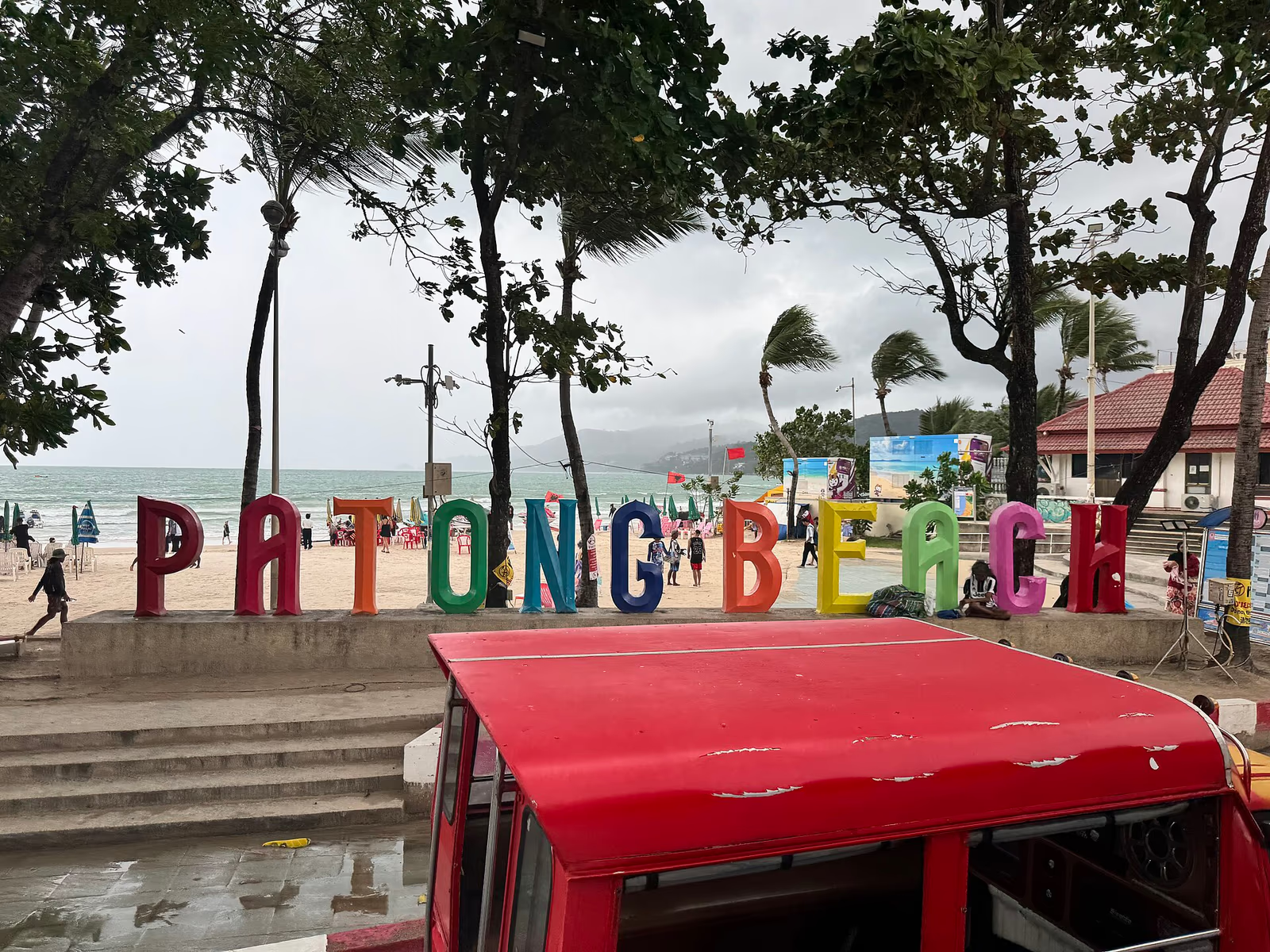
1. Phuket beachfront where freehold quota is exhausted. Many premium beachfront projects in Bang Tao, Surin, Kamala, and Kata sold out their 49% freehold quota during launch. Buyers who specifically want a unit in one of these buildings, and who accept the resale and inheritance trade-offs, can use leasehold as the only path. The 25-30% discount partially compensates.
2. Samui and selected island projects with restricted land title. Koh Samui’s land title mix includes large chunks of land where foreign freehold is structurally blocked at the underlying title level. Leasehold becomes the default rather than a choice, and buyers should price and plan accordingly.
3. Short time horizon (5-10 years) with certainty of exit. A buyer who knows they will use the unit for a defined period, is comfortable with a 50-60% residual value exit, and wants to free up capital at purchase can rationally choose leasehold. This profile is rare and requires disciplined exit planning.
4. Quota-exhausted buildings where the specific unit matters. Occasionally the only unit available on a preferred floor or view is in the Thai quota and sold on a leasehold basis to a foreign buyer. If the price discount is meaningful (25%+) and the contract is professionally drafted, this can work.
5. Land-and-house product in provincial markets where freehold is not legally available. Detached houses in Thailand come with land title, and under Land Code Section 86 a foreigner cannot hold that land freehold. The textbook real-world example is U-Sabai in Korat — the dominant detached-house developer in Nakhon Ratchasima, with more than 4,000 homes delivered across nine projects since 2003. A foreign buyer of a U-Sabai house works with a registered 30-year leasehold of the land under Civil and Commercial Code Section 540 (or Thai-spouse title), not because leasehold is preferred but because the freehold-condominium pathway is structurally unavailable. See the foreign ownership law guide for the Section 86 mechanics in detail.
Outside these five scenarios, freehold is the correct choice. The 15-30% headline discount on leasehold almost always turns into a worse total-cost outcome once residual value decay, financing limitations, resale friction, and inheritance uncertainty are priced in.
Red flags in leasehold contracts
A badly drafted leasehold contract is worse than the structural limitations of leasehold itself. Before signing, have a Thailand-licensed attorney (not the developer’s lawyer) review the contract against this checklist.
1. “30+30+30” structure marketed as a 90-year lease with pre-paid full-term consideration. Supreme Court Judgement 7113/2560 invalidated this structure where the lessee had paid up-front for the full 90 years. The extensions must be separate contracts executed at the end of each term. Pay only for the first 30-year registered term.
2. Extensions not registrable in advance, with no clear protection mechanism. If the contract says “the lessor agrees to grant two additional 30-year terms” but does not grant a registrable option with a clear trigger price (e.g., a fixed renewal fee registered as an obligation against the title), the extensions are contractual promises only. If the freehold owner sells the land mid-term, the new owner is not bound.
3. Subordinated extension rights. Some contracts make the renewal conditional on the lessee “being in good standing” with vague or discretionary standards, effectively giving the lessor a veto dressed up as a formality.
4. No express inheritance clause. The contract must state that the lease and all extension rights transfer to heirs. Without this, Section 544 default rules apply and may not produce the expected outcome.
5. Lessor entity not the underlying freeholder. If the lease is granted by a subsidiary or operating company rather than the entity holding the underlying title, the lessee’s position is weakened. A buyer assumes the underlying freeholder will honour the sublessor’s obligations. This often fails.
6. Land still mortgaged by the lessor with no prior-ranking lease registration. A lease registered after an existing land mortgage is subordinate to the mortgage. If the lessor defaults and the bank forecloses, the lease can be extinguished. Always register the lease before any outstanding mortgage, or secure a prior-ranking consent from the lender.
7. No building completion guarantee for off-plan leasehold purchases. Leasehold off-plan contracts sometimes defer registration until completion. If the developer fails to complete, the buyer’s remedies may be weak. Pay staged payments into escrow, not directly to the developer.
8. Rent “pre-paid” without delivery of the unit. Full up-front rent payment before handover, without an escrow mechanism or completion guarantee, creates counterparty risk.
9. Absence of a sub-lease clause. Many lease contracts forbid subletting without the lessor’s written consent. For a buyer who plans to rent out the unit, a broad pre-authorised sub-lease clause is essential.
10. Termination rights favouring the lessor. Material termination rights (for modest breaches, arrears under a short cure period, or “discretionary” grounds) can wipe out the lessee’s investment. Any termination for cause should require a serious breach and a 90-day cure period, plus judicial enforcement.
Tilleke & Gibbins and Siam Legal both publish leasehold-review checklists that expand on these points. Budget 40,000-80,000 THB for a professional contract review on any leasehold purchase above 5 million THB. The fee is trivial compared with the downside exposure.
Recommendation by buyer profile
Investors (rental yield and capital appreciation focus): freehold, always. The narrower buyer pool and residual value decay of leasehold destroy the investment case. Even the 25-30% discount does not compensate over a 5-10-year hold, and the inability to finance freely on leasehold further compresses the buyer pool at exit.
Retirees, cash buyers, primary residence: freehold where available; leasehold only if the specific location is structurally unavailable on freehold terms and professional legal review clears the contract. Retirees planning to hold 10-20 years face the worst of the leasehold residual decay. Budget the professional review cost as mandatory.
Short-horizon users (3-7 years) with high liquidity: freehold still wins. The transfer taxes and friction costs of freehold are modest (roughly 2.5% split with the seller), and the exit pool is dramatically wider. The headline discount on leasehold is usually not worth the exit friction.
Phuket beachfront or Samui specific-project buyers: leasehold with full professional legal review. This is the one clear case for leasehold. Insist on a registrable renewal option, express inheritance language, and a subordination review.
Digital nomads, DTV-visa users, 2-3-year snowbirds: rent, do not buy leasehold. A short-horizon user should usually rent rather than take on an asset with declining residual value and narrow exit. For longer horizons, switch to the retiree analysis above.
Heirs-focused buyers (estate planning is the priority): freehold. Inheritance mechanics are materially cleaner under the Condominium Act than under a negotiated lease contract.
Freehold vs leasehold FAQ
Is a 30-year lease the maximum in Thailand?
Yes, for privately held land and condominium units under the Civil and Commercial Code Section 540. Commercial leases of industrial estate land under the Industrial Estate Authority of Thailand Act can reach 50 years, but this does not apply to residential condos.
What about 90-year leases, are they valid?
The first 30 years are registrable and valid. Any additional 30-year extensions are contractual promises only; they cannot be pre-registered alongside the original lease. Supreme Court Judgement 7113/2560 invalidated structures where buyers paid up-front for the full 90-year term.
Can a foreigner inherit a freehold condo in Thailand?
Yes. Under the Condominium Act Sections 19/5 to 19/8, foreign heirs can inherit a freehold condo unit. If the inheritance would push the building over the 49% foreign quota, the heir must sell the unit within one year and keep the proceeds.
Is leasehold cheaper than freehold?
Usually 15-30% cheaper at purchase, sometimes more where the developer is clearing quota-exhausted stock. The discount narrows against lifetime total cost once residual value decay, financing limitations, and resale friction are included.
Can I get a mortgage on a leasehold condo as a foreigner?
Very rarely. Bangkok Bank Singapore and UOB Thailand both restrict their foreign-buyer mortgage programs to freehold units. Developer financing for leasehold is occasionally available at the original 30-year grant but does not survive resale.
Does freehold ownership give me a visa?
No. Condo ownership does not qualify for any Thai visa. Review the Thailand visa + property guide for the DTV, LTR, Privilege Card, and retirement visa options.
What happens to a leasehold unit at the end of the 30 years?
The unit reverts to the freehold owner unless the parties execute a new lease. The original lessee has no statutory right to renew; renewal depends on the contract terms and the lessor’s willingness at the time.
Can leasehold units be sold before the term ends?
Yes, by assignment of the lease. The buyer takes over for the remaining term, subject to any consent requirements in the contract. Resale demand is materially weaker than freehold and tightens as residual term shortens.
Is leasehold safer in any way than freehold?
No. Freehold has the same protections plus more. The only scenario where leasehold can be more practical is where freehold is structurally unavailable (quota-exhausted or restricted land title).
Should I ever buy leasehold?
Only when (a) the specific location you want is not available on freehold, (b) the contract has been reviewed by a Thailand-licensed property attorney, and (c) the discount is meaningful (20%+) and you accept the residual value decay. Outside those conditions, choose freehold.
Next steps
If freehold works for your situation, the next reads are the foreign quota 49% rule guide and the complete foreign condo buying process. Model the total cost using the cost calculator and the condo costs breakdown. For investment buyers, cross-reference the rental yield analysis to make sure the location and unit type match the target yield profile. For inheritance planning, review the condo inheritance guide.
If leasehold is genuinely the only path for the building or location you want, have the contract professionally reviewed (Tilleke & Gibbins, Siam Legal, or an equivalent firm), insist on the red-flag checklist above, and price the exit scenario realistically before committing.
References
Sources
- 01Condominium Act B.E. 2522 (1979), amended 2008, Sections 19 and 19 bis · https://www.krisdika.go.th/Foreign condo ownership permitted under the 49% rule and the definition of freehold condominium ownership. Accessed 2026-04-16.
- 02Civil and Commercial Code of Thailand, Sections 537 to 571 (specifically Section 540) · https://www.krisdika.go.th/Lease registration capped at 30 years; extensions require re-execution and re-registration. Accessed 2026-04-16.
- 03Dika Court Judgement 7113/2560 (2017) and subsequent 2019 appellate applications · https://www.supremecourt.or.th/Supreme Court ruling invalidating pre-paid long-term lease structures beyond the 30-year ceiling. Accessed 2026-04-16.
- 04Land Code B.E. 2497, Sections 86 and 96 bis · https://www.dol.go.th/Foreign land ownership generally prohibited; BOI-investment route for freehold land. Accessed 2026-04-16.
- 05CBRE Thailand Real Estate Market Outlook 2026 · https://www.cbre.co.th/insights/reports/thailand-real-estate-market-outlook-2026Leasehold vs freehold price gap in Phuket and Samui developer stock. Accessed 2026-04-16.
- 06Knight Frank Thailand Phuket Residential Market 2026 · https://www.knightfrank.co.th/researchForeign quota exhaustion in Phuket beachfront driving leasehold structures. Accessed 2026-04-16.
- 07Bangkok Bank (Singapore) International Mortgage Program 2026; UOB Thailand Home Loan Program · https://www.bangkokbank.com/en/Personal/Other-Services/Home-Loan-for-International-CustomerForeign mortgage availability with Bangkok Bank Singapore branch and UOB Thailand. Accessed 2026-04-16.
- 08Condominium Act B.E. 2522, Section 19/5 to 19/8; Civil and Commercial Code Book V (Succession) · https://www.krisdika.go.th/Inheritance of freehold condominium units by foreign heirs under the Condominium Act. Accessed 2026-04-16.
- 09Thailand Land Department Registration Fee Schedule 2026 · https://www.dol.go.th/Lease registration procedure, 1.1% duty, and land office practice notes. Accessed 2026-04-16.
- 10Tilleke & Gibbins Thailand Property Practice Notes 2025-2026 · https://www.tilleke.com/insights/Leasehold contract drafting standards and red flags. Accessed 2026-04-16.
- 11Siam Legal International, Thailand Property Leasehold Guide 2026 · https://www.siam-legal.com/realestate/thailand-leasehold.phpSiam Legal practitioner guidance on 30+30+30 lease structures. Accessed 2026-04-16.
Published · How we research and date our content