Condo Koh Samui 2026: Foreign Buyer's Market Guide
Buy a condo on Koh Samui 2026: Chaweng, Bophut, and Lamai prices, leasehold villa reality, 5 to 8 percent yields, and honest legal trade-offs for foreign buyers.
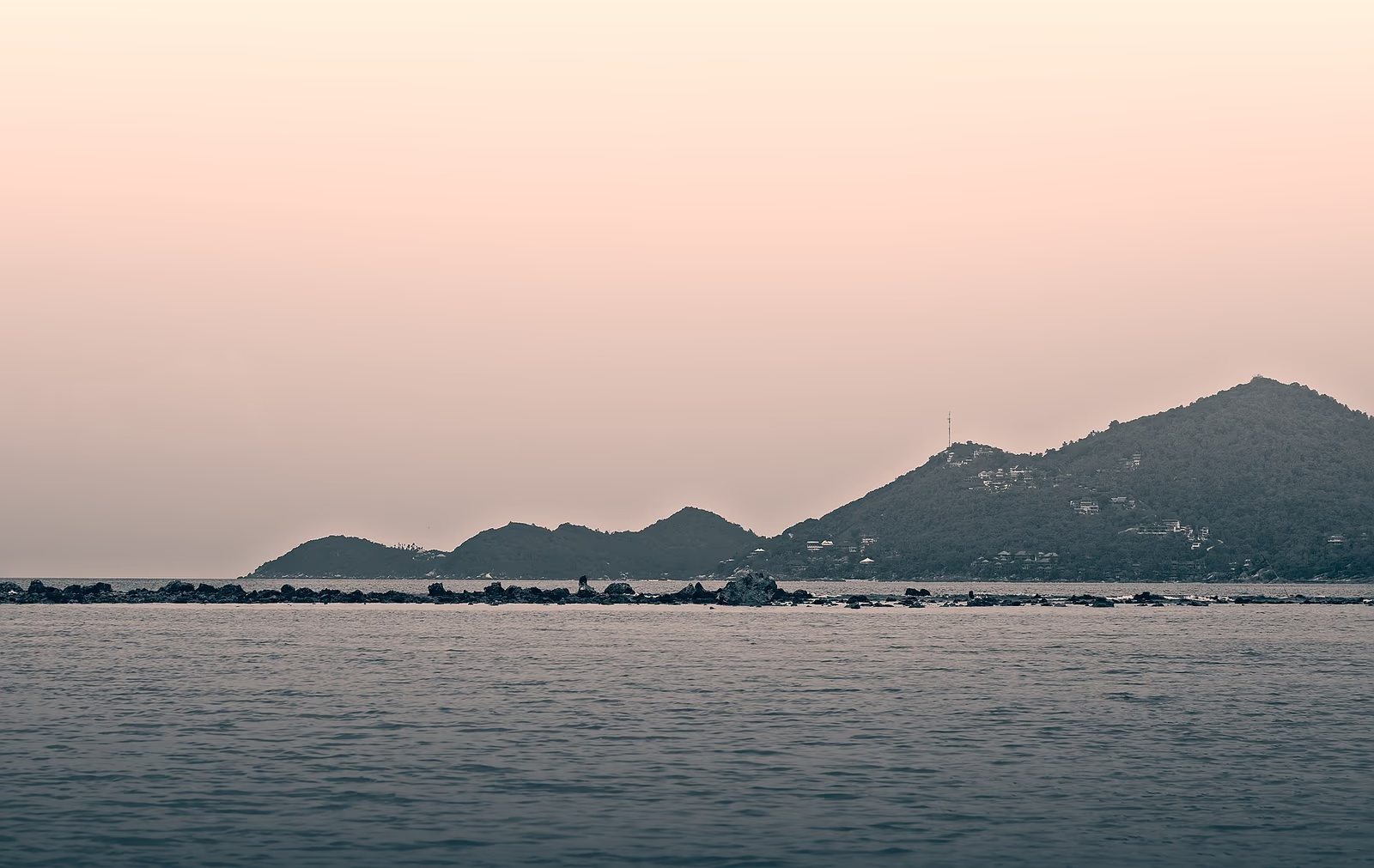
Koh Samui is primarily a villa leasehold market, not a condo market, and that is the single most important fact for any foreign buyer approaching the island. Savills Thailand, CBRE Thailand, and Knight Frank Thailand all classify Samui as branded-residence and villa-dominant, with freehold condominium supply materially below Phuket or Pattaya (Savills Thailand 2026; CBRE Thailand 2026; Knight Frank Thailand 2026). Foreign nationals can own a Samui condominium unit under freehold title up to the 49% building cap set by the Condominium Act B.E. 2522 (Condominium Act 1979, amended 2008), but total condo inventory is small, concentrated in three pockets: Chaweng Noi, Bophut-Choeng Mon hill, and Lamai south. Per-sqm pricing runs 85,000 to 180,000 baht; gross yields 5 to 8% net in strong hotel-managed buildings. Most foreign property here is structured as 30-year registered leasehold, sometimes marketed as “60-year” or “90-year” through sequential leases, a structure carrying legal uncertainty under the Civil and Commercial Code (Sections 540-541).
Koh Samui foreign property market in 2026
Koh Samui’s foreign property market is villa-weighted, tourism-driven, and structurally different from any Thai mainland market. C9 Hotelworks’ 2025 Samui hospitality report records island-wide hotel occupancy around 70% with rising average daily rates in the four- and five-star segment (C9 Hotelworks 2025). The majority of foreign-bought stock on Samui operates inside hotel-managed rental programs rather than on long-term residential leases.
Thailand recorded 14,899 foreign condo transfers nationally in 2025 valued at 60.92 billion baht (Thailand REIC, March 2026). Surat Thani province (containing Samui) sits well below Phuket, Chonburi, and Bangkok in foreign condo transfer share, typically under 3% of national volume. That understates total foreign property absorption: the villa leasehold market does not register as condominium transfers.
Typical foreign purchasers split into three: holiday-home buyers acquiring a villa or branded-residence unit for personal use with managed rental during absence, yield investors targeting hotel-program returns in Chaweng or Bophut, and lifestyle relocators choosing Samui for pricing 20 to 40% below comparable Phuket stock. Russian, British, German, French, and Scandinavian buyers dominate; Chinese volume is lower than in Phuket or Chiang Mai.
Koh Samui Airport (Bangkok Airways) provides direct links to Bangkok, Phuket, Hong Kong, Singapore, and seasonal European routes. The airport is single-operator and prices reflect that. For the purchase process, see the foreigner buying guide; for the freehold-vs-leasehold distinction, see the freehold vs leasehold guide.
Condos vs villa leasehold on Koh Samui: why this matters
Most foreign-marketed property on Samui is villa leasehold, not condominium freehold. The distinction changes legal structure, resale profile, yield mechanics, and exit risk. A condominium freehold unit gives foreign owners a Chanote-registered title deed, full freehold ownership rights, and a juristic-person-managed common area under the Condominium Act. A villa leasehold gives a 30-year registered lease under the Civil and Commercial Code Sections 540-541, with contractual (not statutory) renewal options.
Three specific leasehold structures circulate on Samui:
- Standard 30-year registered leasehold. The cleanest foreign structure outside condominium freehold. Registered at the Land Department, protected as a registered real right. Renewal at year 30 depends on the landowner’s contractual commitment at that future date.
- “60-year” or “90-year” three-lease structures. Marketed as a sequence of three 30-year leases. Thai law guarantees only the first; subsequent leases rely on contractual commitments with no binding case law confirming enforceability. Siam Legal and Tilleke & Gibbins publish cautionary guidance.
- Leasehold plus company-structured freehold. Some offerings bundle a 30-year land lease with a freehold building interest via a Thai majority-owned company. Using a Thai nominee company to circumvent foreign land-ownership restrictions is prosecutable under Thai law.
Buyers seeking a clean structure should prefer condominium freehold. Buyers accepting leasehold should prefer the single 30-year registered lease and disregard 60- or 90-year marketing claims.
The 3 Koh Samui condo pockets at a glance
Koh Samui’s condominium inventory concentrates in three areas: Chaweng Noi for hotel-adjacent short-stay product, Bophut-Choeng Mon hill for sea-view premium, and Lamai south for the value-entry segment. Chaweng Beach itself is largely hotel-dominated and contains minimal residential condominium stock, a common point of confusion for first-time Samui buyers.
| Area | Per-sqm range (THB) | Gross yield | Beach access | Best for |
|---|---|---|---|---|
| Chaweng Noi | 110,000 – 180,000 | 6.0 – 8.0% | 300 m – 1.0 km | Hotel-program yield, short-stay investment |
| Bophut / Choeng Mon hill | 100,000 – 170,000 | 5.0 – 7.0% | 500 m – 2.0 km | Sea-view premium, holiday-home, branded residence |
| Lamai south | 85,000 – 140,000 | 5.5 – 7.5% | 400 m – 1.5 km | Value entry, lower density, longer-stay tenants |
Sources: Hipflat, FazWaz, Thailand-Property, and direct developer price sheets Q1 2026. Supply constraint keeps the spread wide: a single premium branded-residence launch can reset the ceiling for a corridor, and one distressed resale can anchor the floor. Expect higher deal-to-deal variance on Samui than in Pattaya or Hua Hin.
Chaweng Noi: the hotel-program corridor
Chaweng Noi sits immediately south of Chaweng Beach, separated by a small headland. Unlike Chaweng Beach (hotel-dominated, minimal residential stock), Chaweng Noi contains hillside and bay-view condominium projects operated inside hotel rental programs. Typical structures combine foreign-freehold title with a hotel-operator management agreement.
Q1 2026 per-sqm pricing 110,000 to 180,000 baht. Non-branded entry one-bedrooms 5.5 to 7.0 million baht; branded-residence product 8 to 25 million baht. Gross yields inside strong hotel programs run 6 to 8% net after fees (typically 25 to 35% of gross room revenue), with single-operator dependency risk. Foreign quota is typically open. Review management agreement terms, exit clauses, and occupancy guarantees before signing.
Bophut and Choeng Mon hill: the premium sea-view band
Bophut runs along the northern coast into the Choeng Mon hillside, containing Fisherman’s Village retail, branded hotels (Four Seasons, W, Anantara-adjacent), and Samui’s largest concentration of premium branded-residence activity. Cushman & Wakefield 2026 flags Samui branded residences as part of the national growth trend.
Q1 2026 per-sqm pricing 100,000 to 170,000 baht non-branded; branded product can clear 200,000 baht per sqm. Entry two-bedroom non-branded 6.5 to 9.0 million baht; branded residences 12 to 40 million baht. Gross yields 5.0 to 7.0%, lower than Chaweng Noi because the buyer profile is holiday-home-weighted. Resale timelines 18 to 36 months. Many products here are structured as villas rather than condominiums: verify the Chanote condominium title and juristic-person registration.
Lamai south: the value entry
Lamai sits on the east coast 6 km south of Chaweng, quieter and historically a European long-stay market. Condo stock is smaller and lower-density than Chaweng Noi or Bophut, with more inland and hillside product.
Q1 2026 per-sqm pricing 85,000 to 140,000 baht. Entry one-bedroom inventory 3.5 to 5.0 million baht. Gross yields 5.5 to 7.5%, strong versus the lower absolute purchase price. Rental profile mixes seasonal stays and 3- to 6-month European winter tenancies, stabilising annual yield relative to pure hotel-program stock. Foreign quota typically open.
How foreign ownership quota works in Samui condo buildings
Foreigners may own up to 49% of the total saleable floor area of any Koh Samui condominium building under Section 19 bis of the Condominium Act B.E. 2522 (amended 2008). Condominium freehold is the only foreign-ownership structure that gives a registered title deed in a foreign name without company or nominee involvement.
Three practical realities for Samui:
- Genuine condominium buildings are a minority of foreign-marketed inventory. Much of what is offered is villa leasehold, company-structured freehold, or hotel-branded residence product. Confirm the building holds a Chanote condominium common-area title certificate and a registered juristic person before treating a unit as condominium freehold.
- Hotel-operator contracts matter as much as the quota letter. In hotel-program product, the operator contract governs most of the buyer’s economic exposure. A 5% net yield under a strong operator is worth more than an 8% gross yield under a weak one.
- Quota in true condominium buildings is generally open. The narrow Samui condo inventory has not attracted the concentrated buying waves that saturated Phuket branded beachfront.
Broader mechanics are in the 49% foreign quota rule guide.
Koh Samui vs Phuket vs Pattaya for foreign buyers
Samui is the smallest and most specialised of Thailand’s major foreign-resort property markets: lower total inventory than Phuket, villa- and branded-weighted rather than condo-weighted, thinner resale liquidity, and strong single-operator hotel-program yields in the right buildings.
| Metric | Koh Samui | Phuket | Pattaya |
|---|---|---|---|
| Median foreign condo price (2026) | 5.0 – 9.0M THB | 7.5 – 15.0M THB | 3.5 – 5.0M THB |
| Median per-sqm (2026) | 85,000 – 180,000 THB | 130,000 – 350,000 THB | 70,000 – 130,000 THB |
| Gross rental yield | 5.0 – 8.0% (hotel program) | 4.5 – 9.0% | 6.0 – 8.0% |
| Dominant product | Villa leasehold + hotel-program condo | Villa + branded residence + condo | Condominium freehold |
| Resale timeline | Long (18-36 months) | Medium (12-24 months) | Short (6-18 months) |
Sources: Thailand REIC 2025; Global Property Guide Q3 2025; CBRE Thailand 2026; Knight Frank Thailand 2026; C9 Hotelworks Samui 2025; Savills Thailand 2026.
Samui works for buyers who genuinely want Samui. It does not work as a yield-arbitrage play against Pattaya or a capital-growth play against Phuket.
Koh Samui regulatory and market shifts to know in 2026
Three factors shape Samui’s 2026 environment: hospitality-rate recovery flagged by C9 Hotelworks, ongoing scrutiny of 60- and 90-year leasehold structures, and the continued narrow new-condominium pipeline.
C9 Hotelworks’ 2025 report shows four- and five-star average daily rates rising through 2024-2025, supporting hotel-program yield projections. Yield underwriting should apply a 10 to 20% discount to the first three years’ projected room revenue; operators consistently overstate stabilised performance in launch-phase pro forma.
Siam Legal, Tilleke & Gibbins, and other Thai firms continue to publish cautionary guidance on 60- and 90-year three-lease structures. Treat only the first registered 30-year lease as legally secured (Civil and Commercial Code, Sections 540-541).
Knight Frank Thailand classifies Samui among resort markets with constrained new supply through 2026. The constraint supports pricing in the branded-residence segment but does not compensate for thin resale liquidity on exit. For scam patterns, see the condo scams guide.
Koh Samui’s notable developers and projects
Samui’s developer base is dominated by resort specialists, branded-residence operators, and local island developers; national Bangkok-based developers have a lighter presence than in Pattaya or Hua Hin.
- Replay Destination and branded-residence operators, active in Bophut and Choeng Mon with branded-villa and mixed-use projects.
- The Ridge Samui, established Bophut hillside condominium with open foreign freehold allocation historically.
- The Beach Samui, Wing Samui, and comparable Chaweng Noi hotel-program product, foreign-freehold allocation with operator rental agreement.
- Four Seasons Private Residences Koh Samui, Anantara Residences, W-branded product, premium branded-residence pipeline flagged by Cushman & Wakefield 2026.
- Unique Residences and local developers, boutique Bophut, Lamai, and Maenam product, variable quality. Diligence critical.
Sources: Thailand-Property Samui listings (April 2026); Hipflat; FazWaz; C9 Hotelworks 2025; direct developer price sheets Q1 2026.
Who Koh Samui suits as a foreign buyer
Samui’s foreign-buyer base splits into three profiles: holiday-home buyers prioritising personal use, hotel-program yield investors targeting short-stay returns, and lifestyle relocators choosing island pace over mainland access.
- Holiday-home buyers. Typical spend 6 to 20 million baht for a two- or three-bedroom in Bophut, Choeng Mon, or a branded residence. Priority: personal use 8 to 14 weeks a year, managed rental during absence. Hold horizon 10 years plus.
- Hotel-program yield investors. Typical spend 5 to 10 million baht for a one- or two-bedroom in Chaweng Noi. Priority: operator quality, contract terms, realistic occupancy projections. Net yield target 5 to 7%.
- Lifestyle relocators. Typical spend 4 to 8 million baht for a condo in Lamai, Maenam, or inland Bophut. Priority: hospital access (Bangkok Hospital Samui), grocery logistics, expat social network.
Samui does not suit pure capital-growth buyers, short-cycle speculators, or buyers underwriting 60- or 90-year leasehold claims at face value.
References
Sources
- 01Thailand Real Estate Information Center (REIC) / Thailand Land Department, reported by Nation Thailand, March 2026 · https://www.nationthailand.com/business/property/4006505314,899 foreign condo transfers registered in Thailand in 2025, up 2.2% year on year, total value 60.92 billion baht. Accessed 2026-04-16.
- 02Condominium Act B.E. 2522 (1979), Section 19 bis, amended by the Condominium Act (No. 4) B.E. 2551 (2008)Condominium Act B.E. 2522 (1979) limits foreign ownership of any condominium to 49% of total saleable floor area, amended 2008. Accessed 2026-04-16.
- 03C9 Hotelworks Koh Samui Hospitality Outlook 2025 · https://www.c9hotelworks.com/research-reports.htmlC9 Hotelworks Koh Samui hospitality market report 2025 records island-wide hotel occupancy around 70% with average daily rates rising in the branded four- and five-star segment. Accessed 2026-04-16.
- 04CBRE Thailand Market Outlook 2026 · https://www.cbre.co.th/insights/reports/thailand-market-outlook-2026Koh Samui residential and hospitality market weighted heavily toward villa and branded-residence product, with condominium supply materially below Phuket and Pattaya. Accessed 2026-04-16.
- 05Savills Thailand Residential Market Report 2026 · https://www.savills.co.th/researchSavills Thailand identifies Koh Samui as a branded-residence and villa-dominant market, with foreign buyer activity concentrated in leasehold villa structures rather than freehold condominiums. Accessed 2026-04-16.
- 06Knight Frank Thailand Residential Market Review 2026 · https://www.knightfrank.co.th/researchKnight Frank Thailand 2026 classifies Samui among resort markets where new supply remains constrained and average pricing in the premium segment has proved resilient through 2024-2025. Accessed 2026-04-16.
- 07Cushman & Wakefield Thailand Market Outlook Q1 2026 · https://www.cushmanwakefield.com/en/thailandCushman & Wakefield Thailand Q1 2026 outlook anticipates continued branded-residence activity in resort markets including Samui, with limited freehold condominium pipeline. Accessed 2026-04-16.
- 08Civil and Commercial Code of Thailand, Sections 540 and 541, on hire of immovable propertyThai law recognises a registered leasehold of up to 30 years, renewable by agreement; marketing claims of automatic 60-year or 90-year leases rely on sequential contracts without statutory guarantee of renewal. Accessed 2026-04-16.
- 09Hotel Act B.E. 2547 (2004), Ministry of Interior ThailandHotel Act B.E. 2547 (2004) bars nightly condominium rental below 30 days without a hotel operating licence. Accessed 2026-04-16.
- 10Global Property Guide, Thailand Rental Yields Q3 2025 · https://www.globalpropertyguide.com/asia/thailand/rental-yieldsGlobal Property Guide records Thailand resort markets delivering mid-to-high single-digit gross rental yields in premium short-stay segments, with Samui comparable to Phuket. Accessed 2026-04-16.
Published · How we research and date our content