Off-Plan Condos Thailand: Buying Before It's Built
Off-plan condos in Thailand sell 10-30% below completed stock but expose buyers to cancellation, insolvency, spec change, and 3-12 month delivery slippage.
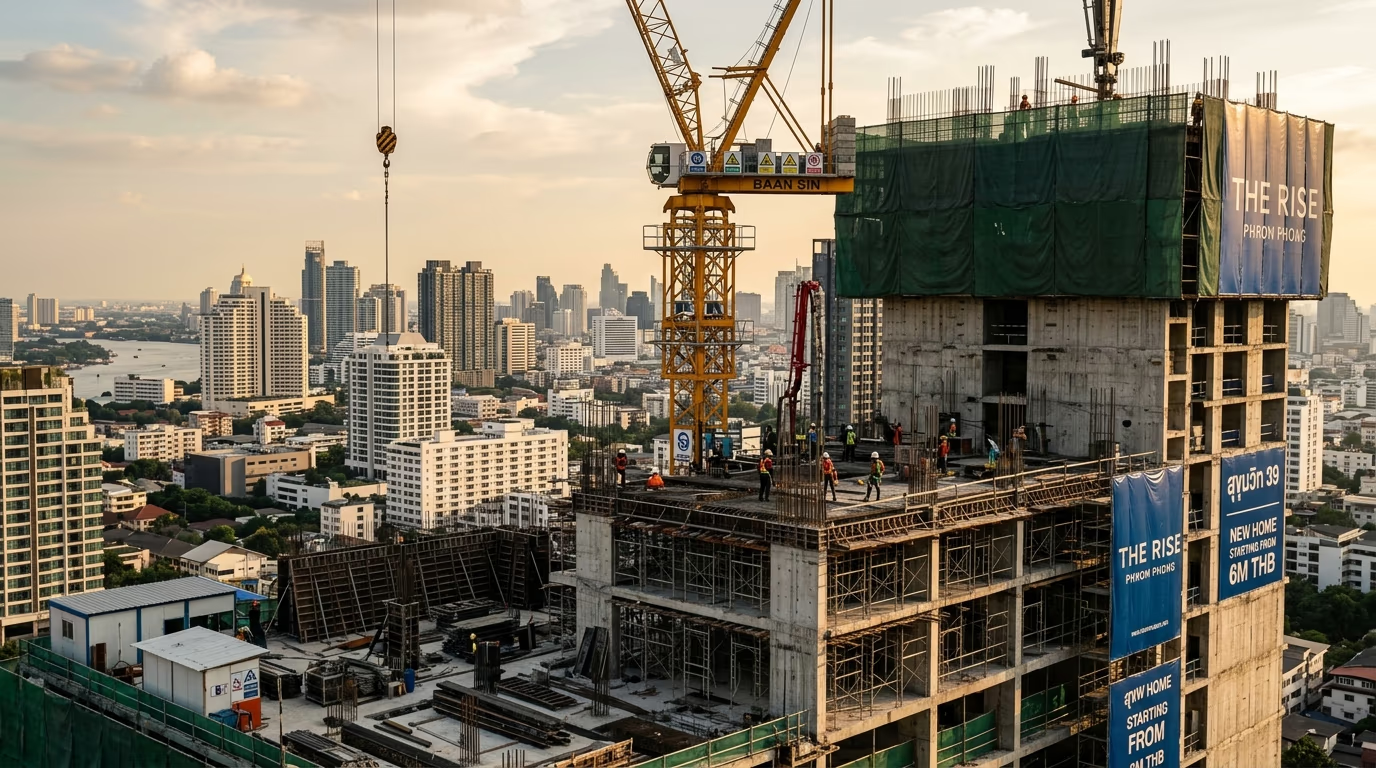
Off-plan condos in Thailand: what you are actually buying
Off-plan condo purchases in Thailand sell at a 10-30% discount to completed stock in the same building, but the buyer carries four distinct risks that do not exist in resale — developer cancellation, developer insolvency, specification and layout change, and delivery slippage of 3-12 months beyond the contracted completion date. The discount is the developer’s price for your cashflow during construction. Whether the discount is worth the risk depends on the project, the developer’s corporate track record, the contract, and the building permit status on the day you sign.
Off-plan purchases are legal and common in Thailand. Most new Bangkok and Pattaya launches move the majority of units at pre-sale, with completed inventory reserved for higher-margin buyers. The Condominium Act B.E. 2522 (1979) governs the completed product. The off-plan transaction itself sits under a hybrid of Thai contract law, the Consumer Protection Board’s standard condominium sale and purchase agreement under the 2015 Notification, the Building Control Act B.E. 2522, and the Environmental Impact Assessment regime under the Enhancement and Conservation of National Environmental Quality Act B.E. 2535. An off-plan buyer is signing a promise to deliver a future unit. The enforceability of that promise depends on the legal status of the project at the moment the contract is signed.
This guide walks through why off-plan is discounted, the standard payment schedule, the legal documents that must exist before your money moves, the contract clauses that matter, the Pattaya and Bangkok off-plan landscape through 2026, and the specific situations where off-plan is the correct choice versus ready-built. Paired with the due diligence checklist, the foreign quota rule, and the cost calculator, it gives a foreign buyer a defensible framework for an off-plan decision.
Why off-plan is cheaper than completed stock
Developers discount off-plan units because pre-sale revenue funds the build. Thai condo construction is typically financed by a blend of bank debt and buyer deposits. The buyer deposit portion is cheaper than bank debt and lowers the developer’s financing cost, which the developer passes on through the pre-sale price. A project selling well at pre-sales also reduces sales-risk on the unsold inventory, which lets the developer build with confidence.
The pre-sale discount ranges from 10% for an established developer in a proven location to 30% or more for a smaller developer launching in a new micro-market. CBRE Thailand’s 2026 outlook documents the pattern across Bangkok, the Eastern Seaboard, and Phuket. The discount compresses as the building progresses. Units sold in the month of launch are cheapest. Units sold at 50% construction complete typically trade at 10-15% above launch. Completed units in the same line then clear at close to or above the developer’s final asking price.
The discount is not a gift. It is the developer’s payment to you for four things: the risk that the project does not complete, the risk that it does not match the marketing materials, the time value of money over 24-48 months, and the liquidity cost of cash tied up that you cannot sell, rent, or live in. If you cannot price all four, you cannot tell whether the discount is rich or cheap.
The off-plan buying process
A standard Thai off-plan purchase follows a five-stage payment sequence: a small booking fee, a reservation deposit, a down payment at contract signing, construction instalments, and a large balloon at handover. The precise schedule varies by developer and by project stage, but the structure is consistent.
Stage 1 — Booking fee
A booking fee of 50,000 to 200,000 THB reserves a specific unit for 7 to 30 days. It is usually non-refundable if the buyer withdraws and usually creditable against the reservation deposit. A booking fee is not a binding purchase — the buyer still has the option to walk after reading the sale and purchase agreement.
Stage 2 — Reservation agreement and reservation deposit
Within the reservation window, the buyer pays a reservation deposit of roughly 5-10% of the purchase price and signs a reservation agreement. This document is the first binding instrument. It should name the registered developer entity (not the marketing brand), the unit number, floor, layout, net and gross area in sqm, the full purchase price, the payment schedule for the remainder, and the expected handover date. It should also state that the unit sits within the building’s 49% foreign freehold quota per Section 19 bis of the Condominium Act.
Stage 3 — Sale and purchase agreement and down payment
The full sale and purchase agreement is executed 30 to 90 days after the reservation agreement with a down payment totalling 20-30% of the purchase price. The SPA replaces the reservation agreement and becomes the governing instrument. Under the 2015 OCPB Notification on the standard form for condominium sales, the SPA must include specific protective clauses for consumers, including detailed delivery specifications, warranty terms, and refund procedures in the event of developer default.
Stage 4 — Construction instalments
Between down payment and handover, the buyer pays construction instalments totalling 10-20% of the purchase price, usually spread across 12-36 months. These are typically tied to construction milestones (foundation complete, 10th floor complete, topping out, internal fitting, final inspection) or to a flat monthly schedule. Missing an instalment triggers default provisions in the SPA, which usually allow the developer to charge interest, suspend construction for the buyer’s unit, or cancel the contract and retain payments already made.
Stage 5 — Balloon at handover
The final 40-60% of the purchase price is paid at handover, concurrent with transfer of freehold title at the Thailand Land Department. The buyer should not pay this balloon before the unit has passed inspection, the Or. Chor. 2 condominium license has been issued, and the foreign quota has been confirmed for that specific unit. The Land Department will register the transfer only if these conditions are in place.
- 1
Stage 1 — Booking fee
50,000-200,000 THB reserves the specific unit; creditable against reservation deposit.
Typical duration: 7-30 days
- 2
Stage 2 — Reservation agreement
5-10% of price, first binding document; names developer entity, unit, foreign-quota status.
Typical duration: Signed within booking window
- 3
Stage 3 — SPA + down payment
20-30% of price under the OCPB 2015 standard form; SPA replaces reservation agreement.
Typical duration: 30-90 days after reservation
- 4
Stage 4 — Construction instalments
10-20% of price paid across construction milestones or flat monthly schedule.
Typical duration: 12-36 months
- 5
Stage 5 — Balloon at handover
40-60% of price at Land Department transfer, concurrent with Or. Chor. 2 issue and foreign-quota confirmation.
Typical duration: On handover
Legal requirements that must exist before you pay
Three legal milestones govern whether a Thai off-plan developer is actually entitled to collect money for future units: the building permit, the EIA approval, and the Or. Chor. 2 condominium license. These are regulated through separate authorities and each carries separate evidentiary weight. A developer that is missing any of them is not legally in a position to deliver a freehold condominium unit.
Building permit
Every condo project requires a building permit (anuyat korsang) issued by the local municipal authority (Tessaban or Or. Bor. Tor.) under the Building Control Act B.E. 2522 (1979). The permit is issued against specific engineering drawings and for a specific land plot. If construction deviates materially from the permitted plan, the permit can be suspended and the building can be ordered modified or demolished at the developer’s cost.
A responsible buyer requires written confirmation of the building permit number and issuing authority before paying the reservation deposit. Thai law does not technically prohibit a developer from collecting reservation deposits before the permit is issued, but the Consumer Protection Board and reputable Thai counsel (Tilleke & Gibbins, Siam Legal) treat pre-permit deposits as a material risk factor. If the permit is not issued or is issued with materially different parameters, the project cannot complete as marketed.
Environmental Impact Assessment
Condominium projects meeting any of three thresholds must obtain EIA approval before construction: 80 or more units, 4,000 sqm or more of usable floor area, or a building height of 30 metres or more. The EIA process sits under the Enhancement and Conservation of National Environmental Quality Act B.E. 2535 (1992) and is administered by the Office of Natural Resources and Environmental Policy and Planning (ONEP).
EIA review can take 6 to 18 months and can require design changes that alter the unit mix, height, or site layout a buyer thought they were purchasing. A project selling off-plan without EIA approval is carrying an open risk that the final product will not match the marketed one. Ask for the EIA approval letter. If it has not been issued, ask what design parameters the developer expects may change during EIA review.
Or. Chor. 2 condominium license
The Or. Chor. 2 license is the formal condominium license issued by the Land Department under Sections 6 and 7 of the Condominium Act. It is what converts a completed residential building into a registrable condominium where individual units can be transferred to foreign and Thai freehold buyers. It is issued late in the process, typically after the building is complete and has passed its final structural inspection.
Until Or. Chor. 2 is issued, no unit in the building can be registered to a foreign buyer at the Land Department. A developer that collects handover payments before Or. Chor. 2 issuance is asking the buyer to trust that the license will eventually be granted. In practice, for an established developer with a history of Or. Chor. 2 issuance on previous projects, this risk is low. For a new developer with no track record, it is not.
The off-plan sale and purchase agreement
Thailand’s Consumer Protection Board issued a standard-form sale and purchase agreement for condominium units in 2015, updated periodically, which the developer is expected to use as the baseline. The standard form sets out mandatory protective terms: defined unit specifications, delivery date, warranty period, refund procedure on developer default, and procedure for transfer at the Land Department. Developers can add clauses but cannot contract out of the protective terms.
Clauses that matter to a foreign buyer
Unit specifications. The SPA should specify the exact unit number, floor, orientation, net and gross sqm, finish specifications (flooring, kitchen, bathroom), appliances if any, ceiling height, and attached items (parking slot number, storage unit). Vague specifications (“similar quality to the show unit”) are a red flag.
Delivery date and slippage. The SPA should name a specific expected completion month, the final delivery deadline, and the consequences of slippage. Reputable developers will allow 3-6 months of grace without penalty, with escalating penalties (daily damages or refund rights) beyond that. Siam Legal’s standard review recommends negotiating a buyer’s right to rescind with full refund if slippage exceeds 12 months.
Foreign quota. The SPA should confirm that the specific unit sits within the building’s 49% foreign allocation under Section 19 bis of the Condominium Act. Without this clause, the buyer is exposed to the Land Department refusing to register the unit in a foreign name at handover.
Payment schedule and default. Buyer default provisions should be proportionate. A developer that retains the full down payment on a single missed construction instalment is setting a punitive default term. A proportionate penalty is a late-payment interest charge plus a procedure for cure before cancellation.
Developer default. The SPA should specify what happens if the developer cannot deliver. This is the clause buyers read last and should read first. Ideal terms include full refund plus interest within a defined period, right to claim against a building guarantee or escrow, and right to assign the unit to a third party.
Material change. Developers sometimes reserve the right to change the unit layout, size, or finish specifications “as construction requires”. A protective clause caps the change at a low percentage (commonly 3-5%) with right of rescission above that threshold.
Governing law and jurisdiction. Thai law, Thai courts. Any clause moving jurisdiction offshore or to arbitration in a non-Thai seat is a red flag for a Thai condo purchase.
Red flags in off-plan SPAs
- SPA signed in a language the buyer does not read, without a certified translation.
- SPA names a marketing brand rather than the registered Thai developer company. Always cross-check the named party against the DBD company registry.
- No reference to the 2015 OCPB standard form at all.
- Payment wired to a personal Thai bank account rather than the named developer’s corporate account.
- No refund clause on developer default.
- No cap on unit specification changes.
- Handover triggered by developer-declared “practical completion” rather than issuance of Or. Chor. 2 and physical delivery.
Independent legal review before signing is the single highest-return defensive spend in an off-plan purchase. Typical fee: 25,000 to 60,000 THB depending on project complexity. See due diligence checklist for the full procedure.
Risks specific to off-plan purchases
Off-plan buyers carry four risks that resale buyers do not: cancellation, insolvency, specification change, and delivery slippage. Each has historical precedent in the Thai market and each has a specific mitigation.
Project cancellation
A developer can cancel a project before construction if sales do not reach the internal threshold required to secure bank financing, if the EIA is rejected, if the building permit is revoked, or if market conditions deteriorate materially. The buyer is entitled to a refund under the standard SPA. Recovery depends on the developer’s financial position at the time of cancellation. Established listed developers typically refund promptly. Smaller private developers sometimes require litigation.
Developer insolvency
Thai law does not mandate escrow for condo pre-sales. Unless the developer voluntarily uses an escrow agent under the Escrow Business Act B.E. 2551 (2008), buyer deposits sit on the developer’s balance sheet and are exposed to the developer’s general creditors if the company enters insolvency. The Department of Business Development (DBD) public registry shows registered capital, paid-in capital, director list, and annual filings. A developer with minimal paid-in capital and no track record of completed projects is carrying a higher insolvency risk than a publicly-listed developer with Bt 5 billion+ in equity.
Specification and layout change
Projects often change between marketing and delivery. The amenity mix can shrink. The landscaping can be reduced. Unit finishes can be downgraded. Car park ratios can be cut. Some of these changes are legitimate responses to EIA review or construction cost escalation. Others are margin recovery exercises by the developer. The SPA’s specification and material-change clauses govern the buyer’s remedies.
Delivery slippage
A typical Thai off-plan project delivers 3 to 12 months late against the SPA completion date. Published Bangkok data and CBRE’s project tracking suggest 6-month slippage is roughly average across the market. Projects by first-time developers or in complex regulatory environments slip longer. A buyer relying on the condo for a dated purpose (lease-up, residency move, retirement timing) must build in a slippage buffer or negotiate a date-certain rescission right.
Escrow and guarantees
Escrow is available in Thailand under the Escrow Business Act B.E. 2551 (2008) but is not mandatory for condo pre-sales. An escrow agent holds buyer deposits in a ring-fenced account and releases funds to the developer only on defined milestones. Escrow insulates buyer deposits from developer insolvency. It does not protect against project cancellation or design change, but it substantially reduces the financial loss in a worst-case developer failure.
Escrow adoption has grown since 2020, particularly among Bangkok developers targeting foreign buyers. Some listed developers now offer escrow as a standard option for international purchasers. A buyer who cannot negotiate full escrow can often negotiate partial escrow on specific instalments or on the balloon payment, or negotiate a bank-issued performance guarantee in favour of the buyer. The Tilleke & Gibbins and Forbes & Partners briefings both flag escrow as a rising norm for international transactions.
If a developer refuses any form of escrow or performance guarantee, the buyer is accepting full insolvency risk. That risk is priced in the discount, and the buyer should decide whether the discount is adequate. For a BOI-listed top-tier developer, the risk is demonstrably low. For a first-time developer, it is not.
The Pattaya and Bangkok off-plan landscape 2026
Pattaya and Bangkok remain the two deepest off-plan markets in Thailand, with Phuket the third, each with distinct developer cohorts and risk profiles. The Cushman & Wakefield Thailand Market Beat Q1 2026 and CBRE’s 2026 outlook both report Bangkok condo absorption stabilising after a multi-year oversupply cycle, while Pattaya off-plan supply is increasingly skewed toward foreign buyers in the Wongamat, Jomtien, and Na Jomtien micro-markets.
Developer cohorts
The publicly-listed Thai developers (Sansiri, Ananda, Pruksa, Supalai, AP Thailand, Noble Development, LPN Development, Origin Property, among others) publish annual reports, maintain audited DBD filings, and carry reputational incentives that affect how off-plan projects are delivered. Their pre-sale discounts are smaller (10-15%) but their delivery risk is lower.
A second tier of private Thai developers (including branded-residence partners with international hotel groups, boutique Bangkok developers, and Pattaya specialists) operates with more variable track records. Due diligence on this tier matters more than it does for the listed cohort.
A third tier of micro-developers and single-project SPVs carries meaningfully higher risk. Historical cases — some documented in Thai and international property press, some investigated by the DSI — show first-time developers running out of financing, selling beyond permitted density, or dissolving the SPV before completion. Buying off-plan from a first-time developer is a structurally different transaction from buying off-plan from Sansiri.
How to verify a specific developer
- Pull the DBD record at datawarehouse.dbd.go.th. Check registered capital, paid-in capital, director list, and whether annual financial statements have been filed for the last three years.
- List the completed projects visible on Thai property portals (Hipflat, DDproperty, Baania) under the developer’s name. Cross-check against the corporate entity.
- Review any ongoing projects. Are they delivering on schedule? Are there buyer complaints on Thai property forums or Pantip threads that cite specific issues?
- Ask reputable Thai counsel for a background review. Firms like Tilleke & Gibbins, Siam Legal, Forbes & Partners, and larger regional firms maintain current intelligence on developer reputations.
Cashback, free furniture, and guaranteed yield in off-plan
“Free furniture”, “cashback at transfer”, and “guaranteed rental return” offers attached to off-plan units are almost always funded by a proportional increase in the list price. The buyer who takes the incentive is paying for it through a higher cost basis, which affects appraisal, resale, and any loan-to-value calculation.
A 500,000 THB “free furniture package” offered on a 5 million THB unit is not a 10% discount. It is a 10% markup. The pre-sale price was set to fund the incentive. A buyer who asks for the incentive removed, or for it redirected to a direct price reduction, will usually find the developer either agrees (revealing the markup) or refuses (revealing that the incentive is the marketing hook and the underlying unit does not move at the list price).
Guaranteed rental return attached to off-plan is a separate category of risk. The guarantee is only as strong as the developer’s ability to rent the unit at a rate that funds the guaranteed payment plus operating costs. When occupancy drops, developers default, restructure, or withdraw the guarantee. See the Thailand condo scams guide for the full legal and commercial breakdown.
When off-plan makes sense versus ready-built
Off-plan is the correct choice when the buyer’s discount compensates adequately for the four off-plan risks, the buyer has a long enough holding period to wait out construction, and the specific unit is demonstrably superior to anything available ready-built. It is the wrong choice for buyers who need occupancy within 12 months, for buyers whose investment case relies on immediate rental cashflow, and for buyers who cannot absorb a 15-25% loss in a worst-case cancellation scenario.
Off-plan favours: investors with multi-year horizons, buyers targeting the earliest stages of a new launch cycle in an under-supplied micro-market, buyers who want the best unit (floor, view, line) in a building rather than scraps of inventory after completion, and buyers buying from a listed developer with a proven handover track record.
Ready-built favours: buyers who need occupancy or rental cashflow inside 12 months, buyers who want to physically inspect finishes and building quality before purchase, buyers who are price-sensitive to the 10-15% discount but cannot absorb the tail risk, and buyers entering markets with a high ratio of completed but unsold stock (oversupplied Bangkok sub-markets often fall in this category).
Model both paths with the cost calculator and the yield calculator before committing. Off-plan’s discount only outperforms ready-built if the project completes on spec and on schedule.
Off-plan verification checklist
Before signing any binding document, verify each of the following.
- Registered developer corporate entity named in all documents (cross-check against DBD).
- Building permit issued, number and issuing authority documented.
- EIA approval letter received (required for 80+ unit or 4,000+ sqm or 30+ m projects).
- Land ownership of the project plot verified at the Land Department.
- Sale and purchase agreement follows 2015 OCPB standard form.
- Specific unit number, floor, sqm, and foreign-quota status written into the SPA.
- Payment schedule proportionate, with defined default procedures.
- Developer default clause with full-refund-plus-interest remedy.
- Material change clause capped at 3-5% of specifications.
- Delivery date specified with slippage penalty or buyer rescission right.
- Payment wired to named corporate account only, with FET form for foreign-currency remittance.
- Independent Thai lawyer engaged before signing.
Off-plan FAQ
How much deposit do I pay on an off-plan Thai condo?
Typical structure: 50,000-200,000 THB booking fee, 5-10% reservation deposit, 20-30% down payment at SPA signing, 10-20% construction instalments, 40-60% balloon at handover. The full pre-handover commitment is 40-60% of the purchase price across 12-36 months.
Is escrow legally required for off-plan condo purchases in Thailand?
No. Escrow is available under the Escrow Business Act B.E. 2551 (2008) but is not mandatory. Adoption is growing, particularly for international buyers. A buyer who cannot negotiate escrow is accepting full developer insolvency risk on all funds paid before handover.
What happens if the developer cancels the project?
Under the standard OCPB sale and purchase agreement, the buyer is entitled to a refund of paid amounts, sometimes with interest. Recovery speed depends on the developer’s financial position. Listed developers typically refund promptly. Private developers may require litigation or a DBD-filed civil claim.
Can foreigners buy off-plan condos in Thailand?
Yes. Foreigners can buy off-plan units within the building’s 49% foreign freehold quota under Section 19 bis of the Condominium Act. The SPA should confirm the unit’s quota status explicitly. Foreign-currency remittance must be documented with a Foreign Exchange Transaction (FET) form from the receiving Thai bank.
How late do Thai off-plan condos typically deliver?
Typical slippage is 3-12 months past the SPA contractual completion date. Six months is roughly the market average based on CBRE and Cushman & Wakefield project tracking. First-time developers and projects in complex regulatory environments slip longer. Buyers with dated occupancy needs should negotiate a rescission right for slippage above 12 months.
Should I buy off-plan or ready-built?
Off-plan if you have a multi-year horizon, want the best unit inventory at launch, and can absorb cancellation risk. Ready-built if you need near-term occupancy or cashflow, want to inspect the finished product, or are entering an oversupplied market where completed unsold stock trades at a deeper discount than the pre-sale.
How do I verify a Thai developer’s track record?
Pull the DBD corporate record at datawarehouse.dbd.go.th for registered capital, director list, and annual filings. Cross-check against named completed projects on Thai property portals. Review ongoing-project delivery performance. For any deal above 10 million THB, engage reputable Thai counsel for a background review.
What is the Or. Chor. 2 license?
Or. Chor. 2 is the condominium license issued by the Thailand Land Department under Sections 6 and 7 of the Condominium Act B.E. 2522. It converts a completed residential building into a registrable condominium where individual units can be transferred to foreign and Thai freehold buyers. Until Or. Chor. 2 is issued, no unit can be registered in a foreign name.
Is the building permit enough to start taking pre-sale deposits?
Legally, yes — but the responsible practice is to insist on the building permit and EIA approval before paying the reservation deposit. Pre-permit deposits carry the risk that the project never secures its permits as marketed, which can materially alter unit count, floor heights, and amenities.
Where do I find the 2015 OCPB standard condominium contract?
The Office of the Consumer Protection Board publishes the standard form and its amendments at ocpb.go.th. Any Thai-qualified real estate lawyer (Tilleke & Gibbins, Siam Legal, Forbes & Partners, among others) can supply a current English summary of the mandatory terms and the clauses that remain negotiable.
References
Sources
- 01Office of the Consumer Protection Board (OCPB), Standard Contract for Sale and Purchase of Condominium Units (2015 Notification as amended) · https://www.ocpb.go.th/Off-plan sale and purchase agreements must comply with Consumer Protection Board standard form for condominium pre-sales. Accessed 2026-04-16.
- 02Condominium Act B.E. 2522 (1979), Sections 6 and 7; Thailand Land Department procedures · https://www.dol.go.th/Condominium license (Or. Chor. 2) and building permit required before foreign-freehold unit registration. Accessed 2026-04-16.
- 03Office of Natural Resources and Environmental Policy and Planning (ONEP), EIA Notification under the Enhancement and Conservation of National Environmental Quality Act B.E. 2535 (1992) · https://www.onep.go.th/Environmental Impact Assessment required for condominiums of 80 units or more or 4,000 sqm usable area. Accessed 2026-04-16.
- 04Building Control Act B.E. 2522 (1979), as amendedBuilding Control Act governs building permits issued by local municipal or Tessaban authority. Accessed 2026-04-16.
- 05Tilleke & Gibbins, Thailand Real Estate Legal Briefings 2024-2026 · https://www.tilleke.com/insights/Tilleke & Gibbins property briefings on Thai off-plan contracts, developer insolvency, and escrow practice. Accessed 2026-04-16.
- 06Siam Legal International, Thailand Real Estate Resources · https://www.siam-legal.com/realestate/Siam Legal International practical guides on Thai off-plan reservation agreements and SPA review. Accessed 2026-04-16.
- 07Department of Business Development (DBD), Ministry of Commerce · https://datawarehouse.dbd.go.th/Department of Business Development public registry for Thai developer company records. Accessed 2026-04-16.
- 08CBRE Thailand Real Estate Market Outlook 2026 · https://www.cbre.co.th/insights/reports/thailand-real-estate-market-outlook-2026CBRE Thailand market outlook on Bangkok and Pattaya pre-sales pricing gap vs completed stock 2026. Accessed 2026-04-16.
- 09Condominium Act B.E. 2522 (1979), Section 19 bis, amended by Condominium Act (No. 4) B.E. 2551 (2008)Condominium Act foreign quota cap of 49% of saleable area per building. Accessed 2026-04-16.
- 10Escrow Business Act B.E. 2551 (2008)Escrow Business Act provides the legal framework for voluntary escrow services for real estate transactions. Accessed 2026-04-16.
- 11Bank of Thailand, foreign exchange regulations · https://www.bot.or.th/FET (Foreign Exchange Transaction) form requirement for foreign-currency remittance into a Thai condo purchase. Accessed 2026-04-16.
- 12Cushman & Wakefield Thailand Market Beat Q1 2026 · https://www.cushmanwakefield.com/en/thailand/insights/thailand-marketbeatCushman & Wakefield market data on Bangkok and Eastern Seaboard launch pipeline and absorption rates. Accessed 2026-04-16.
Published · How we research and date our content