Transfer Money to Thailand for a Condo: FET Form & SWIFT
Foreign funds for a Thai condo purchase arrive via SWIFT in foreign currency and must be documented with a Foreign Exchange Transaction (FET) form from the Thai bank.
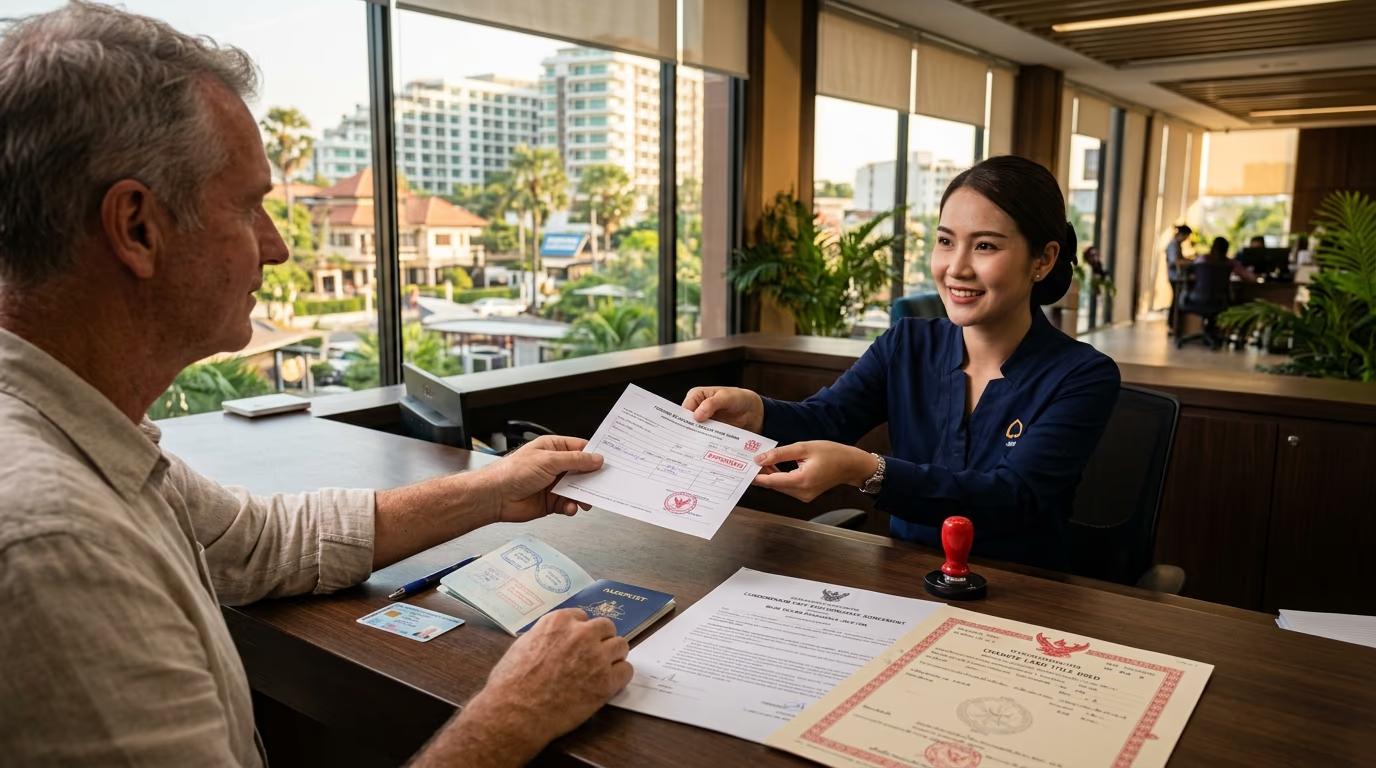
How a foreign condo purchase actually gets funded
Funds for a foreign-quota condominium purchase in Thailand must arrive from overseas in foreign currency (USD, SGD, EUR, GBP, AUD, JPY, HKD are all accepted), be received by a Thai commercial bank, and be converted to Thai baht inside Thailand. The receiving bank issues a Foreign Exchange Transaction (FET) form — formerly called a Thor Tor 3 — that the Land Department uses as evidence that the funds qualify under Section 19 bis of the Condominium Act to register the unit under the 49% foreign quota. Below USD 50,000 per transaction the FET form is no longer mandatory under Bank of Thailand regulations, but it remains the documentation the Land Department asks for, and banks issue it on request in almost every condominium purchase scenario. Without a proper FET trail, a foreign buyer cannot register a unit on foreign quota and cannot later repatriate sale proceeds in foreign currency without complication.
This guide walks through the full transfer mechanics: why the FET form matters, SWIFT versus money-service-business routes, receiving-bank choice, FET procurement procedure, exchange-rate timing, forward contracts for large deals, AMLO source-of-funds scrutiny, the tax position on inbound and outbound flows, and how to set up the paperwork now so the sale 5 or 10 years out repatriates cleanly.
Why the FET form is the document that matters
The FET form is not a tax document, it is not a currency-control permit, and it is not optional paperwork. It is the evidence trail the Thai Land Department requires under Section 19 bis of the Condominium Act to confirm that a foreign buyer’s purchase funds meet the statutory condition for foreign-quota registration — namely that the funds originated overseas, arrived in foreign currency, and were converted to baht inside Thailand. See foreign quota 49 percent rule for how the quota itself works.
The FET form states: the remitter’s name and country of origin, the amount in foreign currency and baht, the exchange rate on the conversion date, the Thai recipient’s name and bank account, and the stated purpose of the remittance. For a condo purchase the stated purpose must read “purchase of condominium unit” (or the Thai equivalent) and ideally reference the property by project name or unit number. When the Land Department reviews the transfer registration, it matches the name on the FET form to the name on the buyer’s passport and the name on the sale contract.
The FET form also matters at exit. When the unit is sold, proceeds must be repatriated in the reverse direction if the seller wants to move them out in foreign currency. The receiving-overseas bank and the Thai outbound bank will ask for the original FET form that accompanied the inbound purchase to support the repatriation. Without the original FET on file, the outbound remittance can still happen, but it becomes a more administratively heavy process and, for large amounts, can trigger deeper AMLO review. See condo resale Thailand and capital gains tax condo for the sale-side sequence.
SWIFT mechanics: how the money moves
A cross-border wire to a Thai commercial bank runs over the SWIFT network. The sequence is standard:
- The buyer instructs their home-country bank to wire an amount in foreign currency to a Thai commercial bank, citing the SWIFT BIC code of the Thai bank and the beneficiary account details (name, account number, Thai branch).
- The home-country bank sends a SWIFT MT103 message to the Thai bank, routed through one or more correspondent banks that hold nostro accounts in the remittance currency.
- The Thai bank receives the foreign-currency credit, typically within 1-3 business days, and holds it in a foreign-currency account in the beneficiary’s name.
- The beneficiary (the buyer) instructs the Thai bank to convert to baht. The bank converts at its prevailing rate (commercial rate, which includes a spread on the interbank mid-rate) and credits the baht-denominated account.
- On request, the Thai bank issues the FET form documenting the inbound remittance, the conversion, and the purpose.
Typical fees: sending-bank outbound SWIFT charge of USD 25-50, correspondent-bank fees of USD 10-30 (sometimes waived depending on routing), and receiving-bank inbound charge of 200-500 THB at the Thai end. For a USD 500,000 purchase, total wire costs are typically USD 70-100 — modest against the transaction value.
The FX cost is larger. Thai commercial banks convert at a spread of roughly 0.5-1.5% away from the interbank mid-rate for typical retail-amount condo purchase conversions. On USD 500,000 that spread is USD 2,500-7,500. Comparing bank quotes on conversion day — or pre-booking a rate with the bank’s treasury desk for transfers above roughly USD 200,000-300,000 — is worth the effort.
Choosing the receiving Thai bank
All major Thai commercial banks handle inbound foreign-currency remittances and issue FET forms. The practical choices are:
- Bangkok Bank — the largest commercial bank, strong foreign-customer desk at head-office and main city branches, long-standing default for foreign property buyers. English service strong at central Bangkok, Pattaya Beach Road, Phuket Patong, and Chiang Mai main branches.
- Kasikornbank (KBank) — excellent digital tools (K PLUS app), strong foreign-customer support in Bangkok and Pattaya, efficient FET form workflow.
- Siam Commercial Bank (SCB) — broad branch network, good English service, fast inbound remittance processing.
- Krungsri (Bank of Ayudhya) — MUFG-owned, strong corporate FX desk, competitive on treasury-booked rates for larger transfers.
- Krungthai Bank — state-owned; common choice for government-employee accounts but less used by foreign buyers.
- UOB Thailand, CIMB Thai, Standard Chartered Thailand — relevant if the buyer already holds a UOB, CIMB, or SCBT relationship in Singapore, Malaysia, or Hong Kong, in which case in-network routing can be faster and cheaper.
Practical guidance: open the Thai account at a branch in the city where the condo is located, if possible at a branch with confirmed English-speaking staff. A Bangkok-resident account can still receive funds for a Pattaya or Phuket purchase, but face-to-face FET retrieval is easier at a local branch.
Most Thai banks allow foreign non-resident account opening with the condo sale contract, passport, and visa (any visa class) as supporting documents. Some branches ask for a Thai address — a hotel reservation or the developer’s confirmation of intended unit address is usually accepted.
Requesting the FET form: timing and wording
The FET form is not issued automatically. It must be requested from the receiving bank, ideally within a few days of the inbound credit and before the funds leave the inbound account for the seller’s bank. Some banks issue the FET in a few hours at the branch counter; others take 1-2 weeks depending on head-office processing. For a purchase heading to a Land Department transfer date, request the FET the moment the foreign-currency credit lands, not the day before transfer.
The form should cite the purpose as “purchase of condominium unit” (or the Thai equivalent, ซื้อห้องชุด), and ideally include the project name and unit number. Land Department clerks have accepted generic “real estate purchase” wording but specific wording removes friction. Keep the original FET form — the Land Department returns it to the buyer after transfer registration, and it must be stored for the lifetime of ownership.
Where a purchase is funded across multiple wires — for example a booking fee, an installment payment schedule on an off-plan unit, and a final balance at transfer (buy condo Thailand foreigner) — each wire above the FET threshold gets its own FET form, and all FET forms must sum to the registered purchase price.
Below USD 50,000: Wise, Revolut, and money-service businesses
The Bank of Thailand’s current foreign-exchange framework sets the formal FET-form reporting threshold at USD 50,000 equivalent per transaction. Below that amount, the FET form is not required by banking regulation — but the Land Department’s practice is to ask for one regardless, because Section 19 bis of the Condominium Act requires evidence of overseas-origin foreign-currency funds and the FET form is the accepted evidence.
Money-service businesses — Wise, Revolut, OFX, Instarem — deliver Thai baht to the beneficiary’s Thai bank account by local payment rails after converting offshore; they do not route through SWIFT as a foreign-currency remittance into Thailand, which means they do not generate a FET form. For a small transfer (tuition, living costs, small retainer) this is cheap and fast. For a condo purchase on foreign quota it is the wrong rail, because the Land Department will not accept a baht-denominated domestic transfer as Section 19 bis evidence.
Where Wise-style rails are useful:
- Booking deposits below the local-transfer scrutiny threshold, for speed — provided the main purchase funds still route via SWIFT in foreign currency and a FET is generated on the main tranche.
- Legal fees, inspection fees, broker fees — where FET is not required.
- Living expenses unrelated to the purchase.
Never fund the purchase price itself through Wise, Revolut, or similar if foreign-quota registration is required.
Exchange-rate timing and forward contracts
The USD/THB rate was around 36.5 in early 2024, 34.5-35.5 through 2025, and 33-35 in early 2026. Movement of 2-3% over a 30-60 day purchase window is normal; movement of 5-7% over a longer off-plan timeline is plausible. On a USD 500,000 purchase, a 3% swing is USD 15,000 — material against the total.
Two tools mitigate the timing risk:
- Convert-at-receipt — convert foreign currency to baht immediately on arrival, fixing the purchase cost in baht terms. Appropriate where the transfer date is close and the buyer wants rate certainty.
- Forward contract — book a forward with the Thai bank’s treasury desk (or a sending-bank FX desk), locking a rate for a future settlement date matching the transfer. Available at most major Thai banks for amounts above roughly USD 200,000-300,000 with documented underlying (the sale contract). Forwards typically price at a small premium or discount to spot depending on the interest-rate differential. Appropriate for off-plan purchases with installment schedules 6-24 months ahead.
For purchases under USD 200,000 the forward market is usually not available at retail scale; timing risk is managed by converting in tranches or by converting at receipt.
AMLO scrutiny: source of funds for larger transfers
Under the Anti-Money Laundering Act B.E. 2542, Thai banks carry customer due diligence obligations that scale with transaction size. Inbound property wires above roughly USD 200,000 equivalent routinely trigger a source-of-funds questionnaire from the receiving bank. This is standard and not a red flag. The bank will ask the buyer for: employment or business ownership details, a narrative of how the funds were accumulated, and supporting documents — payslips, employer letter, sale contract of a property sold overseas, corporate distribution statement, inheritance letter, brokerage statement showing the position liquidated to fund the purchase.
Respond promptly and with documentary support. Banks have escalation timelines; unexplained delays trigger enhanced review. For buyers moving funds out of jurisdictions with elevated money-laundering risk scores, or for buyers whose profession sits on the bank’s enhanced-due-diligence list, expect more detailed questions and allow an additional 1-2 weeks in the transfer plan.
Tax on inbound and outbound flows
There is no inbound tax on foreign funds remitted to Thailand for a property purchase. The funds are not income to the buyer in Thailand, they are capital being deployed into an asset. Thai personal income tax does not attach to the remittance, and there is no stamp duty or transfer tax on the wire itself.
Outbound repatriation of sale proceeds is different. To remit sale proceeds out of Thailand in foreign currency, the seller needs: the original FET form from the purchase, a tax clearance confirmation that Land Department withholding has been paid (capital gains tax condo and transfer fees taxes), and documentation that the outbound amount does not exceed the original inbound amount plus realised gain. Where the sale price exceeds the original purchase price, the gain portion can still be repatriated but the bank will ask for the tax-paid evidence from the Land Department transfer receipt.
Setting up now for a clean exit years later
Three disciplines during purchase avoid exit-side friction:
- Keep the original FET form, Land Department receipt, and sale contract together. Store scanned copies in secure cloud backup as well. Any of these documents lost after 5-10 years materially complicates the repatriation.
- Register the unit in the same name as the FET remitter and the passport. Mismatches — funds wired from a joint family account but unit registered solely, or a nominee remitter — create the kind of documentation gap that takes weeks to reconcile at exit.
- Use a named Thai bank account the buyer controls. Do not fund the purchase through the developer’s holding account or through a broker-managed escrow unless the chain is watertight; the FET trail should read buyer overseas → buyer Thai account → seller Thai account.
For the broader buying sequence including legal, due diligence, and transfer mechanics, see buy condo Thailand foreigner, due diligence checklist, and condominium Act Thailand.
FAQ
Do I need a Thai bank account to buy a condo?
Effectively yes. The Land Department accepts a FET form from a Thai commercial bank as Section 19 bis evidence, and the FET form is issued to the Thai-account beneficiary. It is theoretically possible to wire directly to the seller’s Thai account and have the seller’s bank issue the FET, but the form then carries the seller’s name rather than the buyer’s and is not usable evidence for the buyer’s registration. Open a Thai account in the buyer’s name and route through it.
What if I am buying from overseas sale proceeds — can I use those?
Yes. Funds from an overseas property sale, brokerage liquidation, or overseas employer distribution all qualify, as long as the wire originates outside Thailand in foreign currency. Keep the overseas sale contract or liquidation statement available for the bank’s source-of-funds questionnaire.
How long before transfer should I start the transfer?
Plan on 3-4 weeks before the Land Department transfer date for a clean SWIFT + conversion + FET issuance + contingency buffer. For a purchase above USD 500,000 or where source-of-funds documentation is more involved, allow 5-6 weeks.
Can I use cryptocurrency to fund a condo purchase?
No. Section 19 bis requires foreign currency remitted through a Thai commercial bank. Crypto-to-baht off-ramp services cannot generate a FET form, and the Land Department will not register the unit on foreign quota.
What currency should I send?
Send in the currency you hold. Thai banks receive USD, EUR, GBP, SGD, JPY, AUD, HKD, and others, and convert each at the prevailing spread. Converting at the sending end (for example USD to SGD before remitting) adds an extra conversion cost without benefit. Send in the natural currency and convert once in Thailand.
References
Sources
- 01Condominium Act B.E. 2522 (1979), Section 19 bis, as amended · https://www.krisdika.go.th/Section 19 of the Condominium Act B.E. 2522 requires a foreign buyer to remit funds into Thailand in foreign currency and convert to Thai baht inside Thailand in order to register a unit under the 49% foreign quota; the receiving bank's Foreign Exchange Transaction (FET) form is the evidence accepted by the Land Department. Accessed 2026-04-16.
- 02Exchange Control Act B.E. 2485 (1942), as amended; Bank of Thailand Notifications on Foreign Exchange · https://www.bot.or.th/en/our-roles/financial-markets/foreign-exchange-regulations.htmlThe Bank of Thailand regulates cross-border capital flows under the Exchange Control Act B.E. 2485 (1942) and supervises commercial banks' issuance of FET forms for inbound remittances. Accessed 2026-04-16.
- 03Bank of Thailand, Foreign Exchange Regulations — Inbound Remittance Reporting · https://www.bot.or.th/en/our-roles/financial-markets/foreign-exchange-regulations.htmlThe Bank of Thailand's current relaxed foreign exchange regulation framework (Ministerial Regulation issued 2020 and subsequent BOT notifications) sets the FET-form reporting threshold for inbound remittances at USD 50,000 equivalent per transaction. Accessed 2026-04-16.
- 04Thailand Department of Lands, Condominium Transfer Registration Procedures · https://www.dol.go.th/Land Department registration of a foreign-quota condominium transfer requires evidence that funds originated overseas in foreign currency, produced through the Foreign Exchange Transaction form issued by the receiving Thai commercial bank. Accessed 2026-04-16.
- 05Anti-Money Laundering Act B.E. 2542 (1999), as amended; AMLO guidance on customer due diligence · https://www.amlo.go.th/Anti-Money Laundering Office (AMLO) scrutiny of inbound remittances is enhanced above the cash-threshold reporting level; property-purchase wire transfers above USD 200,000 equivalent commonly trigger a source-of-funds questionnaire from the receiving Thai bank. Accessed 2026-04-16.
- 06Bank of Thailand, licensed commercial bank directory 2026 · https://www.bot.or.th/en/financial-institutions/financial-institutions-in-thailand.htmlBangkok Bank, Kasikornbank (KBank), Siam Commercial Bank (SCB), Krungthai Bank, Krungsri (BAY), and UOB Thailand are the primary Thai commercial banks receiving foreign-currency remittances for condominium purchases and issuing FET forms. Accessed 2026-04-16.
- 07Tilleke & Gibbins, Thailand Real Estate Legal Briefings 2024-2026 · https://www.tilleke.com/insights/Tilleke & Gibbins practitioner guidance on Foreign Exchange Transaction form procurement, foreign-quota funding mechanics, and repatriation of sale proceeds. Accessed 2026-04-16.
- 08Siam Legal International, Thailand Real Estate Resources · https://www.siam-legal.com/realestate/Siam Legal International guidance on FET form procurement timeline, purpose-of-remittance wording, and typical Thai bank receiving fees for condominium purchase wires. Accessed 2026-04-16.
- 09Bank of Thailand Payment Systems Committee; Wise Thailand operating disclosures · https://wise.com/help/articles/2932175/thailand-payments-explainedWise (formerly TransferWise) and similar money-service businesses are licensed in Thailand and provide retail cross-border transfers below typical FET-reporting thresholds; their transfers do not generate a FET form because they deliver baht to the Thai account rather than foreign currency. Accessed 2026-04-16.
- 10Bank of Thailand, daily reference rates; Bank for International Settlements effective exchange rate series · https://www.bot.or.th/en/statistics/exchange-rate.htmlUSD/THB exchange rate trajectory showing Thai baht at approximately 36.5 THB/USD in early 2024, 34.5-35.5 range through 2025, and trading in the 33-35 range in early 2026. Accessed 2026-04-16.
Published · How we research and date our content