Capital Gains Tax on Thai Condos: What Foreigners Pay (2026)
Thailand has no separate capital gains tax. Condo sale gains are taxed as ordinary income with a years-held reduction. Withholding at transfer, rates, worked examples.
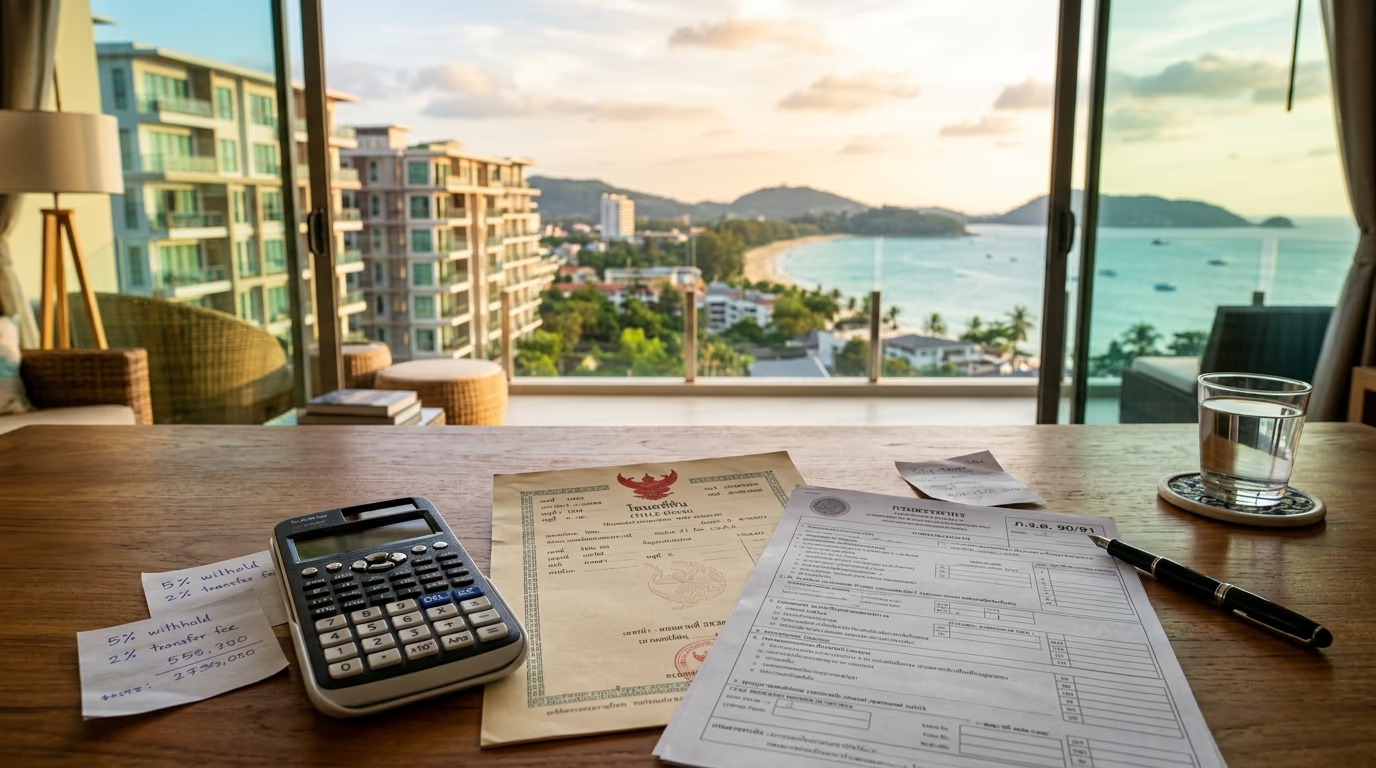
Thailand has no separate capital gains tax for individuals. Gains on the sale of a condominium are treated as ordinary assessable income under Thai Revenue Code Section 40(8), with a years-held reduction schedule applied under Section 48(4), and the tax is collected by withholding at the Land Department at transfer under Section 50(5). The withholding is computed on the Land Department’s appraised value of the unit, not on the declared sale price, and the seller can either accept the withholding as final or file a PND 90/91 return to reclaim the excess if personal tax liability is lower. For sales within 5 years of acquisition, a 3.3% Specific Business Tax also applies; after 5 years the SBT is replaced by 0.5% stamp duty.
This guide walks through the withholding formula, the years-held reduction, worked examples, the SBT-versus-stamp-duty threshold, when to file for a refund, how foreign sellers are treated, tax-treaty interaction for US, UK, Canadian, Australian, and EU resident sellers, and the planning levers that materially change the tax bill.
- Transfer fee 2% (seller 50% share of 3.4M appraised) 34k THB (7.1%)
- Specific Business Tax 3.3% of 5M (held <5yr) 165k THB (34.6%)
- Withholding tax (Section 50(5), 3 yrs, 77% taxable) 87k THB (18.2%)
- Agent commission (3% market standard) 150k THB (31.4%)
- Juristic no-arrears cert + legal 41k THB (8.6%)
No separate capital gains tax — gains are taxed as ordinary income
Thailand does not have a dedicated capital gains tax regime for individuals on real estate. Section 40(8) of the Revenue Code classifies the gain on sale of a condominium as “income from sale of immovable property,” which is one of the eight categories of assessable income. This is the same statutory basket as lottery winnings, sale of other assets, and miscellaneous profits. The tax rate is the ordinary progressive individual income tax rate — 0% to 35% — but the taxable base is computed on a separate and more favourable basis than ordinary salary or business income.
The favourable basis is Section 48(4): when immovable property is not acquired for commercial purposes, the seller can elect to compute tax on the gain separately from other income, applying a statutory deduction schedule based on years held. This separation means the condo gain does not push the seller into higher ordinary income brackets, and the years-held reduction significantly compresses the taxable amount for longer-held units.
Because tax is collected by withholding at the Land Department under Section 50(5), most sellers never file a return for the sale at all — the withholding is treated as final. Sellers whose actual personal rate is lower than the withheld amount can file PND 90 or PND 91 for the calendar year of sale and claim a refund.
The years-held reduction schedule
Under the Royal Decree issued pursuant to Section 50, the taxable portion of a condominium sale is reduced according to the number of calendar years the property has been held. A unit sold in the same calendar year it was acquired pays on 92% of the adjusted value; a unit held 8 years or more pays on only 50%. The full schedule is published in the Revenue Department’s withholding tables and is applied mechanically at the Land Department counter.
| Years held (calendar years) | Taxable percentage | Reduction |
|---|---|---|
| 1 year | 92% | 8% |
| 2 years | 84% | 16% |
| 3 years | 77% | 23% |
| 4 years | 71% | 29% |
| 5 years | 65% | 35% |
| 6 years | 60% | 40% |
| 7 years | 55% | 45% |
| 8+ years | 50% | 50% |
“Years held” is counted by calendar years not full 365-day periods. A unit bought in November 2023 and sold in January 2026 counts as 4 years (2023, 2024, 2025, 2026) for the withholding table even though actual ownership is about 26 months. This calendar-year counting is the single most common point of confusion and it works in the seller’s favour when the sale straddles a year-end.
The 8-year band is the most favourable the schedule offers. Holding longer than 8 years does not reduce the taxable percentage further.
How withholding is calculated — worked example
The withholding formula has four steps: take the Land Department’s appraised value, apply the years-held reduction, divide by the number of years held to get an “annualised” taxable amount, apply the ordinary progressive rate to that annualised amount, then multiply the resulting tax back up by the years held. The output is the tax withheld at the Land Department.
Worked example — a 5,000,000 THB one-bedroom unit in Jomtien, sold after 3 calendar years of ownership. Assume the Land Department’s appraised value is 4,800,000 THB. Note: the actual sale price (6,000,000 THB) is not used in the withholding — the appraised value is.
- Step 1. Appraised value: 4,800,000 THB
- Step 2. Apply 3-year reduction (77% taxable): 4,800,000 × 77% = 3,696,000 THB
- Step 3. Annualise — divide by years held: 3,696,000 / 3 = 1,232,000 THB
- Step 4. Apply progressive rates to 1,232,000 THB:
- 0 – 150,000: 0% = 0 THB
- 150,001 – 300,000: 5% = 7,500 THB
- 300,001 – 500,000: 10% = 20,000 THB
- 500,001 – 750,000: 15% = 37,500 THB
- 750,001 – 1,000,000: 20% = 50,000 THB
- 1,000,001 – 1,232,000: 25% = 58,000 THB
- Annual tax: 173,000 THB
- Step 5. Multiply back by years held: 173,000 × 3 = 519,000 THB
The Land Department withholds 519,000 THB from the seller at transfer. On a 6,000,000 THB sale that is 8.65% of the headline price and around 22% of the nominal capital gain of 1,000,000 THB. The tax does not look like a “capital gains tax” in the Western sense — it is computed on appraised value, not on actual gain, and it is insensitive to the seller’s acquisition cost.
A longer hold materially reduces the result. The same unit sold after 8 years on the same 4,800,000 THB appraised value: 4,800,000 × 50% = 2,400,000 taxable; annualised 300,000 THB; annual tax 7,500 THB; multiplied back by 8 = 60,000 THB withheld. Going from 3-year hold to 8-year hold reduces the withholding tax by around 88%.
Revenue Code provisions — Sections 40(8), 48(4) and 50(5)
Three Revenue Code sections govern tax on a condo sale by an individual. Section 40(8) defines the income. Section 48(4) provides the optional separate computation basis. Section 50(5) is the withholding mechanism.
- Section 40(8) — “income from sale of immovable property” is assessable income, bringing the sale within ordinary income tax rather than leaving it untaxed.
- Section 48(4)(a) — for property not acquired for commercial purposes, tax is computed separately from other income using the years-held reduction, isolating the sale from the seller’s salary or business income.
- Section 50(5) — the transferor is withheld at the Land Department at transfer. The Royal Decree under Section 50 fixes the years-held schedule. The Land Office collects; the buyer does not bear this withholding.
Units acquired with commercial purpose (developer inventory, a clear flipping pattern) fall outside Section 48(4) and are taxed on the actual gain at ordinary rates with no reduction. This rarely applies to individual retail sellers.
Specific Business Tax versus stamp duty — the 5-year threshold
Sales within 5 years of acquisition attract a Specific Business Tax (SBT) of 3.3% on the higher of appraised value or declared sale price. Sales after 5 years of ownership are exempt from SBT and pay 0.5% stamp duty instead. The 5-year threshold is a hard planning lever. SBT is imposed by Revenue Code Sections 91/2 and 91/5 and the Royal Decree (No. 342) B.E. 2541 (1998) which sets the 3.3% rate (3% plus 10% municipal surcharge).
On the 6,000,000 THB / 4,800,000 THB appraised value example above:
- Sale within 5 years: 4,800,000 × 3.3% = 158,400 THB SBT
- Sale after 5 years: 4,800,000 × 0.5% = 24,000 THB stamp duty
The 5-year threshold is calendar-year counted, but strictly — the Revenue Department’s practice is to require actual calendar-year-based holding to exceed 5 years, measured by the date on the chanote. Sellers pushing against the threshold should confirm the count before signing a sale agreement.
Exceptions to SBT — inheritance transfers, transfers to legitimate children, and certain forced sales are exempt. These exemptions are narrow and not available for ordinary retail re-sales.
Can you reclaim the withholding at tax-filing time?
Yes. The withholding under Section 50(5) is a provisional collection, not final tax. A seller whose personal income tax liability on the sale (computed under Section 48(4)) is lower than the withheld amount can file PND 90 (if the taxpayer has multiple income sources) or PND 91 (salary only, rarely applicable to property sellers) for the calendar year of sale and reclaim the excess.
The filing deadline is 31 March of the year following the sale. Most retail sellers do not bother — the withholding amount is close to the correct final tax in the majority of cases, and the Revenue Department may request additional evidence (cost basis, improvements, original FET) which is administratively heavy. The refund route matters most when:
- The seller has no other Thai-source income that year, which maximises use of the 150,000 THB tax-free band and the lower progressive brackets.
- The unit was sold at a loss or a small gain and the withholding on appraised value significantly overstates the economic gain.
- The taxpayer can document acquisition cost, legal fees, and capital improvements, which under a Section 48(4) computation on actual gain (rather than appraised value) produce a lower taxable amount.
Tilleke & Gibbins document real cases where PND 90 filings produced refunds of 30-50% of the withheld tax. The filing is worth the effort on higher-value sales (25M THB +) where the absolute refund is material.
Foreign sellers — specific tax treatment
Foreign sellers are treated identically to Thai sellers under Section 50(5). Nationality does not change the withholding formula. The Land Department applies the same years-held reduction and the same progressive brackets. Procedural additions for foreign sellers: passport, and for foreign-quota units, the original Foreign Exchange Transaction (FET) form that evidenced the inward remittance used to acquire the unit.
Non-resident sellers (under 180 days in Thailand in the sale year) typically treat the withholding as final — PND 90 refund filings are harder without an ongoing Thai tax position. Resident foreign sellers (183+ days) are treated exactly like Thai residents.
The FET also matters for repatriation. Bank of Thailand rules allow a foreign seller to remit sale proceeds out of Thailand up to the original remittance plus documented gain. A missing FET is the single most common repatriation blocker — retrieve it from the Thai bank before listing.
Tax treaties — US, UK, Canada, Australia, EU
Double-taxation treaties between Thailand and the US, UK, Canada, Australia, and most EU states allocate primary taxing rights on immovable property gains to the situs country (Thailand). The home country typically grants a foreign tax credit for the Thai withholding. This is the immovable property article (Article 7 in the US-Thailand treaty; numbering varies).
A US taxpayer selling a Thai condo: Thailand withholds under Section 50(5), the taxpayer reports on Form 1040 Schedule D at US capital gains rates (0/15/20% federal plus state), and Form 1116 claims a foreign tax credit up to the US tax on the same gain. UK, Canadian, Australian, and EU sellers follow the same pattern with home-country adjustments.
Non-treaty countries — gains are still taxable in Thailand, and the home country applies its domestic foreign-tax-credit or foreign-income rules. Take home-country tax advice before signing.
Tax planning before selling
Three levers move the tax bill materially: holding period (the 5-year SBT cliff and the 8-year reduction floor), calendar-year timing, and structure (direct sale vs intra-family transfer).
- The 5-year cliff. A sale at 4 years 10 months pays 3.3% SBT. At 5 years 1 month it pays 0.5% stamp duty. On a 10M THB unit that is a 280,000 THB saving for 2 months of patience.
- The 8-year reduction. At year 8 the taxable percentage drops to 50% and stabilises. A seller at 7 years 10 months can save 10-15% of the withholding by waiting to 8 years 1 month.
- Calendar-year counting. A December versus January closing can shift the table by a full year. A unit held since 2022 sold in December 2026 counts as 4 calendar years; sold in January 2027 it counts as 5 — also crossing the SBT threshold. Closing dates matter.
- Family transfers. Transfers to legitimate children are SBT-exempt and attract gift tax only above 20M THB per year (Revenue Code Section 42(26)-(27)). Legitimate for succession planning; not a route around arm’s-length sale tax.
- Pre-sale documentation. Under a PND 90 Section 48(4) actual-gain election, documented acquisition cost, legal fees, and capital improvements reduce the taxable gain. Keep every receipt.
Full resale procedure and post-sale repatriation are in the condo resale guide. Full transfer-fee stack is in the transfer fees and taxes guide.
Frequently asked questions
Is there a capital gains tax in Thailand?
No — Thailand does not have a dedicated capital gains tax for individuals on real estate. Gains on the sale of a condominium are taxed as ordinary income under Section 40(8) of the Revenue Code, with a years-held reduction under Section 48(4), collected by withholding at the Land Department under Section 50(5).
What tax do foreigners pay when selling a condo in Thailand?
The same tax as Thai sellers. Withholding tax (progressive 0-35% on a reduced base, 1-8% effective rate on appraised value for typical sales), 3.3% Specific Business Tax if sold within 5 years or 0.5% stamp duty if sold after 5 years, plus the 2% transfer fee (usually shared 50/50 with the buyer).
Is the tax calculated on the sale price or the appraised value?
Withholding tax is calculated on the Land Department’s appraised value, not on the declared sale price. SBT is calculated on the higher of the two. Appraised values are reset every 4 years and are typically 60-80% of market value.
Can I reduce the tax by declaring a lower sale price?
No — the appraised value is the floor for the withholding calculation, and under-declaring the price understates SBT (computed on the higher of the two). Under-declaration is a Revenue Code offence.
Do I pay tax in Thailand if I am resident abroad?
Yes — Thailand taxes sales of Thai-situs property regardless of the seller’s residence. Home-country treatment depends on the applicable double-taxation treaty.
Is inherited condo sale treated differently?
Yes. The 5-year SBT period is measured from the deceased’s acquisition date, so an inherited unit often qualifies for 0.5% stamp duty immediately. Inheritance tax is covered in the condo inheritance guide.
When is the tax paid?
At the Land Department at transfer registration. The Land Office collects withholding, SBT or stamp duty, and transfer fee before the new chanote is issued. No separate filing is required unless the seller elects to claim a refund via PND 90.
References
Sources
- 01Thai Revenue Code, Section 40(8) · https://www.rd.go.th/english/37749.htmlGain on the sale of immovable property is taxable as assessable income under Section 40(8) of the Thai Revenue Code; no separate capital gains tax exists for individuals. Accessed 2026-04-16.
- 02Thai Revenue Code, Section 48(4) · https://www.rd.go.th/english/37749.htmlSale of immovable property not acquired for commercial purposes may be computed on a separate basis under Section 48(4), with specific deductions by years of holding. Accessed 2026-04-16.
- 03Thai Revenue Code, Section 50(5); Royal Decree issued under Section 50 · https://www.rd.go.th/english/37749.htmlTransferor of immovable property is subject to withholding tax at transfer under Section 50(5) computed on the appraised value, with the years-held reduction schedule applied. Accessed 2026-04-16.
- 04Thai Revenue Code, Sections 91/2 and 91/5; Royal Decree (No. 342) B.E. 2541 (1998) · https://www.rd.go.th/english/37749.htmlSpecific Business Tax of 3.3% applies when immovable property is sold within 5 years of acquisition; sales after 5 years are subject to stamp duty of 0.5% instead. Accessed 2026-04-16.
- 05Thai Revenue Code, Section 48(1); Royal Decree (No. 576) B.E. 2559 (2016) · https://www.rd.go.th/english/37749.htmlIndividual income tax is charged on a progressive scale from 0% to 35%, with a 150,000 THB tax-free band and the 35% band starting at 5,000,001 THB. Accessed 2026-04-16.
- 06US-Thailand Double Taxation Agreement (1996), Article 7 · https://www.irs.gov/pub/irs-trty/thailand.pdfThe US-Thailand income tax treaty allocates taxing rights on gains from immovable property to the country where the property is situated. Accessed 2026-04-16.
- 07Tilleke & Gibbins, Thailand Personal Income Tax on Sale of Real Property · https://www.tilleke.com/insights/Tilleke & Gibbins analysis of withholding tax on condominium sale and refund procedure under PND 90/91. Accessed 2026-04-16.
- 08Siam Legal International, Taxes on Sale of Property in Thailand · https://www.siam-legal.com/realestate/thailand-tax-on-sale-of-property.phpSiam Legal analysis of tax liability on sale of condominium including SBT and stamp duty thresholds. Accessed 2026-04-16.
- 09Thailand Department of Lands, Transfer Procedures Handbook 2024 · https://www.dol.go.th/Land Department procedure for collecting withholding tax at the point of transfer registration. Accessed 2026-04-16.
Published · How we research and date our content