Sinking Fund vs Maintenance Fee: What's the Difference?
Thailand condo sinking fund is a one-time 500-1,000 THB/sqm capex reserve at handover. CAM is a 30-150 THB/sqm monthly operating budget. Legal basis explained.
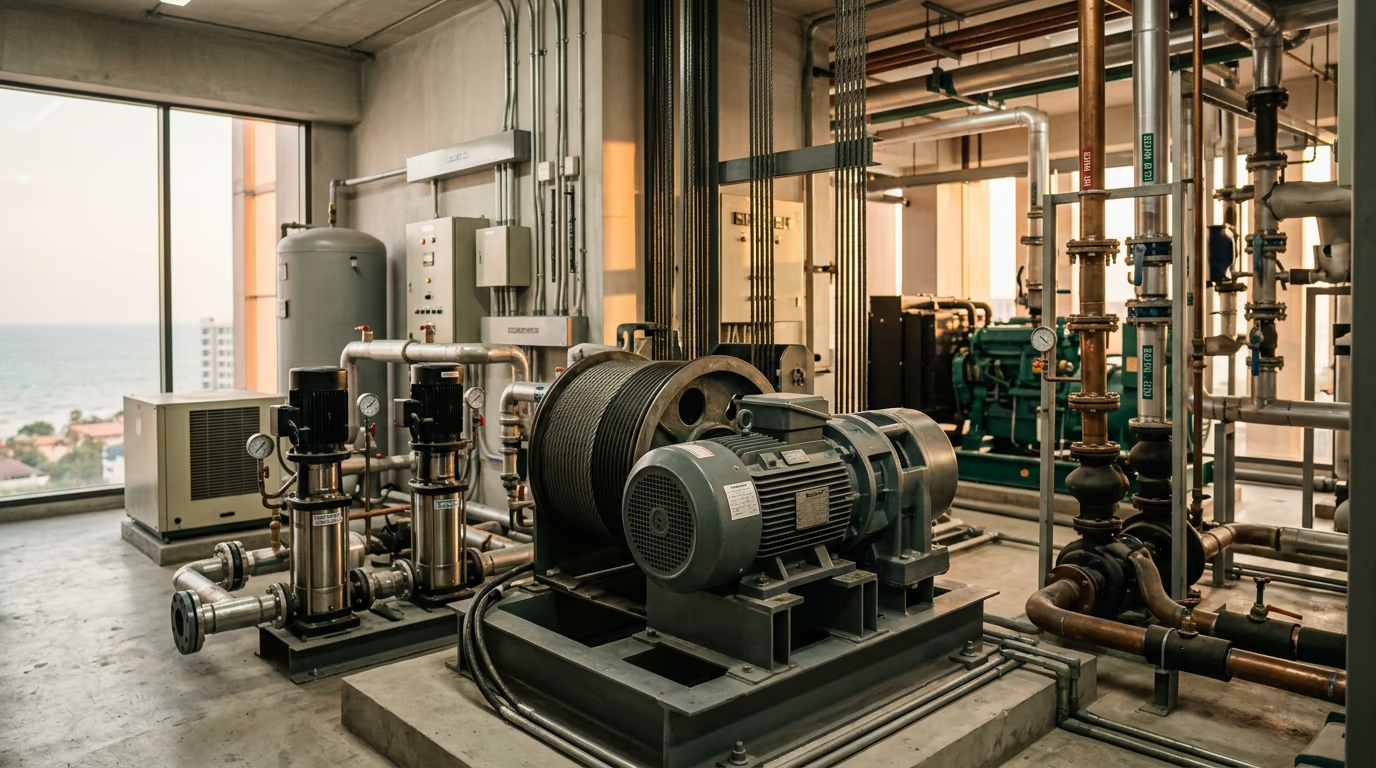
Sinking fund vs maintenance fee: the Thailand distinction
A Thai condominium sinking fund is a one-time capital reserve paid by each new unit owner at first handover, typically 500 to 1,000 THB per sqm, governed by Section 40 bis of the Condominium Act B.E. 2522 and held on a separate ledger for large, irregular building expenditures. A common area maintenance fee (CAM) is a monthly operating charge, typically 30 to 150 THB per sqm, governed by Section 18 bis and adopted at the annual general meeting under Section 48 bis, that funds the building’s day-to-day operations: cleaning, security, landscaping, pool maintenance, utilities for common areas, and the juristic person manager’s salary.
The two are not interchangeable. The sinking fund exists to fund events a building must pay for occasionally and expensively — elevator overhaul, facade waterproofing, roof replacement, pool resurfacing, pump and chiller replacement. CAM exists to fund what the building pays for every month. Mixing the two — pulling from the sinking fund to cover operating shortfalls, or pulling from CAM to fund capex — is the most common failure mode of Thai condominium financial governance and the leading cause of surprise special assessments on existing owners.
This guide sets out the legal basis for each, what each pays for, why Thai sinking funds get depleted more often than they should, how to inspect a building’s sinking fund status during due diligence, and how the Thai structure compares to Singapore’s management corporation model. For the full cost-of-ownership framework, pair with condo costs Thailand and condo maintenance fees. For the governance mechanics, see juristic person Thailand.
- 1
Year 7-15 — Pool resurfacing
Pool resurfacing and pool mechanical plant replacement; 300k-1.5M THB on mid-market stock.
Typical duration: every 7-15 years
- 2
Year 10-15 — Facade paint & waterproofing
Full exterior repaint and waterproofing; major line item drawn from sinking fund.
Typical duration: every 10-15 years
- 3
Year 10-20 — HVAC / chillers
Central pumps, chillers and major HVAC components replacement.
Typical duration: every 10-20 years
- 4
Year 15-20 — Lift overhaul
Elevator cab and motor overhaul; one of the largest line items in a building's life.
Typical duration: every 15-20 years
- 5
Year 15-25 — Roof replacement
Roof membrane and rooftop equipment replacement.
Typical duration: every 15-25 years
The sinking fund: legal basis and mechanics
Section 40 bis of the Condominium Act requires every condominium to maintain a sinking fund (ngoen tun sam rong) as a reserve for capital expenditures and long-term building maintenance. The fund is separate from the operating account, must be held in a dedicated ledger, and can only be drawn down for its designated purposes per the juristic person’s approved usage policy.
How the sinking fund is funded
The sinking fund is established at the start of a building’s operating life through a one-time contribution from each first buyer at handover. The contribution is calculated per sqm of unit area. Pattaya and Bangkok developers typically set the rate in the range 500 to 1,000 THB per sqm, with 700 THB per sqm a common benchmark for mid-market projects. Luxury branded residences run higher — some set the initial sinking fund at 1,500 or 2,000 THB per sqm to pre-fund a higher class of common-area maintenance.
For a 60 sqm one-bedroom unit at 700 THB per sqm, the one-time sinking fund contribution at handover is 42,000 THB. For a 100 sqm two-bedroom at 1,000 THB per sqm, the contribution is 100,000 THB. This is paid in full at transfer, not financed, and the buyer’s cost calculator must budget for it separately from the purchase price, transfer fees, and specific business tax. See condo costs Thailand for the full acquisition cost build.
How the sinking fund is used
The juristic person committee, under Section 37-38 of the Condominium Act, authorises draws from the sinking fund for capital expenditures listed in the approved usage policy. Typical eligible expenditures:
- Elevator cab and motor overhaul (typically every 15-20 years)
- Building facade painting and waterproofing (every 10-15 years)
- Roof and rooftop equipment replacement (every 15-25 years)
- Pool resurfacing and pool mechanical plant replacement (every 7-15 years)
- Central pump, chiller, and HVAC major components replacement (every 10-20 years)
- Fire safety system overhaul and upgrade
- Parking structure repairs
- Emergency structural repairs
Any single draw of material size (thresholds vary by bylaw, commonly 500,000 THB or more) requires committee approval and, for larger amounts, AGM ratification under Section 48 bis. The financial statements presented at each AGM should show the sinking fund balance, contributions received from new transfers, draws in the period, and projected balance for the coming year.
How the sinking fund is topped up
Sinking funds are rarely replenished in Thailand, and this is the structural weakness of the Thai model. New contributions flow only from first transfers of units; resales do not trigger a new sinking fund contribution because the contribution attaches to the unit at first handover, not to each change of ownership. Once a building is fully sold and stabilised, sinking fund contributions effectively stop.
Replenishment options are limited. The juristic person can raise a special assessment (charging all current owners a one-time top-up) under Section 48 bis with AGM approval. It can raise the monthly CAM with a designated portion allocated to the sinking fund — but this requires a bylaw amendment and AGM approval at a material majority. In practice, a depleted sinking fund in a mature building is usually addressed through a special assessment when a major capex item can no longer be deferred.
The common area maintenance fee (CAM): legal basis and mechanics
Section 18 bis of the Condominium Act obliges every unit owner to pay a monthly common area maintenance fee in proportion to the unit’s share of building ownership, typically calculated on the unit’s net sqm. The CAM rate is set by the juristic person’s annual budget, adopted at the AGM under Section 48 bis, which requires a 25% quorum and a simple majority.
Typical CAM rate ranges
Thai condo CAM fees vary by building quality, age, amenity level, and management tier. Published CBRE and industry benchmarks give the following indicative bands:
- Budget and older stock: 30 to 50 THB per sqm per month
- Mid-market new stock: 50 to 80 THB per sqm per month
- Upper-mid with extensive amenities: 80 to 120 THB per sqm per month
- Luxury branded residences: 120 to 250 THB per sqm per month
For a 60 sqm unit at 60 THB per sqm, monthly CAM is 3,600 THB and annual CAM is 43,200 THB. For a 100 sqm unit at 100 THB per sqm, monthly is 10,000 THB and annual is 120,000 THB. CAM is usually billed quarterly or semi-annually with a discount for annual prepayment. Arrears attract interest under the juristic person’s bylaws and under Section 18 bis attach to the unit — a new buyer inherits the seller’s CAM arrears if they are not cleared at transfer.
What CAM pays for
The CAM budget funds all recurring operating costs of the building. A typical budget includes:
- Juristic person manager’s salary and administrative staff
- Security (24/7 guards, CCTV monitoring, access control)
- Cleaning of common areas (lobby, corridors, car park, pool deck, stairwells)
- Landscaping and garden maintenance
- Pool chemical treatment and routine cleaning (not resurfacing, which is sinking fund)
- Common-area utilities (lobby lighting, lift power, pump power for common services)
- Routine elevator maintenance contract (not overhaul, which is sinking fund)
- Pest control
- Accounting, audit, and statutory compliance
- Insurance on the building and common areas
- Minor repairs and maintenance reserve
The budget is published to unit owners ahead of the AGM, debated at the AGM, and adopted with any amendments agreed by the owners. Under Section 48 bis, a 25% quorum of ownership shares is required for the meeting to be quorate, and a simple majority of those present carries the vote. Owners in arrears on CAM have their voting rights suspended until arrears are settled.
What each pays for, itemised
Distinguishing sinking fund from CAM matters in every due diligence review and every annual AGM. The following table captures the standard allocation in most Thai condominium bylaws.
Sinking fund (one-time capex reserve):
- Elevator overhaul and cab replacement
- Facade repainting and waterproofing
- Roof replacement and major roof works
- Pool resurfacing, pool mechanical plant
- Central HVAC plant replacement (chillers, cooling towers)
- Structural repairs
- Fire alarm and sprinkler system overhaul
- Emergency generator replacement
- Parking structure repairs
- Major plumbing riser works
CAM (monthly operating budget):
- Manager and staff salaries
- Security services
- Common-area cleaning
- Landscaping
- Pool chemical treatment and daily cleaning
- Routine elevator service contract
- Common-area electricity and water
- Insurance premium
- Accounting and audit
- Pest control
- Minor day-to-day repairs
Grey area items exist — for example, a major roof leak repair that is reactive rather than planned may be debated as CAM or as sinking fund depending on scope and cost. The juristic person committee, with AGM input, decides on contested items.
Why Thai sinking funds get depleted
Three structural factors leave Thai condominium sinking funds under-funded more often than the Condominium Act drafters envisaged.
First-buyer-only funding
The sinking fund is funded once at first transfer. Resales do not trigger new contributions. A building that sells out over 24 months at launch then continues operating for 40 to 60 years on the sinking fund established in that first 24 months. For mid-market buildings at 500-700 THB per sqm, this base is insufficient for the full capex cycle of a modern high-rise, which is why many older Thai condominiums face sinking fund exhaustion in their second or third decade.
Use for operating shortfalls
Bylaws and bylaw interpretation vary. In some buildings, the juristic person has used sinking fund draws to plug CAM operating shortfalls — particularly during periods of collection weakness, or when low-CAM buildings cannot meet rising operating costs. Each operating draw reduces the capex reserve without replacing it, leaving the fund thinner when the next elevator overhaul or facade cycle arrives.
Deferred capex on dysfunctional committees
Committees dominated by short-term-focused owners (particularly owners planning to sell within a few years) have an incentive to defer capex and keep CAM low. The result is underinvestment in maintenance, which preserves paper reserves at the cost of accelerating building deterioration. When the deferred capex can no longer be avoided, it arrives as a large, unbudgeted special assessment on current owners — often after the original short-termists have sold.
Emergency use
Major storm damage, structural surprises (such as concrete cancer in coastal buildings exposed to salt air), or regulatory changes (fire safety upgrades mandated after a high-profile building incident) can trigger unplanned sinking fund draws. An emergency draw is legitimate and is one of the reasons the fund exists, but repeated emergencies in a single building suggest either construction defects or deferred maintenance catching up.
Red flags in buildings with low sinking fund balance
A building whose sinking fund balance is materially below the level needed for its next major capex cycle is signalling a coming special assessment or a CAM increase. During due diligence, the buyer’s lawyer should request the juristic person’s financial statements, look at the sinking fund balance as a number, and ask the committee or manager what capex is anticipated in the next 3-5 years.
Red flags to check for:
- Sinking fund balance below 100 THB per sqm of total building area, in a building more than 10 years old.
- Pattern of operating draws from the sinking fund over the last 3-5 years.
- History of special assessments in the last 3 years (indicates structural underfunding).
- Committee or manager unable to produce a capex plan.
- CAM rate materially below the market rate for comparable buildings (indicates underfunded operations, with the risk being either service degradation or sinking fund raids).
- AGM minutes showing contested decisions on fee increases over multiple years.
The due diligence checklist sets out the full document request, and the juristic person Thailand guide covers how to read financial statements and assess committee quality.
How to inspect sinking fund and CAM status
Request the following from the juristic person before finalising purchase of any Thai condominium:
- Latest audited financial statements showing sinking fund balance, contributions in the period, and draws in the period.
- Last 3 years of AGM minutes.
- Current budget for the operating year, including breakdown of CAM allocation.
- Any special assessments levied in the last 3 years, with amount, purpose, and collection status.
- Statement of CAM payment status for the specific unit being purchased.
- Sinking fund balance and any projected major capex in the next 3-5 years.
A well-run juristic person can produce all of this in 3-5 business days. A juristic person that refuses, cannot locate the documents, or produces inconsistent records is itself a signal about the quality of the building’s governance. The Condominium Act Section 36 gives unit owners a right to inspect the juristic person’s books, and a prospective buyer working through their Thai lawyer can usually extend this right during due diligence.
Thailand versus Singapore: a structural comparison
Singapore’s Building Maintenance and Strata Management Act (BMSMA) imposes a more demanding management corporation framework than Thailand’s Condominium Act. The comparison is useful for foreign buyers who may be familiar with the Singapore model or who are choosing between Bangkok and Singapore for property investment.
Under BMSMA, Singapore management corporations maintain both a management fund (analogous to CAM) and a sinking fund (analogous to Section 40 bis), with the sinking fund topped up through ongoing monthly or quarterly contributions. The ongoing contribution requirement is the key difference: Singapore buildings are structurally required to keep replenishing the sinking fund throughout their operating life, which avoids the under-funding problem that affects older Thai buildings. Singapore also mandates more detailed capex planning and reporting cycles.
Thailand’s model places more discretion in the juristic person committee and the AGM. A well-run Thai building can operate comfortably under Section 40 bis and Section 18 bis. A badly-run Thai building accumulates deferred maintenance and sinking fund weakness. Foreign buyers used to the Singapore cadence should adjust their diligence accordingly when assessing Thai buildings, and should be willing to walk from buildings with depleted reserves even if the headline purchase price looks attractive.
Sinking fund and CAM FAQ
How much is the sinking fund on a typical Thai condo?
500 to 1,000 THB per sqm, paid one time at first handover. For a 60 sqm one-bedroom at 700 THB per sqm, the sinking fund payment is 42,000 THB. Luxury branded residences run 1,500-2,000 THB per sqm.
Is the sinking fund refundable if I sell?
No. The sinking fund contribution is an obligation attached to the unit’s first entry to the building’s reserve. On resale, the buyer does not pay a new sinking fund — the unit’s contribution was made once at original handover and remains with the building. This also means the seller cannot recover the contribution at sale.
What is the typical Thai condo CAM rate?
30 to 50 THB per sqm per month for budget and older buildings; 50 to 80 THB for mid-market new stock; 80 to 120 THB for upper-mid with full amenities; 120 to 250 THB for luxury branded residences. See condo maintenance fees for the full rate survey.
Can CAM be increased without owner approval?
No. Under Section 48 bis, a CAM increase must be adopted at an AGM with 25% quorum and simple majority. Committees cannot unilaterally raise CAM between AGMs except in narrowly-defined emergency circumstances set out in the bylaws.
What happens if a unit owner does not pay CAM?
Under Section 18 bis, CAM arrears attach to the unit. The juristic person can suspend services (pool, gym, common area access), add interest to the arrears, and block the owner from voting at the AGM. At sale, the Land Department will typically require CAM arrears to be settled before processing transfer. A buyer inheriting arrears from a seller who did not settle them becomes liable.
Can I use sinking fund money for CAM operating shortfalls?
Legally contested and governance-dependent. The Condominium Act designates the sinking fund for capital expenditures and the operating account for operations. Bylaws and AGM decisions in some buildings allow short-term operating use of the sinking fund, but persistent operating draws signal management failure and lead to under-funded capex.
How do I check the sinking fund balance before buying?
Request the juristic person’s latest audited financial statements and last three AGM minutes through your Thai lawyer during due diligence. The sinking fund should appear as a separate line item with a stated balance. A well-run building produces this in under a week. A building that cannot or will not produce it is a red flag.
What is a special assessment?
A one-time charge levied on all current unit owners to fund a specific capital expenditure not covered by the existing sinking fund balance. Special assessments require AGM approval under Section 48 bis and are the default mechanism for topping up depleted sinking funds in the absence of ongoing contributions.
Who sets sinking fund and CAM rates for a new condominium?
The developer, during the pre-sale phase, with disclosure in the sale and purchase agreement. Once the juristic person is formed after handover, the rates can be amended at future AGMs. The initial rates often prove too low for the building’s long-term costs, which is why new owners should expect some upward adjustment in the first 3-5 years of building operation.
References
Sources
- 01Condominium Act B.E. 2522 (1979), Section 40 bis, as amended by Condominium Act (No. 4) B.E. 2551 (2008)Sinking fund legal basis and separate ledger requirement. Accessed 2026-04-16.
- 02Condominium Act B.E. 2522 (1979), Section 18 bisCommon area maintenance fee (CAM) legal basis and obligation of unit ownership. Accessed 2026-04-16.
- 03Condominium Act B.E. 2522 (1979), Sections 48 and 48 bisAnnual general meeting and budget adoption procedures for juristic person. Accessed 2026-04-16.
- 04Condominium Act B.E. 2522 (1979), Sections 17, 36, 37, and 38Juristic person structure and committee authority for financial decisions. Accessed 2026-04-16.
- 05Thailand Land Department (Department of Lands), condominium juristic person registration procedures · https://www.dol.go.th/Thailand Land Department registration of condominium juristic person and sinking fund disclosure requirements. Accessed 2026-04-16.
- 06Tilleke & Gibbins, Thailand Real Estate Legal Briefings 2024-2026 · https://www.tilleke.com/insights/Tilleke & Gibbins briefings on Thai condominium financial governance and sinking fund practice. Accessed 2026-04-16.
- 07Siam Legal International, Thailand Real Estate Resources · https://www.siam-legal.com/realestate/Siam Legal International practical guidance on Thai condo CAM fees and sinking fund obligations. Accessed 2026-04-16.
- 08CBRE Thailand Real Estate Market Outlook 2026 · https://www.cbre.co.th/insights/reports/thailand-real-estate-market-outlook-2026CBRE Thailand benchmarks for Bangkok and Pattaya condo CAM fee ranges and management quality tiering. Accessed 2026-04-16.
- 09Singapore Building Maintenance and Strata Management Act (BMSMA), Cap. 30C · https://sso.agc.gov.sg/Singapore Building Maintenance and Strata Management Act for comparative management corporation framework. Accessed 2026-04-16.
Published · How we research and date our content