Condo Maintenance Fees Thailand 2026: What You'll Actually Pay
Thai condo maintenance fees explained: 30 to 150 THB per sqm CAM rates, sinking fund, non-payment consequences, AGM budget approval, red flags, and city comparisons.
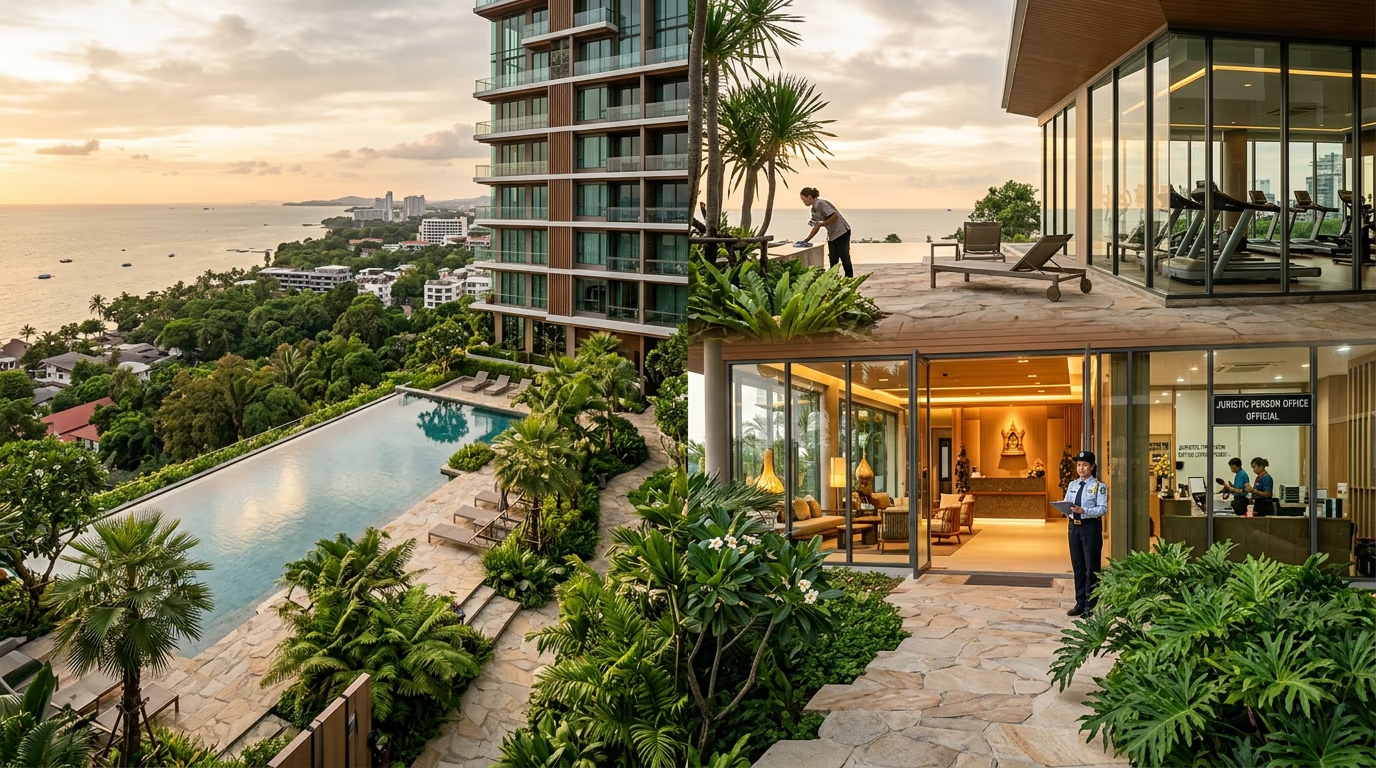
Thai condo maintenance fees in 2026 run from 15 THB per square metre per month in budget Pattaya buildings to 150 THB per square metre per month in branded Bangkok residences. A typical 40 sqm mid-market unit pays 1,200 to 3,200 THB per month, or 14,400 to 38,400 THB per year. On top of that, buyers pay a one-time sinking fund of 500 to 1,000 THB per square metre at handover. The maintenance fee — known in Thai as the Common Area Maintenance fee or CAM — funds day-to-day operations: security, cleaning, pool, lifts, and juristic person administration. The sinking fund is separate and funds major repairs: lift replacement, facade repainting, pool resurfacing. Both are mandated by the Condominium Act B.E. 2522 (1979) and are legally enforceable against the owner. This guide walks through the 2026 rate ranges by city and tier, the legal framework that sets them, what actually happens if you stop paying, and the red flags to check before you buy.
The single biggest mistake foreign buyers make is assuming CAM is a flat figure quoted by the agent. In practice CAM sits on a budget approved annually by the juristic person committee and voted on at the Annual General Meeting under Section 48 of the Condominium Act. A low CAM quote on a glossy developer brochure often signals the opposite of good news — it means the opening budget is deliberately undercharged, deferred maintenance is building up, and a sharp CAM increase or special assessment is coming as soon as the developer hands the building over. The numbers below are the ones that actually appear on juristic person statements in Pattaya, Bangkok, Phuket, and Chiang Mai today.
1. CAM fee: what it actually covers
The Common Area Maintenance fee is a monthly charge per square metre of saleable area that pays for everything outside the four walls of your unit. The Condominium Act calls this the common expense under Section 18; the building’s juristic person collects it under the authority of Section 18/1 and spends it according to an annual budget approved at the Annual General Meeting.
The line items below appear on almost every Thai condominium operating budget. Percentages are indicative of a typical mid-market Pattaya or Bangkok project of 200 to 500 units.
- Security: 24-hour guard rotation, CCTV monitoring, access control. Typically 20 to 30% of the operating budget.
- Cleaning of common areas: lobby, corridors, lifts, pool deck, garden, car park, garbage rooms. Typically 12 to 20%.
- Lift maintenance: monthly service contract with Mitsubishi, Schindler, KONE or Hitachi. Typically 6 to 10% in mid-rise buildings and 10 to 15% in 30-plus-storey towers.
- Pool and gym operation: chemistry, pumps, filtration, trainer or attendant cost, equipment servicing. Typically 8 to 12%.
- Landscaping and pest control: garden upkeep, tree trimming, pest treatment. Typically 4 to 8%.
- Shared utilities: common-area electricity (lifts, lobby air conditioning, corridor lights, pump rooms, pool equipment) and common-area water. Typically 12 to 20%.
- Juristic person administration: licensed juristic person manager, accounting, legal retainer, insurance premiums, office supplies. Typically 10 to 15%.
- Reception and concierge (where offered): front-desk staff, parcel handling, resident services. Adds 5 to 10% in premium buildings.
- Minor repairs and consumables: light bulbs, plumbing fixes, door closers, paint touch-ups. Typically 3 to 6%.
- Contingency reserve: 2 to 5% retained for unplanned items.
This list is the baseline. Branded residences, serviced condominiums, and mixed-use towers with hotel partners (Dusit, Banyan Tree, Marriott, Six Senses) add concierge, valet, food and beverage subsidies, and branded-service licence fees that push CAM well above the ranges in the next section. That is why a Phuket Six Senses residence can run at 180 THB per sqm per month while a similar-sized Chiang Mai condo runs at 25 THB per sqm per month — the buildings are providing different products.
2. Typical CAM rates by tier and city in 2026
Budget Thai condominiums run 15 to 35 THB per sqm per month. Mid-market runs 30 to 80 THB per sqm per month. Premium runs 80 to 150 THB per sqm per month. Branded residences and serviced condominiums push beyond 150 THB per sqm per month. These ranges reflect primary-market positioning as captured in the CBRE Thailand Real Estate Market Outlook 2026 and Cushman and Wakefield Thailand Market Beat Q1 2026, cross-referenced against juristic person disclosures visible on the Land Department Condominium Registration system.
The table below gives actual monthly CAM ranges by city and building tier, and translates them into an annual cost for a 40 sqm one-bedroom — the unit size the majority of foreign buyers transact at in Pattaya, Bangkok, Phuket, and Chiang Mai.
| City / tier | CAM (THB/sqm/month) | Monthly for 40 sqm (THB) | Annual for 40 sqm (THB) |
|---|---|---|---|
| Pattaya budget (South Pattaya, older stock) | 15 to 25 | 600 to 1,000 | 7,200 to 12,000 |
| Pattaya mid-market (Jomtien, Pratumnak) | 30 to 60 | 1,200 to 2,400 | 14,400 to 28,800 |
| Pattaya premium (Wongamat beachfront) | 60 to 100 | 2,400 to 4,000 | 28,800 to 48,000 |
| Bangkok mid-market (outer Sukhumvit, Ratchada, Ladprao) | 45 to 70 | 1,800 to 2,800 | 21,600 to 33,600 |
| Bangkok CBD (Asoke, Thonglor, Silom, Sathorn) | 70 to 100 | 2,800 to 4,000 | 33,600 to 48,000 |
| Bangkok luxury branded (riverside, Chidlom, Langsuan) | 100 to 180 | 4,000 to 7,200 | 48,000 to 86,400 |
| Phuket beachfront standalone | 70 to 120 | 2,800 to 4,800 | 33,600 to 57,600 |
| Phuket branded residence (Banyan Tree, Six Senses, Marriott) | 140 to 220 | 5,600 to 8,800 | 67,200 to 105,600 |
| Hua Hin beachfront | 50 to 90 | 2,000 to 3,600 | 24,000 to 43,200 |
| Koh Samui hillside / beachfront | 60 to 110 | 2,400 to 4,400 | 28,800 to 52,800 |
| Chiang Mai city / Nimman | 20 to 45 | 800 to 1,800 | 9,600 to 21,600 |
CAM is normally billed monthly by direct debit, bank transfer, or counter payment at the juristic person office. Many buildings offer a small discount of 2 to 5% for owners who prepay the full year in advance; developers almost always require 12 months of CAM prepayment at handover, held by the juristic person as a starter cash reserve.
- Security (24-hr + CCTV) 25 % of operating budget (25.0%)
- Shared utilities (common lights, pumps) 16 % of operating budget (16.0%)
- Juristic person administration 12 % of operating budget (12.0%)
- Cleaning common areas 16 % of operating budget (16.0%)
- Pool & gym operation 10 % of operating budget (10.0%)
- Lift maintenance 8 % of operating budget (8.0%)
- Landscaping & pest 6 % of operating budget (6.0%)
- Repairs & contingency 7 % of operating budget (7.0%)
A practical rule of thumb: if a new-build unit’s CAM quote is below the bottom of its tier range in the table above, either the building is stripped back on services or the budget is being subsidised by the developer and will rise once the juristic person is handed over. The next sections explain why that matters.
3. Sinking fund vs CAM: capex versus opex
The sinking fund is a separate reserve for major capital items — lift replacement, roof membrane, facade repainting, pool resurfacing, fire system upgrades. The CAM fee funds day-to-day operations. Confusing the two is the single most common cause of nasty surprises in year six of ownership.
Section 40 of the Condominium Act states that each building’s juristic person shall establish a common property sinking fund, funded by a contribution from each unit owner registered against that unit. The Act does not fix the amount — the juristic person, at the registration stage, sets the sinking fund per unit as part of the registered regulations. In practice, Thai market convention runs as follows.
| Tier | Sinking fund (THB per sqm) | For a 40 sqm one-bedroom (THB) |
|---|---|---|
| Budget Thai-market projects | 300 to 500 | 12,000 to 20,000 |
| Mid-market foreign-quota projects | 500 to 800 | 20,000 to 32,000 |
| Premium beachfront | 800 to 1,200 | 32,000 to 48,000 |
| Branded residences | 1,200 to 2,000 | 48,000 to 80,000 |
The sinking fund is paid once at handover. It is not refundable when you sell — the balance stays with the unit and passes to the buyer, who acquires it as an accumulated reserve. If the sinking fund runs low, the juristic person can vote a top-up contribution at an Annual General Meeting, applied pro rata to saleable area. These top-ups are uncommon in the first ten years of a building’s life and common after year fifteen as the original capex cycle starts.
The conceptual test: if the expense repeats every month and funds daily operation, it belongs in CAM. If the expense happens once in a decade and replaces a major asset, it belongs in the sinking fund. A building that tries to fund major repairs out of CAM has a budget problem and usually ends up running a special assessment on owners.
4. What happens if you don’t pay the CAM
Non-payment of CAM or sinking fund contributions is not a soft default. Under Section 18/1 of the Condominium Act, unpaid common expenses carry a statutory surcharge of up to 12% per annum for the first six months and up to 20% per annum after that. Under Section 41, the juristic person can register the debt as a statutory charge on the unit — which blocks any future sale or transfer at the Land Department. That combination is what makes non-payment a serious problem: the debt compounds at penalty rates, and the Land Department will not register a transfer until the juristic person issues a no-arrears certificate under its own procedure.
The practical enforcement sequence used by Thai juristic persons is consistent across Bangkok, Pattaya, and Phuket:
- Month 1 to 2: formal reminder letter from the juristic person manager, late surcharge begins accruing.
- Month 3 to 6: registered letter, temporary suspension of common-area access rights (pool, gym, parking fob) as permitted under most juristic person regulations.
- Month 6 to 12: lawyer’s demand letter, filing of a lien notice with the Land Department registering the debt as a charge against the unit.
- Year 2 onwards: civil action to recover the debt, judgement, seizure, and court-ordered auction of the unit under the Civil Procedure Code.
Court-ordered sale of a Thai condominium unit for unpaid common fees is rare but it happens, and auction pricing is typically 20 to 40% below open-market value. Tilleke and Gibbins briefings on juristic person enforcement document enforcement actions in Bangkok, Pattaya, and Phuket each year. For the buyer, the more immediate issue is that a unit carrying a CAM arrears certificate cannot be sold until the debt is cleared — so even owners who never intended to pay end up paying in full, with penalties, at the moment they try to exit.
One protection for buyers: always request a no-arrears certificate from the juristic person as part of the due diligence process before signing. A seller who cannot produce a clean certificate is a seller with a problem, and you do not want to inherit it. The condo resale guide walks through the full seller-side procedure.
5. How CAM increases work: AGMs and budget approval
Under Section 48 of the Condominium Act, the annual operating budget must be approved at the Annual General Meeting of co-owners by simple majority of owners present. CAM rate changes are a budget item — they cannot be increased unilaterally by the juristic person manager, the developer, or a self-appointed committee. That is the law as written. In practice the rate-setting process runs on a one-year cycle:
- The juristic person manager prepares a draft budget in the last quarter of the fiscal year, showing expected operating costs, reserve contributions, and the CAM per square metre required to balance.
- The committee reviews, amends, and recommends the budget to the AGM.
- The AGM is held within 120 days of fiscal year end, as required by Section 42/2.
- Co-owners representing a simple majority of those present approve the budget. Proxy voting is allowed if the building’s regulations permit.
- Once approved, the rate applies from the start of the new fiscal year.
Sinking fund top-ups and special assessments require a higher threshold — typically a resolution of owners representing at least one-quarter of voting rights, depending on the building’s regulations and the item being voted. Big-ticket items such as a major facade overhaul or a chiller plant replacement are normally structured as sinking fund spends with a matching top-up contribution, voted under the special-resolution procedure.
As a foreign owner, attend the AGM or send a proxy. AGMs determine your CAM, your assessments, and the quality of the manager running the building. A pattern we see repeatedly in Pattaya and Bangkok: foreign owners skip the AGM, a small group of engaged Thai owners votes through a manager they prefer, and the quality of building management follows the votes, not the ownership share.
6. CAM increases: what a healthy trajectory looks like
A well-run Thai condominium raises CAM by roughly 3 to 6% per year to track inflation, utility cost increases, and wage growth. A sudden 25% jump usually means one of three things: the original developer-set budget was undercharged, major repairs are overdue, or the building has been under-managed and is catching up. Budget documents distributed before the AGM should show the year-on-year line-item changes. Ask for three years of historical financials before you buy — every reputable juristic person will provide them.
Healthy trajectory examples from real Thai buildings:
- Bangkok Sukhumvit mid-market, 2019 to 2026: CAM moved from 50 to 62 THB per sqm per month, compounding at 3.1% per year. Sinking fund untouched.
- Jomtien beachfront mid-premium, 2019 to 2026: CAM moved from 40 to 52 THB per sqm per month, compounding at 3.8% per year. Two sinking fund top-ups for lift overhaul and facade work.
- Phuket branded residence, 2019 to 2026: CAM moved from 150 to 195 THB per sqm per month, compounding at 3.8% per year. Branded-service licence re-negotiation in year 4 caused a one-off 12% jump.
Problem-trajectory examples:
- Pattaya primary-market project launched 2018 at 30 THB per sqm per month; re-set to 55 THB after developer handover in 2022 (+83% step change). Classic undercharged-opening pattern.
- Bangkok mid-rise 2017 with CAM held flat at 45 THB per sqm per month through 2023, then special assessment of 800 THB per sqm to fund lift replacement and fire system upgrade. Deferred maintenance catching up.
The lesson for buyers: a CAM that looks low today is not a saving. It is a deferred expense. Price it into your five-year and ten-year total cost of ownership model using the cost calculator and the numbers in the condo costs guide.
7. Red flags in CAM budgets
Seven concrete signals that a CAM budget is in trouble. Any one of them warrants closer inspection; two or more is a reason to walk away from the building.
- Reserve or sinking fund balance below 5% of annual operating budget. Healthy buildings run reserves at 15 to 25% of annual operating spend.
- CAM per sqm materially below the city-tier range in the table above, on a building with equivalent services. The spread usually closes within three years.
- No audited financial statements for the last three fiscal years, or the auditor’s name changing each year.
- Juristic person manager appointed by the developer and never re-elected under a genuine AGM vote. This is legal in the first year after registration but not afterwards.
- Insurance coverage below replacement cost of the building. Check the sum insured figure on the policy.
- Arrears of 10% or more of the CAM receivable. A building with high arrears will need either a rate increase to cover the gap or a special assessment — either way the paying owners subsidise the non-payers.
- Major repair items flagged in AGM minutes with no funding plan. Lift overhaul, facade repainting, chiller plant replacement, waterproofing, and fire-system upgrade are the five most common landmines.
The fixable issues are manager quality and budget discipline; the near-fatal issues are deferred maintenance and structural under-charging. A lawyer conducting condominium due diligence should pull the last three AGM minutes, the current financial statements, and the insurance certificate before you commit. The condo scams guide covers the broader due diligence landscape.
8. Thailand CAM compared with Singapore, Malaysia, and Bali
Thai CAM runs materially below Singapore and Kuala Lumpur for equivalent service levels and broadly on par with or slightly above Bali for villa-style residences. That is one reason the total cost of owning a Thai condo remains lower than neighbouring Asia-Pacific markets even after transfer taxes.
| Market | Typical CAM (USD/sqm/month) | Notes |
|---|---|---|
| Singapore private condo | 2.80 to 4.50 | Management fee + sinking fund; mid-market new launches |
| Kuala Lumpur KLCC | 1.20 to 2.20 | Service charge including Sinking Fund Act allocation |
| Bangkok CBD mid-market | 1.40 to 2.80 | CAM only; sinking fund one-off at handover |
| Pattaya Jomtien mid-market | 0.90 to 1.70 | CAM only; sinking fund one-off at handover |
| Bali branded villa residence | 2.50 to 5.00 | Service charge and estate fees; wide dispersion |
| Phuket branded residence | 4.00 to 6.50 | Comparable to Singapore prime; hotel-service premium |
Exchange rates used: 1 USD = 35 THB, 1 USD = 1.35 SGD, 1 USD = 4.65 MYR, 1 USD = 16,500 IDR (Q1 2026 averages). Ranges are indicative of mid-market primary-issue product and do not include branded-residence service-charge premiums above the tier.
The Thai price advantage narrows at the premium end because branded-residence service charges converge globally — a Six Senses or Banyan Tree residence in Phuket, Singapore, or Bali operates on similar staffing ratios and similar charge levels. Where Thailand keeps the advantage is in the mid-market, largely because Thai wages and energy costs remain below regional peers.
9. Frequently asked questions
Is the CAM fee negotiable?
No. CAM is set by the juristic person budget approved at the AGM and applies equally to all units on a per-square-metre basis. A developer cannot legally offer a CAM-waiver deal on a specific unit, although they sometimes offer to prepay the first one or two years as a sales incentive. Any permanent reduction requires an AGM vote and would apply to every owner.
What is the difference between CAM and service charge?
In Thai practice they are the same thing. Developer brochures and branded-residence prospectuses sometimes use “service charge” to signal that the fee covers hotel-style amenities, but the legal basis is identical — common expense under Section 18 of the Condominium Act.
Who collects the CAM?
The juristic person (นิติบุคคลอาคารชุด), a registered legal entity created at the same time as the building under Section 35 of the Condominium Act. Every condominium has one. The juristic person may outsource the day-to-day management to a property management company, but the legal obligation to collect and spend CAM sits with the juristic person.
Do I pay CAM on an empty unit?
Yes. CAM is a charge against the unit, not the occupier. Empty units accrue CAM, sinking fund top-ups, and any special assessments at the same rate as occupied units. Rental and occupancy do not affect the charge.
How does CAM interact with rental yield?
CAM is an operating cost that reduces net rental yield. On the Jomtien reference unit from the rental yield guide, CAM at 50 THB per sqm per month on a 40 sqm unit is 24,000 THB per year — roughly 14% of a 170,000 THB gross annual rent, or 120 basis points of gross yield on a 5,000,000 THB property value.
Can the juristic person change the CAM mid-year?
Only with an Annual General Meeting resolution and a restated budget. Mid-year increases require either an extraordinary general meeting or a special assessment vote, and both follow the same majority thresholds as the annual budget vote.
What happens to unpaid CAM when I sell?
The debt transfers with the unit unless paid at closing. In practice the buyer’s lawyer requires a no-arrears certificate from the juristic person at the Land Department transfer, and any outstanding CAM is deducted from the seller’s proceeds. No transfer will register without the certificate.
Does the sinking fund earn interest?
Yes. The juristic person is required to hold sinking fund balances in a segregated interest-bearing account. Interest accrues to the fund, not to individual owners. Larger buildings sometimes split the sinking fund into fixed deposits and savings accounts for yield optimisation.
References
Sources
- 01Condominium Act B.E. 2522 (1979), Sections 17/1, 18, 18/1, 40, 41, 42/2 and 48; amended by Condominium Act (No. 4) B.E. 2551 (2008) · https://www.krisdika.go.th/Juristic person governance, budget adoption, and annual general meeting authority for common expense decisions. Accessed 2026-04-16.
- 02Condominium Act B.E. 2522, Section 40; Ministry of Interior Regulations on Condominium Registration · https://www.dol.go.th/Sinking fund legal basis and juristic person discretion to set the amount per unit at registration. Accessed 2026-04-16.
- 03Condominium Act B.E. 2522, Sections 18/1 and 41; Land Department practice note on unpaid common fee certification · https://www.dol.go.th/Non-payment of common expenses triggers a statutory charge against the unit and can block transfer registration. Accessed 2026-04-16.
- 04CBRE Thailand Real Estate Market Outlook 2026 · https://www.cbre.co.th/insights/reports/thailand-real-estate-market-outlook-2026Common area maintenance fee ranges for primary-market Bangkok and Pattaya condominiums in 2026. Accessed 2026-04-16.
- 05Cushman and Wakefield Thailand Market Beat Q1 2026 · https://www.cushmanwakefield.com/en/thailand/insights/thailand-marketbeatBangkok luxury residential CAM levels and operating cost benchmarks. Accessed 2026-04-16.
- 06Knight Frank Thailand Residential Market Review 2026 · https://www.knightfrank.co.th/researchPhuket and Koh Samui branded-residence CAM and service-charge levels. Accessed 2026-04-16.
- 07Tilleke and Gibbins, Condominium Juristic Person Enforcement Briefing 2025 · https://www.tilleke.com/insights/Legal process for common fee disputes, juristic person enforcement, and court-ordered sale under the Civil Procedure Code. Accessed 2026-04-16.
- 08Siam Legal International, Condominium Common Area Fee Guide 2025-2026 · https://www.siam-legal.com/realestate/Practical guidance on CAM prepayment, sinking fund setup, and handover procedures under Thai market practice. Accessed 2026-04-16.
Published · How we research and date our content