Juristic Person Thailand: Who Actually Manages Your Condo?
The juristic person (nitibukhon) is the legal entity owning and managing a Thai condo's common areas. Registered under Section 17, governed by committee and AGM.
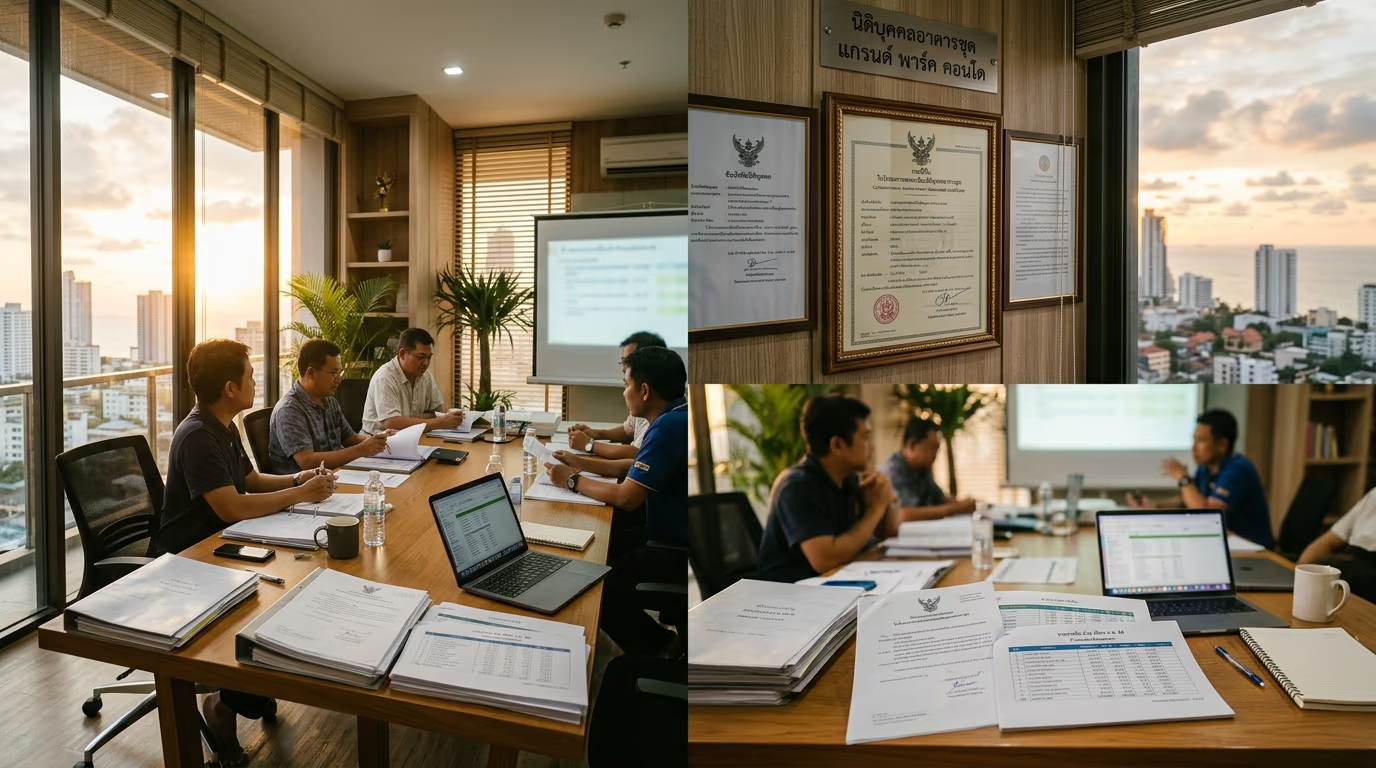
Juristic person Thailand: the legal entity that manages your condo
The juristic person of a condominium (nitibukhon aa-khan chut, นิติบุคคลอาคารชุด) is the legal entity that owns and manages the common areas of a Thai condominium, registered with the Thailand Land Department under Section 17 of the Condominium Act B.E. 2522 (1979). It is not a company, not a homeowners’ association in the American sense, and not a voluntary body. It is a statutory juridical person with defined rights, obligations, and governance structure: a manager (Section 36) who executes operational decisions, a committee of 3-9 owners (Sections 37-38) elected at the annual general meeting, and an annual general meeting of all owners (Sections 48, 48 bis) that adopts the budget, elects the committee, and approves major decisions.
Every Thai condominium has a juristic person. The quality of that juristic person — its manager, its committee, its bylaws, and its financial discipline — determines whether the building is a well-maintained asset that appreciates or a deteriorating liability that loses resale value faster than market. For a foreign buyer, the juristic person is the single most important operational question after foreign quota, title, and price: the buyer will live with this entity for as long as they own the unit.
This guide sets out what the juristic person does, how it is structured, how to read its financials, the common failure modes (developer-controlled first-year teams that defer maintenance, manager conflicts of interest, capture by large-unit-holder blocks), how owners change a failing juristic person, the difference between a self-managed juristic person and one that contracts an external property manager, and the foreign owner’s rights under the Condominium Act. Pair with sinking fund vs CAM for the financial mechanics and due diligence checklist for what to verify before purchase.
- 1
Q4 — Draft budget
Juristic person manager prepares operating budget, CAM rate, and capex plan for the new fiscal year.
Typical duration: Late fiscal Q4
- 2
Pre-AGM — Committee review
Committee of 3-9 owners reviews and recommends the budget for owner approval.
Typical duration: 30-60 days
- 3
Within 120 days of year-end — AGM
Annual General Meeting adopts budget, elects committee, approves major decisions (Sections 48, 48 bis).
Typical duration: Statutory window
- 4
Post-AGM — Execution
Manager implements budget; CAM rate applies from start of new fiscal year.
Typical duration: Ongoing
- 5
Mid-year — Sinking fund draws
Committee authorises draws from sinking fund under Section 40 bis for capital expenditures.
Typical duration: As needed
What the juristic person does
The juristic person has five core operational responsibilities, all derived from the Condominium Act.
Own and maintain the common areas
Under the Condominium Act, a condominium is legally divided into private units (each owned by an individual buyer) and common areas (lobby, corridors, lifts, pool, gym, landscaping, parking, mechanical plant, roof, structural elements, and all other parts not defined as private units). The juristic person holds title to the common areas on behalf of all unit owners collectively, and is responsible for their maintenance, repair, and operational continuity.
Collect CAM and sinking fund contributions
The juristic person is the invoicing entity for common area maintenance fees (Section 18 bis) and for the original sinking fund contribution at each new unit’s first handover (Section 40 bis). It maintains the accounts receivable ledger, pursues arrears, and enforces the consequences of non-payment (suspended voting rights, interest on arrears, potential legal action against persistent defaulters, and — at the Land Department — a hold on the unit’s transfer until arrears clear).
Manage the operating budget and capital reserves
The juristic person executes the operating budget adopted at the AGM. It pays for security, cleaning, landscaping, utilities for common areas, routine maintenance contracts, insurance, management staff, audit, and statutory compliance. It also administers the sinking fund as a separate ledger under Section 40 bis, authorising draws for capital expenditures in line with the approved usage policy and AGM ratification thresholds.
Enforce the bylaws
The juristic person’s bylaws (sometimes called condominium regulations) set the rules for unit use, common area use, pet policy, short-term rental policy, noise policy, modification policy for private units, and commercial activity within the building. The manager and committee enforce these rules and can levy fines, restrict access, and in persistent cases pursue civil action against rule-breakers.
Represent the owners to third parties
The juristic person is the legal interface between the building and external parties. It signs utility contracts with the electricity and water authorities, contracts with cleaning and security firms, contracts with routine maintenance providers, and insurance policies on the building. It handles communications with the Land Department, the local municipality (for building permit compliance matters), the Revenue Department (for annual tax filings on any operating surplus), and government inspectors.
Structure: manager, committee, and AGM
Three organs govern the juristic person. Each has defined authority under the Condominium Act and none can fully override the others.
The manager (Section 36)
The manager is the executive of the juristic person — a single person or a company appointed under Section 36 to carry out day-to-day operations. The manager’s duties include collecting fees, paying operating costs, enforcing bylaws, signing routine contracts, maintaining records, preparing the annual budget for AGM approval, and reporting to the committee.
In a self-managed building, the manager is usually a paid professional hired by the committee, commonly a former hotel or property professional. In a building that contracts an external property management firm (Plus Property, JLL Managed Services, CBRE Thailand property management, Knight Frank Thailand, among others), the management firm supplies both a named manager and a team that performs the operational work under the firm’s brand and methodology. The firm is paid a management fee typically in the range 5-12% of the annual CAM budget.
Manager appointment is registered with the Land Department. A change of manager requires registration updating. The manager holds specific signing authority defined in the juristic person’s records and is personally accountable to the committee and the AGM.
The committee (Sections 37-38)
The committee is the governance body — a group of 3 to 9 unit owners elected at the AGM to direct and supervise the manager, make financial decisions within delegated authority, and bring major decisions to the AGM. Committee terms are usually 1-2 years, renewable. Committee members are unpaid (although bylaws sometimes allow modest expense reimbursement).
The committee’s authority includes approving budget line items within the AGM-adopted envelope, authorising sinking fund draws within agreed thresholds (larger draws typically require AGM ratification), setting operational policies (security protocols, pool operating hours, move-in/move-out procedures), hearing owner complaints, and overseeing the manager’s performance. Committee composition signals a lot about a building: an absent or inactive committee usually means a manager with de facto unchecked authority; a contested or dysfunctional committee usually means a building where major decisions stall.
The annual general meeting (Sections 48, 48 bis)
The AGM is the legislature of the juristic person — an annual meeting of all unit owners (or their proxies) that adopts the annual budget, elects the committee, approves major capital expenditures, ratifies bylaw amendments, and handles any issue reserved to the owners collectively. Under Section 48 bis, the AGM requires a 25% quorum of ownership shares (calculated on unit floor area, not on headcount) and adopts ordinary resolutions by simple majority of those present or represented by proxy.
Certain decisions require higher thresholds. Bylaw amendments typically require a larger majority (frequently 50% or two-thirds, as specified in the specific bylaw being amended). Changes to ownership shares or to common-area use rules can require higher thresholds still. The specific threshold sits in the building’s bylaws and in the Condominium Act for the relevant category of decision.
Meeting notice must be given in advance (7 days minimum for the standard AGM under most bylaws), with the agenda, budget proposal, committee election slate, and supporting documents circulated to all owners. Owners unable to attend can appoint a proxy — commonly another owner, a lawyer, or a managing agent. A building with persistently inquorate AGMs is a building where the committee and manager operate without owner oversight for extended periods, which is a governance red flag.
How to read juristic person financials
Every juristic person must maintain accounting records, prepare annual financial statements, and present them at the AGM. The financial statements are the most informative diligence document for any prospective buyer and for any current owner evaluating the building’s operational health.
The statement of financial position (balance sheet)
Shows the juristic person’s assets (cash in operating account, cash in sinking fund ledger, receivables from unit owners, prepaid expenses, fixed assets owned by the juristic person), liabilities (accounts payable to suppliers, accrued expenses, any borrowings, deferred income), and accumulated reserves.
The single most diagnostic line is the sinking fund balance as a standalone figure. Compare it to building age and the typical capex cycle length. A 15-year-old building with a sinking fund balance equivalent to less than 200 THB per sqm of total building area is running on fumes. A new building with a balance of 600-900 THB per sqm of total building area is starting in a sound position.
The statement of income and expenses (operating statement)
Shows CAM received during the period, sinking fund contributions received from new first-handover transfers, other income (fees, deposits, bank interest on reserves), and expenses broken down by category (staff, security, cleaning, utilities, insurance, maintenance, professional fees, taxes).
Diagnostic points: Does CAM collected match CAM billed (collection rate)? Are expenses in line with the adopted budget? Are there unbudgeted items or material overruns? Is there a consistent operating surplus or deficit?
The sinking fund ledger
Should be a separate ledger under Section 40 bis showing opening balance, contributions received, draws authorised, and closing balance. Each draw should identify the capex project it funded and the AGM or committee resolution that authorised it.
The capex plan
A well-run building attaches a forward capex plan to the AGM pack — a list of anticipated major expenditures over the next 3-5 or 5-10 years with estimated amounts and funding source (sinking fund, special assessment, CAM surplus). Absence of a capex plan in the pack is a governance red flag.
Auditor’s opinion
For any building above a material size, the financial statements should be audited. A clean auditor’s opinion is a baseline expectation. Qualified opinions, disclaimers, or going-concern notes are material red flags for a prospective buyer.
Common juristic person problems
Five failure modes recur across Thai condominium juristic persons. Each has a signature pattern and each has a defence for prospective buyers and current owners.
Developer-controlled first-year team underinvesting
When a new condominium hands over its first units, the developer typically installs the initial juristic person manager and often dominates the initial committee. This is legitimate in a transition phase. It becomes a problem when the developer-installed team holds office beyond the natural transition point, sets an unrealistically low CAM (to protect the developer’s unsold inventory marketing price point), and defers maintenance the developer should have completed. Owners who move in discover deferred snagging, unresolved common-area defects, and a building running on a budget that cannot sustain it long-term.
Defence: during due diligence in a new building, verify when the developer’s transition ends, when the first owner-elected committee takes office, and what reserves exist at that handover. For a building less than 2 years into operation, expect meaningful CAM adjustment within the first 3-5 years as the owner-elected committee moves the budget to a sustainable level.
Manager conflicts of interest
A manager who is also a vendor (for example, owning or holding an interest in the cleaning, security, or maintenance contractor) has a direct conflict of interest. A manager introduced by the developer and paid partly by the developer has an indirect conflict. Either can result in inflated contract pricing, maintenance contracts with weak performance specifications, or procurement that excludes competitive alternatives.
Defence: ask the committee chair whether any related-party contracts exist, review the last three years of major vendor contracts for competitive tender evidence, and check whether contracts have been renewed without re-tender over multiple cycles.
Capture by large-unit-holder blocks
A building where a single owner, developer, or investment fund holds a large block of units (for example, 25-40% of saleable area through bulk purchase) can be captured at AGM votes where voting shares are allocated by sqm. That block can drive the election of committee members aligned with its interests, adopt a CAM and capex policy that suits its position (for example, low CAM to preserve rental margins), and deflect AGM decisions away from majority-unit-holder interests.
Defence: during due diligence, ask about the building’s ownership concentration. A building where the top three holders hold more than 50% of ownership shares has a different governance profile from a building with broad ownership.
Chronic arrears and collection failure
A building where 15-25% of CAM is in arrears beyond 90 days has a collection problem. It usually indicates weak enforcement, bylaws that the manager does not follow through on, or a resident profile where many owners are absent and slow to pay. Collection failure compresses the operating budget, leads to service cuts, degrades common areas, and pressures the sinking fund for operating draws.
Defence: request aged debtors data for the last 2-3 years. A healthy building runs CAM collection at 93-98% within 60 days. Anything materially below that is a signal.
Dysfunctional committee disputes
Committees that feud publicly, litigate one another, or suffer high turnover are committees that cannot make coordinated operational decisions. The building suffers: decisions defer, capex slips, vendors become unaccountable, and the manager either fills the vacuum with unilateral decisions or freezes. AGM minutes are where this pattern shows up. Review 3 years of minutes before any serious purchase commitment.
Changing the juristic person
Unit owners can replace the manager, elect a new committee, or change the external management firm, each with its own procedure under the Condominium Act and the building’s bylaws.
Changing the manager
A change of manager is authorised by the committee under the terms of the manager’s contract and is registered with the Land Department under Section 36. Committees initiating a manager change typically run a search process, interview candidates (or property management firms), and execute a new management contract. Transition planning — handover of records, bank authority, keys, and ongoing vendor relationships — takes 30-60 days in most cases.
Electing a new committee
Committee elections happen at the AGM under Section 48 bis. Any owner not in CAM arrears can stand for election and vote. Owner-led campaigns to replace an existing committee require organisation: identifying candidates, circulating position statements in advance, collecting proxies from owners unable to attend, and ensuring quorum at the meeting. Siam Legal and Tilleke & Gibbins have both documented resident-led committee changes where a dysfunctional incumbent committee was voted out in favour of a reform slate.
Changing external management firms
In buildings that contract an external management firm, the committee can terminate the firm’s contract on the contract’s termination terms (typically 60-90 days notice or for cause) and tender the management appointment to another firm. Plus Property, JLL Managed Services, CBRE Thailand property management, Knight Frank Thailand, and several mid-market Thai firms compete for these appointments. A change of firm requires the new firm’s manager to be registered with the Land Department.
Developer-to-owner transition post-completion
The cleanest governance transition point is the end of the developer’s initial period. Bylaws and Condominium Act provisions require the developer to hand over control within a defined window (commonly 6-12 months after the last unit transfer in many buildings, subject to the specific bylaw). Owners should organise before this transition to contest the first post-developer committee, because the first independent committee sets the tone for the building’s governance for years afterwards.
Self-managed vs externally-managed juristic persons
Thai condominiums split roughly between self-managed juristic persons (with a salaried in-house manager reporting to the committee) and externally-managed juristic persons (where a professional property management firm supplies the manager and operating team). Neither model is inherently better. Each suits different building profiles.
Self-managed suits buildings where the committee has sufficient time, expertise, and engagement to supervise a single in-house manager effectively, where building complexity is moderate, and where bylaws can be enforced without the weight of a large firm’s brand. Cost structure is leaner (manager salary plus admin staff), which can translate to lower CAM for equivalent service levels.
Externally-managed suits larger buildings, branded residences with specific service-level expectations, buildings with complex amenities, and buildings where the owner base is predominantly overseas and cannot supply ongoing committee engagement. Named firms with meaningful Thai condo books include Plus Property, JLL Managed Services, CBRE Thailand property management, Knight Frank Thailand, Colliers Thailand, and several specialist mid-market firms. Management fees typically 5-12% of the annual operating budget, with additional fees for capex project management and special engagements.
For a prospective buyer, the identity and reputation of the external firm (where applicable) is part of the diligence. A well-established firm brings procurement discipline, reporting standards, and accountability that smaller self-managed buildings may lack. An under-performing external firm is easier to replace than an entrenched in-house manager.
Your rights as a unit owner
The Condominium Act grants foreign and Thai unit owners a specific set of rights against the juristic person. These rights are the same regardless of nationality — ownership is what matters, not citizenship.
Right to vote at the AGM
Every owner not in CAM arrears votes at the AGM, with voting power allocated by the unit’s sqm share of total building area (Section 48). Owners unable to attend can appoint a proxy.
Right to stand for and serve on the committee
Any owner not in CAM arrears can stand for election to the committee, regardless of nationality (Sections 37-38). Foreign unit owners serve on committees across Thailand and can meaningfully shape building governance.
Right to inspect records
Under Section 36 and related provisions, owners have a right to inspect the juristic person’s books, accounts, minutes, and registry. In practice this is exercised through a written request to the manager. A manager or committee refusing to produce inspection access is in breach and the issue can be escalated through the committee, AGM, or the Land Department.
Right to attend AGMs and receive minutes
Owners receive notice of the AGM, the agenda, the budget proposal, and any other AGM materials in advance. Post-meeting minutes should be distributed to owners. Late or absent minutes are a sign of weak governance.
Right to contest elections and decisions
AGM decisions that breach the Condominium Act or the bylaws can be challenged. Elections conducted without proper notice, without quorum, or in breach of procedure can be voided. Owners or groups of owners can bring civil actions to address governance failures, typically through Thai counsel.
Right to exit via sale
Where governance cannot be reformed, the owner retains the right to sell the unit (subject to foreign quota and Land Department transfer procedures). A building’s resale market is the ultimate discipline on governance quality: well-run buildings trade on tight spreads at market pricing; badly-run buildings trade at discounts that compensate buyers for the governance risk.
Red flags at purchase time
Before committing to a Thai condo, the following juristic person signals should trigger deeper diligence or a decision to walk.
- Inability to produce current bylaws, financial statements, AGM minutes, or capex plan within 5-10 business days.
- Sinking fund balance materially below the level needed for the building’s next capex cycle, with no replenishment plan.
- Consistent operating deficits over the last 2-3 years.
- CAM collection rate below 90% at 60 days.
- Multiple special assessments levied in the last 3 years.
- Manager or committee with documented conflicts of interest.
- Ownership concentration above 40% in a single holder, with committee dominated by that holder’s interests.
- Litigation between committee members or between committee and manager.
- AGM minutes showing repeated failure to achieve quorum.
- Bylaws that prohibit short-term rental, where the buyer’s investment case assumes short-term rental income.
- Bylaws changed within the last 3 years in ways that materially disadvantage a specific owner class.
- Developer still controlling the juristic person 2+ years after the last unit transfer, past the bylaw’s transition window.
Juristic person FAQ
What does nitibukhon aa-khan chut mean?
Nitibukhon aa-khan chut (นิติบุคคลอาคารชุด) is the Thai term for the condominium juristic person — the legal entity that owns and manages the common areas of a Thai condominium, registered with the Land Department under Section 17 of the Condominium Act B.E. 2522 (1979).
Is the juristic person a company?
No. The juristic person is a statutory juridical entity created by the Condominium Act, not a company registered under the Civil and Commercial Code. It has legal personality, can contract, sue, and be sued, but it is not a corporate entity and does not appear in the DBD company registry.
Who appoints the juristic person manager?
Initially, the developer appoints the manager at the time of condominium registration. Subsequently, the juristic person committee (elected at AGMs under Section 37-38) appoints and supervises the manager under Section 36. Manager changes are registered with the Land Department.
Can foreigners serve on the juristic person committee?
Yes. The Condominium Act does not restrict committee membership by nationality. Any owner not in CAM arrears can stand for election and serve on the committee. Foreign unit owners serve on committees across Thailand.
What happens at the AGM?
The AGM adopts the annual budget, elects committee members, approves major capital expenditures, ratifies bylaw amendments, and handles other matters reserved to owners collectively. Quorum is 25% of ownership shares under Section 48 bis; ordinary resolutions pass by simple majority.
Can the juristic person force me to pay a special assessment?
Yes, if the special assessment is adopted at an AGM with the quorum and majority required under Section 48 bis and the bylaws. A special assessment duly adopted creates an enforceable obligation on each unit owner, typically with arrears provisions under Section 18 bis.
Does the juristic person pay tax?
Yes, on any annual operating surplus. Juristic persons file returns with the Revenue Department under the provisions of the Revenue Code applicable to juridical persons. In practice, many juristic persons budget to a small surplus or breakeven, with material surpluses often used for capex rather than retained as taxable income.
How do I find my building’s juristic person contact information?
The juristic person’s office is typically located in the building (lobby, management floor, or dedicated office). Contact details appear in the building’s onboarding documents provided at handover and are usually displayed in the lobby. For newly-acquired units, request contact details and a copy of the current bylaws from the seller or developer at transfer.
What is the difference between the juristic person and an external property management firm?
The juristic person is the statutory legal entity that owns and manages common areas. It exists regardless of whether the building is self-managed or externally managed. An external property management firm (Plus Property, JLL, CBRE, Knight Frank, and others) is contracted by the juristic person to supply the manager and the operating team under a service agreement. The firm reports to the juristic person committee; the firm does not replace the juristic person.
Can a foreign buyer’s lawyer review the juristic person during due diligence?
Yes, and should. A standard due diligence pack includes a review of the current bylaws, last 2-3 years of AGM minutes, latest audited financial statements, capex plan, sinking fund status, CAM collection status, any pending litigation, and the specific unit’s CAM payment status. See due diligence checklist for the full list.
References
Sources
- 01Condominium Act B.E. 2522 (1979), Section 17, as amended by Condominium Act (No. 4) B.E. 2551 (2008)Juristic person registration with the Land Department as the legal entity for condominium common area ownership and management. Accessed 2026-04-16.
- 02Condominium Act B.E. 2522 (1979), Section 36, as amendedJuristic person manager duties, authority, and appointment procedures. Accessed 2026-04-16.
- 03Condominium Act B.E. 2522 (1979), Sections 37 and 38Juristic person committee composition, election, and authority for financial and operational decisions. Accessed 2026-04-16.
- 04Condominium Act B.E. 2522 (1979), Sections 48 and 48 bisAnnual general meeting quorum, voting procedures, and budget adoption. Accessed 2026-04-16.
- 05Condominium Act B.E. 2522 (1979), Section 40 bisSinking fund separate ledger requirement and capital expenditure reserve purpose. Accessed 2026-04-16.
- 06Thailand Land Department (Department of Lands), condominium juristic person registration procedures · https://www.dol.go.th/Thailand Land Department procedures for registering juristic person, manager change, and bylaw amendments. Accessed 2026-04-16.
- 07Revenue Department of Thailand, juristic person taxation under the Revenue Code · https://www.rd.go.th/english/Juristic person tax filing requirements on annual operating surplus. Accessed 2026-04-16.
- 08Tilleke & Gibbins, Thailand Real Estate Legal Briefings 2024-2026 · https://www.tilleke.com/insights/Tilleke & Gibbins briefings on Thai condominium juristic person governance and owner rights. Accessed 2026-04-16.
- 09Siam Legal International, Thailand Real Estate Resources · https://www.siam-legal.com/realestate/Siam Legal International practical guides on juristic person disputes and committee election procedures. Accessed 2026-04-16.
- 10CBRE Thailand, JLL Thailand, Knight Frank Thailand, Plus Property corporate profiles on condominium management services · https://www.cbre.co.th/Professional property management firms operating in Thailand for condo juristic person contracts. Accessed 2026-04-16.
Published · How we research and date our content