Thailand vs Vietnam Property Investment Compared 2026
Thailand vs Vietnam property investment 2026: foreign ownership law, 49% quota versus 30% cap, freehold versus 50-year lease, prices, yields, and profile verdict.
The short answer: which country wins for which buyer
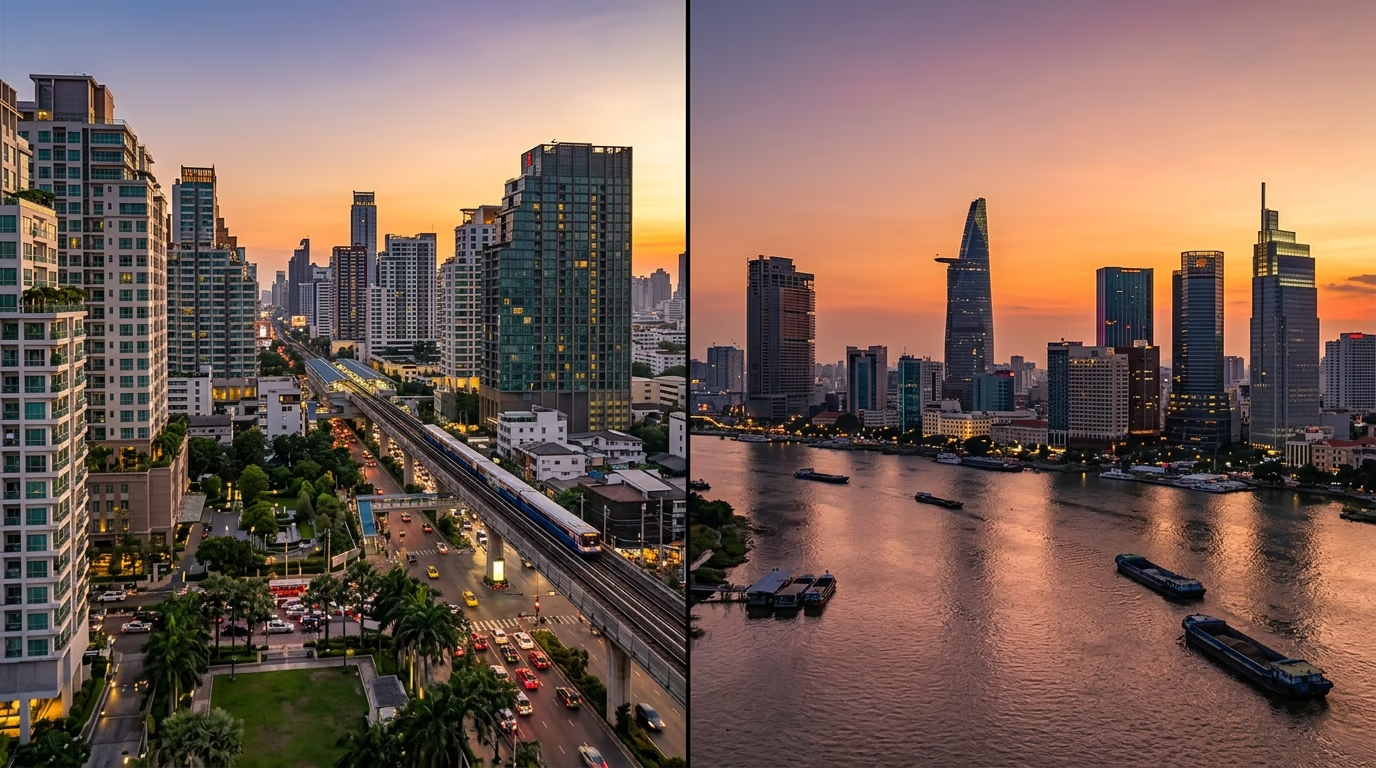
Thailand wins for clean foreign freehold condo ownership, deeper foreign-buyer infrastructure, higher rental yields in resort cities, and a more mature legal framework. Vietnam wins for stronger macro growth, lower entry prices in HCMC and Hanoi compared to Bangkok, and exposure to a faster-compounding urban middle-class rental base. The material caveat: foreign ownership is a 50-year renewable lease-like right, not true freehold, and is capped at 30% of units in any condominium project.
For a foreign buyer in 2026 with a 3-10 million THB budget wanting straightforward ownership, predictable rental yield, and an established expat ecosystem, Thailand is the lower-risk choice. For a foreign buyer comfortable with Vietnamese ownership structure and targeting appreciation on a 7-10 year hold in HCMC District 2 or Hanoi west, Vietnam offers a higher growth beta on a smaller ticket. Most foreign investors comparing the two end up in Thailand because the ownership framework is simpler; the investors who choose Vietnam typically have regional exposure reasons or specific HCMC conviction.
This comparison is built on CBRE Thailand 2026, Cushman & Wakefield Q1 2026, Knight Frank Thailand 2026, Savills Thailand 2026, GlobalPropertyGuide Q1 2026 (both countries), Savills Vietnam Q1 2026, CBRE Vietnam 2026, KPMG Vietnam 2025-2026, GSO Vietnam 2025, the Thai Condominium Act B.E. 2522, and the Vietnam Law on Housing 2023 (effective 1 August 2024).
Master comparison table
The table summarises 22 dimensions that separate Thailand from Vietnam for a 2026 foreign condo buyer.
| Dimension | Thailand | Vietnam |
|---|---|---|
| Foreign ownership structure | True freehold under Condominium Act B.E. 2522 | 50-year lease-like ownership (renewable) under Law on Housing 2023 |
| Foreign quota per building | Up to 49% of saleable area | Up to 30% of units per condominium |
| Geographic cap | None (national quota applies per building) | Max 250 houses per administrative ward |
| Ownership term | Perpetual freehold | 50 years, renewable subject to approval |
| Inheritance rights | Full, under Thai civil code | Permitted but subject to ownership-term limits |
| Prime capital city per sqm | Bangkok 200,000-350,000 THB | HCMC District 1/2 120,000-220,000 THB eq. |
| Resort city per sqm (prime) | Pattaya/Phuket 160,000-280,000 THB | Da Nang 85,000-160,000 THB eq. |
| Entry condo (1-bed, mid-market) | 2.8-5.0M THB | 1.8-3.5M THB eq. |
| Gross yield long-term (resort) | 5.5-7.5% | 4.5-6.5% |
| Gross yield capital city | 4.0-5.5% | 4.5-6.0% |
| Net yield after expenses | 3.5-5.5% | 3.5-5.0% |
| Transaction costs (buy side) | 3-6% total | 2-3% total |
| Annual property tax | None on residential primary | 0.03-0.15% VAT on rental; no annual condo tax |
| Capital gains | WHT/SBT on sale (~3-4%) | 2% of transfer value |
| Mortgage availability (foreigners) | Limited, UOB/ICBC/MBK select | Very limited, typically cash-only |
| Currency | THB (stable, floating) | VND (managed, chronic inflation spread) |
| Inflation 2025 | 0.4-1.0% | 3.2-4.5% |
| GDP growth 2025 | 2.5-3.0% | 6.5-7.0% |
| Resale liquidity (foreign units) | Active secondary, 2-6 month | Thin secondary, 4-12 month |
| Legal complexity | Moderate, established conveyancing | Higher, evolving regulations |
| Foreign expat community | 300,000+ long-stay residents | 80,000-120,000 long-stay residents |
| English in conveyancing | Common | Variable |
Sources: CBRE Thailand 2026, Savills Thailand 2026, Savills Vietnam Q1 2026, CBRE Vietnam 2026, GlobalPropertyGuide Q1 2026 (both), KPMG Vietnam 2025-2026, Vietnam Law on Housing 2023, Thai Condominium Act B.E. 2522.
Foreign ownership: the structural difference
The ownership gap is the single largest Thailand-vs-Vietnam decision factor. Thailand grants true Thai freehold title to foreigners up to 49% of a condominium’s saleable area. Vietnam grants foreigners a 50-year renewable ownership right, capped at 30% of units per project and 250 houses per ward. A Thai freehold owner holds the same title class as a Thai national; a Vietnamese foreign owner holds a distinct, term-limited class.
Thailand: Condominium Act B.E. 2522
The Condominium Act of 1979 (amended 2008) permits foreigners to own condo units in freehold up to 49% of the saleable area in any one building. Title is perpetual, transferable, inheritable, and identical in class to Thai freehold. Proof of foreign-currency inward remittance is required at transfer. See the foreign quota 49% rule guide for detail.
Vietnam: Law on Housing 2014 (amended 2023, effective August 2024)
The Law on Housing 2023 (Luật Nhà ở 2023), which took effect on 1 August 2024, confirms the framework first established in 2015. Foreign individuals and organisations may own residential housing in Vietnam subject to three caps:
- Project cap: Maximum 30% of the total units in any one condominium project.
- Ward cap: Maximum 250 landed houses per administrative ward.
- Term cap: 50 years from the ownership certificate date, renewable once for a further period subject to competent-authority approval.
Foreigners must enter Vietnam on a valid visa to qualify. Inheritance is permitted but the inheritor may be restricted to receiving sale proceeds if they do not qualify to own under the 50-year framework.
Practical implication
A Thai freehold condo passes to an heir with identical title perpetually. A Vietnamese foreign-owned condo on a 50-year term passes to the heir with the residual term and a renewal application that is not automatic. For a foreign buyer targeting a multi-generation hold, Thailand’s structure is materially cleaner. For a foreign buyer targeting a 7-15 year investment hold with exit via sale, both structures are workable; the Vietnam 50-year term is not a binding constraint on typical investment horizons.
Price comparison by tier
Vietnam HCMC and Hanoi prime condo pricing runs 30-45% below Bangkok prime in 2026. Vietnam Da Nang pricing runs 30-50% below Pattaya/Phuket prime. The price gap reflects Vietnam’s earlier development stage, tighter foreign-buyer pool, and ownership-structure discount.
| Tier | Thailand (THB/sqm) | Vietnam (THB equivalent/sqm) | Ratio (TH/VN) |
|---|---|---|---|
| Capital city prime | 200,000-350,000 (Bangkok) | 120,000-220,000 (HCMC D1/D2) | 1.6x |
| Capital city mid-market | 120,000-180,000 (Bangkok) | 75,000-120,000 (HCMC D7, Hanoi Tay Ho) | 1.5x |
| Resort prime beachfront | 180,000-280,000 (Pattaya/Phuket) | 90,000-160,000 (Da Nang, Nha Trang) | 1.9x |
| Resort mid-market | 85,000-140,000 | 55,000-90,000 | 1.6x |
| 1-bedroom entry ticket | 2.8-4.5M THB (Pattaya) | 1.8-3.2M THB eq. (HCMC D9, Hanoi west) | 1.5x |
| 2-bedroom mid-market | 5.0-9.5M THB | 3.2-6.0M THB eq. | 1.5x |
Sources: CBRE Thailand 2026, Cushman & Wakefield Q1 2026, Savills Vietnam Q1 2026, CBRE Vietnam 2026.
On an identical 8 million THB budget in 2026:
- Thailand: 70-90 sqm 2-bedroom in Jomtien Pattaya or Sukhumvit 71 Bangkok, clean freehold.
- Vietnam: 80-110 sqm 2-bedroom in HCMC District 2 (Thu Thiem) or Hanoi Tay Ho, 50-year term with 30% quota check required.
The Vietnam discount buys a larger unit; the Thailand premium buys freehold certainty and a deeper foreign resale market.
Yields by city
Vietnam HCMC and Hanoi gross yields are modestly competitive with Bangkok on mid-market condos. Thailand resort-city yields (Pattaya, Phuket) materially outperform Vietnam resort-city yields (Da Nang, Nha Trang) on both long-term and short-stay strategies.
| Strategy | Thailand gross | Thailand net | Vietnam gross | Vietnam net |
|---|---|---|---|---|
| Capital city long-term (Bangkok/HCMC) | 4.0-5.5% | 3.0-4.2% | 4.5-6.0% | 3.2-4.5% |
| Capital city short-stay | 5.5-8.0% | 3.5-5.0% | 5.5-7.5% | 3.2-4.5% |
| Resort long-term | 5.5-7.5% | 3.8-5.0% | 4.5-6.5% | 3.0-4.2% |
| Resort short-stay | 7.0-11.0% | 4.5-5.8% | 6.0-9.0% | 3.8-5.2% |
Sources: GlobalPropertyGuide Q1 2026 (Thailand and Vietnam), CBRE Thailand 2026, Savills Vietnam Q1 2026.
Why Thailand resort yields are higher. Pattaya and Phuket have mature long-stay foreign tenant bases (European retirees, Russian and British snowbirds, digital nomads). Vietnamese resort cities have a thinner long-stay foreign resident base and rely on domestic holiday rentals, which pay less per night. Net yield gap widens after Vietnam’s currency-hedging friction for foreign investors.
Why Vietnam capital-city yields are modestly higher. HCMC and Hanoi yields benefit from strong domestic rental demand driven by urban migration and a young professional population. Bangkok’s more mature market and higher entry prices compress yields slightly.
Macro environment and currency
Vietnam is a higher-growth, higher-inflation, managed-currency economy. Thailand is a lower-growth, low-inflation, freely floating baht economy. The macro pictures shape the capital-appreciation versus yield trade-off.
| Indicator | Thailand 2025 | Vietnam 2025 |
|---|---|---|
| GDP growth | 2.5-3.0% | 6.5-7.0% |
| CPI inflation | 0.4-1.0% | 3.2-4.5% |
| Currency regime | Free-float THB | Managed-float VND |
| FDI inflow (USD bn) | 8-10 | 28-38 |
| Foreign tourist arrivals | 38-42M | 17-19M |
| Urban migration rate | Moderate, slowing | High, accelerating |
Sources: Bank of Thailand 2025, Office of the National Economic and Social Development Council (NESDC) Thailand 2025, GSO Vietnam 2025, State Bank of Vietnam 2025.
Vietnam’s FDI and GDP advantage translates into higher nominal price appreciation but also higher inflation and a structurally weakening VND against hard currencies. Thailand’s lower growth comes with stability and convertibility. Foreign investors taking a 10-year view should model Vietnam returns in USD after accounting for a 2-4% annual VND depreciation spread versus USD; Thailand returns hold closer in THB-to-USD terms.
Transaction costs and taxes
Thai transaction costs run 3-6% of price on buy side (transfer fee, specific business tax, withholding tax, stamp duty split between buyer and seller). Vietnam transaction costs run 2-3% on buy side (registration fee, notary, VAT already embedded). Annual holding taxes are near-zero in both jurisdictions for primary residential condo ownership.
| Cost | Thailand | Vietnam |
|---|---|---|
| Transfer/registration fee | 2.0% of appraised value | 0.5% of contract value |
| Stamp duty | 0.5% (if no SBT) | 0% on condo transfer |
| Specific Business Tax (SBT) | 3.3% if seller held <5 years | N/A |
| Withholding tax (seller) | 1% (corporate) or progressive (individual) | 2% of contract value |
| VAT embedded in new-build price | 7% | 10% |
| Annual property tax | None on residential condo | None on residential condo (2026) |
| Rental income tax (foreign owner) | 5-15% progressive or 15% flat option | 5% VAT + 5% PIT = ~10% effective |
Sources: Thai Revenue Code, Thailand Land Department transfer schedule 2026, KPMG Vietnam Real Estate Tax Guide 2025-2026. See the Thailand property taxes guide and the condo transfer fees guide.
Legal and conveyancing complexity
Thai conveyancing is mature, standardised, and English-fluent in major cities. Vietnam conveyancing is evolving, regulatory changes are more frequent, and English-language documentation is less consistent outside top-tier developers.
Thailand
- Standard sale and purchase agreement under Condominium Act.
- Foreign-currency inward remittance certificate (Foreign Exchange Transaction form) required.
- Land Department transfer completed within 30-90 days of final instalment.
- Condominium juristic-person register updates foreign quota status.
- Typical conveyancing fee: 30,000-60,000 THB per transaction.
Vietnam
- Sale and purchase agreement under Law on Housing 2023 with prescribed form.
- Foreign buyer must present valid visa/residency documentation.
- Ownership certificate (Pink Book / sổ hồng) issued with 50-year annotation.
- Registration at Department of Natural Resources and Environment.
- Typical conveyancing/legal fee: 20-35 million VND per transaction.
Practical risk comment. Vietnam’s 2014-2023 period saw Ministry of Construction clarifications to the Law on Housing on multiple points (quota counting, renewal mechanism, inheritance path). The 2023 amendment stabilised the framework. Most experienced foreign-facing developers (Vinhomes, Masterise, Keppel, CapitaLand, Gamuda) now issue ownership certificates reliably within 12-24 months of handover. First-time foreign buyers should select projects with track record of delivering Pink Books.
Rental market and tenant base
Thailand has a significantly deeper foreign long-term tenant base (especially in Pattaya, Phuket, and Hua Hin) that supports stable long-term yield. Vietnam’s rental market is dominated by domestic urban professionals with a smaller expat segment concentrated in HCMC D2/D7 and Hanoi Tay Ho.
Thailand rental tenant profile (resort)
- 55-65% European retirees, British snowbirds, Russian long-stay.
- 15-20% digital nomads.
- 10-15% Thai professionals.
- 5-10% short-stay tourists.
Vietnam rental tenant profile (HCMC D2/D7, Hanoi Tay Ho)
- 55-70% Vietnamese urban professionals and young families.
- 15-25% expatriate professionals (Korean, Japanese, Western corporate postings).
- 5-15% short-stay travellers.
Yield implication. Thailand’s foreign retiree base anchors resort-city long-term yields at 5.5-7.5% with low vacancy. Vietnam’s domestic-led rental market tracks local wage growth (6-8% per annum) but is more sensitive to local employment cycles. Both are sustainable; Thailand’s foreign tenant base is more rate-insensitive in downturns.
Who wins by buyer profile
Profile maps to the winning choice.
Yield-focused investor, 4-10M THB budget
Winner: Thailand (Pattaya or Phuket). Clean freehold, 5.5-7.5% gross yield, established resale liquidity, familiar conveyancing path. Target Jomtien, Pratumnak, or Rawai.
Growth-focused investor, 5-12M THB budget with 7-10 year hold
Winner: Vietnam (HCMC D2/Thu Thiem, Hanoi Tay Ho). Higher GDP growth, urban migration tailwind, compounding rental demand. Accept 50-year term, quota constraint, and currency friction. Select Vinhomes, Masterise, or Keppel projects with foreign-quota availability.
Retirement / long-term primary residence buyer
Winner: Thailand. Mature retirement visa framework (Non-Immigrant O-A, Long-Term Resident), deeper retiree infrastructure, broader healthcare access, English-fluent service economy, lower cost of living at the premium end. Vietnam lacks a comparable retirement visa.
Second-home lifestyle buyer
Winner: Thailand. Better resort product, direct international flights to Phuket, Bangkok, Samui, Chiang Mai. Vietnam resort inventory is improving but narrower in product quality at foreign-targeted prices.
Regional-portfolio investor with Vietnam conviction
Winner: Vietnam. Specific HCMC thesis, CVA exposure to Vietnam manufacturing/services growth, and comfort with ownership-term structure.
First-time foreign property buyer with no prior SE Asia exposure
Winner: Thailand. Lower legal complexity, mature foreign-buyer ecosystem, deeper secondary market. Start here; add Vietnam later if thesis develops.
Risk comparison
Both countries carry normal emerging-market real estate risks plus country-specific structural risks.
Thailand-specific risks
- Currency strength cycles (THB has run 32-38 per USD range 2018-2026).
- Tourism concentration in resort cities.
- Short-stay regulatory enforcement under Hotel Act B.E. 2547.
- Political cycles affecting capital flows.
Vietnam-specific risks
- 50-year ownership term renewal is subject to approval, not automatic.
- Currency depreciation trend (VND has weakened 15-25% vs USD 2018-2026 in cumulative real terms).
- Regulatory change velocity on foreign ownership rules.
- Thinner foreign resale market: exits can take 6-12 months at prime pricing.
- Limited foreign-buyer mortgage financing.
Frequently asked questions
Can foreigners own property outright in Vietnam like in Thailand?
No. Vietnam grants foreigners a 50-year renewable ownership right under the Law on Housing 2023 (effective August 2024), capped at 30% of units per condominium and 250 landed houses per administrative ward. Thailand grants full perpetual freehold to foreigners up to 49% of a condominium’s saleable area. The Thai structure is true freehold; the Vietnamese structure is a term-limited right that functions as ownership but is not perpetual.
Which country has better rental yields?
Thailand resort cities lead on long-term and short-stay yield (5.5-7.5% gross long-term, 7-11% gross short-stay on hotel-licensed stock). Vietnamese capital cities are modestly competitive with Bangkok on mid-market condo yield (4.5-6% versus Bangkok 4-5.5%). For a yield-focused foreign investor, Thailand’s resort cities are the stronger target.
Can I get a mortgage as a foreigner in either country?
Limited in both. In Thailand, UOB Thailand, ICBC Thailand, MBK, and a handful of offshore banks offer 50-70% LTV mortgages to qualifying foreign buyers at 5.5-7.5% THB rates. In Vietnam, foreign-buyer mortgage lending is very restricted; most foreign purchases are cash. Both markets are functionally cash-purchase markets for foreign investors at the entry level.
What are total transaction costs for a foreign buyer?
Thailand: 3-6% of price on buy side (transfer fee 2%, stamp 0.5%, SBT 3.3% if seller <5 year hold, WHT 1% or progressive). Vietnam: 2-3% on buy side (registration 0.5%, notary fees, VAT already embedded in new-build). Annual holding cost is near-zero in both jurisdictions.
Is Vietnam’s 50-year term a deal-breaker?
Not for investment holds of 7-15 years. The 50-year term from ownership certificate issuance is renewable once by application to the competent authority, and the market has not yet seen mass-renewal test cases since the 2015 framework. For a multi-generational family hold, Thai freehold is materially cleaner. For a sell-in-10-years investment view, the 50-year term has not historically compressed exit pricing in practice.
Which currency is safer to hold property in?
Thai baht. THB is a freely floating convertible currency with a 32-38 per USD trading range over 2018-2026. VND is a managed-float currency with chronic inflation spread and has weakened 15-25% in real terms against USD over the same period. Thailand offers better currency stability for foreign investors measuring returns in hard currency.
Is foreign quota tracked similarly in both countries?
Similar in principle, different in execution. Thailand tracks foreign quota at the Land Department building register; you can verify availability for a specific unit before depositing. Vietnam tracks foreign quota at the project level via the Department of Construction; verification is typically done through the developer’s sales office. Both jurisdictions require proof of compliance at title transfer.
Which market has better resale liquidity for foreign owners?
Thailand. Bangkok and Pattaya have active foreign-to-foreign and foreign-to-Thai resale markets with 2-6 month typical sale cycles on correctly priced units. Vietnam’s foreign secondary market is thinner; foreign-quota units sometimes trade only back to other foreign buyers (quota constraint) with 4-12 month sale cycles. Exit liquidity is a meaningful differentiator.
Related reading
- Foreign quota 49% rule in Thailand — Condominium Act B.E. 2522 explained.
- Buying a condo in Thailand as a foreigner — step-by-step process.
- Freehold vs leasehold in Thailand — ownership structures.
- Rental yields in Thailand — city-by-city yield data.
- Thailand property taxes — buyer and seller tax breakdown.
- Pattaya vs Bangkok comparison — city-level investment comparison.
- Thailand vs Bali comparison — alternative jurisdiction comparison.
References
Sources
- 01CBRE Thailand Real Estate Market Outlook 2026 · https://www.cbre.co.th/press-releases/thailand-real-estate-market-2026-balancing-risk-rewardThailand condo price benchmarks, yield ranges, and foreign transfer volumes 2026. Accessed 2026-04-16.
- 02Cushman & Wakefield Thailand Market Beat Q1 2026 · https://www.cushmanwakefield.com/en/thailand/insights/thailand-marketbeatThailand national condo supply, take-up, and Q1 2026 district pricing. Accessed 2026-04-16.
- 03Knight Frank Thailand Residential Market Research 2026 · https://www.knightfrank.co.th/researchThailand residential capital growth 2018-2026 and prime yield ranges. Accessed 2026-04-16.
- 04Savills Thailand Property Market 2026 Strategic Outlook · https://www.savills.co.th/blog/article/225734/singapore-articles/thailand-property-market-2026--strategic-outlook-and-emerging-trends.aspxThailand 2026 strategic outlook, city-level yield forecasts, and investor demand. Accessed 2026-04-16.
- 05Condominium Act B.E. 2522, Thailand Land Department · https://www.dol.go.th/Condominium Act B.E. 2522 (1979, amended 2008) 49% foreign quota framework. Accessed 2026-04-16.
- 06GlobalPropertyGuide Thailand Rental Yields Q1 2026 · https://www.globalpropertyguide.com/asia/thailand/rental-yieldsThailand rental yields by city Q1 2026. Accessed 2026-04-16.
- 07Vietnam Law on Housing 2023 (Luật Nhà ở 2023), Ministry of Construction guidance · https://moc.gov.vn/en/Vietnam Law on Housing 2014 amended by Law on Housing 2023 (effective 1 August 2024): 30% unit cap per condominium and 250-house ward cap for foreign owners, 50-year renewable ownership term. Accessed 2026-04-16.
- 08Savills Vietnam HCMC and Hanoi Market Report Q1 2026 · https://www.savills.com.vn/researchVietnam HCMC and Hanoi primary condo pricing, take-up, and yield benchmarks 2026. Accessed 2026-04-16.
- 09CBRE Vietnam Market Outlook 2026 · https://www.cbrevietnam.com/Vietnam residential market outlook and foreign demand 2026. Accessed 2026-04-16.
- 10KPMG Vietnam Real Estate Tax Guide 2025-2026 · https://kpmg.com/vn/en/home.htmlVietnam property tax and transaction cost framework; foreign ownership compliance. Accessed 2026-04-16.
- 11General Statistics Office of Vietnam (GSO) 2025 Annual Data · https://www.gso.gov.vn/en/homepage/Vietnam GDP, inflation, FDI, and real estate sector statistics 2025. Accessed 2026-04-16.
- 12GlobalPropertyGuide Vietnam Rental Yields Q1 2026 · https://www.globalpropertyguide.com/asia/vietnam/rental-yieldsVietnam rental yields by city Q1 2026. Accessed 2026-04-16.
Published · How we research and date our content