Pattaya vs Bangkok Condo Investment 2026: Data-Backed Comparison
Pattaya vs Bangkok condo investment 2026: price per sqm, yields, foreign share, resale liquidity, capital growth, lifestyle, and who wins for each investor profile.
The short answer: which city wins for which buyer
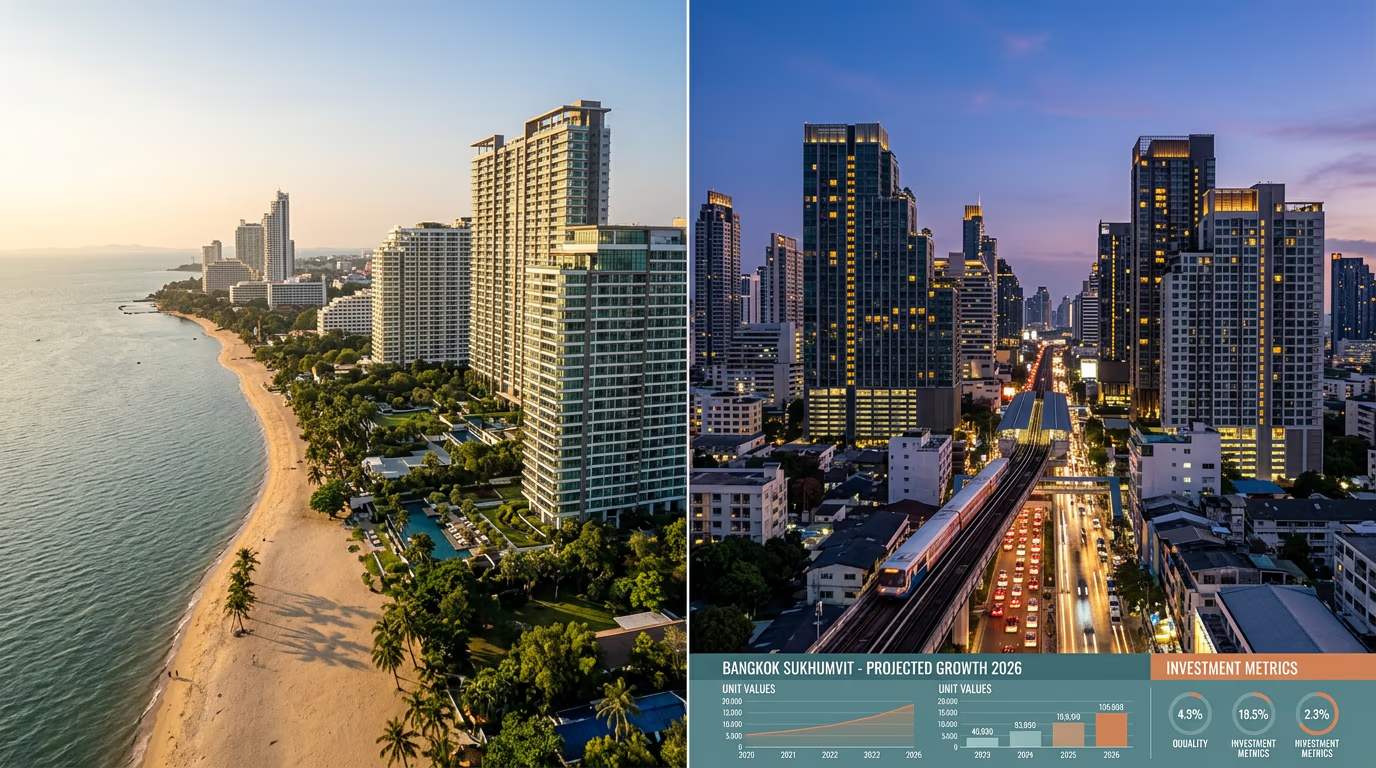
Pattaya wins for rental yield, lower entry price, and lifestyle affordability. Bangkok wins for resale liquidity, capital growth in prime stock, and professional tenant depth. On the same 6 million THB budget in 2026, a buyer gets a 65-75 sqm 2-bedroom in Jomtien with a 6-7% gross yield, or a 28-32 sqm studio in Asoke with a 4.2-4.8% gross yield. The trade is explicit: cash flow and size in Pattaya, liquidity and location prestige in Bangkok.
For a yield-focused foreign investor with a 3-10 million THB budget, Pattaya wins on the numbers by a clear margin. For a capital-appreciation-focused investor treating the condo as a store of value with rental upside, Bangkok prime wins on liquidity and resilience. For a retiree with a lifestyle preference for beach, year-round sun, an established foreign community, and a lower cost of living, Pattaya wins decisively. For a working expat or executive relocation, Bangkok wins on job access, international schools, and hospital density.
This comparison is built on CBRE Thailand 2026, Cushman & Wakefield Q1 2026, Savills Thailand 2026, Knight Frank Thailand 2026, GlobalPropertyGuide Q1 2026, REIC foreign transfer data 2025, and the Condominium Act B.E. 2522. All figures are 2026 market ranges; verify the specific building, unit, and timing with the cost calculator and yield calculator before committing.
Master comparison table
The following side-by-side table summarises 24 dimensions that matter for foreign condo buyers in 2026. Numbers are directional 2026 ranges from the named sources.
| Dimension | Pattaya | Bangkok |
|---|---|---|
| Typical entry price per sqm (mid-market) | 65,000-110,000 THB | 130,000-200,000 THB |
| Prime price per sqm | 160,000-250,000 THB | 280,000-400,000 THB |
| 1-bedroom entry (38-45 sqm) | 2.8-4.5M THB | 5.5-9.0M THB |
| 2-bedroom mid-market (60-80 sqm) | 5.0-9.5M THB | 11-18M THB |
| Gross rental yield (long-term) | 5.0-8.0% | 4.0-6.0% |
| Gross rental yield (short-stay, where legal) | 7.0-11.0% | 5.5-7.5% |
| Net yield after expenses | 3.5-5.5% | 2.5-4.0% |
| Foreign quota availability | Generally open | Tight in prime Sukhumvit, open outside |
| Foreign buyer share (of new launches) | ~28% | ~55% |
| 2018-2026 capital growth (prime) | +18-24% | +22-30% |
| 2020-2022 tourism drawdown impact | Severe | Moderate |
| 2023-2026 recovery | Strong, ongoing | Steady |
| Resale liquidity (median days on market) | 90-180 | 45-90 |
| Primary rental tenant | European retirees, digital nomads | Corporate expats, Thai professionals |
| Airport access | U-Tapao 45 min, BKK 120 min | BKK 30 min, DMK 40 min |
| Healthcare (international hospitals) | 2 (Bangkok Hospital Pattaya, Bangkok-Pattaya) | 15+ (Bumrungrad, BNH, Samitivej, etc.) |
| English spoken (service level) | High | High in CBD, moderate elsewhere |
| International schools | 4-5 | 40+ |
| Cost of living (index vs Bangkok) | 70-80 | 100 |
| Beach access | 10-30 min from all areas | None (nearest 110 km) |
| Climate | Tropical, beach, year-round | Tropical, urban heat, year-round |
| Nightlife | Dense, diverse | Dense, concentrated (Sukhumvit, RCA) |
| Expat community size | Mature, 40,000-60,000 residents | Mature, 120,000-180,000 residents |
| Family-friendly rating | Area-dependent (Jomtien, Wongamat yes) | Strong in Ari, Phrom Phong, Ekkamai |
Sources: CBRE Thailand 2026, Cushman & Wakefield Q1 2026, Savills Thailand 2026, Knight Frank Thailand 2026, GlobalPropertyGuide Q1 2026, REIC 2025.
Price comparison by tier and area
Bangkok pricing is roughly 1.8 to 2.3 times Pattaya pricing on equivalent-tier stock in 2026. The gap widens in the prime segment (Sukhumvit core vs Wongamat beachfront) and narrows in the mid-market segment (outer Sukhumvit vs Jomtien beachfront).
| Tier | Pattaya price/sqm | Bangkok price/sqm | Ratio (Bangkok/Pattaya) |
|---|---|---|---|
| Entry | 55,000-80,000 THB | 90,000-130,000 THB | 1.6x |
| Mid-market | 75,000-125,000 THB | 140,000-200,000 THB | 1.7x |
| Upper mid | 120,000-175,000 THB | 200,000-280,000 THB | 1.6x |
| Prime | 160,000-250,000 THB | 280,000-400,000 THB | 1.7x |
| Ultra-prime | 250,000-400,000 THB | 400,000-650,000 THB | 1.6x |
Source: CBRE Thailand 2026 Outlook, Cushman & Wakefield Q1 2026 Market Beat.
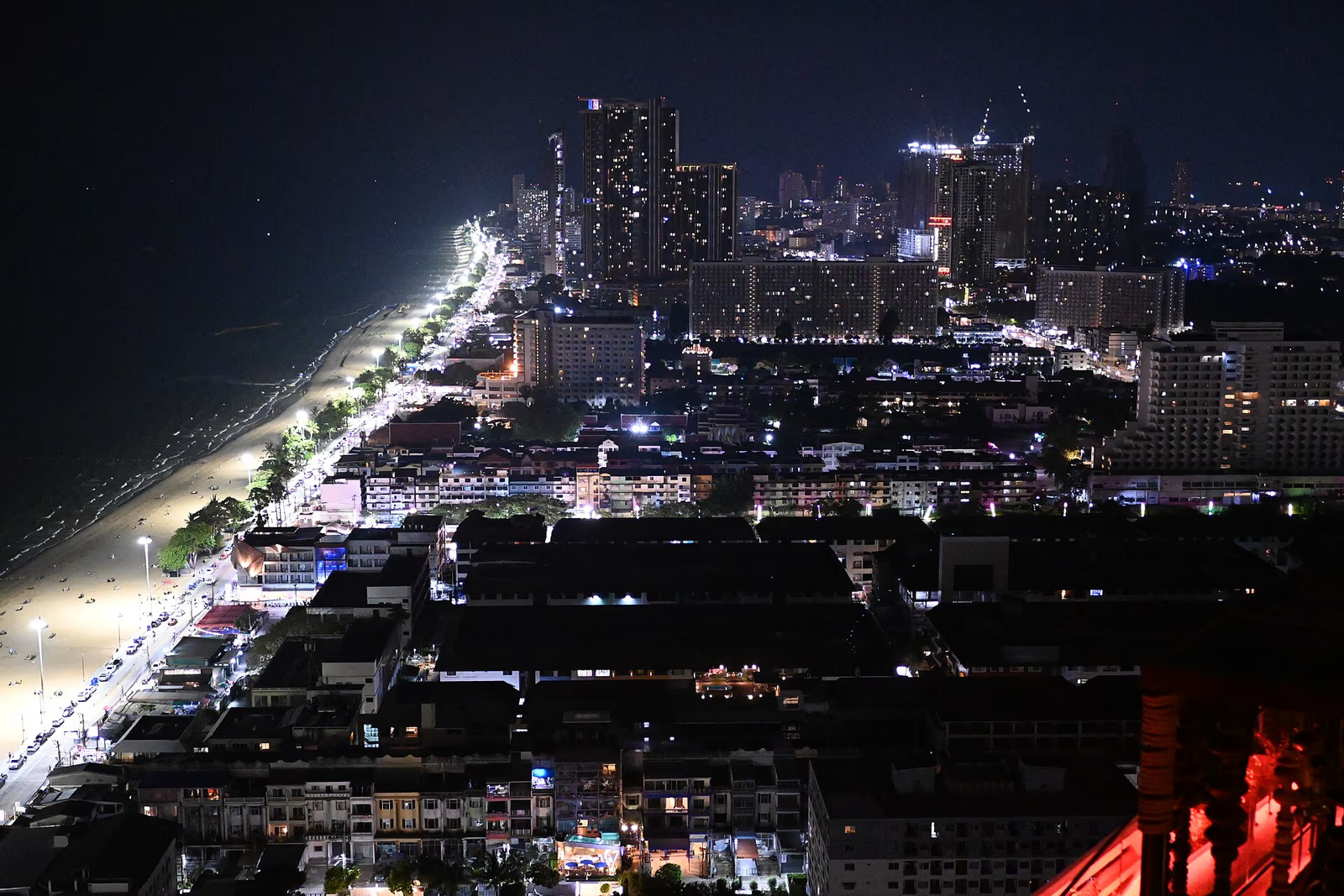
Pattaya area pricing 2026. Jomtien Beach runs 75,000-110,000 THB per sqm mid-market; Wongamat and Naklua beachfront 180,000-280,000 THB per sqm; Pratumnak Hill 85,000-150,000 THB per sqm; Na Jomtien new launches 95,000-170,000 THB per sqm; Central Pattaya 70,000-95,000 THB per sqm; South Pattaya 60,000-85,000 THB per sqm. See the Pattaya area hub for area-level detail.
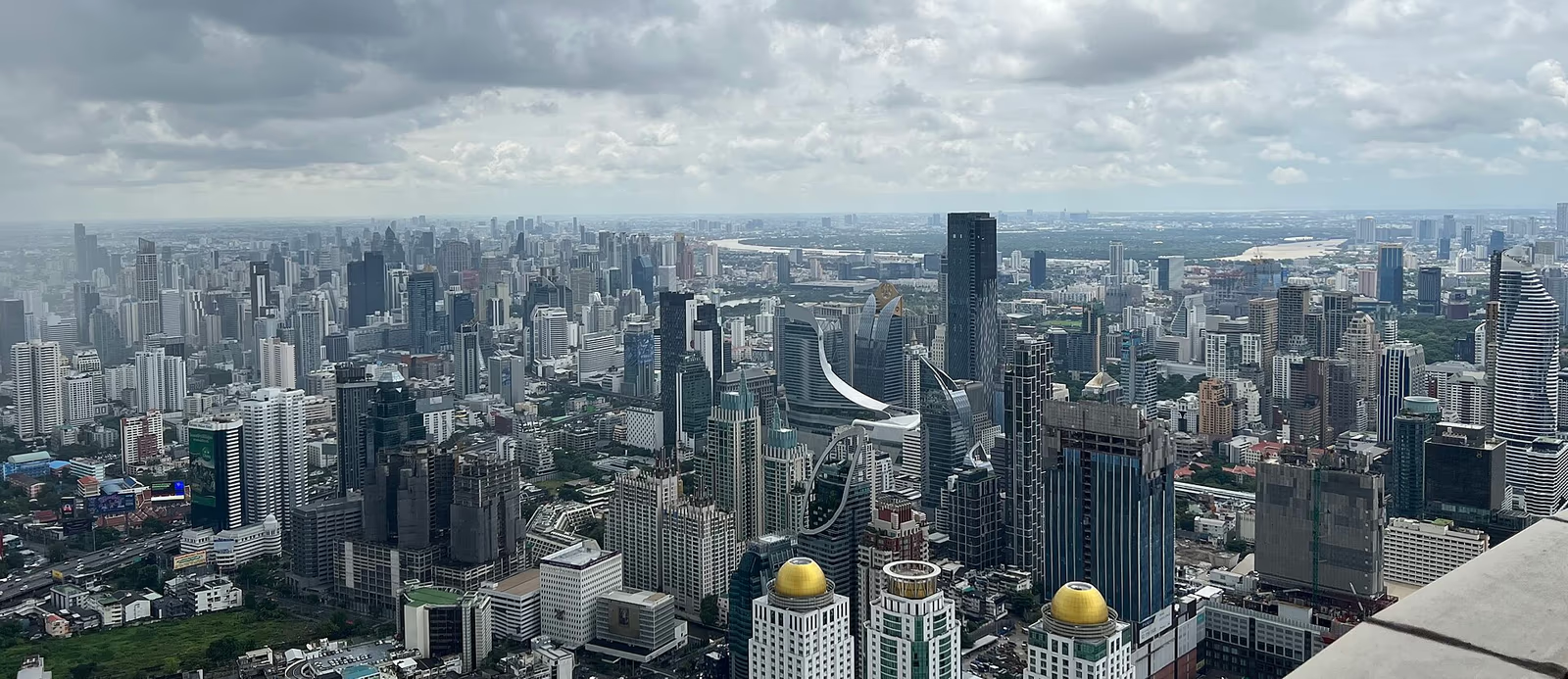
Bangkok district pricing 2026. Asoke, Phrom Phong, and Thong Lor run 220,000-350,000 THB per sqm; Silom and Sathorn 180,000-280,000 THB per sqm; outer Sukhumvit (On Nut, Bang Chak, Ekkamai) 130,000-200,000 THB per sqm; Ari 140,000-200,000 THB per sqm; Ratchada 100,000-150,000 THB per sqm; Bang Na and Bearing 80,000-130,000 THB per sqm.
On identical 6 million THB budgets in 2026, the realistic options are:
- Pattaya: 65-75 sqm 2-bedroom in Jomtien or Pratumnak, fully fitted, 200m from beach.
- Bangkok: 28-32 sqm studio in Asoke or Phrom Phong, fully fitted, 400m from BTS.
The Bangkok premium buys square-metre efficiency in a high-liquidity location. The Pattaya discount buys beach proximity and a second bedroom.
Yield comparison by strategy
Pattaya produces 120-220 basis points more gross yield than Bangkok on equivalent-tier condos in 2026. The spread is structural, not cyclical, and reflects Bangkok’s sustained price growth against flat rent growth since 2015.
| Strategy | Pattaya gross | Pattaya net | Bangkok gross | Bangkok net |
|---|---|---|---|---|
| Long-term lease (12+ months) | 5.5-7.5% | 3.8-5.0% | 4.0-5.5% | 2.6-3.7% |
| Medium-term (3-6 month) | 6.0-8.0% | 4.0-5.2% | 4.5-6.0% | 3.0-4.0% |
| Short-stay (hotel-licensed) | 8.0-12.0% | 4.5-5.8% | 6.0-7.5% | 3.8-4.5% |
| Short-stay (non-licensed, illegal) | 7.0-10.5% | 4.0-5.2% | 5.5-7.0% | 3.5-4.2% |
Sources: GlobalPropertyGuide Q1 2026, CBRE Thailand 2026, Cushman & Wakefield Q1 2026, Savills Thailand 2026.
Why Pattaya yields more. Entry prices grew slower than Bangkok’s since 2018 while rent growth tracked Bangkok closely. Pattaya yields compressed during 2020-2022 tourism collapse, then recovered fully by 2024 on European, Chinese, and Russian demand. Bangkok prime yields kept compressing as price growth outran rent growth.
When Bangkok wins on yield. Outer Sukhumvit fresh 2024-2025 stock on the MRT extension can hit 5.5-6.5% gross, matching mid-tier Pattaya. Ratchada studios at 100,000-130,000 THB per sqm also produce 5.0-6.5% gross. For a yield-focused Bangkok strategy, avoid the Sukhumvit core and buy outer stock near confirmed 2026-2028 transit extensions.
Short-stay legal reality. Sub-30-day letting without a hotel licence violates the Hotel Act B.E. 2547 (2004) in both cities. Enforcement has tightened. Both cities see building juristic persons prohibiting short-stay in bylaws. Budget for long-term yields unless buying a branded hotel-licensed residence. See the rental yield guide for detail.
Foreign buyer volume and demand depth
Bangkok absorbs roughly 55% of Thailand’s foreign condo transfer volume; Pattaya and Chonburi absorb roughly 28%; Phuket, Samui, and the rest split the remaining 17%. Bangkok’s absolute volume is larger but Pattaya has higher foreign concentration as a share of local transactions.
| Metric | Pattaya (Chonburi) | Bangkok |
|---|---|---|
| Share of national foreign condo transfers 2024 | 27-29% | 54-56% |
| Foreign share of local condo transfers | 45-60% | 12-18% |
| Primary foreign nationality | Chinese 28%, Russian 18%, European 22%, Other 32% | Chinese 42%, Taiwanese 9%, Hong Kong 7%, Japanese 8%, European 18%, Other 16% |
| Typical foreign buyer ticket size | 4-12M THB | 8-20M THB |
Source: REIC Foreign Demand Report 2025, CBRE Thailand 2026 Outlook.
Bangkok foreign demand is Chinese-led and dominant; Pattaya is more diverse. Bangkok launched projects increasingly depend on Chinese off-plan absorption; CBRE flagged 2024-2026 buyer-mix concentration risk if Chinese outbound capital tightens. Pattaya’s diversified European, Russian, GCC, and Asian mix gives demand resilience. A China-only shock hits Bangkok prime harder than Pattaya.
49% foreign quota implications differ by market. In Bangkok prime Sukhumvit, the 49% foreign quota (Condominium Act B.E. 2522, Section 19 bis) is often exhausted on new launches within 90 days; buyers accept Thai-name leasehold as a workaround in poorly advised transactions. Pattaya foreign quota is typically available across all new stock including beachfront, with quota exhaustion mainly in specific signature branded projects. Always verify foreign quota availability at the Land Department before paying a deposit. See the 49% rule guide.
Resale liquidity comparison
Bangkok prime condos sell in 45-90 days to list; Pattaya condos sell in 90-180 days to list. The liquidity gap is Bangkok’s structural advantage. Resale friction is the hidden cost of Pattaya’s yield premium.
| Market segment | Median days to sell | Discount from list at sale | Buyer pool depth |
|---|---|---|---|
| Bangkok prime Sukhumvit | 45-75 | 3-8% | Deep: local HNW, foreign, rental investors |
| Bangkok outer Sukhumvit | 60-120 | 5-12% | Moderate: Thai professionals, foreigners |
| Bangkok Ari/Ratchada | 75-150 | 5-15% | Moderate: Thai professionals |
| Pattaya beachfront | 90-180 | 8-18% | Thin: foreign buyers mainly |
| Pattaya mid-tier | 120-240 | 10-20% | Thin: foreign-dominant |
| Pattaya resale 10+ year old | 180-400 | 15-30% | Very thin |
Source: Knight Frank Thailand 2026 Residential Market Research; agency sales data aggregated Q1 2026.
Three reasons Bangkok resells faster. Larger domestic buyer pool (Thai high-net-worth), concentrated investor demand in fewer districts, and established pricing comparables at building level via 15 years of deep transaction data. Pattaya’s challenge is the foreign-buyer-dominant resale market with more fragmented pricing signals.
Exit planning implication. Pattaya buyers should price a 6-9 month sale horizon into hold-period calculations. Bangkok prime buyers can realistically plan 3-5 month sale horizons. On a 7-year hold, the liquidity gap translates to 150-250 bps of effective IRR drag on Pattaya versus Bangkok, partially offsetting the 200+ bps yield premium.
Lifestyle comparison: honest pros and cons
Pattaya and Bangkok offer fundamentally different lifestyle products. Pattaya is beach, pool, retirement, leisure, and lower cost of living. Bangkok is career, dining, culture, international infrastructure, and urban energy. Neither is universally better; they serve different buyer profiles.
Pattaya advantages. Year-round beach access from any condo. Cost of living 20-30% below Bangkok for equivalent lifestyle. Mature European, Russian, and British retiree community of 40,000-60,000 residents with familiar services (English-speaking dentists, European groceries, international sports clubs). Lower traffic and shorter commutes. U-Tapao International Airport (expanded 2024-2026) plus BKK 110-130 km. Quieter residential areas (Wongamat, Naklua, Bang Saray, Na Jomtien). Jomtien and Wongamat sit in the upper 20% of global retirement-destination rankings.
Pattaya disadvantages. Reputation for nightlife and sex tourism concentrated in Walking Street, Soi 6, and Beach Road drags overall perception. Healthcare is good at Bangkok-Pattaya Hospital but thinner than Bangkok. International school selection limited to a handful. Career mobility near zero for most professional fields. Seasonal tourism spikes (Chinese New Year, Songkran, November-February) create crowding. Weather: hotter, drier, windier than Bangkok, with brief intense monsoon (May-October).
Bangkok advantages. International hospitals (Bumrungrad, Samitivej, BNH, Bangkok Hospital) rank among Asia’s best. 40+ international schools covering British, American, French, Japanese, IB, and Singaporean curricula. Rich dining scene (8 Michelin-starred restaurants, dense hawker culture). International corporate job market for expats. BTS/MRT transit network (180+ stations by 2026 with extensions). Cultural infrastructure (theatres, galleries, live music, Chatuchak, TCDC). Two international airports (BKK 30 min, DMK 40 min).
Bangkok disadvantages. Cost of living 20-30% higher than Pattaya for equivalent lifestyle. Traffic notorious; surface travel can take 60-120 minutes at peak. PM2.5 air quality warnings for 40-80 days per year, mostly December-April (Thai Pollution Control Department 2025 data). No beach (nearest 110 km). Urban heat amplification in dense districts. Social scene requires work for newcomers; community is more transient than Pattaya’s retirees.
Tax treatment: identical national regime
Pattaya and Bangkok sit within the same national tax regime; there is no city-level differentiator on condo taxes in 2026. Both markets apply the full national transfer and ownership tax stack.
Relevant tax lines on a Thai condo transaction and hold:
| Tax | Rate | Basis | Applies |
|---|---|---|---|
| Transfer fee | 2% | Appraised value | Always at sale |
| Specific business tax (SBT) | 3.3% | Sale price | If sold within 5 years of purchase |
| Stamp duty | 0.5% | Sale price | If SBT not applicable |
| Withholding tax (individual) | 1% progressive | Sale price with ownership adjustment | Always at sale |
| Land and Buildings Tax | 0.02% residential | Appraised value | Annual, if >50M THB or non-resident |
| Rental income tax | 5-35% progressive | Net rental income | Annual, on rental receipts |
| Value Added Tax on rental | 7% | Rental income | If business operation and >1.8M THB/year |
Source: Thai Revenue Code Section 91, Land Code, Land and Buildings Tax Act B.E. 2562 (2019).
Tax is a national variable; it does not move the Pattaya vs Bangkok decision. What matters is the tax-aware structuring of entry (always freehold under the foreign quota where possible) and exit (time beyond 5 years to avoid SBT). See the condo costs guide for the full transaction cost model.
Capital growth 2018-2026
Bangkok prime condo prices grew 22-30% over 2018-2026; Pattaya prime condo prices grew 18-24% over the same period. The gap narrowed sharply after 2022 as Pattaya’s post-pandemic recovery outpaced Bangkok’s slower prime growth. Year-by-year direction shows the two markets are in different cycles.
| Year | Bangkok prime price growth | Pattaya prime price growth |
|---|---|---|
| 2018 | +4.2% | +3.1% |
| 2019 | +3.8% | +2.5% |
| 2020 | +0.5% | -3.8% |
| 2021 | -1.2% | -4.5% |
| 2022 | +2.1% | +1.8% |
| 2023 | +3.2% | +5.6% |
| 2024 | +3.8% | +6.4% |
| 2025 | +3.5% | +5.8% |
| 2026 YTD | +2.0% (forecast +3-4% full year) | +3.0% (forecast +5-7% full year) |
| Cumulative 2018-2026 | +22-30% | +18-24% |
Sources: Knight Frank Thailand 2026, CBRE Thailand 2026, Cushman & Wakefield Q1 2026.
The cycles are diverging. Bangkok prime is in late-cycle territory with yield compression, slowing domestic demand, and heavy reliance on Chinese off-plan absorption. Pattaya is mid-cycle with tourism recovery, EEC infrastructure (Pattaya-Rayong high-speed rail targeted 2028, U-Tapao expansion), and catch-up pricing after 2020-2022 losses. The 2026-2030 forward forecast from CBRE places Pattaya capital growth at 5-7% per year and Bangkok prime at 3-4% per year.
Implication for 5-year holds. On a 5-year hold from 2026, a Pattaya prime purchase looks like total return 10-13% per year (6% yield + 5-7% appreciation), while a Bangkok prime purchase looks like 7-9% per year (4.5% yield + 3-4% appreciation). The IRR gap favours Pattaya once yield and appreciation combine, but the liquidity gap (resale friction) partly closes it.
Who wins: by investor profile
The investor profile determines the winner. There is no universally right answer. The four common profiles map cleanly.
Yield investor (cash flow priority, 3-15M THB budget)
Winner: Pattaya. The 150-250 bps yield premium compounded over 5-10 years produces meaningfully higher total return, even after discount for resale friction. Target Jomtien or Pratumnak for long-term tenant depth, avoid beachfront ultra-prime where yield compresses.
Capital appreciation investor (prestige, 12M THB+ budget)
Winner: Bangkok prime. Sukhumvit, Silom, Sathorn, Ari branded residences offer best resale liquidity, consistent foreign demand, corporate tenant depth, and the resilience to hold value in a downturn. Target projects with Japanese or Singaporean institutional tenants.
Retiree (use + light investment, 4-10M THB budget)
Winner: Pattaya. Lower cost of living, beach access, mature retiree community, fewer administrative hurdles, year-round warm weather, and the Elite Visa or retirement visa infrastructure. Target Jomtien or Wongamat for family-friendly areas; avoid Walking Street proximity.
Working expat / family (career + quality of life, 8-18M THB budget)
Winner: Bangkok. International schools, hospitals, corporate job access, and transit. Target Phrom Phong, Ekkamai, or Ari for family districts; Asoke or Thong Lor for single executives. Accept the yield compromise in exchange for lifestyle infrastructure.
Lifestyle buyer profile (second home, part-time use)
Split decision. Pattaya wins for weekly beach use and lower holding costs; Bangkok wins for airline access, culture, and ease of short trips from overseas. A common pattern: retirees buy Pattaya primary + Bangkok pied-a-terre. Investors with 20-30M THB budgets often do both.
Frequently asked questions
Which is a better rental investment, Pattaya or Bangkok?
Pattaya on yield; Bangkok on capital growth and liquidity. Pattaya delivers 150-250 bps higher gross and net yield on equivalent-tier stock. Bangkok prime delivers higher capital appreciation in the Sukhumvit core and faster resale. For total return over 5-10 years with realistic exit, both markets produce 7-12% per year when well-selected; Pattaya typically 50-100 bps higher on an average hold.
Is Bangkok condo price still rising in 2026?
Yes, at 3-4% per year in prime Sukhumvit per CBRE Thailand 2026 Outlook. The growth is slower than 2018-2019 and slower than Pattaya’s current 5-7% per year. Bangkok prime is in late-cycle yield compression with price growth sustained by foreign off-plan absorption.
Can a foreigner buy a condo in both Pattaya and Bangkok?
Yes. There is no national limit on the number of condos a foreigner can own in Thailand. Each purchase must satisfy the building-level 49% foreign quota and the transfer-funds documentation requirement (inward remittance FET form). See the foreign quota rule guide and the foreign buyer guide.
What is the minimum budget to buy a decent condo in each city?
Pattaya: ~2.5M THB for a studio in Jomtien or South Pattaya; ~4.0M THB for a 1-bedroom in Jomtien or Pratumnak. Bangkok: ~4.5M THB for a studio in outer Sukhumvit or Ratchada; ~6.5M THB for a studio in Asoke or Phrom Phong. All figures 2026 primary-market pricing for foreign quota units in credible buildings.
Is Pattaya safer than Bangkok?
Comparable overall crime rates per National Statistical Office data, with different profiles. Pattaya has higher tourist-area petty crime concentration around Walking Street and Soi 6 but lower violent crime outside those zones. Bangkok has lower petty crime and moderately higher traffic-accident risk. Residential areas in both cities are safe by international standards.
What about currency risk?
Same currency (Thai baht), same national regime. Currency risk is uniform. THB depreciated against USD by 12-18% over 2022-2024 and partially recovered in 2025; the 2026 consensus from the Bank of Thailand positions USDTHB in the 33-35 range. Entry pricing on a foreign currency basis is 15-25% below 2019 levels, a separate tailwind for foreign buyers.
How does the 49% foreign quota actually play out in Bangkok prime?
Prime Sukhumvit new launches frequently exhaust their 49% foreign quota within 90 days of launch, forcing later buyers onto Thai-name leasehold or waitlists. Pattaya new launches typically have foreign quota available throughout the launch period. Always verify quota availability at the Land Department before paying a deposit.
Related reading
- Best areas to buy a condo in Pattaya — area-by-area Pattaya analysis.
- Rental yields in Thailand 2026 — full yield methodology and city comparisons.
- Foreign quota 49% rule explained — the Condominium Act framework.
- Freehold vs leasehold in Thailand — ownership structures compared.
- Thailand condo buyer guide — the full foreign purchase process.
- Pattaya vs Phuket comparison — resort market comparison.
- Condo vs villa in Thailand — structural ownership comparison.
References
Sources
- 01CBRE Thailand Real Estate Market Outlook 2026: Balancing Risk and Reward · https://www.cbre.co.th/press-releases/thailand-real-estate-market-2026-balancing-risk-rewardBangkok prime condo prices 200,000-350,000 THB per sqm; yield compression 3.8-5.2% in 2026. Accessed 2026-04-16.
- 02Cushman & Wakefield Thailand Market Beat Q1 2026 · https://www.cushmanwakefield.com/en/thailand/insights/thailand-marketbeatBangkok district-level condo prices, take-up, and rental yields Q1 2026. Accessed 2026-04-16.
- 03Savills Thailand Property Market 2026 Strategic Outlook · https://www.savills.co.th/blog/article/225734/singapore-articles/thailand-property-market-2026--strategic-outlook-and-emerging-trends.aspxPattaya 2026 yields 5-8%; Bangkok 4-6%; national condo supply outlook. Accessed 2026-04-16.
- 04Thailand Real Estate Information Center (REIC) Foreign Demand Report 2025 · https://www.reic.or.th/Foreign condo transfer volumes and nationality share 2025. Accessed 2026-04-16.
- 05Condominium Act B.E. 2522, Ministry of Interior Land Department guidance · https://www.dol.go.th/Condominium Act B.E. 2522 (1979, amended 2008) 49% foreign quota framework. Accessed 2026-04-16.
- 06Thai Revenue Code Section 91 and Land Department transfer schedule 2026 · https://www.rd.go.th/english/Transfer and specific business tax schedule on Thai condo sales. Accessed 2026-04-16.
- 07Knight Frank Thailand Residential Market Research 2026 · https://www.knightfrank.co.th/researchBangkok and Pattaya capital growth index 2018-2026. Accessed 2026-04-16.
- 08GlobalPropertyGuide Thailand Rental Yields Q1 2026 · https://www.globalpropertyguide.com/asia/thailand/rental-yieldsThailand condo gross rental yield by city Q1 2026. Accessed 2026-04-16.
- 09Thailand Board of Investment EEC Update 2026 · https://www.boi.go.th/en/eec/EEC infrastructure spend and Pattaya-Rayong high-speed rail progress 2026. Accessed 2026-04-16.
Published · How we research and date our content