Pattaya vs Phuket 2026: Where to Buy a Condo for Investment
Pattaya vs Phuket condo investment 2026: freehold availability, prices, yields, tourism volume, airport access, lifestyle, and honest profile-based verdict.
The short answer: which resort wins for which buyer
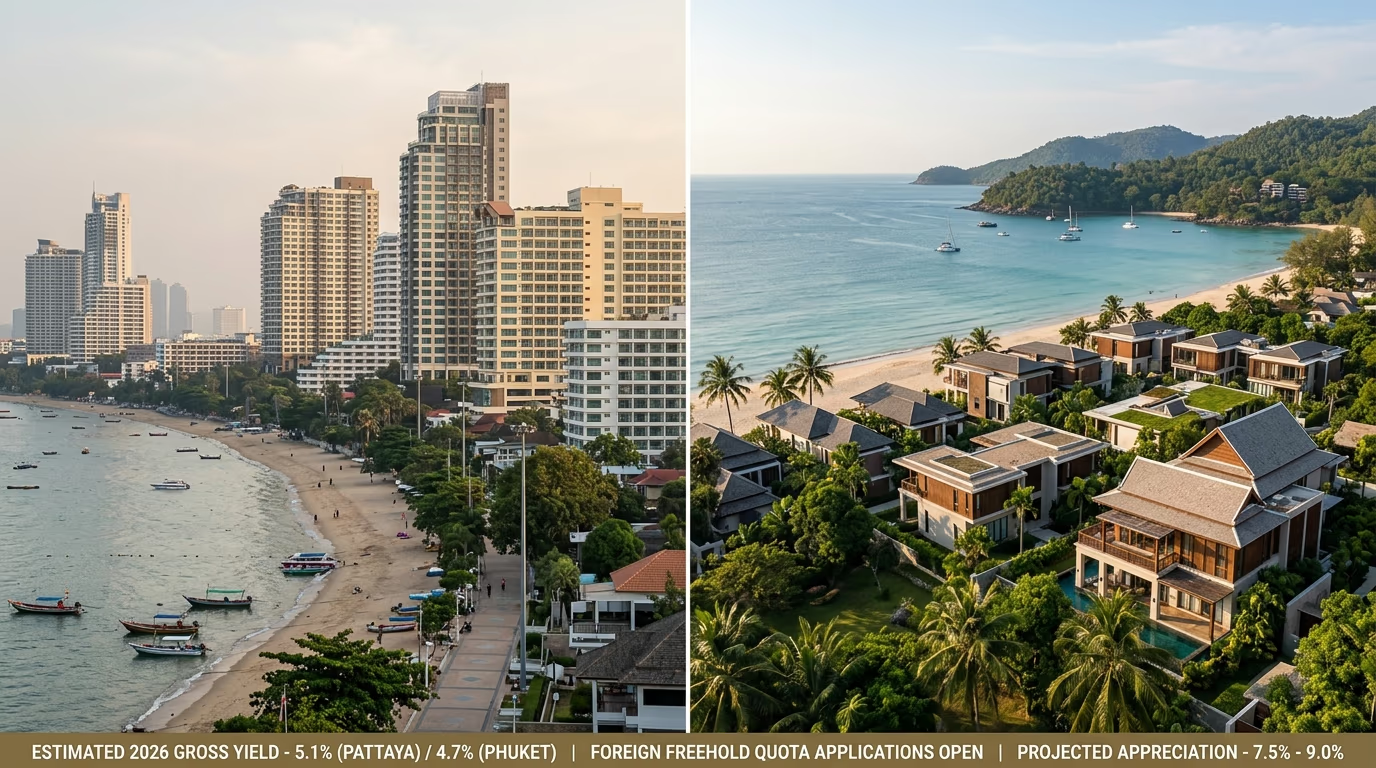
Pattaya wins for freehold condo availability, easier entry budget, stronger long-term rental market, and proximity to Bangkok. Phuket wins for premium beachfront product, hotel-licensed short-stay yield on the right stock, international airport access, and a higher-income tourist base. The critical structural difference: Phuket’s premium beachfront market has tight foreign freehold quota (most new signature projects go majority-leasehold), while Pattaya has freehold condo quota available across almost all areas and price tiers in 2026.
For a yield-focused foreign investor with a 4-12 million THB budget, Pattaya wins on clean freehold entry and predictable long-term rental yield. For a hospitality-style investor with 10-30 million THB targeting hotel-licensed beachfront short-stay, Phuket wins on product quality and 2024-2026 tourism recovery. For a lifestyle buyer choosing a second home, the decision reduces to city character preference: Pattaya’s density and European community versus Phuket’s premium resort feel and international flight access.
This comparison is built on CBRE Thailand 2026, Knight Frank Thailand Phuket 2026, C9 Hotelworks Phuket 2026, Cushman & Wakefield Q1 2026, Savills Thailand 2026, GlobalPropertyGuide Q1 2026, REIC foreign transfer data 2025, and the Thai Condominium Act B.E. 2522. All figures are 2026 ranges.
Master comparison table
The table summarises 22 dimensions that separate Pattaya from Phuket for a 2026 foreign condo buyer.
| Dimension | Pattaya | Phuket |
|---|---|---|
| Typical entry price per sqm (mid-market) | 65,000-110,000 THB | 90,000-170,000 THB |
| Prime beachfront price per sqm | 160,000-250,000 THB | 200,000-350,000 THB |
| Ultra-prime branded residences | 250,000-400,000 THB | 280,000-500,000 THB |
| 1-bedroom entry (40-50 sqm) | 2.8-4.5M THB | 3.8-6.5M THB |
| 2-bedroom mid-market (65-85 sqm) | 5.0-9.5M THB | 7.0-13.0M THB |
| Foreign freehold quota (new launches) | Available across most areas | Tight in premium beachfront; many leasehold-only |
| Gross yield long-term | 5.0-8.0% | 5.0-7.0% |
| Gross yield short-stay (hotel-licensed) | 7.0-11.0% | 7.0-11.0% |
| Net yield after expenses | 3.5-5.5% | 3.5-5.0% |
| Foreign buyer share (city) | ~28% of national | ~14% of national |
| Primary foreign nationality | Chinese, Russian, European, GCC | Russian, Chinese, European, GCC |
| Capital growth 2018-2026 (prime) | +18-24% | +22-30% |
| Airport access | U-Tapao 45 min, BKK 120 min | HKT International 30-45 min |
| International direct flights | Limited at U-Tapao | 80+ weekly international routes |
| Tourism arrivals 2025 | 8-10M | 13-16M |
| Healthcare | Bangkok-Pattaya Hospital, Bangkok Hospital Pattaya | Bangkok Hospital Phuket, Bumrungrad Phuket branch |
| International schools | 4-5 | 4-6 |
| Cost of living (index vs Bangkok) | 70-80 | 85-95 |
| Climate | Dry tropical with short wet May-Oct | Wet tropical with extended May-Oct monsoon |
| English spoken (service) | High | High |
| Nightlife | Dense, Walking Street concentrated | Dispersed, Patong + Bangla |
| Expat community | Mature, 40,000-60,000 | Mature, 30,000-45,000 |
Sources: CBRE Thailand 2026, Knight Frank Thailand 2026, Cushman & Wakefield Q1 2026, Savills Thailand 2026, REIC 2025, Tourism Authority of Thailand 2025-2026.
Freehold availability: the structural difference
Pattaya has freehold condo quota available across almost all areas and price tiers in 2026. Phuket’s premium beachfront zones (Bang Tao, Surin, Kamala, Naithon, parts of Rawai and Patong) increasingly launch as majority-leasehold projects, with the freehold 49% quota either unavailable or exhausted fast. This structural asymmetry is the single largest Pattaya-vs-Phuket decision factor for foreign buyers.
Why Phuket beachfront often goes leasehold. Premium Phuket developments face three dynamics:
- Beachfront land parcels often sit under hotel-operator master leases with long-term fixed Thai ownership.
- Hotel-branded residences (Banyan Tree, Aman, Montazure, Anantara, Phuket residences) structure transactions as hotel-managed investment products with leasehold titles matching the underlying hotel-operation term.
- Developers preserve Thai ownership majority in signature projects to retain long-term operational control and avoid condominium juristic-person complications.
Pattaya structural contrast. Most Pattaya condo launches are conventional condominium buildings under the Condominium Act B.E. 2522 with 49% foreign quota actively marketed. Beachfront Wongamat, Naklua, Jomtien, and Pratumnak projects typically have freehold quota available across the launch period. Quota exhaustion is rare outside specific branded Naklua projects.
Decision implication. A foreign buyer in 2026 wanting clean Thai freehold on a beachfront condo has the easier path in Pattaya. A Phuket foreign buyer seeking freehold must be highly selective on project and area, or pivot to leasehold. See the freehold vs leasehold guide for detail on leasehold rights and renewal mechanics.
Prices by tier
Phuket mid-market and premium pricing runs 25-45% above Pattaya equivalent-tier stock in 2026. The premium reflects Phuket’s product mix (branded residences, beachfront villas, hotel-managed investments) and international airport hub access.
| Tier | Pattaya price/sqm | Phuket price/sqm | Ratio (Phuket/Pattaya) |
|---|---|---|---|
| Entry | 55,000-75,000 THB | 75,000-100,000 THB | 1.4x |
| Mid-market | 75,000-115,000 THB | 90,000-150,000 THB | 1.3x |
| Upper mid | 115,000-165,000 THB | 140,000-210,000 THB | 1.3x |
| Prime beachfront | 160,000-250,000 THB | 200,000-320,000 THB | 1.3x |
| Ultra-prime branded | 250,000-400,000 THB | 280,000-500,000 THB | 1.2x |
Sources: CBRE Thailand 2026 Outlook, Knight Frank Thailand 2026, Cushman & Wakefield Q1 2026.
Pattaya area pricing 2026. Jomtien Beach 75,000-110,000 THB per sqm; Wongamat and Naklua beachfront 180,000-280,000 THB per sqm; Pratumnak Hill 85,000-150,000 THB per sqm; Central Pattaya 70,000-95,000 THB per sqm; Na Jomtien 95,000-170,000 THB per sqm. See the Pattaya area hub for detail.
Phuket area pricing 2026. Bang Tao and Laguna 180,000-280,000 THB per sqm; Surin and Kamala 200,000-320,000 THB per sqm; Patong beach 140,000-220,000 THB per sqm; Rawai and Nai Harn 95,000-150,000 THB per sqm; Chalong 90,000-130,000 THB per sqm; Kathu and inland 80,000-120,000 THB per sqm.
On identical 8 million THB budgets in 2026:
- Pattaya: 70-90 sqm 2-bedroom in Jomtien or Pratumnak, 200m from beach, clean freehold.
- Phuket: 45-60 sqm 1-bedroom in Bang Tao or Surin beachfront residence, often on leasehold structure.
The Phuket premium buys international airport access and resort infrastructure; the Pattaya discount buys condo size and freehold certainty.
Yields by strategy
Pattaya delivers modestly higher long-term gross yield. Phuket delivers modestly higher short-stay gross yield on hotel-licensed stock. The net yields after expenses converge closer than the gross headlines suggest.
| Strategy | Pattaya gross | Pattaya net | Phuket gross | Phuket net |
|---|---|---|---|---|
| Long-term (12+ month leases) | 5.5-7.5% | 3.8-5.0% | 5.0-7.0% | 3.5-4.5% |
| Medium-term (3-6 month) | 6.0-8.0% | 4.0-5.2% | 6.0-8.0% | 4.0-5.0% |
| Short-stay (hotel-licensed beachfront) | 8.0-11.0% | 4.8-5.8% | 7.0-11.0% | 4.5-5.5% |
| Short-stay (non-licensed, illegal) | 7.0-10.0% | 4.0-5.2% | 6.5-10.0% | 3.8-5.0% |
Sources: GlobalPropertyGuide Q1 2026, CBRE Thailand 2026, Knight Frank Thailand 2026, C9 Hotelworks 2026.
Pattaya long-term yield premium is structural. Lower entry prices against closer rent levels produce the 50-150 bps gap. Pattaya’s deep European, Russian, and digital-nomad long-term tenant base keeps vacancy low.
Phuket short-stay premium is seasonal. Phuket hotel-licensed branded residences achieve 7-11% gross during the high season (November-March) but drop toward 4-6% during the May-October monsoon. Annual average lands similar to Pattaya. The net yield compresses further on Phuket’s higher management-fee intensity in hotel-operated residences (management fees of 25-40% of revenue in some branded operations).
Practical selection. For a yield investor wanting a clean long-term lease economy, Jomtien or Pratumnak in Pattaya is the strongest mix. For a hospitality-style investor comfortable with branded residence operational structure, Phuket Bang Tao or Surin hotel-licensed products deliver competitive yield with professional management. See the Airbnb Thailand legal guide on short-stay regulatory reality.
Rental market dynamics
Pattaya’s rental market is built on long-term foreign tenants (European retirees, Russian and British snowbirds, digital nomads). Phuket’s rental market is built on tourist short-stay demand with a smaller long-term expat rental base. The dynamics mean very different landlord operations.
Pattaya rental market
- Tenant profile: 55-65% European retirees and long-stay snowbirds; 15-20% digital nomads; 10-15% Thai professionals; 5-10% tourists.
- Average lease length: 6-12 months.
- Vacancy: 8-15% annual average.
- Seasonality: mild (November-March 10-15% premium on rents).
- Management intensity: low.
Phuket rental market
- Tenant profile: 45-55% short-stay tourists (hotel-licensed units); 15-20% digital nomads; 10-15% long-term expats; 5-10% Thai professionals.
- Average tenant stay: 3-14 days on short-stay; 6-9 months on long-term.
- Occupancy on short-stay: 60-80% annual average (high-season 85-95%, low-season 30-50%).
- Seasonality: strong (May-October monsoon reduces short-stay occupancy 30-50%).
- Management intensity: high.
Operational implication. Pattaya rental management is feasible for owner-landlords; Phuket short-stay typically requires professional property management at 15-30% of gross revenue. Factor this into net yield modelling.
Tourism and flight access
Phuket’s international airport connects directly to 80+ weekly international routes across Europe, Middle East, Asia, and Australia. Pattaya’s U-Tapao International Airport has limited direct international traffic; most Pattaya arrivals route through Bangkok. Phuket’s airport dominance is the key infrastructure asymmetry.
Pattaya airport access.
- U-Tapao International (UTP): 40-50 km south, 45-minute drive. Expanding 2024-2026 under EEC plan. Current routes: Hong Kong, Shanghai, Moscow, a handful of charters. Limited European scheduled service.
- Bangkok Suvarnabhumi (BKK): 140 km, 110-130 minute drive. The primary airport for most European Pattaya residents.
- Pattaya-Rayong High-Speed Rail: target completion 2028, will reduce BKK-Pattaya journey to 30 minutes.
Phuket airport access.
- Phuket International (HKT): on-island, 30-45 minutes from most residential areas. Direct European routes (London, Paris, Frankfurt, Moscow, Istanbul, Dubai). Asia hub for Chinese, Hong Kong, Singapore, Kuala Lumpur, Seoul, Tokyo routes. Australian direct (Sydney, Melbourne, Perth).
Tourism volumes. Phuket received 13-16 million tourists in 2025 per Tourism Authority of Thailand regional stats; Pattaya received 8-10 million. Phuket’s tourism base is internationally diversified and higher-spending; Pattaya’s base is Asian-led (Chinese, Russian, Indian, GCC) with European retirees as the long-stay segment.
Decision weighting. For a foreign owner who will fly in personally from Europe, Middle East, Australia, or North America several times per year, Phuket’s airport access is materially more convenient. For owners flying within Asia, both cities are comparable.
Cost of living comparison
Phuket is 15-20% more expensive than Pattaya for equivalent lifestyle, driven by higher rent, F&B, and imported-goods pricing in beach districts. Pattaya retains a meaningful cost-of-living edge.
| Expense | Pattaya (monthly, mid-market couple) | Phuket (monthly, mid-market couple) |
|---|---|---|
| Rent equivalent (2-bedroom) | 25,000-40,000 THB | 35,000-60,000 THB |
| Groceries | 15,000-22,000 THB | 18,000-28,000 THB |
| Restaurants | 12,000-20,000 THB | 15,000-25,000 THB |
| Transport (car ownership) | 8,000-12,000 THB | 10,000-15,000 THB |
| Healthcare (private insurance) | 6,000-10,000 THB | 6,500-11,000 THB |
| Utilities + internet | 4,500-6,500 THB | 4,500-7,000 THB |
| Monthly total | 70,500-110,500 THB | 89,000-146,000 THB |
Source: Expatistan cost-of-living index 2026; regional agency rental data.
The gap compounds over a 10-year hold. A retiree with 2.5 million THB annual living budget has 25-30% more lifestyle in Pattaya than in Phuket.
Lifestyle profile comparison
Pattaya is dense urban beach city with Walking Street nightlife, long-stay retiree community, and accessible pricing. Phuket is dispersed resort island with international atmosphere, higher-end tourism, and a wetter climate. Neither is objectively better; they serve different lifestyle preferences.
Pattaya advantages.
- Dry tropical climate with less intense monsoon than Phuket.
- Dense retirement community (40,000-60,000 Europeans and Russians).
- Lower cost of living.
- Compact geography: all residential areas are within 20-minute drive.
- Walking Street, Second Road, and Beach Road concentrate entertainment.
- Pattaya-Rayong HSR (2028 target) will improve Bangkok connectivity dramatically.
Pattaya disadvantages.
- Sex tourism and nightlife concentration can detract for family buyers.
- Beach water quality in Pattaya Bay (Central, South) is lower than open-sea beaches.
- International school options limited to 4-5.
- Airline access via Bangkok for most international travel.
- Some areas (Walking Street proximity, parts of South Pattaya) feel rough.
Phuket advantages.
- International airport with direct European, Middle East, Australian routes.
- Open-sea beaches (Surin, Naithon, Nai Harn, Kamala, Bang Tao) with better water.
- Dispersed residential areas: more privacy and less density.
- Higher-end international atmosphere (branded residences, luxury retail, fine dining).
- Marine recreation (diving, sailing, island hopping) naturally integrated.
Phuket disadvantages.
- 15-20% higher cost of living than Pattaya.
- Extended monsoon (May-October) with significant rain and sometimes flight disruption.
- Traffic on Bypass Road during peak tourist season.
- Foreign freehold condo availability tight in premium beachfront.
- Medical evacuation to Bangkok routine for complex cases.
Who wins by buyer profile
Profile maps to the winning choice.
Yield investor, 4-10M THB budget
Winner: Pattaya. Clean freehold, higher long-term yield, lower entry price, and deeper long-term tenant base. Target Jomtien or Pratumnak.
Short-stay hospitality investor, 10-25M THB budget
Winner: Phuket. Hotel-licensed branded residences in Bang Tao, Surin, or Kamala deliver best-in-class short-stay yield with professional management. Accept higher prices and potential leasehold structure.
Retiree (long-term primary residence)
Winner: Pattaya. Lower cost of living, established retiree community, less rainfall, easier logistics, deeper medical infrastructure for day-to-day needs. Target Jomtien, Wongamat, or Pratumnak.
Second-home lifestyle buyer (part-time use, fly in from Europe/Middle East)
Winner: Phuket. International airport access, premium property feel, better water quality, diverse resort amenities. Accept higher cost of ownership.
First-time foreign property buyer in Thailand
Winner: Pattaya. Cleaner freehold path, lower entry budget, clearer quota availability. Reduce transaction-complexity risk on the first purchase.
High-net-worth buyer seeking branded residence prestige
Winner: Phuket. Banyan Tree Grand Residences, Aman Villas, Montazure, Anantara Layan branded residences offer the premium lifestyle product. Accept leasehold structure as cost of entry.
Frequently asked questions
Which is a better investment, Pattaya or Phuket?
Depends on strategy. Pattaya wins for long-term rental yield and clean freehold entry; Phuket wins for hotel-licensed short-stay yield and international tourism exposure. On average over a 5-10 year hold, both deliver 7-11% total return when well-selected; Pattaya typically higher on yield, Phuket higher on capital appreciation in branded beachfront.
Is foreign freehold condo available in Phuket beachfront?
Yes in some projects, tight in most premium beachfront. Quota is visible on the Land Department register before deposit. Check foreign quota availability for the specific building before paying any deposit. Many Bang Tao, Surin, and Kamala signature projects launch majority-leasehold with limited freehold units reserved early. See the foreign quota 49% rule guide.
Can I do short-stay rental in Pattaya or Phuket legally?
Only with a hotel licence or in a pre-licensed branded residence. The Hotel Act B.E. 2547 (2004) requires accommodation operators letting under 30 days to hold a hotel licence. Enforcement tightened in both cities in 2024-2025. Buildings increasingly prohibit short-stay in juristic-person bylaws. See the Airbnb Thailand legal guide.
What is the minimum budget to buy a decent condo in each?
Pattaya: ~2.5M THB for a studio in Jomtien or South Pattaya; ~4M THB for a 1-bedroom in Jomtien or Pratumnak. Phuket: ~3.5M THB for a studio in Chalong/Kathu; ~5M THB for a 1-bedroom in Rawai or inland Bang Tao. All 2026 primary-market pricing for foreign quota units.
Which has better international flight access?
Phuket, by a wide margin. Phuket International has 80+ weekly international direct routes across Europe, Middle East, Asia, and Australia. Pattaya’s U-Tapao has limited international service; most connections route through Bangkok (110-130 min drive).
Which has stronger tourism recovery 2024-2026?
Phuket recovered faster on inbound international tourism; Pattaya recovered faster on long-stay foreign resident demand. Tourism Authority of Thailand data shows Phuket regained pre-pandemic arrival levels by mid-2024, with 2025 volumes of 13-16 million; Pattaya recovered fully by late 2024, with 2025 volumes of 8-10 million.
Is one safer for retirement than the other?
Both have mature retirement infrastructure. Pattaya has a larger absolute European retirement community (40-60k) with more established services; Phuket has a smaller retirement community (30-45k) but deeper premium healthcare options. Both have good international hospital access within 30-45 minutes from major residential areas.
How does climate differ?
Pattaya is drier with a shorter wet season (brief intense rain May-October, mostly late afternoon). Phuket has a fuller monsoon May-October with extended wet stretches, higher humidity, and some flight disruption. November-April is excellent in both cities. Climate matters for short-stay occupancy (Phuket’s monsoon reduces 30-50% in May-September) and quality of life (Pattaya drier, less mould).
Related reading
- Best areas to buy a condo in Pattaya — area-by-area Pattaya analysis.
- Freehold vs leasehold in Thailand — ownership structure comparison.
- Foreign quota 49% rule — Condominium Act B.E. 2522 explained.
- Rental yields in Thailand — city-by-city yield data.
- Airbnb Thailand legal guide — short-stay rules under the Hotel Act.
- Pattaya vs Bangkok comparison — city-level investment comparison.
- Thailand vs Bali comparison — jurisdiction comparison.
- Condo vs villa in Thailand — product structure comparison.
References
Sources
- 01CBRE Thailand Real Estate Market Outlook 2026 · https://www.cbre.co.th/press-releases/thailand-real-estate-market-2026-balancing-risk-rewardPattaya gross yields 5-8%, price ranges, and Eastern Seaboard capital growth 2023-2026. Accessed 2026-04-16.
- 02Knight Frank Thailand Phuket Residential Market 2026 · https://www.knightfrank.co.th/researchPhuket residential yields, tourism-driven short-let performance, foreign quota in beachfront zones 2026. Accessed 2026-04-16.
- 03C9 Hotelworks Phuket Hospitality Review 2026 · https://www.c9hotelworks.com/Phuket hospitality and branded-residence absorption, hotel-licensed yield data 2025-2026. Accessed 2026-04-16.
- 04Cushman & Wakefield Thailand Market Beat Q1 2026 · https://www.cushmanwakefield.com/en/thailand/insights/thailand-marketbeatThailand condo price benchmarks by city and nationwide take-up Q1 2026. Accessed 2026-04-16.
- 05Savills Thailand Property Market 2026 Strategic Outlook · https://www.savills.co.th/blog/article/225734/singapore-articles/thailand-property-market-2026--strategic-outlook-and-emerging-trends.aspxThailand property market 2026 strategic outlook and regional yield forecasts. Accessed 2026-04-16.
- 06Thailand Real Estate Information Center (REIC) Foreign Demand Report 2025 · https://www.reic.or.th/Thailand foreign condo transfer volumes and buyer-nationality breakdown 2025. Accessed 2026-04-16.
- 07Condominium Act B.E. 2522, Ministry of Interior Land Department guidance · https://www.dol.go.th/Condominium Act B.E. 2522 (1979, amended 2008) 49% foreign quota framework. Accessed 2026-04-16.
- 08Tourism Authority of Thailand Regional Statistics 2025-2026 · https://www.tourismthailand.org/Phuket and Pattaya tourism arrival data, airline capacity Q1 2026. Accessed 2026-04-16.
- 09GlobalPropertyGuide Thailand Rental Yields Q1 2026 · https://www.globalpropertyguide.com/asia/thailand/rental-yieldsThailand rental yields by city GlobalPropertyGuide Q1 2026. Accessed 2026-04-16.
Published · How we research and date our content