Thailand vs Bali Property Investment Compared 2026
Thailand vs Bali property investment 2026: freehold condo vs Hak Pakai villa, 49% quota vs PMA-PT company, yields, tax, visa, legal security, honest comparison.
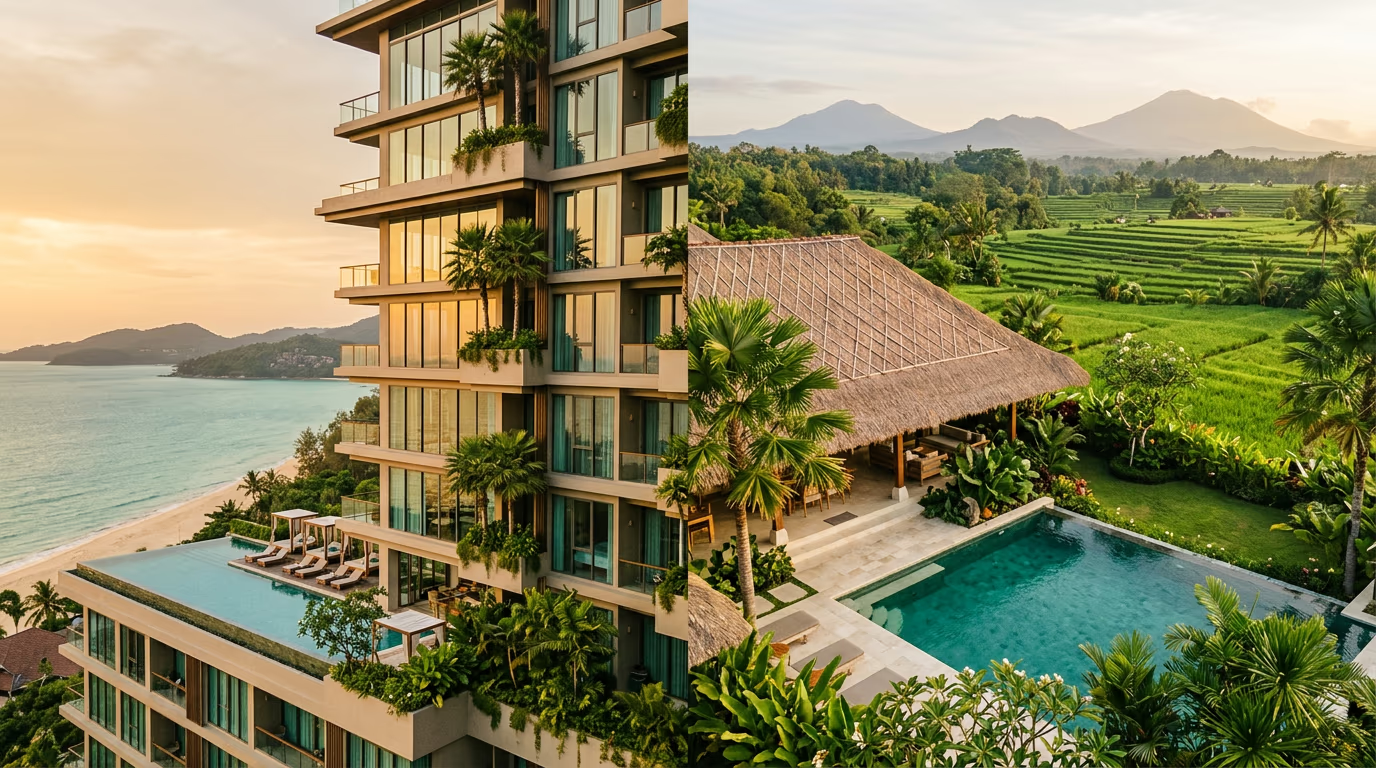
The short answer: which country wins for which buyer
Thailand wins for freehold condo ownership, cleaner legal security, stronger resale liquidity, and competitive yields. Bali wins for premium villa lifestyle, short-stay yield potential in Canggu and Seminyak, and lower all-in living cost for a villa-based lifestyle. The critical structural difference is that foreigners can own a condo freehold in Thailand under the Condominium Act B.E. 2522 (within the 49% building quota), while foreigners cannot own land or buildings freehold in Indonesia under the Basic Agrarian Law (UU No. 5 Tahun 1960); only restricted titles (Hak Pakai) or a PMA-PT company structure allow longer-term control.
For a buy-and-hold yield investor with a 5-15 million THB budget, Thailand wins decisively on legal security and exit liquidity. For a lifestyle buyer seeking a Balinese villa with infinity pool, jungle view, and 5-15 million THB to deploy, Bali wins on property type (condo-equivalents are rare and not the Bali product). For a hospitality-focused investor seeking premium short-stay villa returns in Canggu, Seminyak, or Ubud, Bali offers 7-11% achievable gross but with PMA-PT structural overhead and lower resale liquidity.
This comparison is built on CBRE Thailand 2026, Savills Bali 2026, Knight Frank Indonesia 2026, GlobalPropertyGuide Q1 2026, Indonesian Basic Agrarian Law UU No. 5 Tahun 1960, Omnibus Law UU No. 11 Tahun 2020, Indonesian Company Law UU No. 40 Tahun 2007, and the Thai Condominium Act B.E. 2522. All figures are 2026 ranges.
Master comparison table
The table summarises the 22 dimensions that separate Thai condo investment from Bali villa investment in 2026.
| Dimension | Thailand (condo) | Bali (villa) |
|---|---|---|
| Foreign ownership structure | Freehold condo under 49% building quota (Condominium Act B.E. 2522) | Hak Pakai (25 yrs + extensions) or PMA-PT company (Indonesian Agrarian Law 1960, Omnibus Law 2020) |
| Freehold available to foreigner? | Yes, on condo unit | No on land; restricted titles only |
| Typical property type | Condominium apartment | Detached villa with pool |
| Typical land | Not applicable (titled by unit) | 200-1,500 sqm villa plots |
| Building type | High-rise/mid-rise | 1-2 storey villa |
| Entry price 2026 | 2.5-4.5M THB (75k-140k USD) | 1.8-4.5M THB (50k-130k USD) for basic villa |
| Mid-market 2026 | 5-12M THB (145k-350k USD) | 4.5-10M THB (130k-290k USD) |
| Premium 2026 | 12-35M THB (350k-1M USD) | 12-40M THB (340k-1.15M USD) |
| Long-term gross yield | 4-8% | 4-7% |
| Short-stay gross yield | 7-11% (hotel-licensed or risk) | 7-11% (mainstream, regulated since 2024) |
| Ownership tenure certainty | Freehold in perpetuity for condo | 25 yr + extensions; PMA-PT for longer control |
| Transfer tax (on purchase) | Transfer 2% + SBT 3.3% (seller-side) | BPHTB 5% + PPN 11% on new |
| Annual property tax | Land & Buildings Tax 0.02-0.3% (>50M THB) | PBB 0.1-0.3% on NJOP |
| Rental income tax | 5-35% progressive | 10% final or PPh 22% if business |
| Visa options | DTV, LTR, Retirement, Elite | B211A, KITAS Second Home, Investor KITAS |
| Legal security rating | High | Moderate |
| Nominee risk | Low for condo freehold (no nominee needed) | High; BPN prosecuted 2022-2024 nominee cases |
| Resale liquidity | Moderate-high | Low-moderate |
| Buyer pool depth | Thai + foreign (deep) | Foreign-dominant (thin) |
| Infrastructure maturity | High | Moderate (Bali-wide), low in Ubud |
| Tourism recovery 2024-2026 | Strong | Strong |
| Financing for foreigners | Some via UOB, Bangkok Bank (limited) | Very limited; mostly cash |
Sources: CBRE Thailand 2026, Savills Bali 2026, Knight Frank Indonesia 2026, Condominium Act B.E. 2522, Indonesian Basic Agrarian Law UU No. 5 Tahun 1960, Indonesian Omnibus Law UU No. 11 Tahun 2020.
Legal framework: the structural difference
Thailand allows a foreigner to hold a condominium unit in freehold ownership, registered in their own name at the Land Department, in perpetuity, subject to the 49% foreign quota per building. Indonesia does not allow foreigners to hold land or detached property freehold; the available structures are Hak Pakai (right to use, 25 years + extensions up to 80 years), Hak Guna Bangunan (right to build, 30 years + extensions, only for PMA-PT companies), or freehold via a PMA-PT foreign investment company. This is the largest single difference between the two markets.
Thai condo ownership
The Condominium Act B.E. 2522 (1979, amended 2008) grants foreigners the right to own a condominium unit freehold. The constraints:
- Up to 49% of the total saleable floor area of any one condo building can be held in foreign names.
- Purchase funds must be remitted from abroad in foreign currency, certified by a Foreign Exchange Transaction (FET) form from a Thai commercial bank.
- The unit is registered in the buyer’s name at the Provincial Land Department.
- Ownership passes by inheritance to heirs, including foreign heirs (subject to building quota at the point of inheritance).
- Land is excluded; the Act applies only to condominium units within registered condominium buildings.
This is clean freehold. No nominee required. No company structure required. No time limit.
Indonesian land law
Indonesia’s Basic Agrarian Law UU No. 5 Tahun 1960 establishes the national land tenure system. Titles include:
| Title | Holder | Rights | Term |
|---|---|---|---|
| Hak Milik | Indonesian individual only | Full freehold | Perpetual |
| Hak Guna Bangunan (HGB) | Indonesian individual or PMA-PT | Right to build and use | 30 yrs + 20 extension + 30 renewal |
| Hak Pakai | Foreign individual allowed | Right to use land/building | 25 yrs + 20 extension + 30 renewal |
| Hak Sewa | Any (including foreign) | Leasehold only | As contracted |
A foreigner can hold:
- Hak Pakai on a residential property if holding a valid residence permit (KITAS or KITAP). This is the common legal route for individual foreign villa ownership in Bali.
- PMA-PT company shares. A foreign investor can establish a PMA (Penanaman Modal Asing) limited company under UU No. 40 Tahun 2007 (Indonesian Company Law). The PMA-PT can then hold Hak Guna Bangunan over land, effectively giving foreign-controlled use up to 80 years.
The Omnibus Law UU No. 11 Tahun 2020 (consolidated in UU No. 6 Tahun 2023) streamlined some PMA licensing through the OSS system and clarified that foreign individual Hak Pakai holders on apartments (strata titles) also have enforceable 25+20+30 rights. It did not open freehold land to foreigners.
Nominee structures: the persistent risk
The most common illegal structure in Bali is the “nominee” arrangement: an Indonesian national holds Hak Milik title in their name with a side-contract (often unregistered) giving the foreigner beneficial ownership. This violates Article 26(2) of the Basic Agrarian Law and Article 9 of UU No. 5 Tahun 1960. BPN (Badan Pertanahan Nasional) and provincial authorities actively prosecuted nominee cases in 2022-2025, with documented seizures of properties registered through nominee arrangements and criminal charges against facilitators. The Bali Provincial Government issued specific public warnings in 2024 and 2025.
Bottom line on legal structure. Thai condo freehold is cleaner, simpler, and enforceable in the buyer’s own name. Bali villa ownership requires either accepting a 25-year (+extension) Hak Pakai title or establishing a PMA-PT company with minimum IDR 10 billion paid-up capital requirement and ongoing compliance cost of 3-8 million IDR per month. For a first-time overseas real estate buyer, Thailand’s legal framework is materially less risky.
Prices: not apples-to-apples
The product is different. Thailand’s typical foreign buyer is purchasing a 40-80 sqm condo in a serviced building; Bali’s typical foreign buyer is purchasing a 100-250 sqm villa with 300-800 sqm land. Direct per-sqm price comparison is misleading. Compare by lifestyle product type and realistic competing investments.
| Lifestyle product | Thailand 2026 | Bali 2026 |
|---|---|---|
| Studio/1BR entry urban | 2.5-5M THB Bangkok outer / Pattaya entry | 1.8-3.5M THB Canggu/Ubud basic apartment |
| Mid-market 1-2BR | 5-9M THB Bangkok outer / Jomtien/Pratumnak | 4-7M THB Canggu villa (leasehold) |
| Premium 2-3BR sea or city view | 12-22M THB Phuket beachfront / Bangkok Asoke | 10-18M THB Seminyak/Berawa villa |
| Ultra-prime branded | 25-60M THB Phuket Laguna / Bangkok Ultra-Prime | 25-50M THB luxury Pecatu/Uluwatu villa |
Sources: CBRE Thailand 2026, Savills Bali 2026, Knight Frank Indonesia 2026.
Bali villa pricing has risen 40-70% over 2021-2025 in Canggu-Berawa-Seminyak per Savills Bali 2026, driven by digital nomad and post-pandemic remote work demand plus PMA-PT buyer activity. The 2026 forward forecast is +8-12% per year in tourist-area villas. Thai condo prime growth forecasts are 3-6% per year (CBRE Thailand 2026), so Bali still has a capital-growth edge in the 2026-2028 forward window.
Caveat on Bali prices. Much of the recent Bali growth happened on leasehold stock, where the true cost of ownership includes the decreasing time value of the remaining leasehold term. A 2022 sale of a 20-year remaining lease at 250,000 USD is not equivalent to freehold at 250,000 USD. Adjust for residual term before comparing.

Yield comparison: Thailand vs Bali
Thailand delivers 4-8% gross long-term yield with a legal, predictable framework. Bali delivers 4-7% long-term and 7-11% short-stay in Canggu/Seminyak/Ubud, with higher operational complexity and regulatory evolution.
| Market and strategy | Gross yield 2026 | Net yield 2026 | Legal status |
|---|---|---|---|
| Phuket beachfront hotel-licensed short-stay | 7-11% | 4.5-5.5% | Legal under hotel licence |
| Phuket long-term | 5-7% | 3.5-4.5% | Legal |
| Pattaya long-term | 5.5-7.5% | 3.8-5.0% | Legal |
| Koh Samui short-stay | 7-11% | 4.0-5.5% | Legal under hotel licence |
| Bali Canggu villa short-stay | 7-11% | 4.5-5.8% | Regulated since 2024; local permits |
| Bali Seminyak villa short-stay | 8-12% | 4.5-6.0% | Regulated |
| Bali Ubud villa short-stay | 5-8% | 3.5-4.8% | Regulated |
| Bali long-term villa rental | 4-7% | 3.0-4.5% | Clean |
Sources: GlobalPropertyGuide Q1 2026, Savills Bali 2026, Knight Frank Indonesia 2026, Cushman & Wakefield Thailand Q1 2026.
Bali short-stay regulation tightened in 2024. The Bali Provincial Government introduced mandatory villa rental permits (Pondok Wisata for small operations, up to 5 rooms) with PBJT tourism tax collection, and began cross-referencing short-term letting platforms against registered permits in Q1 2025. Unlicensed operators face fines from 10-50 million IDR and temporary closure. Net-adjusted yields account for permit cost, tourism tax pass-through, and villa management fees of 20-30% of gross revenue.
Practical takeaway on yield. On equivalent budgets, Phuket branded hotel-licensed short-stay and Bali Canggu short-stay are very close (both 4.5-5.8% net). Thailand’s advantage is legal clarity (hotel licence is binary: yes or no); Bali’s advantage is higher headline occupancy due to deeper tourism volume in Canggu-Berawa-Seminyak. For long-term rentals, Thailand edges Bali on both gross and net.
Tax regimes compared
Thailand’s condo tax stack is simpler, predictable, and evenly applied. Bali tax requires PMA-PT corporate compliance in most investor scenarios, with higher annual administrative overhead but lower headline rental income tax.
Thailand condo tax
| Tax | Rate | When paid |
|---|---|---|
| Transfer fee | 2% of appraised value | At transfer |
| Specific Business Tax | 3.3% of sale price | At sale if <5 yrs holding |
| Stamp duty | 0.5% | At sale if SBT not applicable |
| Withholding tax (individual) | 1% progressive | At sale |
| Land and Buildings Tax | 0.02-0.3% | Annual on appraised value |
| Rental income tax | 5-35% progressive | Annual on net rental |
Source: Thai Revenue Code Section 91, Land and Buildings Tax Act B.E. 2562.
Indonesia/Bali property tax
| Tax | Rate | When paid |
|---|---|---|
| BPHTB (acquisition tax) | 5% of NJOP or transaction value | At transfer |
| PPN (VAT) on new property | 11% | On new developer sale |
| PPh (final sales tax) | 2.5% seller | At sale |
| PBB (annual property tax) | 0.1-0.3% of NJOP | Annual |
| Rental income tax (individual, final) | 10% | On gross rental |
| Rental income tax (PMA-PT) | 22% corporate | Annual on profit |
| PBJT (Bali tourism tax on short-stay) | 10% | On guest invoices |
Source: Indonesian NJOP regulations, UU PPh 2008 (as amended), Bali Provincial Tax Regulation 2024.
The tax comparison. Thailand’s 5-35% progressive rental income tax is lower on small rental income (under 300,000 THB net per year) than Bali’s 10% final, but higher on significant rental income (above 900,000 THB per year). Bali’s 11% PPN on new property adds to acquisition cost but reflects in sale value. Thailand’s stamp/transfer/withholding on exit is roughly 3-5% of sale price; Bali’s PPh + BPHTB on buyer-seller sides totals roughly 7-8%. Thailand is cheaper on frictional transaction costs; Bali is cheaper on steady-state rental income taxation at higher rental brackets.
Visa regimes
Thailand’s Long-Term Resident (LTR), Destination Thailand Visa (DTV), and retirement visa options are broader and more accessible than Indonesia’s offerings.
Thailand 2026
- LTR (Long-Term Resident): 10-year renewable, under BOI criteria (pensioner with USD 80k+ income, wealthy citizen with USD 1M+ assets, HNW investor, or work-from-Thailand professional). Tax benefits on offshore income.
- DTV (Destination Thailand Visa, launched 2024): 5-year validity, 180 days per entry, digital nomad or workation. THB 10,000 fee.
- Retirement visa (O-A): 1-year renewable, age 50+, THB 800,000 deposited or 65,000 THB monthly income.
- Elite Visa (Thailand Privilege): 5-20 year renewable at THB 900,000-5,000,000 depending on tier. Private-club service benefits.
- Non-O Marriage: for those married to Thai spouse.
Indonesia 2026
- B211A Visit visa: 60 days + 2x60 extensions (max 180 days). Fee IDR 2-3 million.
- KITAS Investor: 5-year residence permit for PMA-PT shareholders with minimum capital commitment. Compliance-heavy.
- KITAS Second Home: launched 2023, 5-year initially, for foreigners with IDR 2 billion in an Indonesian bank or proof of property ownership above IDR 2 billion. Slow uptake due to strict wealth requirements.
- KITAP (permanent residency): after 3-5 years on KITAS, allows long-term residence.
- Golden Visa (launched 2024): 5-10 year residence for investors meeting multi-million USD thresholds.
Comparison. Thailand’s DTV and retirement visa create flexible access without large deposit lockups. Bali’s Second Home visa requires IDR 2 billion (~130,000 USD) parked in an Indonesian bank, which is a capital-efficiency drag. For residency-driven buyers, Thailand offers easier pathways.
Lifestyle and infrastructure
Thailand has deeper urban infrastructure (Bangkok), more mature retirement communities (Pattaya, Chiang Mai, Hua Hin), and comprehensive international healthcare. Bali offers the premium villa-with-pool lifestyle in Canggu, Seminyak, Ubud, and Uluwatu with a tighter digital-nomad community and a more vivid creative and wellness scene.
Healthcare. Bangkok and Chiang Mai offer JCI-accredited hospitals (Bumrungrad, Samitivej, Chiang Mai Ram). Bali has BIMC Hospital in Kuta, Siloam in Jimbaran, but serious medical cases routinely evacuate to Singapore or Jakarta. For a retiree with health considerations, Thailand wins.
International schools. Bangkok has 40+ options; Chiang Mai and Phuket each have 4-6; Pattaya has 4. Bali’s international schools (Green School, Dyatmika, Sanur Independent) serve a smaller expat family population. Thailand wins for family buyers.
Airport access. Bangkok (BKK and DMK), Phuket, Chiang Mai, and U-Tapao give Thailand multiple hub options. Bali (DPS) is the single primary airport, with a second (North Bali) under construction but repeatedly delayed. Thailand wins for international connectivity.
Community. Pattaya, Hua Hin, and Chiang Mai have established European/British/American retirement communities. Bali Canggu and Ubud have vibrant digital nomad and wellness communities; Seminyak has an expat creative professional scene. Different products for different buyers.
Food and culture. Both are world-class. Thailand’s street food scene and Bangkok’s Michelin density are unmatched. Bali’s wellness, yoga, and creative-retreat culture is unique globally. Different lifestyle products.
Legal security: honest assessment
Thailand delivers materially higher legal security on condo purchases. Bali villa investment carries structural risk premium that buyers should price explicitly.
Thailand advantages.
- Condominium Act B.E. 2522 is 47 years old, well-tested, with clear case law.
- Land Department registration is straightforward and robust.
- 49% foreign quota is verifiable before deposit; quota is a building-level constraint visible on the Land Department register.
- No nominee structure required for condo freehold.
- Inheritance is clean via foreign buyer’s will.
Bali risks.
- Nominee arrangements remain the single largest risk, with BPN active enforcement 2022-2025.
- Hak Pakai extension at year 25 is not guaranteed; approvals depend on land owner and national political climate.
- PMA-PT compliance (OSS system, BKPM annual reports, financial audits, corporate tax) is ongoing work.
- Leasehold structures with Indonesian landowners create counterparty risk: owner death, bankruptcy, or family disputes can destabilise leaseholds.
- Bali zoning enforcement tightened in 2024 with “green zone” building moratoria in specific coastal strips, creating potential for stranded projects.
If structured correctly, Bali villa investment through a PMA-PT with HGB title is a viable long-term play. If structured through a nominee, it is a standing legal risk that can result in property loss. The legal diligence budget for Bali should be 2-3x that for Thailand.
Who wins by buyer profile
Investor profile maps directly to the winning jurisdiction.
Yield investor, 5-15M THB budget
Winner: Thailand. Phuket hotel-licensed short-stay or Pattaya long-term delivers predictable yield with clean legal framework. Bali’s headline yield is competitive but the PMA-PT overhead plus legal diligence cost eats the advantage.
Lifestyle buyer wanting a villa with pool
Winner: Bali. Thailand does have villa stock (Phuket, Samui, Chiang Mai), but the structural foreign-ownership challenge applies. Bali is the villa product market. Accept leasehold or PMA-PT structure as the cost of entry.
Retiree seeking beach + low cost of living
Winner: Thailand (Pattaya, Hua Hin, Phuket). Healthcare, visa clarity, established retiree infrastructure, and condo freehold ownership are the decisive advantages.
Digital nomad/remote worker wanting 1-2 year base
Split. Thailand DTV is easier; Bali Canggu community is denser. Both work. Choose by personal preference for urban Bangkok/Chiang Mai vs village/surf Canggu.
Hospitality investor seeking short-stay villa income
Bali. Canggu-Berawa-Seminyak is the single most developed villa short-stay economy in Southeast Asia. Gross yields and occupancy outperform Thailand’s villa short-stay markets. Accept the PMA-PT structural overhead.
First-time overseas real estate buyer
Winner: Thailand. The legal framework is cleaner, the structural risks are lower, and the downside of a mistake is limited. Bali should be a second-country purchase after the buyer has experience with foreign property ownership.
Frequently asked questions
Can a foreigner own land in Thailand or Bali?
No in both cases. But a foreigner can own a condominium unit freehold in Thailand under the Condominium Act; no equivalent exists for land or detached villas in Indonesia. Indonesia allows Hak Pakai (25+ years right of use) for foreign individuals on residential properties held under KITAS/KITAP, and allows PMA-PT companies (foreign-owned Indonesian companies) to hold Hak Guna Bangunan (30+ years build/use rights).
Is Bali villa ownership safe for foreigners?
Hak Pakai and PMA-PT structures are legal and enforceable. Nominee arrangements are illegal and actively prosecuted as of 2022-2025. The structural choice and due diligence matter enormously. Spend on a qualified Indonesian notaris (civil law notary) and a BKPM-experienced legal advisor.
Which has better rental yields, Thailand or Bali?
Close on short-stay in tourist zones; Thailand ahead on long-term rentals. Bali Canggu short-stay delivers 7-11% gross; Phuket hotel-licensed short-stay delivers 7-11% gross. Both land at 4.5-5.5% net after management and tax. Long-term Thailand (Pattaya, Bangkok outer) outperforms long-term Bali by 100-200 bps.
How does the 49% foreign quota affect my purchase decision?
Thailand’s quota is a building-level constraint, not a country-level limit. Check quota availability at the target building before deposit. Most Pattaya, Phuket, and outer Bangkok buildings have quota available; prime Sukhumvit launches can exhaust foreign quota fast. See the foreign quota guide.
What is PMA-PT and do I need one for Bali?
PMA (Penanaman Modal Asing) PT is a foreign-owned Indonesian limited company under UU No. 40 Tahun 2007. A PMA-PT can own HGB (Hak Guna Bangunan) land, making it the primary structure for foreign investors in Bali villas who want long-term control and no title restrictions. Minimum paid-up capital requirement is IDR 10 billion (~650,000 USD), with ongoing OSS compliance, BKPM reporting, and corporate tax obligations. You do not need a PMA-PT for small-scale Hak Pakai ownership; you do need one for serious villa investment control.
Can I get financing for a property in Thailand or Bali as a foreigner?
Limited in both markets. Thailand offers some foreign mortgages via UOB, Bangkok Bank, and selective private banks, typically at 50-60% LTV, 4.5-6.5% interest, 10-20 year terms. Indonesia offers very limited foreign mortgage access; most purchases are cash. Plan for cash purchases in both markets.
Which has better infrastructure for long-term living?
Thailand, by a meaningful margin. Bangkok, Chiang Mai, and Phuket each have international hospital networks, international schools, and reliable utilities. Bali has good infrastructure in Denpasar/Seminyak/Canggu but depth is lower, and medical cases routinely evacuate to Singapore.
How does exit (resale) compare?
Thailand condo resale is faster and cleaner; Bali villa resale is slower and more buyer-pool-dependent. Thai condo resale in Bangkok prime takes 45-90 days; Pattaya 90-180 days. Bali villa resale typically takes 4-9 months, with the leasehold time-value discount reducing headline price on each resale cycle. Factor 6-12 months into Bali exit planning.
Related reading
- Buy condo in Thailand foreigner guide — the full Thai purchase process.
- Foreign quota 49% rule explained — the Thai building-level constraint.
- Freehold vs leasehold in Thailand — Thai ownership structures compared.
- Thailand visa and property guide — LTR, DTV, retirement visa options.
- Condo scams in Thailand — legal traps to avoid.
- Pattaya vs Bangkok comparison — Thai city-level comparison.
- Pattaya vs Phuket comparison — Thai resort comparison.
References
Sources
- 01Condominium Act B.E. 2522, Thailand Land Department guidance · https://www.dol.go.th/Condominium Act B.E. 2522 (1979, amended 2008) 49% foreign quota freehold framework. Accessed 2026-04-16.
- 02CBRE Thailand Real Estate Market Outlook 2026 · https://www.cbre.co.th/press-releases/thailand-real-estate-market-2026-balancing-risk-rewardThai national condo market prices, yields, and demand Q1 2026. Accessed 2026-04-16.
- 03GlobalPropertyGuide Thailand Rental Yields Q1 2026 · https://www.globalpropertyguide.com/asia/thailand/rental-yieldsThailand gross rental yield by city and property type Q1 2026. Accessed 2026-04-16.
- 04Savills Bali Residential Market Brief 2026; Knight Frank Indonesia Bali Spotlight 2025-2026 · https://www.knightfrank.co.id/researchBali residential market prices, yields, and foreign buyer structure 2026. Accessed 2026-04-16.
- 05UU No. 5 Tahun 1960 (Basic Agrarian Law, Indonesia) · https://peraturan.bpk.go.id/Details/37995/uu-no-5-tahun-1960Indonesian Agrarian Law and land ownership title framework. Accessed 2026-04-16.
- 06UU No. 11 Tahun 2020 (Omnibus Law on Work Creation); UU No. 6 Tahun 2023 consolidation · https://peraturan.bpk.go.id/Details/149750/uu-no-11-tahun-2020Omnibus Law on Work Creation and foreign property rights updates. Accessed 2026-04-16.
- 07UU No. 40 Tahun 2007 (Indonesian Company Law) · https://peraturan.bpk.go.id/Details/39965/uu-no-40-tahun-2007PMA company structure governance rules for foreign-owned Indonesian property holdings. Accessed 2026-04-16.
- 08Indonesia Investment Coordinating Board (BKPM) OSS Regulations 2025-2026 · https://oss.go.id/BKPM regulations on foreign investment entity, minimum paid-up capital, and licensing. Accessed 2026-04-16.
- 09BPN (Badan Pertanahan Nasional) enforcement bulletins; Bali Provincial Government statements 2024-2025 · https://www.atrbpn.go.id/Bali foreign buyer nominee structure prosecutions and enforcement actions 2022-2025. Accessed 2026-04-16.
- 10Royal Thai Immigration Bureau and Board of Investment LTR guidance 2026 · https://www.boi.go.th/en/ltrThailand KTAP/DTV/LTR visa frameworks and eligibility 2026. Accessed 2026-04-16.
- 11Indonesian Directorate General of Immigration 2025-2026 policy · https://www.imigrasi.go.id/Indonesian KITAS Investor, Second Home, and B211A visa frameworks 2025-2026. Accessed 2026-04-16.
Published · How we research and date our content