Property Management in Pattaya: What Foreign Owners Should Expect
Pattaya property management fees and service models for 2026: 8-12% long-term, 20-35% short-term. CBRE, Raimon, FazWaz, juristic-person, or self-managed routes compared.
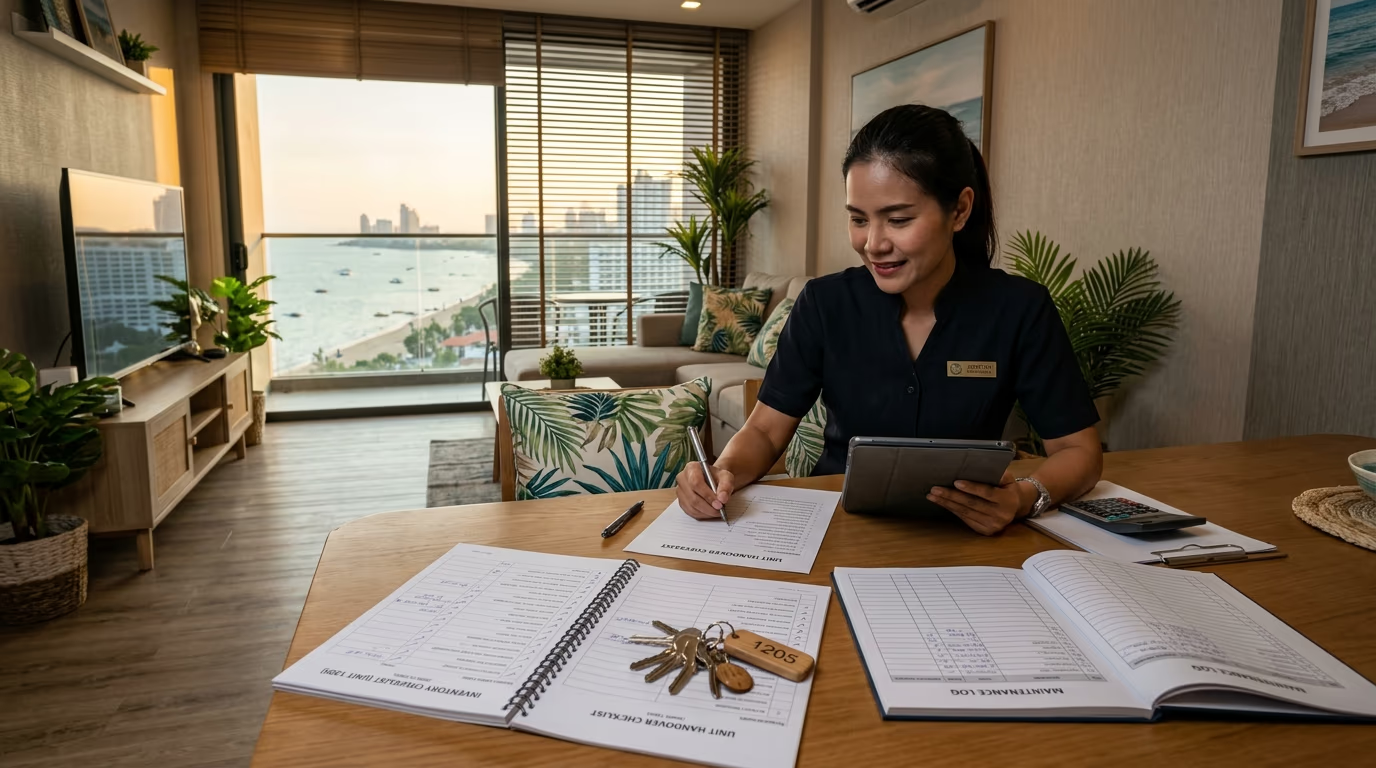
A foreign owner of a Pattaya condominium should expect to pay 8 to 12% of gross rent for long-term management, and 20 to 35% for short-term or serviced management where legally permitted. For a 25,000 THB per month Jomtien 1-bedroom that is 2,000-3,000 THB monthly. For a short-let unit grossing 50,000 THB per month in peak season, 10,000-17,500 THB. The right choice depends on unit size, rental strategy, owner residency, and desired involvement level.
Pattaya’s rental market has two sub-markets: a long-term expat and Thai tenant market on 6-12 month leases, and a short-let holiday and digital-nomad market at higher gross but higher cost. A manager suited to one is often wrong for the other. Decide the sub-market first; manager selection follows.
1. Direct answer: fees, fit, and choice
A long-term manager at 8-12% is the right default for owners who want predictable income and minimum involvement. A short-let manager at 20-35% of gross is justified only where short-letting is legal in the building and the unit is in a short-let-strong location (beachfront Jomtien, Central Pattaya, Wongamat). A juristic-person letting service is cheapest (5-10%) but with thin scope. Self-management from abroad via listing platforms is feasible for owners who travel to Thailand annually and have a local contact.
| Option | Fee range | Best for | Watch out for |
|---|---|---|---|
| Juristic-person letting | 5-10% of rent | Standard long-term units in managed buildings | Limited marketing reach, slow maintenance response |
| Independent long-term PM | 8-12% of rent | Foreign owners, 1-3 units, remote oversight | Tenant quality, contract termination terms |
| Developer-linked PM | 10-15% of rent | Buyers on new developments | Tied to sale contract, conflict of interest |
| Short-let specialist | 20-35% of gross | Beachfront, short-let-permitted buildings | Legality, juristic rules, licensing |
| Self-managed (platform) | 3-5% platform only | Hands-on owners with Thai contact | Time commitment, vacancy risk |
Most Pattaya foreign owners end up with an independent long-term PM at 8-10% for long-let, or self-managed with a single local handyman on retainer.
2. What a property manager actually does
A credible long-term manager handles tenant sourcing and vetting, rent collection, maintenance coordination, routine inspections, statement reporting, and vacancy marketing. A short-let manager adds pricing optimisation, booking platform management, guest communication, cleaning turnover, and check-in and check-out. A juristic-person letting service covers a thinner scope focused on tenant match and rent collection.
Long-term scope:
- Sourcing: advertising on FazWaz, Hipflat, Thailand-Property, Facebook groups, and the manager’s database. Pre-qualified on income, occupation, stay length, visa status.
- Vetting: passport ID, previous landlord reference, bank statement or employment letter, interview or video call.
- Lease: bilingual Thai-English lease, deposit (usually 2 months), advance rent (1 month), utilities handover, inventory check-in with photos.
- Collection: monthly bank transfer to the manager’s client account, 1-5 day grace, late fees. Transfer to owner same month net of fee.
- Maintenance: approved Thai-speaking contractors dispatched on complaint. Owner approval above a threshold (3,000-10,000 THB).
- Inspection (quarterly or semi-annual) with photo report.
- Monthly statement by the 10th.
- Renewal and vacancy marketing: 60-day notice on expiry, renewal or new-tenant search.
Short-let adds: listing on Airbnb, Agoda, Booking.com, Vrbo, Thai platforms; dynamic pricing; 24/7 guest communication; key handover and departure inspection; cleaning and linen (500-1,200 THB per turnover for a 1BR); consumables restock; review management.
The juristic-person letting service (see juristic person guide) typically covers tenant matching from walk-ins and referrals, simple lease paperwork, and rent collection. Marketing reach and vetting are lower than an independent PM.
3. Pattaya PM landscape 2026
Three categories: international firms with Thai residential arms, Thai regional agencies with Pattaya offices, and local boutique operators. Publicly verifiable: CBRE Residential Services Thailand, Raimon Residential, FazWaz Management, Colliers Thailand Residential.
- CBRE Residential Services Thailand: Bangkok and Pattaya coverage. Full end-to-end management, lease broking, investment advisory. 10-12%, setup and tenant-find fees typically 1 month rent. Best for portfolios of 2+ units at 30,000+ THB monthly rent.
- Raimon Residential: residential affiliate of Raimon Land (Zire Wongamat, Northpoint, The Riviera). Focus on Raimon portfolio and adjacent projects. CBRE-tier pricing.
- FazWaz Management: platform-integrated PM with marketing advantage (every unit listed across FazWaz’s tenant audience). 8-10% long-term.
- Colliers Thailand Residential: primarily Bangkok, smaller Pattaya footprint. CBRE-tier pricing.
Local operators are numerous, typically expat-run with 20-200 units. Fees negotiable, service depth variable. A good local PM with deep Pattaya knowledge can outperform a larger firm; a weak one is harder to hold accountable. Vetting matters more with local operators.
Developer-linked PMs: many Pattaya developers (Tulip Group, Heights Holdings, Matrix, Habitat) offer in-house rental management, sometimes bundled with the sale. Convenient but with conflict-of-interest risk — the seller is setting the rent and taking a commission.
4. Fee structures
Two shapes: percentage of collected rent (long-term) and percentage of gross booking revenue (short-let).
Long-term. The manager collects gross rent, deducts the fee, pays authorised expenses, transfers balance to the owner. If the tenant pays late, the fee accrues only on actual collection.
Usually inside the 8-12%: sourcing, lease preparation, rent collection, routine maintenance up to threshold, quarterly inspection, monthly statement. Billed separately:
- Tenant-find fee: 50-100% of one month rent at the start of each new tenancy.
- Renewal fee: 25-50% of one month rent.
- Maintenance above threshold: cost plus 5-15% supervision.
- Furnishing repairs: at cost.
- Enhanced vacancy marketing: after first 30-60 days.
Short-let. Calculated on gross booking revenue:
- Platform fee (Airbnb, Booking, Agoda): 12-18%
- Cleaning: charged to guest, paid to cleaners
- PM fee: 20-35% of gross (net of platform, or gross of — check the contract)
- Consumables: at cost
Net to owner: gross minus platform minus PM minus cleaning minus utilities minus juristic minus consumables. A headline 8,000 THB per night nets 3,500-5,000 THB after all costs.
Flat fees and commissions on increases. A minority of PMs offer flat monthly fees (8,000-15,000 THB per unit). Percentage fees align incentives better. Watch clauses granting a PM commission on rent increases — in practice they push aggressive raises, increasing turnover and vacancy.
5. Long-term vs short-term
The rental strategy decision precedes PM selection. Long-term tenancies deliver stable income, low vacancy, modest gross yield. Short-let (where legal) delivers higher gross but higher variance, operational intensity, and regulatory risk. Many Pattaya buildings now explicitly prohibit short-let in their juristic regulations.
Under the Hotel Act B.E. 2547, any rental under 30 days without a hotel licence is technically unlawful. Enforcement has been inconsistent, but since 2018 several Pattaya and Phuket juristic persons have pursued unlicensed short-let operations. Many developers now include short-let prohibitions in sale agreements and juristic regulations.
The Pattaya short-let market in 2026 operates in three postures:
- Licensed: small boutique buildings operated as hotel-condominium hybrids under a group hotel licence. Fully legal but limited inventory.
- Tolerated: buildings with mixed owner attitudes where the juristic has not actively enforced. Legality is marginal.
- Prohibited: buildings with express juristic rules against stays under 30 days. Short-let carries fines and legal action.
Read the Airbnb legality in Thailand guide before committing. If the building does not permit short-let, a manager who promises to “handle it quietly” is a material risk.
Long-term tenant mix varies sharply by area: Jomtien skews retiree, Central Pattaya skews short-stay and nightlife-adjacent, Pratumnak skews professional expat, Wongamat skews premium retiree and Russian-speaking.
6. Self-managed remote
Many foreign owners self-manage remotely using listing platforms, a local handyman on retainer, and occasional travel. Viable with one or two units, direct-tenant tolerance, and annual travel. Saves the 8-12% fee entirely — 2,000-3,000 THB monthly, 24,000-36,000 THB per year on a typical unit.
Elements:
- Listing: own the listing on FazWaz, Hipflat, Thailand-Property, and Pattaya Facebook groups. Professional photos (5,000-10,000 THB one-time) materially improve click-through.
- Vetting via video call: 20-minute interview. Request passport photo and bank statement or employment letter before signing.
- Lease: a Thai-English template (15,000-25,000 THB one-time from a lawyer). Signing via registered post with certified copies, or in person.
- Deposit: held in the owner’s Thai account, never co-mingled.
- Maintenance: one or two handymen on retainer (2,000-5,000 THB standby plus hourly). A Thai-speaking contact is essential.
- Collection: direct bank transfer with standing order. Late payment triggers pre-agreed fee and, after 14 days, formal notice.
- Tax filing: Thai annual filing, 15,000-30,000 THB per year via an accountant.
Self-management fails when the owner cannot travel annually, lacks a Thai contact, does not speak Thai, or has 4+ units where complexity outstrips time.
7. Maintenance reserves and invoice approval
A well-run PM arrangement includes a maintenance reserve (10,000-30,000 THB held for small repairs) and an explicit approval protocol above that threshold. Weak arrangements either spend without approval or require approval on every tiny expense.
A standard protocol:
- Under 3,000 THB: PM spends from reserve without individual approval. Monthly summary.
- 3,000-10,000 THB: PM notifies owner with quote, proceeds unless objection within 24-48 hours. Urgent issues (broken aircon in July, blocked drain) need quick action for tenant satisfaction.
- Over 10,000 THB: written owner approval required. Two contractor quotes for items over 20,000 THB.
- Emergencies: PM authorised to spend up to 15,000 THB immediately for safety or damage-limiting emergencies with post-hoc notification.
Reserve held in a segregated client account. Replenished monthly from rent before transfer to owner. Top up when below 10,000 THB. Unused reserve returned at end of contract.
Major works (refurbishment, full repaint, appliance replacement) are budgeted separately as a project.
8. Rent collection, repatriation, tax
Rent collected in Thailand is Thai-source income and taxable in Thailand regardless of the owner’s residence. Under Section 50 of the Thai Revenue Code, a PM withholds 15% on rent paid to a non-resident foreign owner. After withholding, net rent can be repatriated under Bank of Thailand rules without further approval.
- Section 40(5): rent is rental income. Standard deduction 30% or actual expenses if higher.
- Withholding: 5% if tenant is a juristic person. Individual tenants do not withhold, but the PM may withhold 15% on remittance to a non-resident.
- Annual filing: Form PND 90, deadline 31 March.
- Rates: after 30% deduction, the 0-35% progressive schedule. A 15% flat election is available for non-residents in certain cases.
- Repatriation: BOT permits outward remittance without prior approval, subject to declaration on transfers over USD 50,000 equivalent.
A Thai accountant runs 15,000-30,000 THB per year for a simple return. Skipping filing is a false economy — the Revenue Department matches PM withholding reports to returns, and a foreign seller is asked for tax compliance proof at the Land Department. Coordinate with home-country tax under the relevant treaty. See the rental yield guide.
9. Red flags in PM contracts
Eleven clauses to check before signing.
- No cap on maintenance spend without approval. Should be capped at the reserve amount with explicit approval protocol above.
- No segregation of client funds. Strong PMs hold rent and deposits in a dedicated client account separate from operating. Confirm in writing.
- Tenant-find fee on every new tenancy. Creates an incentive to churn. Cap to one per 18 months, or reduce after the first.
- Long termination notice. Strong contracts allow 30-60 days without cause. Reject 90-180 days with penalties.
- Lifetime exclusive rights. Reject evergreen lock-ins beyond 1-2 years.
- Commission on owner direct introductions. The PM should not claim a commission on family or friend referrals.
- Escalating fees on rent increases. Reject; misaligns incentives.
- Unauthorised sub-contracting. The PM should not sub-contract management without owner consent.
- Missing statement cadence. Monthly itemised statement should be explicit.
- No audit right. The owner should have the right to inspect on reasonable notice.
- Vague fee definition. “Management fee applies to all revenues arising from the property” is too broad. Specify: rent, utilities recharge, deposit interest — nothing else.
A legal review by a Thai lawyer costs 10,000-25,000 THB and is worth it on the first contract. See the condo scams guide.
10. Typical terms and termination
Standard: 12 months initial, auto-renews 12 months unless 60 days notice; early termination on PM breach, owner sale, or material service failure. Short-let contracts are 6 or 12 months with shorter notice.
- Term: 12 months, auto-renews 12.
- Fees: percentage of collected gross rent with all other fees itemised.
- Without cause: owner may terminate with 60 days notice.
- For cause: immediate on material breach, fraud, failure to transfer rent, unauthorised sub-contracting.
- At termination: PM delivers tenant contacts, lease copies, deposit records, maintenance history within 14 days. Client funds transferred to owner or successor.
- Confidentiality: PM may not market competing properties to the owner’s tenants.
Start short with a new manager: 12 months with 30-60 day termination at any time. After one renewal, move to 24 months with 90 days if the relationship is working.
11. Frequently asked questions
What is the typical fee for a long-term rental in Pattaya?
8-12% of collected gross rent. Brand-name firms at the upper end (10-12%); local independents 8-10%. Below 8% may reflect reduced scope; above 12% should be questioned.
Typical short-let fee?
20-35% of gross booking revenue, sometimes plus a fixed monthly fee or cleaning markup. Model revenue at 50-70% occupancy, not best-case.
Do I need a PM if I live in Thailand?
Not strictly. For a single unit with a stable long-term tenant, self-management is feasible. For multiple units or without language support, a PM is usually worth the fee.
Can a PM help with Thai tax filing?
Yes, most full-service PMs offer tax filing through an affiliated accountant (15,000-30,000 THB extra). Verify filing is done with the owner’s tax ID.
What if my PM goes out of business?
Existing tenancies continue — the tenant has a lease with you. You transition to a new PM. Segregated client accounts should be recoverable; co-mingled funds are at risk in insolvency.
Is property management the same as the juristic person?
No. The juristic person manages the building. The PM manages your unit’s tenancy. Some buildings offer a juristic-run letting service. See the juristic person guide.
How do I verify a local PM?
Thai DBD registration, Thai tax ID, registered business address, verifiable client references, at least 2 years trading. Request professional indemnity insurance.
Can a PM sell the unit on my behalf?
Some hold a Thai broker licence; most do not. Selling requires a licensed broker, with commission 3-5% paid by seller.
CBRE vs local Pattaya PM?
CBRE offers brand reliability, standardised reporting, English communication, professional indemnity. Local PMs offer deeper market knowledge, faster contractor response, lower fees, more flexibility. Both work.
Pay through rent deduction or direct invoice?
Deduction from collected rent is standard — the PM is paid only if rent is collected. Direct invoice is used for flat-fee arrangements.
References
Sources
- 01CBRE Thailand Real Estate Market Outlook 2026; Knight Frank Thailand Pattaya Residential Review 2026 · https://www.cbre.co.th/insights/reports/thailand-real-estate-market-outlook-2026Pattaya and Eastern Seaboard condo rental market fundamentals 2026. Accessed 2026-04-16.
- 02Condominium Act B.E. 2522 (1979) as amended 2008, Sections 35-49 governing juristic person duties · https://www.krisdika.go.th/Thailand condominium juristic person duties and residential building management law. Accessed 2026-04-16.
- 03Thailand Hotel Act B.E. 2547, Ministry of Interior enforcement guidance 2019-2025 · https://www.dopa.go.th/Hotel Act B.E. 2547 (2004) application to short-let condominium rentals and daily letting licensing requirements. Accessed 2026-04-16.
- 04Thailand Revenue Code Section 40(5) rental income, Section 50 withholding tax schedule, Revenue Department guidance 2025 · https://www.rd.go.th/english/Withholding tax, personal income tax, and VAT treatment of residential rental income in Thailand. Accessed 2026-04-16.
- 05CBRE Thailand Residential Property Management Services overview; Raimon Land Residential Services published information 2025 · https://www.cbre.co.th/services/residential-servicesCBRE Residential Services Thailand and Raimon Residential Pattaya service scope and fee structures. Accessed 2026-04-16.
- 06FazWaz Group published management service documentation; Colliers Thailand Residential Services 2025-2026 · https://www.fazwaz.com/FazWaz Management and Colliers Thailand property management service profiles 2026. Accessed 2026-04-16.
- 07Hipflat landlord services 2025; Thailand-Property agent and landlord listing fees 2025-2026 · https://www.hipflat.co.th/Hipflat and Thailand-Property listing-only platform fee structures for owner-managed rentals. Accessed 2026-04-16.
- 08Bank of Thailand Foreign Exchange Regulations, Remittance of Rental Income Abroad provisions · https://www.bot.or.th/en/financial-markets/foreign-exchange-regulations.htmlForeign exchange and income repatriation rules for foreign property owners in Thailand. Accessed 2026-04-16.
Published · How we research and date our content