Guaranteed Rental Returns in Thailand: The Truth
Thailand guaranteed rental return programs explained: sale-and-leaseback mechanics, 5-8% yield promises, post-COVID default history, and red flags to check.
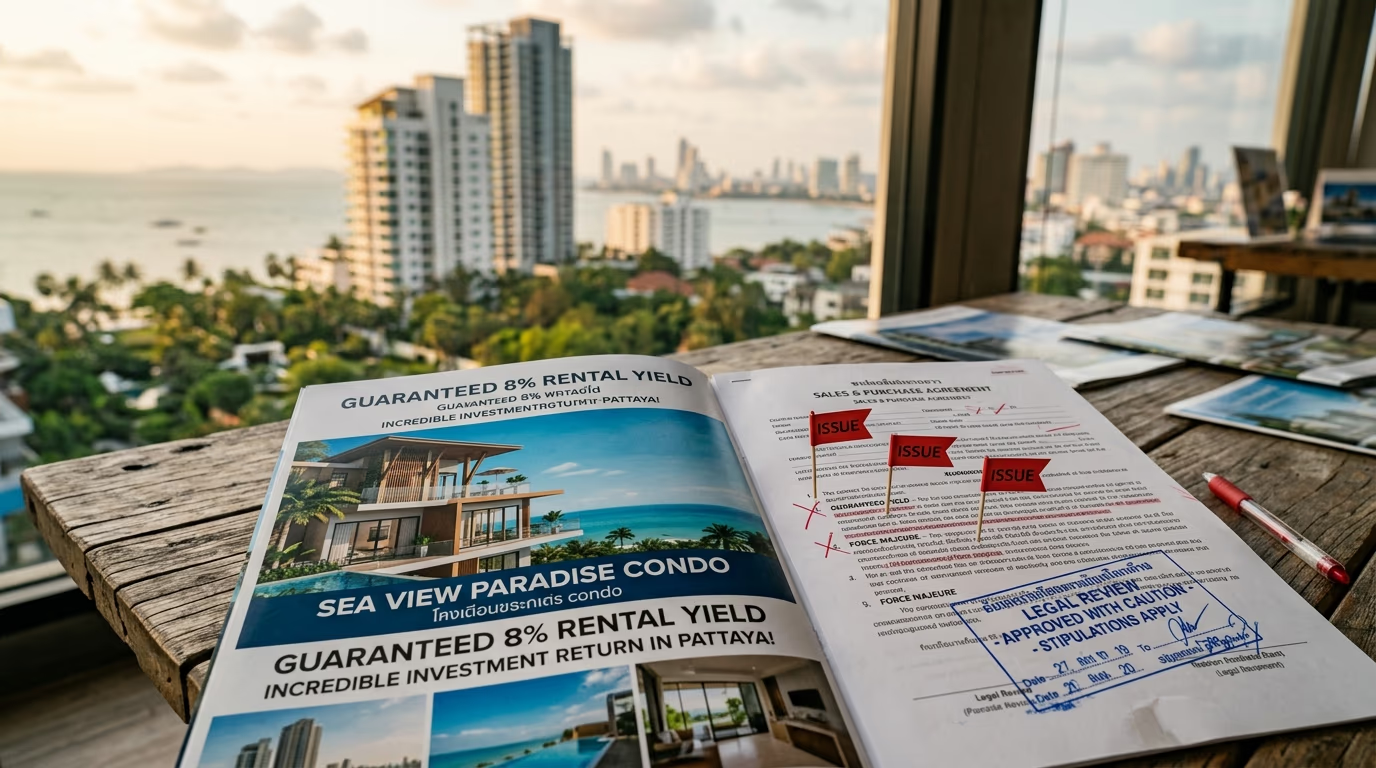
Guaranteed rental return programs in Thailand are sale-and-leaseback contracts. The developer sells you a condominium, then leases it back at a fixed yield of 5 to 8% for 3 to 10 years and promises to pay that yield whether the unit is occupied or empty. The promise is only as strong as the developer’s balance sheet. Between 2015 and 2022 a substantial share of Thai beach-resort GRR programs defaulted or renegotiated yields downward, with post-COVID defaults reported across Phuket, Koh Samui, and parts of Pattaya. The structure is legal under the Thai Civil and Commercial Code, but it is frequently sold to foreign buyers as a passive investment when it is really an unsecured credit exposure to a Thai developer wrapped in a condominium title.
1. Direct answer: what a Thai GRR actually is
A Thailand GRR is a sale-and-leaseback contract attached to a condominium purchase. You buy the condo at the full sale price. On the same day you sign a lease-back granting the developer or its management affiliate the right to rent the unit for a fixed term, typically 3 to 10 years. The developer pays a fixed annual yield, usually 5 to 8% net of management charges, owed whether or not the unit is occupied. At end of term the unit reverts to your control.
Cash flows in practice: Year 0, you pay the full price; the developer books revenue; the lease-back begins. Years 1 to N, the developer pays the yield, internally renting the unit and pocketing any upside above the guarantee (or absorbing the gap if the unit underlets). Year N, you take possession and become responsible for marketing, management, and vacancy on a unit now several years old competing with newer inventory.
2. How GRR contracts are structured
Most Thai GRR agreements have four documents: the sale and purchase agreement, a separate lease-back, a management agreement, and sometimes a buy-back clause. Each has its own counterparty and default remedies.
The SPA is standard: pay X baht, receive title inside the 49% foreign quota (see the buy condo Thailand foreigner guide). The lease-back is a hire of property under the Civil and Commercial Code; you are lessor, the developer’s affiliate is lessee. The “rent” is the guaranteed yield relabelled. Registration at the Land Department is optional under 3 years and mandatory above for enforceability against successors. The management agreement appoints the developer’s affiliate as exclusive letting agent, with fees bundled into the yield calculation.
Clauses that change the economics:
- Owner use period: 14 to 30 days per year free; excess forfeits yield prorata.
- Furnishing retention: developer retains title to furniture for the term; buy-back at depreciated value on exit.
- Assignment and sublease rights: the lessee may sublease without owner consent.
- Early termination penalty: typically 10 to 20% of remaining lease payments.
- Renewal option: developer first right at an undefined “market rate”.
Buy-back clauses promising repurchase at 100 to 130% of original price are typically unenforceable against a distressed developer. Zero weight in pricing.
3. Why the economics usually fail
The fixed yield is a liability on the developer’s balance sheet for the full term. When new sales slow, the cash flow that funds yield payments dries up. The pattern is pay-yield-from-new-sales rather than rental-income-pays-yield: the developer sells units fast because the guarantee attracts foreign buyers, uses fresh proceeds to pay older unit yields, and relies on continued sales to keep the plates spinning. When sales stop (macro downturn, tourism shock, saturation) the yield payments stop too.
A sanity check on the math: a Thai beach-resort condo rents at 4 to 7% gross long-term, and short-let (where legal, see Airbnb legality in Thailand) nets 4 to 7% after vacancy, fees, cleaning, and platform cuts. A developer promising 8% net has to find 8 plus 2 to 3% operating margin, meaning the unit must gross 10 to 11% — the top end of what Phuket beachfront short-let produces in a peak tourism year, above what Pattaya or Hua Hin delivers. One bad year (2020-2022 was three) and the developer eats the gap or defaults.
The second issue is capital recovery. GRR units typically price 10 to 25% above equivalent non-GRR units in the same project. That premium is the NPV of the yield stream, capitalised into the sale price. When the guarantee ends, market value reverts toward the non-GRR comparable. Owners discover they paid for an income stream already delivered and the underlying asset is worth less than they paid.
4. Historical Thai GRR defaults
Public reporting documents a recurring default pattern since at least 2015. Phuket and Koh Samui boutique developers produced the first wave; the 2020-2022 tourism shutdown produced an industry-wide stress event. Specific cases are not named here unless resolved in public court records.
Five-stage pattern:
- Launch and sell-out (years 0-2): GRR sells fast, 60-80% of units in 12-18 months. Foreign buyers dominate. Brochures emphasise the guarantee; rental fundamentals are not discussed.
- Early payment (years 2-4): yields paid on schedule. Buyers receive distributions and often recommend to friends.
- Stress event (year 4-5, or earlier on a macro shock): sales slow, new competing launches dilute pricing, tourism drops. Yield payments move from quarterly to semi-annual to late.
- Renegotiation or default (year 5-7): the developer approaches owners with a restructuring — reduced yield (8% to 4% is common), extended term, or equity conversion.
- Resolution or litigation (year 7+): negotiated restructuring, Consumer Protection Board mediation, Business Rehabilitation under the Thai Bankruptcy Act, or civil suit. Reported recoveries generally sit below 50% of face.
The 2020-2022 shutdown turned a slow-burn developer-specific risk into an industry event. Reporting in Bangkok Post Property and Nikkei Asia during 2021-2022 documented the pattern across multiple Phuket and Samui developers. Pattaya boutique GRRs fared better on a domestic-visitor base but renegotiated yields were common.
A GRR that paid cleanly 2015-2019 and resumed since 2022 has passed one of the hardest tests in modern Thai tourism history. A GRR launched in 2024-2025 has no comparable track record.
5. Red flags in GRR offers
Any two flags: decline. Any four: walk.
- Headline yield above 8% net: structurally unachievable outside a narrow set of peak-tourism beachfront assets. Usually means hidden deductions, gross-not-net accounting, or an inflated price.
- Lease-back term above 10 years: the longer the term, the longer you carry developer credit risk.
- No bank guarantee or escrow: a credible GRR posts a bank guarantee or third-party escrow equal to 12 to 24 months of yield. Without one, the guarantee is paper only.
- Developer is unlisted, new, or without track record: only diversified balance sheets survive a bad year. A single-project SPV developer should not be trusted with a multi-year obligation.
- Sale price materially above non-GRR comparables: walk the local market. If GRR units price at 180,000 THB per sqm and non-GRR resale equivalents sit at 130,000 THB, the 50,000 THB gap is the capitalised guarantee.
- Developer-affiliated management with exclusive letting for the full term: occupancy cannot be independently verified.
- Buy-back clause as the exit: almost never enforceable in distress. Zero value.
- Pressure tactics and early-bird pricing expiring Monday: a real decision does not need urgency.
Cross-reference the condo scams in Thailand guide.
6. How to evaluate a GRR offer
Four steps. None optional.
Step 1: price the unit as if there is no guarantee. Pull three to five non-GRR comparable sales in the same project, tier, and bedroom count. Compute price per sqm. The GRR unit should not price more than 5 to 10% above this comparable.
Step 2: verify the developer’s financial position. Pull public filings (Stock Exchange of Thailand if listed) or audited statements (private). Check debt-to-equity, current ratio, and completion track record. Cross-reference the Thai Department of Business Development registry. A GRR from an unlisted single-project SPV should be declined absent a third-party bank guarantee.
Step 3: demand the yield security instruments in writing. Bank guarantee number, issuing bank, escrow agent. No disclosure, walk.
Step 4: stress-test the cash flow. Assume the yield stops in year 3. Compute standalone market-rate yield, resale value at start of year 4 against non-GRR comparables, and total return. If the stress-test return is negative or below Thai bonds or a home-country index, the GRR does not add value at face.
Use the rental yield Thailand guide and the due diligence checklist.
7. When GRR makes sense (rare)
Three narrow situations. In all three, the guarantee is a small part of the decision.
First, top-tier Thai listed developer with decades of track record, a short guarantee (3 years or less), modest yield (5 to 6%), and price in line with non-GRR comparables. The guarantee signals confidence during a lease-up rather than a long-term liability; the balance sheet absorbs it. Rare but present, typically on the first 6 to 12 months of a major Bangkok or Pattaya launch.
Second, the guarantee is collateralised with a bank guarantee from a Thai scheduled commercial bank for the full amount, payable on first demand. Converts developer credit risk into bank credit risk. Rare because bank guarantees cost the developer margin.
Third, the unit is bought at a non-GRR-inflated price and the guarantee is a sweetener. Same price as non-GRR units plus a short guarantee on top is a bonus with limited downside. Check the price really is equivalent.
Outside these, a Thai condo bought for rental income will almost always do better on a risk-adjusted basis as a plain purchase with a professional manager or self-management — see the property management in Pattaya guide.
8. Legal recourse when a GRR defaults
Three main routes when a GRR stops paying: civil suit under the Civil and Commercial Code, a complaint to the Office of the Consumer Protection Board, and participation in Business Rehabilitation or bankruptcy proceedings. None is quick; recovery rates are materially below face.
Civil suit for breach of lease-back. The lease-back is a binding contract; default is a breach for which the owner can sue. Filed in the Provincial Court where the property is located, Thai lawyer required, typically 18 to 36 months to judgment. Even with a favourable judgment, collection depends on attachable assets. If the developer has been asset-stripped, judgment may be uncollectable.
OCPB complaint. The Office of the Consumer Protection Board has jurisdiction over unfair contract terms and misleading advertising. A complaint can produce mediation and a negotiated settlement faster than litigation. OCPB does not award damages directly but findings on unfair terms strengthen a subsequent civil suit.
Business Rehabilitation or bankruptcy. Under Chapter 3/1 of the Thai Bankruptcy Act, owners become unsecured creditors. The plan may offer a restructured yield, debt-to-equity conversion, or a cents-on-the-dollar settlement. Reported recovery rates in Thai property Business Rehabilitations since 2020 generally sit at 30 to 60% of original yield liability.
A criminal complaint for fraud is sometimes tried but requires intentional deception rather than commercial failure; Thai prosecutors rarely take these cases absent clear fraud.
The practical reality for most defaulting GRR owners: a restructured deal negotiated by a group legal representative, accepting a haircut to avoid multi-year costs, and keeping the underlying unit at residual market value.
9. Alternatives to GRR
The reasons a buyer considers a GRR — predictable income, passive management, minimum hassle — are legitimate. The structure is not the only way to get there.
Self-manage with an online rental agent. FazWaz, Hipflat, and Thailand-Property list units on leads-only commission. Vet via video call, collect deposits into a Thai bank account, engage a local contractor for maintenance. Long-term gross yields 5 to 7% on a well-located unit without the developer credit exposure.
Professional property manager long-term. Pattaya and Bangkok PMs charge 8 to 12% of collected rent. Net yields 4 to 6%, similar to a conservative GRR without developer risk. See the property management in Pattaya guide.
Long-term lease to a family member or trusted third party at a discount. Predictable cash flow, occupied unit, lower headline yield.
Diversify into multiple non-GRR units. Two or three smaller units across buildings or areas diversify tenant mix, building quality, and micro-market risk. Combined yield typically matches or beats a single GRR at the same capital outlay.
A GRR is rarely the best way to earn rental income from a Thai condo. It is mostly a sales tool that price-anchors a unit above market and transfers rental-market risk from the developer to the buyer for a fixed period. Pricing that risk correctly is the whole analysis.
10. Frequently asked questions
Is a guaranteed rental return legal in Thailand?
Yes. The sale-and-leaseback combines a condominium sale under the Condominium Act and a lease of property under the Civil and Commercial Code. The legal form is enforceable; enforceability against a developer that has run out of cash is a separate question.
What is the typical yield offered?
5 to 8% net, paid quarterly or annually. Above 8% should trigger immediate caution. 5 to 6% on a short 3-year guarantee from a listed developer is the most plausible; 7 to 8% for 7 to 10 years from a boutique is the most likely to default.
Can I get a bank guarantee on my rental guarantee?
Only if the developer voluntarily posts one. A few top-tier developers back GRRs with a bank guarantee equal to 12 to 24 months of yield. Most do not. Ask during negotiation and walk if the answer is no.
What happens to my condominium if the developer goes bankrupt?
Your title deed is registered in your name at the Land Department and is unaffected by developer bankruptcy. You retain ownership of the unit. What you lose is the yield stream, the management service, and potentially common-area maintenance quality.
Can I sell a GRR unit during the lease-back period?
Legally yes, but the lease-back continues with the new buyer. The resale market narrows to investors willing to take on the lease-back, at a discount. Selling at full market value usually requires ending the lease-back early and paying the exit fee.
Are GRRs more common in Pattaya, Phuket, or Bangkok?
Phuket has historically carried the highest concentration, then Koh Samui and Pattaya. Bangkok GRRs exist but are less common — the long-let market is deep enough that a guarantee is less persuasive there. Resort tourism dependence makes GRR marketing effective and also makes defaults more likely.
How does GRR affect my Thai income tax?
The yield is rental income under Section 40(5) of the Thai Revenue Code with a 30% standard deduction. Non-resident foreign owners pay progressive personal income tax or can elect a 15% flat withholding. See the rental yield guide.
Should I buy a GRR as my first Thai condo investment?
No. The structure combines real estate risk, developer credit risk, and contractual complexity. A first-time foreign buyer is better served by a direct purchase of a completed unit in an established project with self-management or a professional PM.
References
Sources
- 01Siam Legal International, Guaranteed Rental Return Programs in Thailand Briefing 2025 · https://www.siam-legal.com/realestate/thailand-rental-guarantee.phpSale-and-leaseback structure of Thai guaranteed rental return programs and typical yield terms. Accessed 2026-04-16.
- 02Tilleke and Gibbins, Thailand Real Estate Practice, Rental Guarantee Investments Advisory Note 2025 · https://www.tilleke.com/insights/Legal risks in GRR contracts including developer insolvency and buyer remedies under Thai law. Accessed 2026-04-16.
- 03Bangkok Post Property, Phuket rental guarantee failure reporting 2018-2020 · https://www.bangkokpost.com/business/propertyPost-2015 Phuket and Koh Samui guaranteed return defaults among boutique developers. Accessed 2026-04-16.
- 04Nikkei Asia, Thailand tourism downturn and developer cash flow reporting 2021-2022 · https://asia.nikkei.com/Business/Markets/PropertyPost-COVID 2020-2022 Thai condominium rental guarantee defaults across beach-resort projects. Accessed 2026-04-16.
- 05CBRE Thailand Real Estate Market Outlook 2026; Knight Frank Thailand Phuket Residential Market 2026 · https://www.cbre.co.th/insights/reports/thailand-real-estate-market-outlook-2026CBRE and Knight Frank guidance on evaluating guaranteed-yield offers relative to market rental rates. Accessed 2026-04-16.
- 06Office of the Consumer Protection Board Thailand, Consumer Protection Act B.E. 2522 as amended · https://www.ocpb.go.th/Thai Consumer Protection Board jurisdiction over property sales contracts and unfair contract terms. Accessed 2026-04-16.
- 07Thai Civil and Commercial Code, Book III Specific Contracts, Title IV Hire of Property · https://www.krisdika.go.th/Thai Civil and Commercial Code provisions on lease, sale, and contractual default remedies. Accessed 2026-04-16.
- 08Thai Bankruptcy Act B.E. 2483 as amended, Chapter 3/1; Central Bankruptcy Court records · https://www.cbc.coj.go.th/Business Rehabilitation proceedings under the Thai Bankruptcy Act for insolvent Thai developers. Accessed 2026-04-16.
Published · How we research and date our content