Condo Insurance in Thailand: What Foreign Owners Actually Need
Thailand condo owners need contents and liability insurance only — building cover sits with the juristic person. Premiums, providers, flood add-ons, claims process.
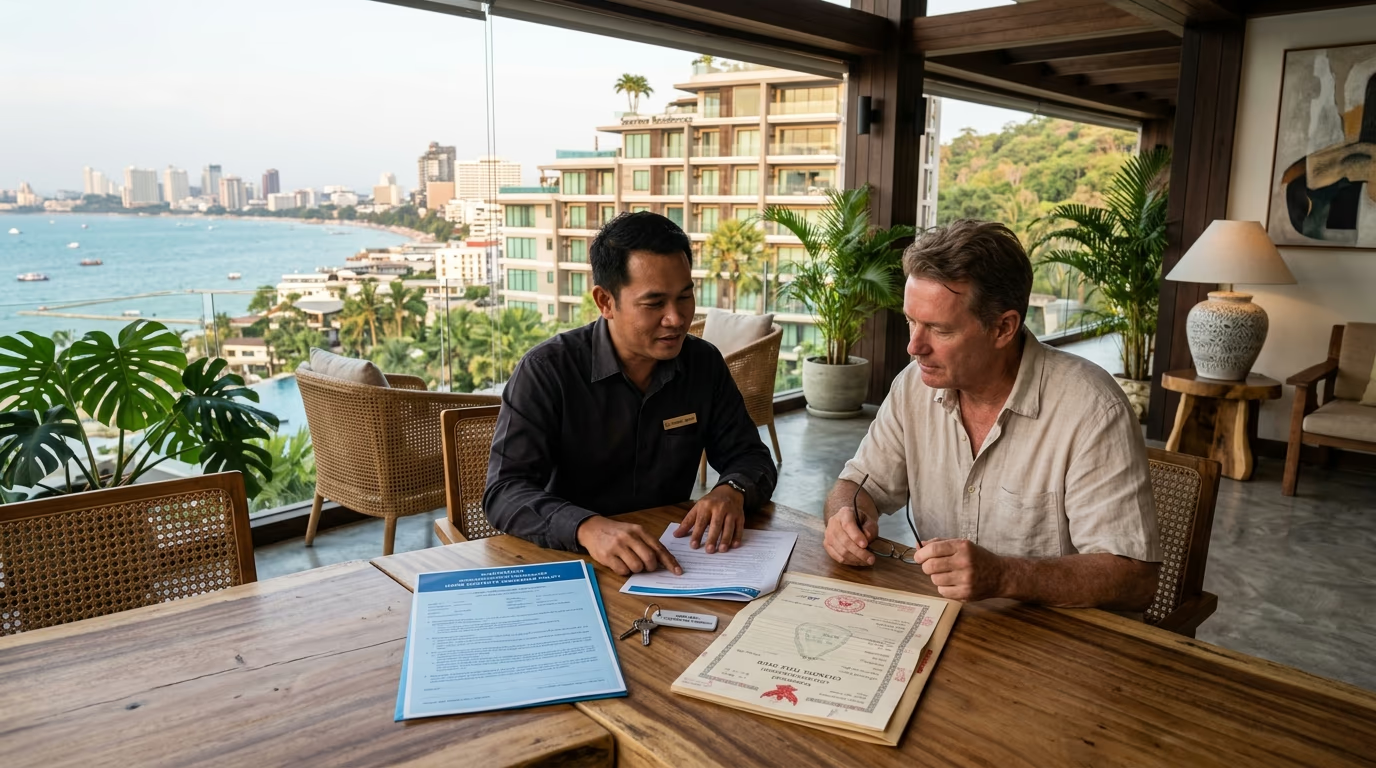
What Thai condo owners actually need to insure
A Thai condo owner needs two policies: a contents policy covering the unit’s interior and personal property, and a personal liability policy covering damage the unit causes to neighbours or to the building. Combined annual premiums typically land between 5,000 and 20,000 THB for a 1-bedroom or 2-bedroom unit, depending on value, building, and whether a flood endorsement is attached. Building cover — the structure, common areas, lifts, pool, car park, roof, facade — is the legal duty of the condominium juristic person under Sections 17 and 36 of the Condominium Act, paid from common area maintenance fees, and should not be duplicated by the owner. Title insurance exists in Thailand but is rare; it is only offered through a handful of brokers and is almost never purchased on resale units.
This guide walks through the three policy layers, who pays for each, typical premiums by unit size, flood and fire endorsements, the expat-specific double-cover problem, the claims process, recommended providers, and how Thai condo insurance compares to Singapore and Hong Kong.
The three-layer insurance structure for Thai condos
Every Thai condominium sits inside a three-layer insurance stack. Confusing the layers is the most common and most expensive mistake foreign owners make.
Layer 1: Building insurance — paid by the juristic person
Under Section 17 of the Condominium Act, the juristic person is the registered legal entity that owns and manages the common property of the building. Section 36 makes it the juristic person’s duty to maintain that common property. In practice, every properly run Thai condominium carries a non-life policy in the juristic person’s name covering fire, windstorm, flood (if endorsed), and public liability on the common areas. The premium is funded from the monthly common area maintenance (CAM) charge paid by every unit owner.
During due diligence, ask the juristic person manager for a certificate of insurance confirming: the named insurer, the sum insured, the perils covered, and the date of expiry. A well-managed building renews annually and produces the certificate on request. A building that cannot produce one is a governance red flag — and a unit owner in that building faces material uninsured exposure. See juristic person Thailand and due diligence checklist for the full governance tests.
Do not re-insure the building shell. You are already paying for that cover through CAM (condo maintenance fees).
Layer 2: Contents insurance — the owner’s responsibility
The interior finish of the unit — flooring, built-in joinery, kitchen, bathrooms, lighting, A/C indoor units — together with furniture, white goods, electronics, and personal property is the owner’s responsibility and is not covered by the juristic person policy. A Thai contents policy from a licensed non-life insurer (AXA Thailand, Allianz Ayudhya, Bangkok Insurance, Muang Thai Insurance, Dhipaya Insurance and others) typically covers fire, smoke, lightning, explosion, burst pipes, theft with evidence of forced entry, and accidental damage, with a flood endorsement available as a paid add-on.
Typical premium ranges for a foreign-owned unit with contents insured to replacement value:
- Studio or 1-bedroom, 35-50 sqm, standard furniture package: 3,000-6,000 THB per year
- 1-bedroom luxury, 50-70 sqm, high-spec kitchen and electronics: 6,000-10,000 THB per year
- 2-bedroom, 70-110 sqm: 8,000-15,000 THB per year
- 3-bedroom or penthouse, 150 sqm+: 15,000-30,000 THB per year
Adding a flood endorsement in Bangkok’s flood-prone corridors (parts of Ratchada, Lat Phrao, Rama IX low-lying areas, the outer ring) or in low-lying Pattaya and Hua Hin zones typically adds 1,500-4,000 THB per year and is often subject to a per-event excess.
Layer 3: Personal liability — essential, cheapest, most forgotten
Personal liability covers damage the unit inflicts on a neighbour or on the common property: a burst washing-machine hose that floods the unit below, an A/C condensate leak through the floor slab, a cooking fire that chars the adjoining wall. This is a real and frequent exposure in high-rise condominium life, and it is the most commonly under-insured layer.
Stand-alone personal liability endorsements from Thai insurers are inexpensive — 1,000-3,000 THB per year for a 1 million to 5 million THB limit is typical — and are usually bundled with the contents policy for a modest uplift. For a foreign owner, the uplift is worth paying. Thai neighbours are generally willing to settle water-damage disputes pragmatically, but the settlement expectation is that the unit owner who caused the damage pays. Without liability cover, that conversation starts from the owner’s personal account.
Fire, flood, and earthquake: which add-ons actually matter
Thai standard fire policies published under the OIC standard wording cover fire, lightning, explosion, aircraft, vehicle impact, smoke, and riot as standard perils. The add-on decisions foreign owners need to make are flood, earthquake, and windstorm.
Flood is the single most important natural-peril decision in Thailand. The 2011 floods caused insured losses of roughly USD 15-20 billion and restructured the Thai flood-insurance market; since then, flood is not automatic under the standard fire policy and must be endorsed separately for most properties. In Bangkok’s known flood zones and in any condo at or near sea level in Pattaya, Hua Hin, Phuket, or Koh Samui, the endorsement is essential. In a high-rise unit above the fourth floor far from a waterway, the peril is remote but the contents-by-sprinkler scenario still exists; cost-benefit favours adding it.
Earthquake cover is low priority. Thailand sits in a low-to-moderate seismic zone — the 2014 Chiang Rai event at Mw 6.1 is the largest onshore event in the modern record, and Bangkok, Pattaya, and Phuket are outside the highest-hazard bands. Most foreign owners skip the earthquake endorsement.
Windstorm is standard under most Thai contents wordings. Typhoon-level storms are rare on the Gulf side; the Andaman coast (Phuket, Khao Lak, Krabi) sees monsoon-season squalls but not Philippines- or Hong Kong-scale typhoons. No special endorsement usually needed.
Title insurance: rare in Thailand, occasionally worth it
Title insurance — a policy that indemnifies the owner if a defect in the title deed is later discovered — is common in the United States but rare in Thailand. First American Title underwrites Thai title indemnity through a small number of Thai legal brokers on a per-transaction basis. It is almost never taken on resale condo units where the chanote title is clear, the Land Department record is clean, and a competent lawyer has completed the due diligence.
Title insurance makes sense in narrow cases: a complex off-plan transaction where the project land chanote is still being subdivided, a foreign-quota transfer in a building with a history of quota disputes, or a large high-value purchase where a committee buyer simply wants contract-grade indemnity. For a typical foreign buyer purchasing a completed unit with a clean chanote, the legal fee to a competent firm (due diligence checklist) delivers better value than title insurance and removes the defect before transfer.
Claims: how the process actually works
Thai contents claims run in a standard sequence. The owner notifies the insurer within the policy timeframe (typically 7 days, sometimes 14), submits photographs and a police report for theft or fire, and the insurer dispatches a loss adjuster. For high-value claims the adjuster will inspect within 3-7 days; straightforward claims under 100,000 THB are often settled on document review alone. Typical settlement timeline: 30-60 days from first notification for clean claims; longer where liability is disputed between the unit owner and the juristic person (common for water-ingress claims where the leak source is contested).
Disputes that cannot be resolved with the insurer can be escalated to the Office of Insurance Commission (OIC), which operates a consumer complaint channel and, for contested matters, a mediation process. OIC intervention is usually sufficient; litigation is rare for standard home-insurance disputes.
Expats: check your home-country policy before double-insuring
Many expat-standard home-country policies — US homeowner umbrella policies, UK worldwide contents extensions, certain Singapore PMI-linked home policies — extend limited contents and personal liability coverage to a second home overseas. The cover is usually thin (sub-limits on overseas assets, caps on individual items, exclusions for unattended properties beyond 60 or 90 days), but for a part-time Thailand user the extension can meaningfully reduce Thai policy limits needed.
Before buying a full Thai contents policy, ask the home-country insurer in writing: what is covered at a Thai address, what the overseas sub-limits are, what “unoccupied” periods void cover, and whether personal liability extends to third-party damage in Thailand. Where home-country cover is adequate for personal property but thin on liability, buy a Thai liability-only endorsement for 1,000-3,000 THB per year and skip the full contents policy.
Recommended providers and how to buy
Most Thai home contents and liability policies are sold through brokers rather than direct from the carrier. The large non-life insurers — AXA Thailand, Allianz Ayudhya, Bangkok Insurance, Muang Thai Insurance, Dhipaya Insurance — all write home-owner products and all work through broker distribution. A Bangkok- or Pattaya-based broker familiar with foreign-owned condominiums will produce comparable quotes from 3-5 carriers within a few days, translate the policy wording into English, and handle the claim if one arises.
Ask the broker for: the sum insured basis (replacement versus indemnity), the flood endorsement status, the liability limit, any occupancy warranties (some policies require notification if the unit is unoccupied for more than 60 days), and the claims contact with English-capable adjusters. A foreign owner buying a Thailand contents policy without an English-capable claims contact is setting up a worst-time-worst-case problem at claim stage.
How Thailand compares: Singapore and Hong Kong benchmarks
Singapore condo owners pay roughly SGD 150-400 per year for comparable contents cover, with flood of negligible concern and the management corporation holding the building policy — the structural arrangement is identical, the premium level runs 30-60% below Thailand for equivalent cover because Singapore’s loss ratios are lower. Hong Kong owners pay HKD 2,000-8,000 for contents cover in a similar structure, with typhoon cover more prominent than flood. Thailand’s premium level sits in line with regional peers and is not a reason to defer taking cover.
FAQ
Does the juristic person insure my unit’s interior?
No. Under Sections 17 and 36 of the Condominium Act, the juristic person insures the common property only. The interior finish, fixtures, and contents of each unit are the owner’s responsibility. Ask the juristic person for a certificate of insurance during due diligence to confirm what is covered at the building level — and do not duplicate that cover.
Is flood insurance essential in Thailand?
In Bangkok flood zones and any ground-level or low-floor unit in Pattaya, Hua Hin, Phuket, or Koh Samui, yes. The 2011 floods showed what a maximum-plausible event looks like and permanently repriced Thai flood exposure. On an upper-floor unit in a dry inland area it is optional. The endorsement typically costs 1,500-4,000 THB per year.
Can I pay for insurance from outside Thailand?
Thai insurers will accept foreign-card or Thai-bank payment. A broker-sold policy is usually invoiced in THB and paid by bank transfer from the Thai account the owner used for the condo purchase (transfer money Thailand condo).
Do I need a Thai address to buy a Thai contents policy?
Yes — the insured property must be in Thailand and the policy will be issued to the Thai address of the unit. Your billing and correspondence address can be overseas; many brokers handle renewal notifications by email.
What happens if I have no insurance and my unit floods the neighbour below?
The neighbour will expect you to pay for the damage. Thai neighbours often settle pragmatically, but the default expectation is that the unit causing the damage pays. Without liability cover, that comes from your personal account. For 1,000-3,000 THB per year, this is the cheapest and most often skipped policy layer to put in place.
References
Sources
- 01Condominium Act B.E. 2522 (1979), Sections 17 and 36 (duties of the juristic person) · https://www.krisdika.go.th/The condominium juristic person is responsible for insuring the common property under Thai condominium law; the building policy attaches to the juristic person, not to individual unit owners. Accessed 2026-04-16.
- 02Office of Insurance Commission (OIC), Non-Life Insurance Act B.E. 2535 · https://www.oic.or.th/enNon-life insurance in Thailand is regulated by the Office of Insurance Commission under the Non-Life Insurance Act B.E. 2535 (1992); fire, contents, liability, and natural peril cover are licensed non-life classes. Accessed 2026-04-16.
- 03Office of Insurance Commission, Standard Fire Insurance Policy and Endorsements · https://www.oic.or.th/enThailand fire insurance standard policy wording, including perils covered and natural disaster endorsement availability, is published by the OIC and carried by all licensed non-life insurers. Accessed 2026-04-16.
- 04Thai General Insurance Association (TGIA) member directory 2026 · https://www.tgia.org/AXA Thailand, Allianz Ayudhya, Bangkok Insurance, Muang Thai Insurance, and Dhipaya Insurance are among the largest non-life insurers licensed by the OIC offering home contents and liability products to individuals. Accessed 2026-04-16.
- 05Swiss Re Institute, sigma No 2/2012 — Natural catastrophes and man-made disasters in 2011 · https://www.swissre.com/institute/research/sigma-research/sigma-2012-02.htmlThe 2011 Thailand floods caused insured losses of approximately USD 15-20 billion, making it the costliest flood event in insurance history and reshaping flood-endorsement pricing across Thai property policies. Accessed 2026-04-16.
- 06US Geological Survey, Thailand seismic hazard summary; Thai Department of Mineral Resources · https://earthquake.usgs.gov/Thailand sits in a low-to-moderate seismic zone; the 2014 Mae Lao earthquake (Mw 6.1) in Chiang Rai is the largest onshore event in the modern Thai record, and major Thai cities lie outside the highest-hazard bands. Accessed 2026-04-16.
- 07Tilleke & Gibbins, Thailand Real Estate Legal Briefings 2024-2026 · https://www.tilleke.com/insights/Tilleke & Gibbins guidance on juristic person insurance duties, unit owner contents responsibility, and the split of building versus unit cover in Thai condominium practice. Accessed 2026-04-16.
- 08Siam Legal International, Thailand Real Estate Resources · https://www.siam-legal.com/realestate/Siam Legal International practitioner guidance on condominium insurance arrangements, including typical premium ranges for contents and liability cover on foreign-owned Thai condos. Accessed 2026-04-16.
- 09First American Title Insurance Company, international operations overview · https://www.firstam.com/title/First American Title operates in Asia through Thai legal partners and is one of the few providers that underwrites title indemnity on Thai condominium transactions; coverage is rare and negotiated on a per-transaction basis. Accessed 2026-04-16.
Published · How we research and date our content