Retiring in Thailand: The Condo Buyer's Guide (2026)
Retiring in Thailand as a foreigner: retirement visa options, cost of living by city, condo budget, healthcare, banking, tax residency, and community networks.
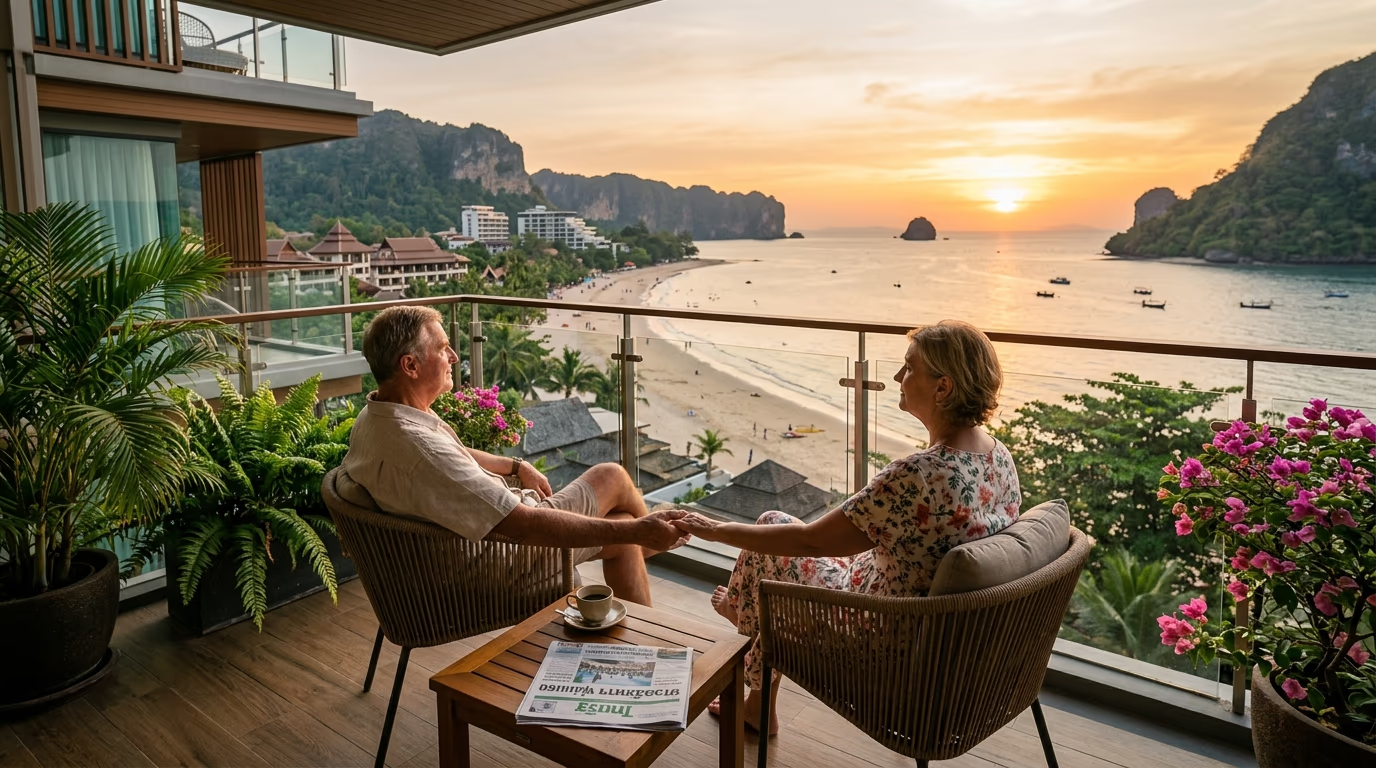
Thailand is one of the most established retirement destinations in Asia for foreign nationals, with a dedicated Retirement Visa (Non-Immigrant O-A 1-year, O-X 10-year for 14 eligible nationalities, and the LTR Wealthy Pensioner category), a cost of living 40-60% below comparable Western standards, and a condominium market that lets foreign retirees own their home freehold under the 49% foreign quota of the Condominium Act. A comfortable retirement for a couple outside Bangkok runs 60,000-100,000 THB per month (around USD 1,700-2,800), healthcare is world-class at private hospitals with JCI accreditation, and the expat communities in Pattaya, Chiang Mai, Hua Hin, and Phuket make the transition practical rather than theoretical. The visa, the banking, and the condo purchase all intersect — done in the right order they are straightforward; done in the wrong order they produce months of delay.
This guide covers the visa options, the realistic monthly budget by city, how to pick a city by retiree profile, the condo-versus-villa choice, budget tiers for the condo itself, healthcare and insurance, banking and money transfer, community networks, and the Thai tax-residency rules that affect pension income.
Retirement visa options — O-A, O-X, and the LTR Wealthy Pensioner
Thailand offers three main long-stay visa routes for retirees. The Non-Immigrant O-A is the standard 1-year renewable retirement visa for applicants 50 and over. The Non-Immigrant O-X is a 10-year multiple-entry visa for 14 eligible nationalities with higher financial thresholds. The Long-Term Resident (LTR) Wealthy Pensioner is a newer 10-year visa from the Board of Investment with passive-income requirements. Each suits a different financial profile and risk preference.
Non-Immigrant O-A (retirement, 1 year renewable).
- Age: 50 or older at application.
- Financial requirement: 800,000 THB in a Thai bank account for at least 2 months before application (seasoned), OR a monthly income of 65,000 THB evidenced by embassy letter or bank statements, OR a combination totalling 800,000 THB per year.
- Health insurance: mandatory 440,000 THB inpatient plus 40,000 THB outpatient coverage from a Thai-approved insurer, or from a qualifying international insurer registered under the Thai General Insurance Association.
- Criminal record check required from home country.
- Renewable annually at Thai immigration without leaving the country.
Non-Immigrant O-X (retirement, 10 years, limited nationalities).
- Eligible nationalities: Japan, Australia, Denmark, Finland, France, Germany, Italy, Netherlands, Norway, Sweden, Switzerland, UK, Canada, and USA.
- Age: 50 or older.
- Financial requirement: 3,000,000 THB seasoned in a Thai bank for 12 months continuously, OR 1,800,000 THB plus 1,200,000 THB annual income.
- Health insurance equivalent to the O-A requirement.
- No work permitted in Thailand.
- Issued as a 5-year initial stay extendable to a total of 10 years.
LTR Wealthy Pensioner (10 years, passive-income route).
- Age: 50 or older.
- Income: at least USD 80,000 per year from passive sources (pension, dividends, rental income).
- Health insurance: at least USD 50,000 coverage, or alternative self-insurance demonstrated by bank deposit.
- Multiple-entry, digital work permit allowed for remote work for foreign employers.
- Issued by the Board of Investment, processed through a dedicated portal.
Full visa procedure for property owners is in the Thailand visa and property guide.
Budget and cost of living by city
A retired couple’s comfortable monthly budget in Thailand runs 50,000-140,000 THB (USD 1,400-3,900) depending on city and lifestyle. Secondary cities are materially cheaper than Bangkok; beach resort cities cost more than upland cities; premium condominium complexes add 15,000-30,000 THB per month over mid-market options. These are realistic 2026 figures, excluding the condo purchase itself, based on expat-reported budgets cross-referenced with Numbeo 2026 cost-of-living data.
| City | Couple, comfortable (THB/month) | Couple, premium (THB/month) |
|---|---|---|
| Chiang Mai | 50,000-80,000 | 80,000-120,000 |
| Pattaya / Jomtien | 60,000-100,000 | 100,000-150,000 |
| Hua Hin | 70,000-110,000 | 110,000-160,000 |
| Koh Samui | 70,000-110,000 | 110,000-170,000 |
| Phuket | 80,000-130,000 | 130,000-200,000 |
| Bangkok | 80,000-140,000 | 140,000-250,000 |
What the comfortable budget covers. Food (mixed local and Western, including dining out 3-4 times per week), utilities (electricity, water, internet — 3,000-6,000 THB per month for a mid-size condo), condo CAM fees (2,000-8,000 THB per month depending on facility quality), domestic help (5,000-10,000 THB per month for part-time cleaner), transport (car ownership and fuel, or grab/taxi), mobile and data, personal and entertainment, and a small travel budget for trips within Southeast Asia. It does not include health insurance (separate line), annual visa renewals, or major one-off purchases.
Full Pattaya cost breakdown is in the Pattaya cost of living guide.
Choosing a city by retiree profile
Each major retirement city in Thailand attracts a distinct retiree profile. Beach versus upland, social versus quiet, infrastructure versus character, budget versus premium — the trade-offs are real and worth visiting before committing to a purchase. Two to four weeks in each shortlisted city is the minimum reasonable diligence; six months of Airbnb stays is common and worth the cost of avoiding the wrong long-term decision.
Pattaya / Jomtien. Large, mature foreign community (20,000+ long-stay Westerners), comprehensive infrastructure, international hospitals, large English-speaking service economy, beach access, 90 minutes from Bangkok and Suvarnabhumi airport. Jomtien is the quieter beach-front retirement suburb; Wongamat is the more upscale north end; central Pattaya attracts more nightlife-driven residents and suits a subset of retirees. Suits active retirees who value infrastructure, community, and proximity to Bangkok.
Chiang Mai. Upland city in Thailand’s north, cooler climate November-February, distinct cultural identity, lower cost of living, strong English-speaking expat community concentrated in Nimmanhaemin and Chang Klan. Suits retirees who prefer mountains, culture, and quieter pace over beach and resort lifestyle. Smoke season (February-April) is a real consideration — air quality index regularly exceeds 200 during burning season.
Hua Hin. Royal seaside town 200 km south of Bangkok, quieter and more conservative than Pattaya, traditional beach-resort character, strong Scandinavian and German communities, excellent golf infrastructure. Suits retirees who want beach lifestyle without the intensity of Pattaya or Phuket. Slower pace, smaller foreign community, fewer services — which some retirees prefer and others find limiting.
Phuket. Large southern resort island, international tourism economy, high-end infrastructure, premium healthcare (Bangkok Hospital Phuket, Bangkok Hospital Siriroj), substantial European community. Higher cost base than Pattaya. Suits affluent retirees who want resort-island lifestyle and are prepared to pay for it. Worth considering by area — Kata, Karon, Kamala, Bang Tao, and Rawai each have distinct character.
Koh Samui. Mid-sized island off the southeast coast, smaller-scale resort character than Phuket, established European community, good beach infrastructure, direct flights from Bangkok. More laid-back than Phuket, less connected than Pattaya. Suits retirees who want island lifestyle, accept the logistical overhead, and have a clear healthcare plan (Bangkok Hospital Samui is the main private hospital).
Bangkok. Thailand’s capital. Premium healthcare, international-standard services, cultural depth, BTS/MRT transit, and global flight connectivity. Not typically chosen as a primary retirement city by cost-conscious retirees but favoured by a subset who want city life, medical proximity, and international community. Sukhumvit, Silom-Sathorn, and Ari are the main expat retirement areas.
Condo versus villa for retirement
For most foreign retirees, a condominium is the better choice over a villa. Freehold foreign ownership of a condo is straightforward under the Condominium Act; foreign freehold of a villa with the underlying land is not permitted under the Land Code. Condos also provide lower maintenance overhead, security, and social contact — all of which matter more as the retirement progresses. The villa route for foreigners typically requires a 30-year registered lease or a Thai-majority company structure, both of which carry legal and succession risks that a freehold condo does not.
Features retirees should prioritise in the condo choice:
- Lift access to the unit. Low-floor units in buildings without lift access are a long-term liability; a stroke or hip replacement at 75 makes stairs impractical.
- Wheelchair-accessible bathroom and entry. A roll-in shower and a zero-threshold entry are cheap to specify off-plan, expensive to retrofit.
- Proximity to a tertiary hospital. Bumrungrad, Samitivej, or Bangkok Hospital within 20 minutes by car for serious conditions; a local private hospital within 10 minutes for routine emergencies.
- Full-service building with 24-hour reception. Package delivery, security, maintenance response, and first-aid presence all matter.
- Walkable surroundings. Condo near a BTS/MRT station in Bangkok, near the beach promenade in Jomtien, or in the old city in Chiang Mai — walkability reduces car dependency which becomes a quality-of-life factor after 70.
- Established building, not off-plan. Retirees do not need off-plan discount economics. A completed building lets you walk the common areas, meet the juristic person, and verify the standard before committing.
Condo budget by city — entry, mid, premium
A retirement-suitable condo in Thailand in 2026 runs from 2.5M THB (entry, smaller cities) to 20M THB (premium beachfront or central Bangkok). A 4-6M THB one-bedroom in Pattaya/Jomtien or Chiang Mai covers the majority of retiree purchases. Budgets below are for completed, foreign-quota, freehold units of 45-70 sqm (studio or one-bedroom) or 70-110 sqm (two-bedroom) in established buildings.
| City | Entry 1BR (THB) | Mid 1BR/2BR (THB) | Premium 2BR (THB) |
|---|---|---|---|
| Chiang Mai | 2.5-4M | 4-7M | 7-12M |
| Pattaya / Jomtien | 3-5M | 5-9M | 9-18M |
| Hua Hin | 3-5M | 5-8M | 8-15M |
| Koh Samui | 4-7M | 7-12M | 12-20M |
| Phuket | 5-8M | 8-15M | 15-30M |
| Bangkok (Sukhumvit mid) | 5-8M | 8-15M | 15-35M |
Full process and foreign quota procedure are in the buy condo Thailand foreigner guide and the 49% foreign quota guide.
Healthcare for retirees
Thailand’s private healthcare is among the best-developed in Asia. The Bumrungrad International Hospital group in Bangkok, the Samitivej group, and the Bangkok Hospital network are JCI-accredited and treat over 1 million foreign patients per year. For routine care the standard is comparable to the UK and Northern Europe; for elective surgery the cost is typically 50-80% lower than US prices at comparable outcome standards. Public hospitals (government) are significantly cheaper but Thai-language and not practical for most foreign retirees.
Expat insurance options. A 65-year-old couple with no significant pre-existing conditions can expect international health insurance at 120,000-250,000 THB per year (USD 3,400-7,000) for comprehensive coverage including inpatient, outpatient, and evacuation. Thai-domestic insurance covering inpatient only runs 40,000-80,000 THB per year for the same couple. Cigna, Pacific Cross Thailand, AXA, and April International are the main providers with English-language claims handling.
Medicare and NHS do not cover Thailand. US Medicare does not cover medical services outside the US (with extremely narrow exceptions). UK NHS does not cover routine care for residents who have moved abroad. Canadian provincial health plans do not cover out-of-country care. This means retirees should budget for either private insurance or a self-insurance fund of at least 3-4M THB (USD 85,000-115,000) to cover a major procedure without insurance.
Mandatory insurance for O-A visa. The 440,000 THB inpatient plus 40,000 THB outpatient mandatory coverage for O-A renewal is well below real-world needs. Retirees should treat it as a floor and buy genuinely comprehensive cover separately.
Banking and money transfer
Opening a Thai bank account is materially easier with a retirement visa than without one. Bangkok Bank, Kasikornbank (KBank), and SCB are the three main banks with mature expat desks. Transferring retirement savings to Thailand to buy the condo requires the Foreign Exchange Transaction (FET) form from the Thai receiving bank, which the Land Department requires to register the purchase under the 49% foreign quota.
The recommended sequence:
- Apply for the Retirement O-A visa in the home country (or enter on a 90-day O visa and convert).
- Arrive in Thailand, open a Thai bank account (some banks require visa plus lease contract or condo reservation agreement).
- Transfer the 800,000 THB retirement deposit and season it for at least 2 months before the first O-A extension.
- Transfer the condo purchase price via SWIFT, instructing the originating bank to write “purpose: purchase of condominium” in the remittance notes. The receiving Thai bank issues the FET.
- Complete the condo purchase at the Land Department, presenting the FET and passport.
Full FET procedure is in the transfer money for condo guide.
Community and English-speaking networks
Pattaya, Chiang Mai, Hua Hin, and Phuket each have dedicated expat clubs, English-language services, and established retirement networks. The Pattaya Expats Club, Chiang Mai Expats Club, Hua Hin Expats Club, and Phuket Expats Club are the largest formal networks; each runs weekly meetings, newsletters, and social programmes. Informal networks — sports clubs, golf societies, language exchange groups, church and temple communities — fill in around the formal ones and are where most long-term friendships form.
English-language services vary significantly by city. Pattaya has the deepest English-language service economy (tradespeople, legal, medical, veterinary, dental, insurance brokers) because of decades of foreign residence. Chiang Mai’s English services cluster around Nimmanhaemin and the old city. Hua Hin has a strong Northern European service cluster. Phuket is bilingual by default in the tourist-facing economy and most of the expat-oriented parts of the island.
Tax residency and foreign pension treatment
An individual is Thai tax resident if physically present in Thailand for 180 days or more in a calendar year (Revenue Code Section 41). A tax resident is in principle taxable on worldwide income, but the tax is charged only on foreign-source income remitted into Thailand, and remittance timing matters. Revenue Department Order Por. 161/2566 (15 September 2023) clarified the treatment of prior-year foreign income remitted in a later year — it is now within the Thai tax net. This is a material change from the pre-2024 position where retirees could remit prior-year pension income tax-free.
The practical retiree position in 2026:
- Pension income earned after 1 January 2024 and remitted into Thailand is Thai-taxable (subject to treaty relief — many treaties protect pensions).
- Pension income earned before 1 January 2024 and remitted into Thailand remains under the pre-Por. 161 treatment and is not Thai-taxable.
- Double-taxation treaties typically allocate taxing rights on pensions to the country of residence (Thailand) or, for government pensions, to the source country. The UK-Thailand treaty, US-Thailand treaty, and most EU treaties should be read carefully for the specific pension type.
Practical planning — retirees often maintain a home-country holding account and remit only the required living budget each year, timing remittances to manage the Thai tax position. Professional advice is essential for US citizens (FATCA, FBAR, Form 8938) and for retirees with defined-benefit pensions and social security payments that may have specific treaty treatment.
Frequently asked questions
What is the minimum age to retire in Thailand?
50 years old is the minimum age for both the Non-Immigrant O-A (1-year) and O-X (10-year) retirement visas. The LTR Wealthy Pensioner visa is also 50+.
How much money do I need to retire in Thailand?
Financially, the visa floor is 800,000 THB in a Thai bank (about USD 22,000) or 65,000 THB per month income (about USD 1,800). A realistic monthly budget for a couple outside Bangkok is 60,000-100,000 THB; add health insurance of 120,000-250,000 THB per year for comprehensive international cover.
Can I buy a condo on a retirement visa?
Yes. A retirement visa does not affect the right to own a condominium freehold under the 49% foreign quota. You still need the Foreign Exchange Transaction form for the inward remittance used for the purchase.
Which is the best city in Thailand to retire?
There is no single best. Pattaya is best for infrastructure and community; Chiang Mai for lower cost and culture; Hua Hin for quieter beach lifestyle; Phuket for premium island living. Spend 4-12 weeks in each shortlisted city before committing.
Does Medicare cover me in Thailand?
No — US Medicare does not cover medical services provided outside the United States. UK NHS and Canadian provincial plans similarly do not cover out-of-country care. Private international or Thai insurance is essential.
Can my spouse and children accompany me on a retirement visa?
The O-A allows dependent visas for a spouse (Non-Immigrant O dependent) but not normally for children over 20. The O-X allows only the spouse. The LTR allows spouse and up to 4 dependents under 20.
Do I pay tax on my foreign pension in Thailand?
If you are Thai tax resident (180+ days per year), foreign pension income remitted into Thailand in the year it is earned (or later, under Por. 161/2566) is in principle taxable. Double-taxation treaties often reduce or eliminate the Thai tax. Take professional advice before remitting.
Can I work in Thailand on a retirement visa?
No — O-A and O-X explicitly prohibit work in Thailand. The LTR Wealthy Pensioner permits remote work for a foreign employer.
What happens to my condo if I die?
Foreign heirs can inherit the unit under the Condominium Act Section 19 septendecim, subject to a 1-year registration and 1-year disposal rule if the building is over the 49% cap at the date of inheritance. A Thai will is strongly recommended. Full detail is in the condo inheritance guide.
References
Sources
- 01Royal Thai Immigration Bureau, Non-Immigrant Visa O-A regulations; Ministry of Public Health notification 14 October 2019 · https://www.immigration.go.th/Non-Immigrant Visa O-A (long stay) is available for applicants 50 and over, with a financial requirement of 800,000 THB in a Thai bank account or monthly income of 65,000 THB, and mandatory health insurance covering 440,000 THB inpatient and 40,000 THB outpatient. Accessed 2026-04-16.
- 02Royal Thai Immigration Bureau, Non-Immigrant Visa O-X regulations, Ministerial Regulation 2017 · https://www.immigration.go.th/Non-Immigrant Visa O-X (long stay) is a 10-year multiple-entry visa for 14 eligible nationalities with a 3,000,000 THB financial requirement or combined assets plus income meeting the threshold. Accessed 2026-04-16.
- 03Thailand Board of Investment, LTR Visa Programme guidelines (2022, updated 2024) · https://ltr.boi.go.th/Long-Term Resident (LTR) Visa Wealthy Pensioner category requires passive income of at least USD 80,000 per year and health insurance of at least USD 50,000 coverage. Accessed 2026-04-16.
- 04International Living Annual Global Retirement Index 2026; Numbeo Cost of Living Index 2026 · https://internationalliving.com/the-best-places-to-retire/Thailand is consistently ranked among the top global retirement destinations, with quality healthcare, established expat communities, and cost of living substantially below Western Europe and North America. Accessed 2026-04-16.
- 05Thai Revenue Code, Section 41; Revenue Department Order Por. 161/2566 (15 September 2023) · https://www.rd.go.th/english/Thai tax residency is established by physical presence of 180 days or more within a calendar year; Revenue Department Order Por. 161/2566 clarified the tax treatment of foreign-source income remitted to Thailand. Accessed 2026-04-16.
- 06Joint Commission International, JCI-Accredited Organizations directory 2026 · https://www.jointcommissioninternational.org/Bumrungrad International Hospital, Samitivej Hospital group, and Bangkok Hospital network are JCI-accredited private hospitals serving the expat and medical tourism markets. Accessed 2026-04-16.
- 07US Centers for Medicare & Medicaid Services; UK NHS Overseas Visitors guidance · https://www.medicare.gov/coverage/travel-outside-the-u-sUS Medicare does not cover medical services provided outside the United States; UK NHS does not cover routine care for residents who have moved abroad. Accessed 2026-04-16.
- 08Bank of Thailand, Foreign Exchange Regulations under the Exchange Control Act B.E. 2485 (1942) · https://www.bot.or.th/en/our-roles/financial-markets/foreign-exchange-regulations.htmlForeign Exchange Transaction form is required for inward remittances of USD 50,000 equivalent or higher, and is used by the Land Department to register a foreigner's purchase of a condominium. Accessed 2026-04-16.
- 09AA Insure Thailand, Cigna Global, and Pacific Cross Thailand product schedules 2026 · https://www.aainsure.net/Thai private health insurance for foreign retirees typically ranges from 30,000 to 100,000 THB annually depending on age, coverage, and pre-existing conditions. Accessed 2026-04-16.
- 10ExpatDen Thailand Retirement Guide 2026; Numbeo Quality of Life Index 2026 · https://www.expatden.com/thailand-retirement-guide/Pattaya, Chiang Mai, Hua Hin, and Phuket are the most established retirement destinations for English-speaking expats in Thailand, with dedicated expat clubs and English-language services. Accessed 2026-04-16.
Published · How we research and date our content